The Human Element
in Organisations 
Nations, Organisations, Groups,
Teams and Individuals
2015 online multi-play game
Use your Mobile device and scan the QR code 
Or
Click on URL to play Video http://goo.gl/a69raZ

Please read and listen carefully to what comes next on the screen when you play the Video…
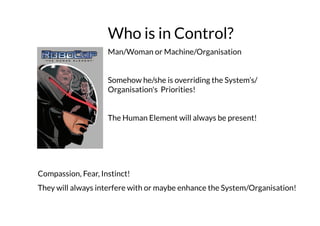
Who is in Control?
Man/Woman or Machine/Organisation

Somehow he/she is overriding the System’s/
Organisation's Priorities!

The Human Element will always be present!


Compassion, Fear, Instinct!
They will always interfere with or maybe enhance the System/Organisation!
The Human Element
Setting the Context 
Organisations, Groups and Teams need to adjust and/or
respond to the needs demanded by both Tasks and
Relationships. 
By doing so, you enable an efficient and effective
Organisation, Group or Team in terms of co-creating
results.
UK Business Degrading ?
Statistics released by the Office
for National Statistics (ONS) in
2014 show that output per hour
worked in the UK is 21% lower
than the average for the other
six members of the G7 – the US,
Germany, France, Italy, Japan
and Canada.
Meanwhile, the UK also lags behind its international competitors in terms of its
management practices. A 2012 report by the Department for Business, Innovation
& Skills (BIS) found that its average management score is some way below that of
the US, Japan, Germany and Canada.
UK’s current leadership and
management performance
Research shows that:
•  Ineffective management is estimated to be
costing UK businesses over £ xxxx per year
in lost working hours.
•  Incompetence or bad management of
company directors causes xx % of
corporate failures
UK’s current leadership and
management performance
Research shows that:
•  Ineffective management is estimated to be costing UK
businesses over £19billion per year in lost working hours.
•  43% of UK managers rate their own line manager as ineffective
– and only one in five are qualified
•  Nearly three quarters of organisations in England reported a
deficit of management and leadership skills in 2012. This deficit
is contributing to our productivity gap with countries like the
US, Germany and Japan.
•  Incompetence or bad management of company directors
causes 56 % of corporate failures
Source: Department for Business, Innovation & Skills Leadership (2012)
Source: The Chartered Management Institute (CMI)
UK Business Landscape Changing ?
Key feature of CMI Open Letter:
For a Better Managed Britain, organisations need to focus on three critical areas: 
Purpose, People and Potential 
Commission Chairs
Peter Ayliffe, President of CMI and 
Barry Sheerman MP, Chair of the APPGM

Matthew Hancock MP: Minister of State for Skills and
Enterprise

Seema Malhotra MP Chair, PLP Departmental Group for
Business, Innovation and Skills Member of APPGM
Commission
THE FATAL BIAS
The prevailing Management Bias
towards 
cost efficiency is seriously harmful
to 
corporate performance
Global Business Landscape Changing ?
For a Better Managed Britain, organisations need to focus on three critical areas: 
Purpose, People and Potential 
The NEED, to enhance change, training and development initiatives across organisations, with a focus on 
People Management and Interpersonal Skills. 
Analysing the input from over 1,000 participants, two Independent reports in 2014 identified: 
The need to provide more training for People Management and Interpersonal skills, 
with a particular concern for first time and middle managers. 

The need to provide more training for People Management and Interpersonal skills,
with a particular concern for first time and middle managers.
Rhetorical Question
•  Do we REALLY know what we don’t know?
•  There are known, knowns; 
•  There are things that we know that we know. 
•  We also know there are known unknowns; that is to say we know there
are some things we do not know.
•  But there are also unknown unknowns, the ones we don't know we
don't know.
Maybe there is more we don’t know afterall!
United	
  States	
  Secretary	
  of	
  Defense	
  Donald	
  Rumsfeld	
  (Feb	
  2002)	
  
Leadership
© Assentire Ltd 
PURPOSE
Culture
Leadership
Motivation
Motivation
Up to 70% of change initiatives fail to meet stakeholders expectations
This failure rate has not changed in over 50 years!
Typical change initiatives
focus above the line,
neglecting or
marginalising the 
human element 
CultureCultureCulture
Organisational Dynamics (OD)
We need to pay special
attention below the line,
dramatically increasing
change success rates
Assentire Ltd ©
Grow Through Change, an Organizational Dynamics (OD) framework
Just more training then?
What to do: Tap into what you already know, just from many different perspectives
There is a SYSTEMIC
weakness in our education
delivery systems as we
continue to create ever
focussed SILOS of Knowledge.

We teach Humans about
Reading, Writing and
Arithmetic, 
WHY don’t we Teach 
People about People!
Some scaffolding to help
while we build
our understanding
Context - What to Focus on?
Creating an org where people want to belong
Environment: Constraints & Opportunities
Behaviours: Action & Reaction
Capabilities: Perception & Direction
Values and Beliefs: Motivation and Permission
Self-identity: Role & Mission
Beyond self-identity: Vision & Purpose
My External Context
What I Actually Do
My Capabilities
My Belief & Values System
Who I Am
Purpose beyond oneself
Derived from the work of the anthropologist, Gregory Bateson.
He identified several fundamental levels of learning and change
Past
 Present
 Future
Known by many names: 
Psychological, Neurological and Logical Levels
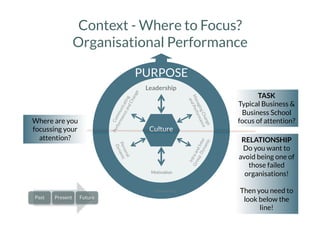
Context - Where to Focus?
Organisational Performance
Leadership
Motivation
© Assentire Ltd 
PURPOSE
Culture
RELATIONSHIP
Do you want to
avoid being one of
those failed
organisations!

Then you need to
look below the
line!
TASK
Typical Business &
Business School
focus of attention?
CultureCulture
Where are you
focussing your
attention?
Past
 Present
 Future
Psychological
Preference:
Adjusting to the
needs of
Relationships and
Tasks
Team Alignment:
‘Speed-read’
others and
yourself to
manage more
effectively
Taking the ‘pulse’ of
the Leadership of the
Organisation
Capability and Capacity
Direction, Drive and Efficiency
Typically Short-term focus
Good Governance and Wisdom 
Typically Long-term focus

Where we stand, directly impacts our own unique perspective of things & others
Context – From What Perspective?
But how do we explore what we
don’t know? All you do is develop…
2:Management
skills and
practice
3: Motivational
skills and
practice
3: Motivational
1: Awareness
of self and
others
don’t know? All you do is develop…
First, look at the Team or Workgroup Space (Group Dynamics)
Second, look at the Individual Relationship Space (Personal Dynamics)
Exploring Group Dynamics
Team or Group Climate Analysis
Becoming Aware
How do individuals within a group or team perceive that space?
Performers
High performing teams able to
work, listen and learn from each
other. However they are
unlikely to come up with highly
Innovative ideas outside the
scope of their responsibilities
Individualists
Fragmented team members
tending to work individually
promoting their own ideas and
not listening. Often considering
how to survive within the
organisation
Assentire Ltd ©
Innovators that Perform
High performing teams able to
Innovate. Ideally positioned to
take Action and Learn together
to address new challenges. They
are likely to continue to pay
attention to what is needed now
Innovators
Ideally positioned to learn and
act to address new challenges
and win new opportunities, but
more as individuals than a team.
Possible fragmented activity
from the team perspective
A simple display
Only 35 questions and takes 15 min per participant
work, listen and learn from each
unlikely to come up with highly
not listening. Often considering
Where to focus your attention?
Developing the skills to manage
Informed	
  by:	
  
Teaching	
  
Smart	
  People	
  
how	
  to	
  Learn	
  
(Single	
  and	
  
Double-­‐loop	
  
learning)	
  
By:	
  Chris	
  Argyris	
  
Informed	
  by:	
  
Understand	
  
how	
  MoIvaIon	
  
really	
  works	
  
(DRIVE	
  =	
  SDT)	
  
Drive	
  by	
  Pink	
  and	
  	
  
SDT	
  by	
  Deci	
  &	
  Ryan	
  	
  
MoIvaIon	
  and	
  
InnovaIon	
  PotenIal	
  
RelaIonship	
  and	
  
Team	
  Performance	
  
Exploring Personal Dynamics
The Mountain
we all will climb
Time for your story
Bring to mind a story where you are climbing a
mountain. As you approach the top, you become
aware of a large group of people coming over the
mountain from the other side. 

Engage with the story as it unfolds

Become aware, what do you do ? 

This is more effective if you close your eyes 
Please do so if you are comfortable 
Let’s stay still and silent for just 1 minute
I will let you know when the 60 seconds is over
Now consider what came to mind! 
•  How does it feel to be in that position? 
•  Do you contact them? 
•  Do they contact you? 
•  Do they come towards you, avoid you, walk away
from you, ignore you? 
•  Do they all act the same ? 
•  What do they look like ? 
•  Is there any contact verbally or physically? How
does your body feel? 
•  Are they friendly or hostile ? 
•  Let that story fade
The Mountain
Amount of
Interaction
Inclusion
Refers to associations between
and among people: the desire to
be given attention, to interact, to
belong, to be unique.
Schutz, 1994
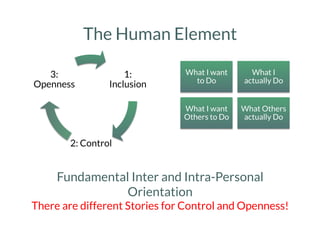
The Human Element 
1:
Inclusion
2: Control
2: Control
3:
Openness
What I want
to Do
What I
actually Do
What I want
Others to Do
What Others
actually Do
Fundamental Inter and Intra-Personal
Orientation
There are different Stories for Control and Openness!
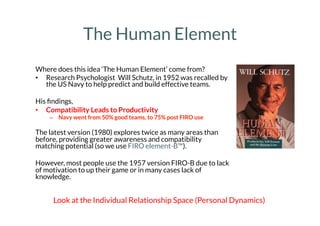
The Human Element
Where does this idea ‘The Human Element’ come from?
•  Research Psychologist Will Schutz, in 1952 was recalled by
the US Navy to help predict and build effective teams.

His findings, 
•  Compatibility Leads to Productivity
–  Navy went from 50% good teams, to 75% post FIRO use

The latest version (1980) explores twice as many areas than
before, providing greater awareness and compatibility
matching potential (so we use FIRO element-B™).

However, most people use the 1957 version FIRO-B due to lack
of motivation to up their game or in many cases lack of
knowledge.
Look at the Individual Relationship Space (Personal Dynamics)
To Summarise
What Next - Grow Through Change
Psychological Levels meets FIRO element B
Environment: Constraints & Opportunities
Behaviours: Action & Reaction
Capabilities: Perception & Direction
Values and Beliefs: Motivation & Permission
Self-identity: Role & Mission
Beyond self-identity: Vision & Purpose
Inclusion > Control > Openness
Past
 Present
 Future
Inclusion > Control > Openness
The Human Element
The Context
What we now Know
We can guide smart people so they KNOW:

•  Context impacts what Actions to take

•  Management Mode impacts Perception 
•  Relationships impact Team Performance

•  Motivations impact Innovation Potential

•  Psychological Mindedness is ESSENTIAL
Leadership
Motivation
© Assentire Ltd 
PURPOSE
Culture
Purpose,	
  People	
  and	
  PotenIal	
  	
  
Do	
  you	
  want	
  to	
  know	
  more…	
  
Use your Mobile device and scan the QR code 
Or
Click on URL to play Video http://goo.gl/ayrR00


Play the Video…
h"p://pulse-­‐behaviour.mobapp.at	
  
Monitoring the behaviours
across the organisation…

Through the eyes and ears
of those within the
organisation…

In a safe and systematic
way…

Using data mining with
Analytics to create
meaningful information…

Presenting your information
to enable early-warning
signals of behavioural drift	


The human element v20s

  • 1.
    The Human Element inOrganisations Nations, Organisations, Groups, Teams and Individuals
  • 2.
  • 3.
    Use your Mobiledevice and scan the QR code Or Click on URL to play Video http://goo.gl/a69raZ Please read and listen carefully to what comes next on the screen when you play the Video…
  • 4.
    Who is inControl? Man/Woman or Machine/Organisation Somehow he/she is overriding the System’s/ Organisation's Priorities! The Human Element will always be present! Compassion, Fear, Instinct! They will always interfere with or maybe enhance the System/Organisation!
  • 5.
    The Human Element Settingthe Context Organisations, Groups and Teams need to adjust and/or respond to the needs demanded by both Tasks and Relationships. By doing so, you enable an efficient and effective Organisation, Group or Team in terms of co-creating results.
  • 6.
    UK Business Degrading? Statistics released by the Office for National Statistics (ONS) in 2014 show that output per hour worked in the UK is 21% lower than the average for the other six members of the G7 – the US, Germany, France, Italy, Japan and Canada. Meanwhile, the UK also lags behind its international competitors in terms of its management practices. A 2012 report by the Department for Business, Innovation & Skills (BIS) found that its average management score is some way below that of the US, Japan, Germany and Canada.
  • 7.
    UK’s current leadershipand management performance Research shows that: •  Ineffective management is estimated to be costing UK businesses over £ xxxx per year in lost working hours. •  Incompetence or bad management of company directors causes xx % of corporate failures
  • 8.
    UK’s current leadershipand management performance Research shows that: •  Ineffective management is estimated to be costing UK businesses over £19billion per year in lost working hours. •  43% of UK managers rate their own line manager as ineffective – and only one in five are qualified •  Nearly three quarters of organisations in England reported a deficit of management and leadership skills in 2012. This deficit is contributing to our productivity gap with countries like the US, Germany and Japan. •  Incompetence or bad management of company directors causes 56 % of corporate failures Source: Department for Business, Innovation & Skills Leadership (2012)
  • 9.
    Source: The CharteredManagement Institute (CMI) UK Business Landscape Changing ? Key feature of CMI Open Letter: For a Better Managed Britain, organisations need to focus on three critical areas: Purpose, People and Potential Commission Chairs Peter Ayliffe, President of CMI and Barry Sheerman MP, Chair of the APPGM Matthew Hancock MP: Minister of State for Skills and Enterprise Seema Malhotra MP Chair, PLP Departmental Group for Business, Innovation and Skills Member of APPGM Commission THE FATAL BIAS The prevailing Management Bias towards cost efficiency is seriously harmful to corporate performance
  • 10.
    Global Business LandscapeChanging ? For a Better Managed Britain, organisations need to focus on three critical areas: Purpose, People and Potential The NEED, to enhance change, training and development initiatives across organisations, with a focus on People Management and Interpersonal Skills. Analysing the input from over 1,000 participants, two Independent reports in 2014 identified: The need to provide more training for People Management and Interpersonal skills, with a particular concern for first time and middle managers. The need to provide more training for People Management and Interpersonal skills, with a particular concern for first time and middle managers.
  • 11.
    Rhetorical Question •  Dowe REALLY know what we don’t know? •  There are known, knowns; •  There are things that we know that we know. •  We also know there are known unknowns; that is to say we know there are some things we do not know. •  But there are also unknown unknowns, the ones we don't know we don't know. Maybe there is more we don’t know afterall! United  States  Secretary  of  Defense  Donald  Rumsfeld  (Feb  2002)  
  • 12.
    Leadership © Assentire Ltd PURPOSE Culture Leadership Motivation Motivation Up to 70% of change initiatives fail to meet stakeholders expectations This failure rate has not changed in over 50 years! Typical change initiatives focus above the line, neglecting or marginalising the human element CultureCultureCulture Organisational Dynamics (OD) We need to pay special attention below the line, dramatically increasing change success rates Assentire Ltd © Grow Through Change, an Organizational Dynamics (OD) framework
  • 13.
    Just more trainingthen? What to do: Tap into what you already know, just from many different perspectives There is a SYSTEMIC weakness in our education delivery systems as we continue to create ever focussed SILOS of Knowledge. We teach Humans about Reading, Writing and Arithmetic, WHY don’t we Teach People about People!
  • 14.
    Some scaffolding tohelp while we build our understanding
  • 15.
    Context - Whatto Focus on? Creating an org where people want to belong Environment: Constraints & Opportunities Behaviours: Action & Reaction Capabilities: Perception & Direction Values and Beliefs: Motivation and Permission Self-identity: Role & Mission Beyond self-identity: Vision & Purpose My External Context What I Actually Do My Capabilities My Belief & Values System Who I Am Purpose beyond oneself Derived from the work of the anthropologist, Gregory Bateson. He identified several fundamental levels of learning and change Past Present Future Known by many names: Psychological, Neurological and Logical Levels
  • 16.
    Context - Whereto Focus? Organisational Performance Leadership Motivation © Assentire Ltd PURPOSE Culture RELATIONSHIP Do you want to avoid being one of those failed organisations! Then you need to look below the line! TASK Typical Business & Business School focus of attention? CultureCulture Where are you focussing your attention? Past Present Future
  • 17.
    Psychological Preference: Adjusting to the needsof Relationships and Tasks Team Alignment: ‘Speed-read’ others and yourself to manage more effectively Taking the ‘pulse’ of the Leadership of the Organisation Capability and Capacity Direction, Drive and Efficiency Typically Short-term focus Good Governance and Wisdom Typically Long-term focus Where we stand, directly impacts our own unique perspective of things & others Context – From What Perspective?
  • 18.
    But how dowe explore what we don’t know? All you do is develop… 2:Management skills and practice 3: Motivational skills and practice 3: Motivational 1: Awareness of self and others don’t know? All you do is develop… First, look at the Team or Workgroup Space (Group Dynamics) Second, look at the Individual Relationship Space (Personal Dynamics)
  • 19.
  • 20.
    Team or GroupClimate Analysis Becoming Aware How do individuals within a group or team perceive that space? Performers High performing teams able to work, listen and learn from each other. However they are unlikely to come up with highly Innovative ideas outside the scope of their responsibilities Individualists Fragmented team members tending to work individually promoting their own ideas and not listening. Often considering how to survive within the organisation Assentire Ltd © Innovators that Perform High performing teams able to Innovate. Ideally positioned to take Action and Learn together to address new challenges. They are likely to continue to pay attention to what is needed now Innovators Ideally positioned to learn and act to address new challenges and win new opportunities, but more as individuals than a team. Possible fragmented activity from the team perspective A simple display Only 35 questions and takes 15 min per participant work, listen and learn from each unlikely to come up with highly not listening. Often considering
  • 21.
    Where to focusyour attention? Developing the skills to manage Informed  by:   Teaching   Smart  People   how  to  Learn   (Single  and   Double-­‐loop   learning)   By:  Chris  Argyris   Informed  by:   Understand   how  MoIvaIon   really  works   (DRIVE  =  SDT)   Drive  by  Pink  and     SDT  by  Deci  &  Ryan     MoIvaIon  and   InnovaIon  PotenIal   RelaIonship  and   Team  Performance  
  • 22.
    Exploring Personal Dynamics TheMountain we all will climb
  • 23.
    Time for yourstory Bring to mind a story where you are climbing a mountain. As you approach the top, you become aware of a large group of people coming over the mountain from the other side. Engage with the story as it unfolds Become aware, what do you do ? This is more effective if you close your eyes Please do so if you are comfortable Let’s stay still and silent for just 1 minute I will let you know when the 60 seconds is over
  • 24.
    Now consider whatcame to mind! •  How does it feel to be in that position? •  Do you contact them? •  Do they contact you? •  Do they come towards you, avoid you, walk away from you, ignore you? •  Do they all act the same ? •  What do they look like ? •  Is there any contact verbally or physically? How does your body feel? •  Are they friendly or hostile ? •  Let that story fade
  • 25.
    The Mountain Amount of Interaction Inclusion Refersto associations between and among people: the desire to be given attention, to interact, to belong, to be unique. Schutz, 1994
  • 26.
    The Human Element 1: Inclusion 2: Control 2: Control 3: Openness What I want to Do What I actually Do What I want Others to Do What Others actually Do Fundamental Inter and Intra-Personal Orientation There are different Stories for Control and Openness!
  • 27.
    The Human Element Wheredoes this idea ‘The Human Element’ come from? •  Research Psychologist Will Schutz, in 1952 was recalled by the US Navy to help predict and build effective teams. His findings, •  Compatibility Leads to Productivity –  Navy went from 50% good teams, to 75% post FIRO use The latest version (1980) explores twice as many areas than before, providing greater awareness and compatibility matching potential (so we use FIRO element-B™). However, most people use the 1957 version FIRO-B due to lack of motivation to up their game or in many cases lack of knowledge. Look at the Individual Relationship Space (Personal Dynamics)
  • 28.
  • 29.
    What Next -Grow Through Change Psychological Levels meets FIRO element B Environment: Constraints & Opportunities Behaviours: Action & Reaction Capabilities: Perception & Direction Values and Beliefs: Motivation & Permission Self-identity: Role & Mission Beyond self-identity: Vision & Purpose Inclusion > Control > Openness Inclusion > Control > Openness Inclusion > Control > Openness Inclusion > Control > Openness Inclusion > Control > Openness Inclusion > Control > Openness Past Present Future Inclusion > Control > Openness Inclusion > Control > Openness Inclusion > Control > Openness Inclusion > Control > Openness Inclusion > Control > Openness Inclusion > Control > Openness The Human Element The Context
  • 30.
    What we nowKnow We can guide smart people so they KNOW: •  Context impacts what Actions to take •  Management Mode impacts Perception •  Relationships impact Team Performance •  Motivations impact Innovation Potential •  Psychological Mindedness is ESSENTIAL Leadership Motivation © Assentire Ltd PURPOSE Culture Purpose,  People  and  PotenIal     Do  you  want  to  know  more…  
  • 31.
    Use your Mobiledevice and scan the QR code Or Click on URL to play Video http://goo.gl/ayrR00 Play the Video…
  • 32.
    h"p://pulse-­‐behaviour.mobapp.at   Monitoring thebehaviours across the organisation… Through the eyes and ears of those within the organisation… In a safe and systematic way… Using data mining with Analytics to create meaningful information… Presenting your information to enable early-warning signals of behavioural drift