What Drives
Resistance to Change?
                 A Leader’s Perspective


  Sponsor: Assentire Ltd www.assentire.net          © Assentire Limited 2012
  Researcher: Rod Willis rod.willis@assentire.net
Is this research Important?


 70% of all change initiatives fail (HBR).http
   ://hbr.org/product/hbr-s-10-must-reads-on-change-management-with-feat/an/12599-PBK-ENG


 Resistance to Change is often cited as the number one reason
   why a change program has not delivered to the level that was
   anticipated.
 Organisations need to respond to turbulent market conditions.
   Needing to achieve more with fewer resources is a common
   theme we hear daily in the media, be this public, private or
   non-profit sectors.
The Prime Research context


 Sixteen change leaders (past and present) via semi-structured
   interviews created the prime data.
 Combined experiences spanning > 55 organisations.

 Operating within Oil and Gas, Professional and Financial
   Services, Public sector, including two District Councils and a
   Police Collaboration Programme.


                                                           © Assentire Limited 2012
It’s not new after all!
               Just some of the articles

   How to Deal with Resistance to Change
      (Lawrence, 1954)

   A person-centred approach to dealing with resistance to change
       (Coghlan, 1993)

   7 Transformations of Leadership
        (Rooke and Torbert, 2005)

   Beyond talk: creating autonomous motivation through self-determination theory
       (Stone et al., 2009)

   Reframing resistance to organizational change
       (Thomas and Hardy, 2011)


                                                                                    © Assentire Limited 2012
The Problem of Change


“Change is occurring at an ever increasing pace in all phases of
man’s life. People fear change because it upsets their way of
doing things and threatens their security. This feeling is balanced
by a desire for new experiences and for the benefits that come as a
result of change” (BURNS, J. E. 1966. THE PROBLEM OF CHANGE. Industrial Management, 8, 1.)


                                                                               © Assentire Limited 2012
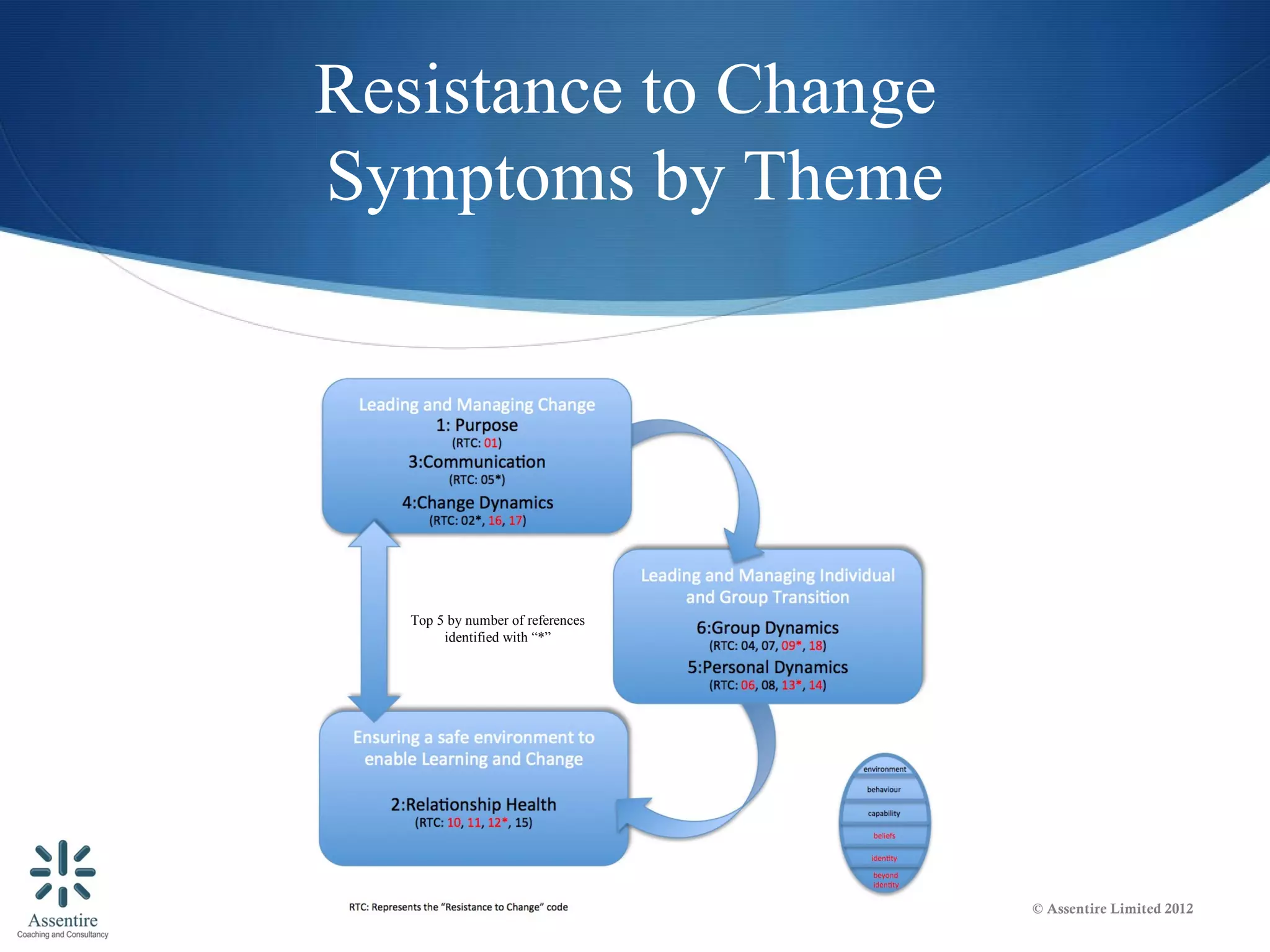
Resistance to Change
Symptoms by Theme


   Top 5 by number of references
        identified with “*”


                                   © Assentire Limited 2012
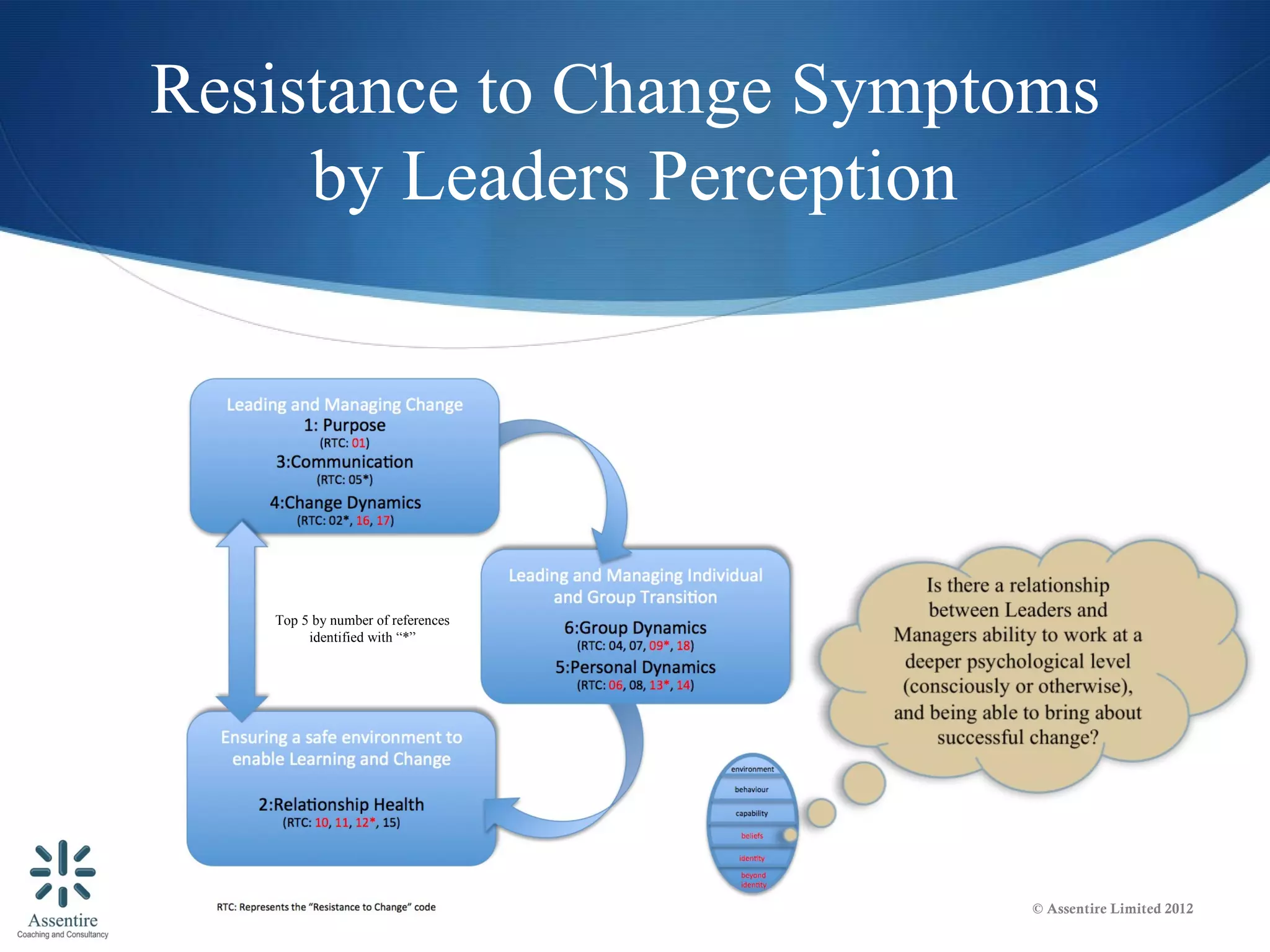
Resistance to Change Symptoms
     by Leaders Perception


   Top 5 by number of references
        identified with “*”


                                   © Assentire Limited 2012
Is Resistance in the
                                   Eye of the Beholder?


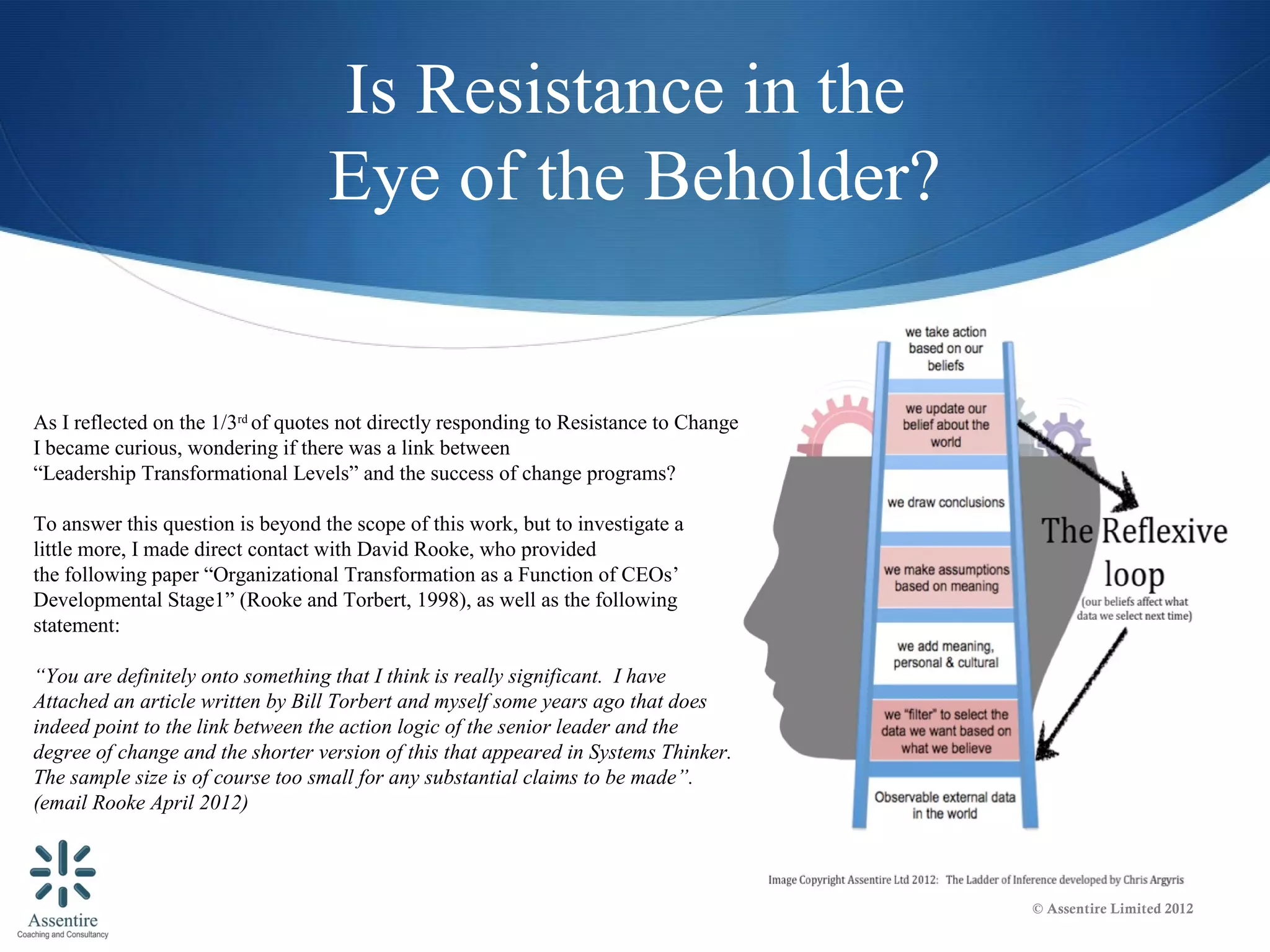
As I reflected on the 1/3rd of quotes not directly responding to Resistance to Change
I became curious, wondering if there was a link between
“Leadership Transformational Levels” and the success of change programs?

To answer this question is beyond the scope of this work, but to investigate a
little more, I made direct contact with David Rooke, who provided
the following paper “Organizational Transformation as a Function of CEOs’
Developmental Stage1” (Rooke and Torbert, 1998), as well as the following
statement:

“You are definitely onto something that I think is really significant. I have
Attached an article written by Bill Torbert and myself some years ago that does
indeed point to the link between the action logic of the senior leader and the
degree of change and the shorter version of this that appeared in Systems Thinker.
The sample size is of course too small for any substantial claims to be made”.
(email Rooke April 2012)


                                                                                        © Assentire Limited 2012
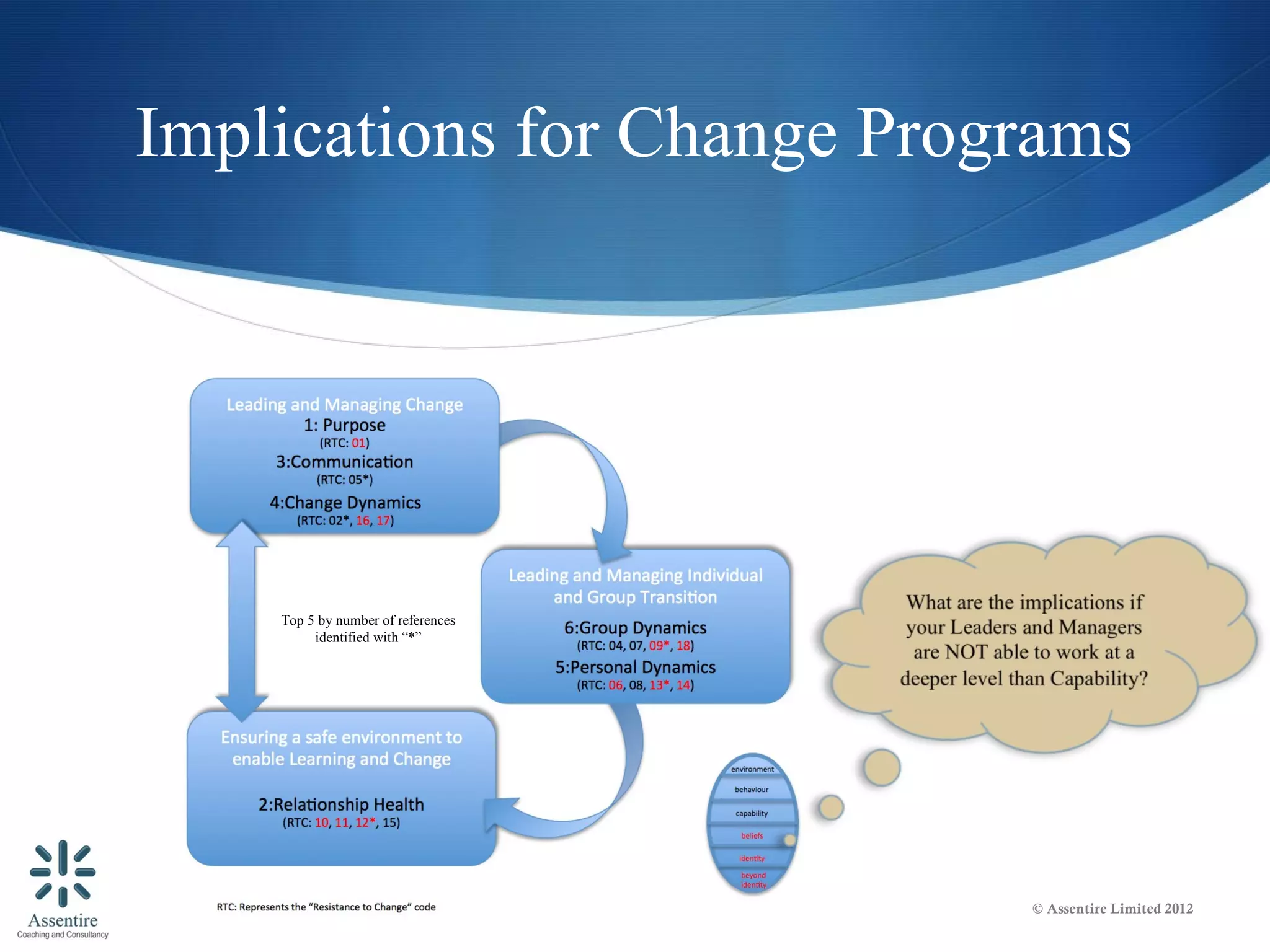
Implications for Change Programs


    Top 5 by number of references
         identified with “*”


                                    © Assentire Limited 2012
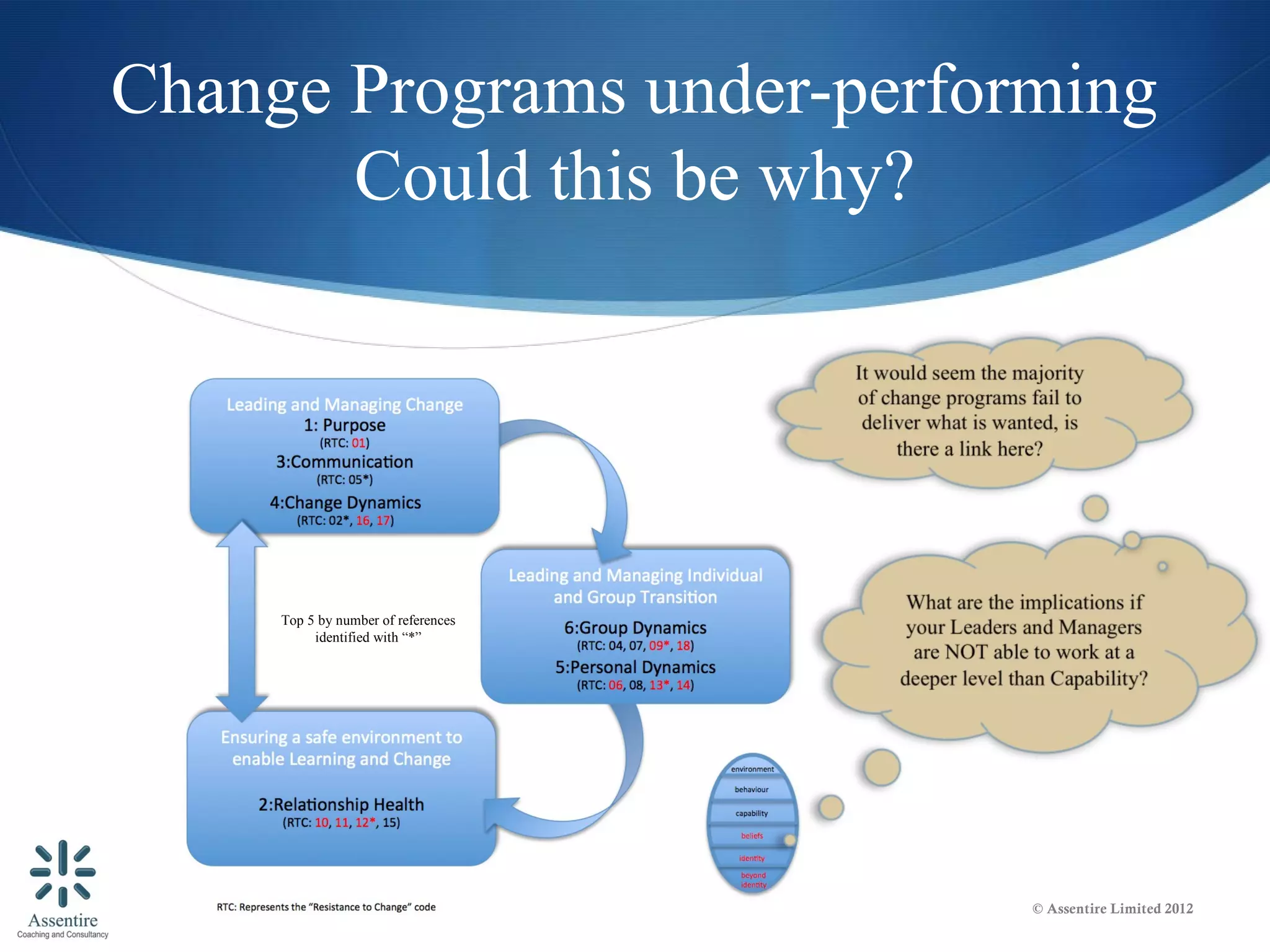
Change Programs under-performing
       Could this be why?


     Top 5 by number of references
          identified with “*”


                                     © Assentire Limited 2012
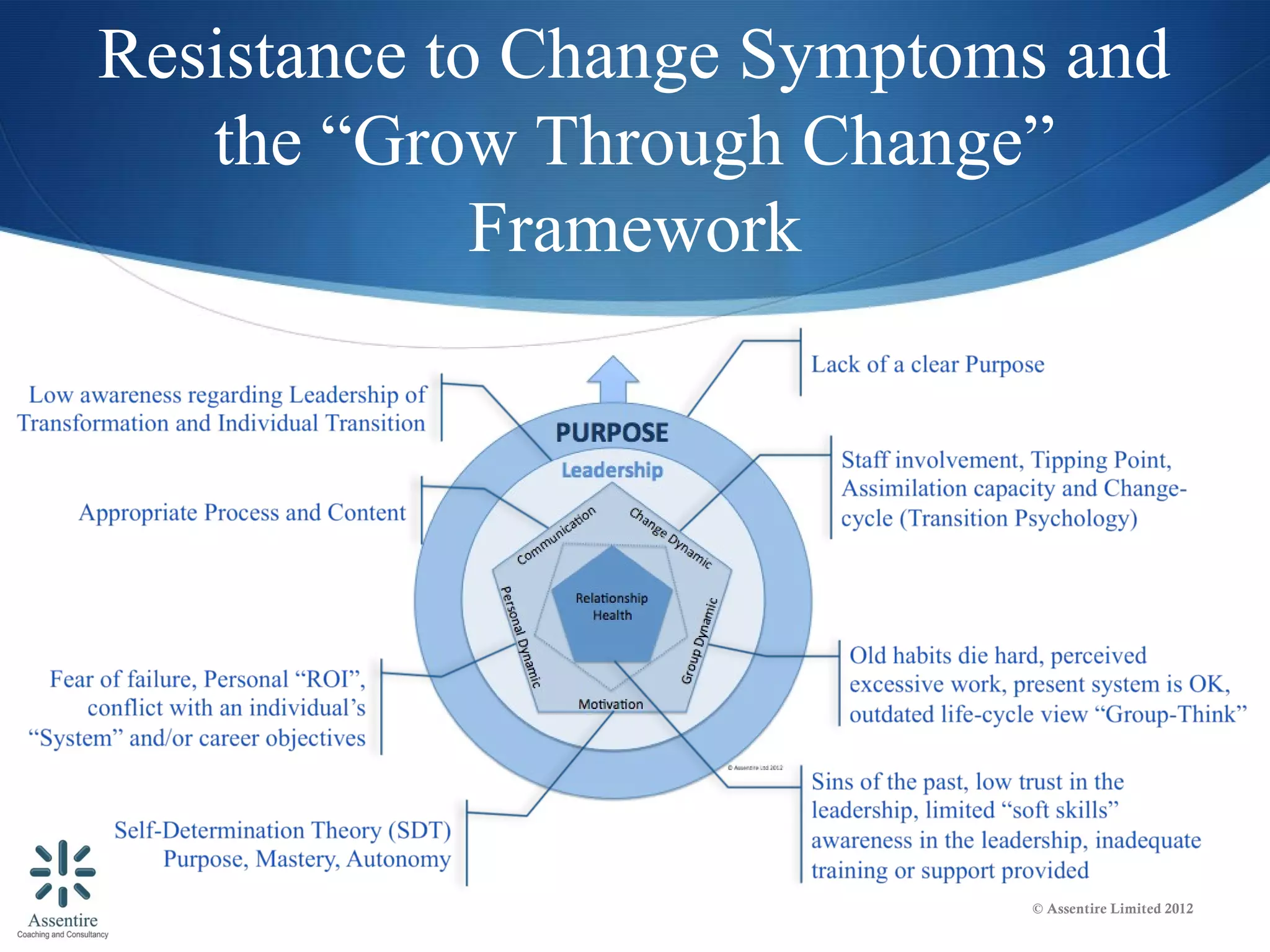
Resistance to Change Symptoms and
   the “Grow Through Change”
             Framework


                            © Assentire Limited 2012
Thoughts for the day

Resistance to Change, has our view actually changed since
                         1954?

 “New research finds 'reality gap’ in the capability of UK
 plc's 8 million managers, undermining attempts to boost
        economic growth” (CIPD 3rd of May 2012)

“Insanity is doing the same thing, over and over again, but
       expecting different results” (Albert Einstein)

                Thank you for your time

                                                              © Assentire Limited 2012
It’s not new after all!
                          Books for consideration

Leading and Managing Change
            1: Purpose (Heron, 1999, Pink, 2011, Jung, 1995, Sinek, 2011)
            3: Communication (Patterson, 2002, Wright, 2009, Gallwey, 1986)
            4: Change Dynamic (Black, 2008, Conner, 2006, Hurst, 2002, *Kim and Mauborgne, 2003)
Ensure a safe environment to enable learning and change
            2: Relationship Health (Covey, 2006, Kotter and Cohen, 2002, *Welsh NHS Confederation, 2008, Schutz, 1994)
Leading and Managing Individual and Group Transition
            6: Group Dynamic (Jaques and Salmon, 2008, Senge, 1994, Senge, 2006, Thornton, 2010)
            5: Personal Dynamic (Argyris, 2008, Cartwright, 2004, Deci, 1997, Hawkins and Smith, 2006, Lawrence and Nohria, 2002)
Transformational Leadership
            Frameworks (*Rooke and Torbert, 2005, *Jr., 2006, Collins, 2005, Barrett, 2011, *Michael J. Zickar, 2008)


            A link for the books available from Amazon is available at http://www.assentire.net/Resources.aspx
            References prefixed with an * are Papers, please contact me for more details if you would like the full reference.


                                                                                                                   © Assentire Limited 2012
References for Journals introduced
  at the start of the presentation

COGHLAN, D. 1993. A person-centred approach to dealing with resistance to change. Leadership & Organization Development Journal, 14, 10.


LAWRENCE, P. R. 1954. How to Deal with Resistance to Change. Harvard Business Review, 32, 49-57.


ROOKE, D. & TORBERT, W. R. 2005. 7 Transformations of Leadership. Harvard Business Review, 83, 66-66.


STONE, D. N., DECI, E. L. & RYAN, R. M. 2009. Beyond talk: creating autonomous motivation through self-determination theory. Journal of
General Management, 34, 75-91.


THOMAS, R. & HARDY, C. 2011. Reframing resistance to organizational change. Scandinavian Journal of Management, 27, 322-331.


                                                                                                                          © Assentire Limited 2012

Grow through change research overview Mar 2013 cc

  • 1.
    What Drives Resistance toChange? A Leader’s Perspective Sponsor: Assentire Ltd www.assentire.net © Assentire Limited 2012 Researcher: Rod Willis rod.willis@assentire.net
  • 2.
    Is this researchImportant?  70% of all change initiatives fail (HBR).http ://hbr.org/product/hbr-s-10-must-reads-on-change-management-with-feat/an/12599-PBK-ENG  Resistance to Change is often cited as the number one reason why a change program has not delivered to the level that was anticipated.  Organisations need to respond to turbulent market conditions. Needing to achieve more with fewer resources is a common theme we hear daily in the media, be this public, private or non-profit sectors.
  • 3.
    The Prime Researchcontext  Sixteen change leaders (past and present) via semi-structured interviews created the prime data.  Combined experiences spanning > 55 organisations.  Operating within Oil and Gas, Professional and Financial Services, Public sector, including two District Councils and a Police Collaboration Programme. © Assentire Limited 2012
  • 4.
    It’s not newafter all! Just some of the articles  How to Deal with Resistance to Change  (Lawrence, 1954)  A person-centred approach to dealing with resistance to change  (Coghlan, 1993)  7 Transformations of Leadership  (Rooke and Torbert, 2005)  Beyond talk: creating autonomous motivation through self-determination theory  (Stone et al., 2009)  Reframing resistance to organizational change  (Thomas and Hardy, 2011) © Assentire Limited 2012
  • 5.
    The Problem ofChange “Change is occurring at an ever increasing pace in all phases of man’s life. People fear change because it upsets their way of doing things and threatens their security. This feeling is balanced by a desire for new experiences and for the benefits that come as a result of change” (BURNS, J. E. 1966. THE PROBLEM OF CHANGE. Industrial Management, 8, 1.) © Assentire Limited 2012
  • 6.
    Resistance to Change Symptomsby Theme Top 5 by number of references identified with “*” © Assentire Limited 2012
  • 7.
    Resistance to ChangeSymptoms by Leaders Perception Top 5 by number of references identified with “*” © Assentire Limited 2012
  • 8.
    Is Resistance inthe Eye of the Beholder? As I reflected on the 1/3rd of quotes not directly responding to Resistance to Change I became curious, wondering if there was a link between “Leadership Transformational Levels” and the success of change programs? To answer this question is beyond the scope of this work, but to investigate a little more, I made direct contact with David Rooke, who provided the following paper “Organizational Transformation as a Function of CEOs’ Developmental Stage1” (Rooke and Torbert, 1998), as well as the following statement: “You are definitely onto something that I think is really significant. I have Attached an article written by Bill Torbert and myself some years ago that does indeed point to the link between the action logic of the senior leader and the degree of change and the shorter version of this that appeared in Systems Thinker. The sample size is of course too small for any substantial claims to be made”. (email Rooke April 2012) © Assentire Limited 2012
  • 9.
    Implications for ChangePrograms Top 5 by number of references identified with “*” © Assentire Limited 2012
  • 10.
    Change Programs under-performing Could this be why? Top 5 by number of references identified with “*” © Assentire Limited 2012
  • 11.
    Resistance to ChangeSymptoms and the “Grow Through Change” Framework © Assentire Limited 2012
  • 12.
    Thoughts for theday Resistance to Change, has our view actually changed since 1954? “New research finds 'reality gap’ in the capability of UK plc's 8 million managers, undermining attempts to boost economic growth” (CIPD 3rd of May 2012) “Insanity is doing the same thing, over and over again, but expecting different results” (Albert Einstein) Thank you for your time © Assentire Limited 2012
  • 13.
    It’s not newafter all! Books for consideration Leading and Managing Change 1: Purpose (Heron, 1999, Pink, 2011, Jung, 1995, Sinek, 2011) 3: Communication (Patterson, 2002, Wright, 2009, Gallwey, 1986) 4: Change Dynamic (Black, 2008, Conner, 2006, Hurst, 2002, *Kim and Mauborgne, 2003) Ensure a safe environment to enable learning and change 2: Relationship Health (Covey, 2006, Kotter and Cohen, 2002, *Welsh NHS Confederation, 2008, Schutz, 1994) Leading and Managing Individual and Group Transition 6: Group Dynamic (Jaques and Salmon, 2008, Senge, 1994, Senge, 2006, Thornton, 2010) 5: Personal Dynamic (Argyris, 2008, Cartwright, 2004, Deci, 1997, Hawkins and Smith, 2006, Lawrence and Nohria, 2002) Transformational Leadership Frameworks (*Rooke and Torbert, 2005, *Jr., 2006, Collins, 2005, Barrett, 2011, *Michael J. Zickar, 2008) A link for the books available from Amazon is available at http://www.assentire.net/Resources.aspx References prefixed with an * are Papers, please contact me for more details if you would like the full reference. © Assentire Limited 2012
  • 14.
    References for Journalsintroduced at the start of the presentation COGHLAN, D. 1993. A person-centred approach to dealing with resistance to change. Leadership & Organization Development Journal, 14, 10. LAWRENCE, P. R. 1954. How to Deal with Resistance to Change. Harvard Business Review, 32, 49-57. ROOKE, D. & TORBERT, W. R. 2005. 7 Transformations of Leadership. Harvard Business Review, 83, 66-66. STONE, D. N., DECI, E. L. & RYAN, R. M. 2009. Beyond talk: creating autonomous motivation through self-determination theory. Journal of General Management, 34, 75-91. THOMAS, R. & HARDY, C. 2011. Reframing resistance to organizational change. Scandinavian Journal of Management, 27, 322-331. © Assentire Limited 2012