Assentire Limited
Innovation - Change - Facilitation
Helping Organisations Grow Through Change

Innovation Audit
For
Behavioural Change

Rod	
  Willis	
  –	
  Assentire	
  Ltd	
  ©	
  2013	


0	


Rod Willis is an APECS Accredited Executive Coach
Assentire Ltd, PO Box 4481, Maidenhead, SL60 1FY, UK
Jan 2014

Rod	
  Willis	
  –	
  Assentire	
  Ltd	
  ©	
  2013	
  

www.assentire.net


T: +44 (0) 1628 632 340
1	
  
M: +44 (0) 7788 457 202
rod.willis@assentire.net
Contents
INTRODUCTION	
  

3	
  

BACKGROUND	
  
THE NEED FOR MEASUREMENT	
  
RETURN ON INVESTMENT	
  
CONCLUSION	
  
ANY QUESTIONS	
  
INNOVATION AUDIT DASHBOARD	
  

3	
  
4	
  
4	
  
5	
  
5	
  
6	
  

Rod	
  Willis	
  –	
  Assentire	
  Ltd	
  ©	
  2013	


2	
  
Introduction

The ‘Innovation Audit’ has been developed to help organisations gain new
insight into how they are positioned regarding Learning, Agility and Flexibility.
These are some of the key components for Innovative organisations. The audit
explores yours and others perspectives of the organisational cultural and Ecocycle. It adds a unique all-round perspective of your organisation, exploring
how it has performed in the past in prior change programmes. Many
organisations believe they already learn from their past or desire to enhance
this behaviour.
Some questions to hold,
How well do you respond to the dynamic demands of your market?
Do you and others;
have a dominant Performance or Learning Culture?
know the 'Strategic Direction' of the company
know where you are on the 'Organisational Eco- Cycle
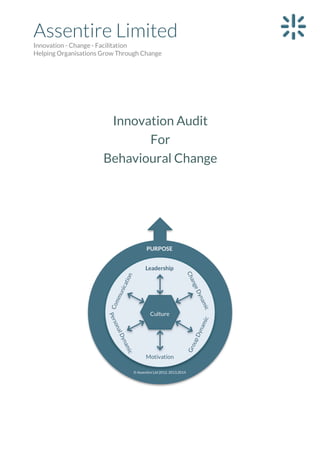
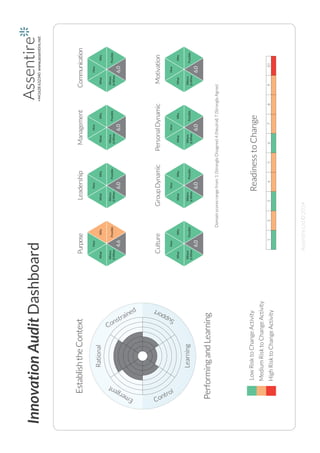
know how your profile looks in terms of the 8 domains of the 'Change
Matrix’ PURPOSE, LEADERSHIP, CULTURE, MOTIVATION, COMMUNICATION,
MANAGEMENT, GROUP DYNAMIC, PERSONAL DYNAMIC

Background
Many people recognise that sometimes organisations and people can look as if
they are ‘stuck’, seemingly not wanting to change. We hear all too often,
‘People are Resistant to Change’.
As a result of two evidence-based research projects, one was exploring how
relationships impact the success of Information Systems and another on How
Leaders Perceive Resistance to Change. We have developed a new way of
exploring this space.
This profile is available in two formats.
One is in paper form, which is often used for a small number of participants. A
report can then manually be created to enable the new insights to be shared.
There is also an online version. This is ideal where there will be many
participants. The online profile takes less than 30 minutes to answer the 90 or
so questions. It has two advantages, as participants complete their input, they
can look at the real-time reporting to see how the output is trending as more
and more participants complete their input.
For some organisations, this may be the first time they are able to see an
accurate view of how the people across the organisation ‘see’ the organisation.

Rod	
  Willis	
  –	
  Assentire	
  Ltd	
  ©	
  2013	


3	
  
The need for measurement
Another advantage of the online system is, we can create a report that provides
statistical information, and understanding what the organisational ‘norms’ are.
This then enable us to measure later on to compare and contrast.
This creates an ideal basis for a change or developmental initiative across the
organisation. Importantly providing a means to measure the impact of such a
programme. We always need to keep in mind; measurement is just that, it is not
judgment. We measure things so we can understand them better and then
make informed decisions. Measurement is a means to support a process to
come to an outcome; it is not the outcome in and of itself.

Return On Investment
Those with robust leadership experience and judgment, often have the ability to
‘see’ what is occurring within their organisation, understanding what
interventions and behaviours help the organisation as a whole, perform more
effectively and efficiently.
They have developed an acute ability to ‘read’ people and the market and lead
the organisation with clear direction in the most productive manner. Within
this context, this type of person is able to make the business case to invest in
specific interventions, supporting personal and professional development.
Bottom line, they can make the business case.
In other situations, there is a need to provide ‘scaffolding’ for those developing
this ability. This could be yourself, or your peers. This reality seems not to be
consciously managed in many organisations we have worked with. As a result,
the following scenario can unfold.
•

Many developmental programmes gain sponsorship through what we
refer to as the ‘belief-sell’. The sponsors truly believe it is the right thing
to do.

•

The challenge, if there is no measurement system in place, it becomes
very difficult (maybe impossible) to establish an ROI calculation.

•

As sponsors move on, and they do, then the initiative can become
suddenly at risk.

•

Importantly, this could mean all the investment (and potential gain to
individuals and the organisation) becomes effectively discarded, as it is
not understood, often due to the fact it was not measured.

•

When you don’t measure something, you don’t know what you are
letting go!

•

By introducing a measurement system, you know what you have and you
can now make informed decisions based on this.

Rod	
  Willis	
  –	
  Assentire	
  Ltd	
  ©	
  2013	


4	
  
Conclusion
To know where to invest resources in any change programme can be a tough
call. This profile starts you on that pathway by providing a unique opportunity
of capturing your performing and learning culture; strategic direction and your
overall capability in terms of how well can you Grow Through Change.
If you want to increase the success rate of your change initiatives, enabling
greater Innovation within the organisation, then you will need to try something
different to what you have been doing. This approach is a simple way of starting
your own Innovative leadership and management process.

Any questions
If you want to know more about this profile, our approach, or our range of
facilitated workshops to help you explore this and other material in an
interactive group setting.
Please make contact; our details are at the end of this document

Rod	
  Willis	
  –	
  Assentire	
  Ltd	
  ©	
  2013	


5	
  
up
p

ort

Em
erg
e

ol

C

tr
on

High Risk to Change Activity

Medium Risk to Change Activity

Low Risk to Change Activity

Performing and Learning

Learning

Rational

Co

S

nt

Establish the Context
Leadership

1

6.0

How

6.0

Possible

Where
& When

What

6.0

How

Possible

Why

Why

Where
& When

What

6.0

How

Possible

Why

Personal Dynamic

Where
& When

6.0

Possible

What

How

Management

Assentire

2

3

4

5

6

7

Readiness to Change
8

Where
& When

What

9

6.0

How

Possible

Why

10

6.0

How

Possible

Why

Motivation

Where
& When

What

Communication

+441628 632340 www.assentire.net

Domain scores range from: 1 (Strongly Disagree) 4 (Neutral) 7 (Strongly Agree)

Possible

Why

Where
& When

Why

Group Dynamic

Assentire Ltd © 2014

Where
& When

What

Culture

Where
& When

4.6

Possible

What
What

How
Why

How

Purpose

Innovation Audit Dashboard

ed

ain
str
n
For further information, contact details


Rod Willis is an APECS Accredited Executive Coach
Assentire Ltd, PO Box 4481, Maidenhead, SL60 1FY, UK
Jan 2014
www.assentire.net Willis	
  –	
  Assentire	
  Ltd	
  ©	
  2013	
  
Rod	


T: +44 (0) 1628 632 340
M: +44 (0) 7788 457 202
rod.willis@assentire.net
7	
  

Innovation audit introduction v3.2

  • 1.
    Assentire Limited Innovation -Change - Facilitation Helping Organisations Grow Through Change Innovation Audit For Behavioural Change Rod  Willis  –  Assentire  Ltd  ©  2013     0  
  • 2.
      Rod Willis isan APECS Accredited Executive Coach Assentire Ltd, PO Box 4481, Maidenhead, SL60 1FY, UK Jan 2014 Rod  Willis  –  Assentire  Ltd  ©  2013   www.assentire.net   T: +44 (0) 1628 632 340 1   M: +44 (0) 7788 457 202 rod.willis@assentire.net
  • 3.
    Contents INTRODUCTION   3   BACKGROUND   THE NEED FOR MEASUREMENT   RETURN ON INVESTMENT   CONCLUSION   ANY QUESTIONS   INNOVATION AUDIT DASHBOARD   3   4   4   5   5   6   Rod  Willis  –  Assentire  Ltd  ©  2013     2  
  • 4.
    Introduction The ‘Innovation Audit’has been developed to help organisations gain new insight into how they are positioned regarding Learning, Agility and Flexibility. These are some of the key components for Innovative organisations. The audit explores yours and others perspectives of the organisational cultural and Ecocycle. It adds a unique all-round perspective of your organisation, exploring how it has performed in the past in prior change programmes. Many organisations believe they already learn from their past or desire to enhance this behaviour. Some questions to hold, How well do you respond to the dynamic demands of your market? Do you and others; have a dominant Performance or Learning Culture? know the 'Strategic Direction' of the company know where you are on the 'Organisational Eco- Cycle know how your profile looks in terms of the 8 domains of the 'Change Matrix’ PURPOSE, LEADERSHIP, CULTURE, MOTIVATION, COMMUNICATION, MANAGEMENT, GROUP DYNAMIC, PERSONAL DYNAMIC Background Many people recognise that sometimes organisations and people can look as if they are ‘stuck’, seemingly not wanting to change. We hear all too often, ‘People are Resistant to Change’. As a result of two evidence-based research projects, one was exploring how relationships impact the success of Information Systems and another on How Leaders Perceive Resistance to Change. We have developed a new way of exploring this space. This profile is available in two formats. One is in paper form, which is often used for a small number of participants. A report can then manually be created to enable the new insights to be shared. There is also an online version. This is ideal where there will be many participants. The online profile takes less than 30 minutes to answer the 90 or so questions. It has two advantages, as participants complete their input, they can look at the real-time reporting to see how the output is trending as more and more participants complete their input. For some organisations, this may be the first time they are able to see an accurate view of how the people across the organisation ‘see’ the organisation. Rod  Willis  –  Assentire  Ltd  ©  2013     3  
  • 5.
    The need formeasurement Another advantage of the online system is, we can create a report that provides statistical information, and understanding what the organisational ‘norms’ are. This then enable us to measure later on to compare and contrast. This creates an ideal basis for a change or developmental initiative across the organisation. Importantly providing a means to measure the impact of such a programme. We always need to keep in mind; measurement is just that, it is not judgment. We measure things so we can understand them better and then make informed decisions. Measurement is a means to support a process to come to an outcome; it is not the outcome in and of itself. Return On Investment Those with robust leadership experience and judgment, often have the ability to ‘see’ what is occurring within their organisation, understanding what interventions and behaviours help the organisation as a whole, perform more effectively and efficiently. They have developed an acute ability to ‘read’ people and the market and lead the organisation with clear direction in the most productive manner. Within this context, this type of person is able to make the business case to invest in specific interventions, supporting personal and professional development. Bottom line, they can make the business case. In other situations, there is a need to provide ‘scaffolding’ for those developing this ability. This could be yourself, or your peers. This reality seems not to be consciously managed in many organisations we have worked with. As a result, the following scenario can unfold. • Many developmental programmes gain sponsorship through what we refer to as the ‘belief-sell’. The sponsors truly believe it is the right thing to do. • The challenge, if there is no measurement system in place, it becomes very difficult (maybe impossible) to establish an ROI calculation. • As sponsors move on, and they do, then the initiative can become suddenly at risk. • Importantly, this could mean all the investment (and potential gain to individuals and the organisation) becomes effectively discarded, as it is not understood, often due to the fact it was not measured. • When you don’t measure something, you don’t know what you are letting go! • By introducing a measurement system, you know what you have and you can now make informed decisions based on this. Rod  Willis  –  Assentire  Ltd  ©  2013     4  
  • 6.
    Conclusion To know whereto invest resources in any change programme can be a tough call. This profile starts you on that pathway by providing a unique opportunity of capturing your performing and learning culture; strategic direction and your overall capability in terms of how well can you Grow Through Change. If you want to increase the success rate of your change initiatives, enabling greater Innovation within the organisation, then you will need to try something different to what you have been doing. This approach is a simple way of starting your own Innovative leadership and management process. Any questions If you want to know more about this profile, our approach, or our range of facilitated workshops to help you explore this and other material in an interactive group setting. Please make contact; our details are at the end of this document Rod  Willis  –  Assentire  Ltd  ©  2013     5  
  • 7.
    up p ort Em erg e ol C tr on High Risk toChange Activity Medium Risk to Change Activity Low Risk to Change Activity Performing and Learning Learning Rational Co S nt Establish the Context Leadership 1 6.0 How 6.0 Possible Where & When What 6.0 How Possible Why Why Where & When What 6.0 How Possible Why Personal Dynamic Where & When 6.0 Possible What How Management Assentire 2 3 4 5 6 7 Readiness to Change 8 Where & When What 9 6.0 How Possible Why 10 6.0 How Possible Why Motivation Where & When What Communication +441628 632340 www.assentire.net Domain scores range from: 1 (Strongly Disagree) 4 (Neutral) 7 (Strongly Agree) Possible Why Where & When Why Group Dynamic Assentire Ltd © 2014 Where & When What Culture Where & When 4.6 Possible What What How Why How Purpose Innovation Audit Dashboard ed ain str n
  • 8.
    For further information,contact details   Rod Willis is an APECS Accredited Executive Coach Assentire Ltd, PO Box 4481, Maidenhead, SL60 1FY, UK Jan 2014 www.assentire.net Willis  –  Assentire  Ltd  ©  2013   Rod     T: +44 (0) 1628 632 340 M: +44 (0) 7788 457 202 rod.willis@assentire.net 7