The Fashion Channel
Presented by:
Shiva Chegini

Fatima Zahira Mazlan

Xing Fei Fei

Ammar Al Tayara
Current Scenario


Dana Wheeler, senior vice president of marketing for The Fashion
Channel (TFC)



Preparing recommendations for TFC’s new Segmentation &
Positioning Strategy



Strengthen competitive position (spending $60 million)



Attracting new customers with new marketing and advertising
approaches



Focusing on revenue stream for TFC when presenting to CEO Jared
Thomas at senior management meeting.
About The Fashion Channel


Founded in 1996 as the first TV cable network devoted only to fashion (24/7)



Constant revenue and profit growth above the industry average since the
beginning



$310.6 millions as revenue were forecasted for 2006



Niche networks reaching almost 80 million U.S. household



Women between 35 and 54 years are most avid viewers



No details about viewers in general and no attempt to focus on any segment



TFC marketing massage “Fashion for Everyone” trying to achieve highest
viewership numbers



Some of board members felt that no need to change. “break something that
isn’t broken”



Main competitors: Lifetime and CNN
Main Sources of Revenue
Generally TFC had two main sources of revenues:
1)

Advertising Revenue model:


Target to achieve $230.6 million of revenues generated by advertising.



The adverting business model was based on “Rating” (the % of TV
households watching on average during measured viewing period.)



TFC average rating 1.0; with 110 million TV households in U.S. TFC’s
average was 1,100,000 viewers at any point of time.



These viewers can be reached via advertising spots (30 or 60 seconds in
length.) Total of ads time during one week is 2,016 minutes



Consumers spent about $20 billion buying spots on cable networks



The competition for ad revenue was always fierce among all networks,
since there were several hundred cable networks competing for viewers.
Main Sources of Revenue
1)

Advertising Revenue model: Cont.


TFC should focus on their ratings and demographics, because the ad
buyers are interested in them and not interested in specific programming
subjects.



Lifetime and CNN offered strong fashion programming blocks “not
dedicated fashion channels,” which represented a double-edged
competitive challenge



If Lifetime and CNN were successful that would attract more networks to
copy their concept.



The advertising pricing is expressed as CPM (Cost Per thousand.)
Main Sources of Revenue
1)

Advertising Revenue Module: Cont.



CPM (Cost Per Thousand)



Audience characteristics:



Ratings





General competitive trends

General Competitive Trends

Main groups of viewers that advertisers were interested in are:


Men of all ages





Advertising revenue for an
individual spot = (Households x
Ratings)/1,000 x CPM

Women aged between 18-34

TFC Ad Sales team could achieve CPM pricing increase from 25% to
75%.
Main Sources of Revenue
2)

Cable Affiliate Fees:



Cable affiliate fee revenue stream were expected to generate $80 million in
2006



Most of U.S. households subscribed to cable television through local affiliates,
by paying monthly fee for a basic channels and paying extra fee for premium
channels



TFC was positioned as a basic channel so most consumers received
automatically.



Large Multi-System Operators (MSO) are interested in signing multi-year
contracts with networks that specify the fee of the network upon customer
subscription
Main Sources of Revenue
2)

Cable Affiliate Fees:



TFC negotiated average fee of $1.00 per subscriber per year



TFC should maintain their viewership to maintain their fee



TFC was at the low end of the industry range, because of their niche
network
Main Competitors


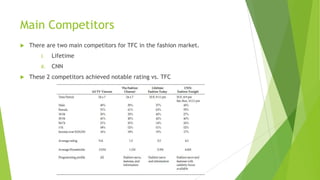
There are two main competitors for TFC in the fashion market.
I.
II.



Lifetime
CNN

These 2 competitors achieved notable rating vs. TFC
Main Competitors


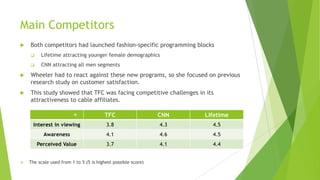
Both competitors had launched fashion-specific programming blocks


Lifetime attracting younger female demographics



CNN attracting all men segments



Wheeler had to react against these new programs, so she focused on previous
research study on customer satisfaction.



This study showed that TFC was facing competitive challenges in its
attractiveness to cable affiliates.
TFC

CNN

Lifetime

Interest in viewing

3.8

4.3

4.5

Awareness

4.1

4.6

4.5

Perceived Value

3.7

4.1

4.4





The scale used from 1 to 5 (5 is highest possible score)
Main Competitors


The previous data was used to by cable operators to determine how much to
pay for each network



If network underperformed the average, they will risk being offered in less
appealing packages, which will eventually reduce the number of households.
SWOT Analysis for TFC to obtain new
segmentation and positioning strategy
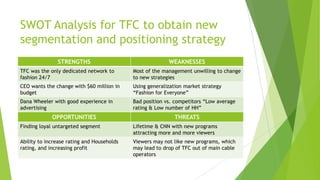
STRENGTHS

WEAKNESSES

TFC was the only dedicated network to
fashion 24/7

Most of the management unwilling to change
to new strategies

CEO wants the change with $60 million in
budget

Using generalization market strategy
“Fashion for Everyone”

Dana Wheeler with good experience in
advertising

Bad position vs. competitors “Low average
rating & Low number of HH”

OPPORTUNITIES

THREATS

Finding loyal untargeted segment

Lifetime & CNN with new programs
attracting more and more viewers

Ability to increase rating and Households
rating, and increasing profit

Viewers may not like new programs, which
may lead to drop of TFC out of main cable
operators
Main Problems to Solve for TFC

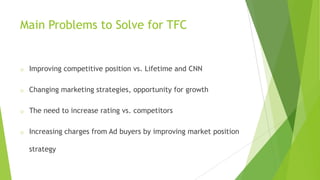
o

Improving competitive position vs. Lifetime and CNN

o

Changing marketing strategies, opportunity for growth

o

The need to increase rating vs. competitors

o

Increasing charges from Ad buyers by improving market position
strategy
Market Research Findings


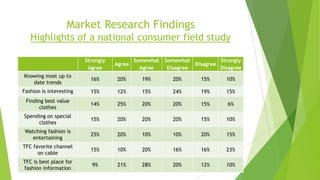
Wheeler was interested in the most recent consumer research reports,
which are mainly 2 reports.

1.

Highlights of a national consumer field study



Which is a list of questions about consumers attitudes toward fashion and TFC.

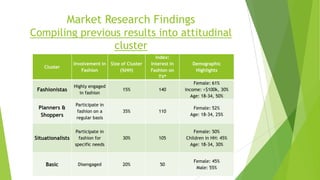
2.

Compiling previous results into attitudinal cluster



They run the previous answers through a statistical correlation program to analyze
patterns in the way consumers answered.



The report suggested 4 unique groups of viewers: Fashionistas, Planners & Shoppers,
Situationalists, and Basics



Segments were varied in size (among the total participants of households.)
Market Research Findings
Highlights of a national consumer field study
Strongly
Agree

Agree

Somewhat Somewhat
Strongly
Disagree
Agree
Disagree
Disagree

Knowing most up to
date trends

16%

20%

19%

20%

15%

10%

Fashion is interesting

15%

12%

15%

24%

19%

15%

Finding best value
clothes

14%

25%

20%

20%

15%

6%

Spending on special
clothes

15%

20%

20%

20%

15%

10%

Watching fashion is
entertaining

25%

20%

10%

10%

20%

15%

TFC favorite channel
on cable

15%

10%

20%

16%

16%

23%

TFC is best place for
fashion information

9%

21%

28%

20%

12%

10%
Market Research Findings
Compiling previous results into attitudinal
cluster
Size of Cluster
(%HH)

Index:
Interest in
Fashion on
TV*

Demographic
Highlights

Cluster

Involvement in
Fashion

Fashionistas

Highly engaged
in fashion

15%

140

Female: 61%
Income: >$100k, 30%
Age: 18-34, 50%

Planners &
Shoppers

Participate in
fashion on a
regular basis

35%

110

Female: 52%
Age: 18-34, 25%

Situationalists

Participate in
fashion for
specific needs

30%

105

Female: 50%
Children in HH: 45%
Age: 18-34, 30%

Basic

Disengaged

20%

50

Female: 45%
Male: 55%
Suggested Solutions


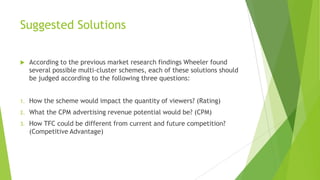
According to the previous market research findings Wheeler found
several possible multi-cluster schemes, each of these solutions should
be judged according to the following three questions:

1.

How the scheme would impact the quantity of viewers? (Rating)

2.

What the CPM advertising revenue potential would be? (CPM)

3.

How TFC could be different from current and future competition?
(Competitive Advantage)
Suggested Solutions


After analyzing the previous results from researches Wheeler found that
(Basic Cluster) is all men, so it would be unwise to target more men viewers,
instead TFC should focus its segmentation and positioning on women,
particularly between the ages 18-to-34.



Since that segment (women aged 18 to 34) were included in all of the
clusters, she found three segments that should be targeted.

1)

Board appeal to a cross segment of: Fashionistas, Planner & Shoppers and
Situationalists.
2)
3)

Single segment approach: Fashionistas

Two segment approach: Fashionistas and Planner & Shoppers
Segment 1
Fashionistas, Planner & Shoppers and Situationalists



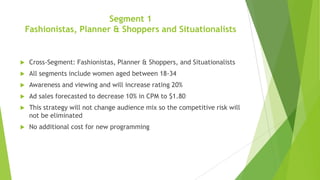
Cross-Segment: Fashionistas, Planner & Shoppers, and Situationalists



All segments include women aged between 18-34



Awareness and viewing and will increase rating 20%



Ad sales forecasted to decrease 10% in CPM to $1.80



This strategy will not change audience mix so the competitive risk will
not be eliminated



No additional cost for new programming
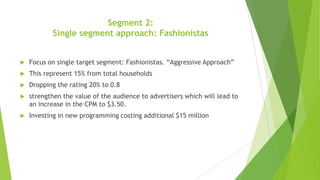
Segment 2:
Single segment approach: Fashionistas


Focus on single target segment: Fashionistas. “Aggressive Approach”



This represent 15% from total households



Dropping the rating 20% to 0.8



strengthen the value of the audience to advertisers which will lead to
an increase in the CPM to $3.50.



Investing in new programming costing additional $15 million
Segment 3
Fashionistas and Planner & Shoppers


Dual targeting segment: Fashionistas and Planner & Shoppers



Driving rating to 1.2



Increasing CPM Ad price to $2.50



Investing in new programming costing additional $20 million
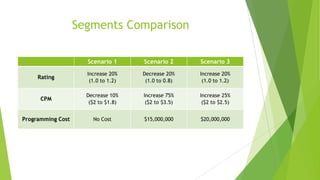
Segments Comparison
Scenario 1

Scenario 2

Scenario 3

Rating

Increase 20%
(1.0 to 1.2)

Decrease 20%
(1.0 to 0.8)

Increase 20%
(1.0 to 1.2)

CPM

Decrease 10%
($2 to $1.8)

Increase 75%
($2 to $3.5)

Increase 25%
($2 to $2.5)

Programming Cost

No Cost

$15,000,000

$20,000,000
Financial Analysis


Wheeler knew that her recommendations should show how her plan would
increase TFC revenue and also quantify risks if the plan was unsuccessful.



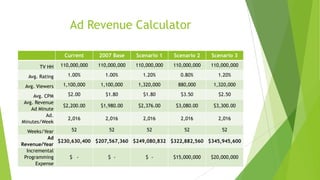
She created a revenue calculator spreadsheet to calculate the impact of
Ratings and CPM increases on potential TFC Ad revenues.



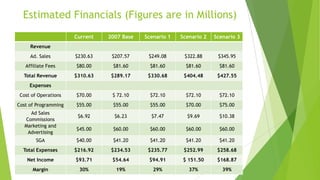
Also conducted a Financial Calculator, to see what different impacts these
segments have on the net income of TFC.



The next slides will show the calculations and impacts of each scenario.
Ad Revenue Calculator
Current
TV HH
Avg. Rating
Avg. Viewers

Avg. CPM
Avg. Revenue
Ad Minute
Ad.
Minutes/Week

2007 Base

Scenario 1

Scenario 2

Scenario 3

110,000,000

110,000,000

110,000,000

110,000,000

110,000,000

1.00%

1.00%

1.20%

0.80%

1.20%

1,100,000

1,100,000

1,320,000

880,000

1,320,000

$2.00

$1.80

$1.80

$3.50

$2.50

$2,200.00

$1,980.00

$2,376.00

$3,080.00

$3,300.00

2,016

2,016

2,016

2,016

2,016

52
52
52
52
52
Weeks/Year
Ad
$230,630,400 $207,567,360 $249,080,832 $322,882,560 $345,945,600
Revenue/Year
Incremental
$ $ $ $15,000,000
$20,000,000
Programming
Expense
Estimated Financials (Figures are in Millions)
Current

2007 Base

Scenario 1

Scenario 2

Scenario 3

Ad. Sales

$230.63

$207.57

$249.08

$322.88

$345.95

Affiliate Fees

$80.00

$81.60

$81.60

$81.60

$81.60

Total Revenue

$310.63

$289.17

$330.68

$404.48

$427.55

Cost of Operations

$70.00

$ 72.10

$72.10

$72.10

$72.10

Cost of Programming

$55.00

$55.00

$55.00

$70.00

$75.00

$6.92

$6.23

$7.47

$9.69

$10.38

$45.00

$60.00

$60.00

$60.00

$60.00

SGA

$40.00

$41.20

$41.20

$41.20

$41.20

Total Expenses

$216.92

$234.53

$235.77

$252.99

$258.68

Net Income

$93.71

$54.64

$94.91

$ 151.50

$168.87

Margin

30%

19%

29%

37%

39%

Revenue

Expenses

Ad Sales
Commissions
Marketing and
Advertising
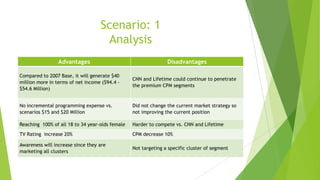
Scenario: 1
Analysis
Advantages

Disadvantages

Compared to 2007 Base, it will generate $40
million more in terms of net income ($94.4 $54.6 Million)

CNN and Lifetime could continue to penetrate
the premium CPM segments

No incremental programming expense vs.
scenarios $15 and $20 Million

Did not change the current market strategy so
not improving the current position

Reaching 100% of all 18 to 34 year-olds female

Harder to compete vs. CNN and Lifetime

TV Rating increase 20%

CPM decrease 10%

Awareness will increase since they are
marketing all clusters

Not targeting a specific cluster of segment
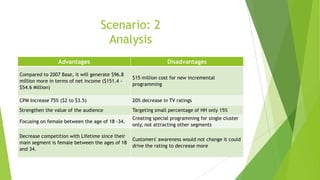
Scenario: 2
Analysis
Advantages

Disadvantages

Compared to 2007 Base, it will generate $96.8
million more in terms of net income ($151.4 $54.6 Million)

$15 million cost for new incremental
programming

CPM Increase 75% ($2 to $3.5)

20% decrease in TV ratings

Strengthen the value of the audience

Targeting small percentage of HH only 15%

Focusing on female between the age of 18 -34.

Creating special programming for single cluster
only, not attracting other segments

Decrease competition with Lifetime since their
main segment is female between the ages of 18
and 34.

Customers' awareness would not change it could
drive the rating to decrease more
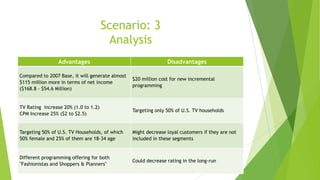
Scenario: 3
Analysis
Advantages

Disadvantages

Compared to 2007 Base, it will generate almost
$115 million more in terms of net income
($168.8 - $54.6 Million)

$20 million cost for new incremental
programming

TV Rating increase 20% (1.0 to 1.2)
CPM Increase 25% ($2 to $2.5)

Targeting only 50% of U.S. TV households

Targeting 50% of U.S. TV Households, of which
50% female and 25% of them are 18-34 age

Might decrease loyal customers if they are not
included in these segments

Different programming offering for both
"Fashionistas and Shoppers & Planners"

Could decrease rating in the long-run
Recommendation and Decision:
Scenario: 3


According to the previous studies and after analyzing market and
financial information we suggest the TFC should apply Scenario 3,
which is: Targeting two segments in the market (Fashionistas and
Planner & Shopper)



This will generate the largest financial return compared to the other
scenarios, also will generate the highest margin



Not Generalized targeting all the market, Not Risky targeting only one
segment



Focusing on specified segments, which will increase the awareness
and improve the competitive position vs. CNN and Lifetime



Improving TFC image with cable operators
THANK YOU FOR YOUR
ATTENTION
ANY QUESTIONS ?

The Fashion Channel

  • 1.
    The Fashion Channel Presentedby: Shiva Chegini Fatima Zahira Mazlan Xing Fei Fei Ammar Al Tayara
  • 2.
    Current Scenario  Dana Wheeler,senior vice president of marketing for The Fashion Channel (TFC)  Preparing recommendations for TFC’s new Segmentation & Positioning Strategy  Strengthen competitive position (spending $60 million)  Attracting new customers with new marketing and advertising approaches  Focusing on revenue stream for TFC when presenting to CEO Jared Thomas at senior management meeting.
  • 3.
    About The FashionChannel  Founded in 1996 as the first TV cable network devoted only to fashion (24/7)  Constant revenue and profit growth above the industry average since the beginning  $310.6 millions as revenue were forecasted for 2006  Niche networks reaching almost 80 million U.S. household  Women between 35 and 54 years are most avid viewers  No details about viewers in general and no attempt to focus on any segment  TFC marketing massage “Fashion for Everyone” trying to achieve highest viewership numbers  Some of board members felt that no need to change. “break something that isn’t broken”  Main competitors: Lifetime and CNN
  • 4.
    Main Sources ofRevenue Generally TFC had two main sources of revenues: 1) Advertising Revenue model:  Target to achieve $230.6 million of revenues generated by advertising.  The adverting business model was based on “Rating” (the % of TV households watching on average during measured viewing period.)  TFC average rating 1.0; with 110 million TV households in U.S. TFC’s average was 1,100,000 viewers at any point of time.  These viewers can be reached via advertising spots (30 or 60 seconds in length.) Total of ads time during one week is 2,016 minutes  Consumers spent about $20 billion buying spots on cable networks  The competition for ad revenue was always fierce among all networks, since there were several hundred cable networks competing for viewers.
  • 5.
    Main Sources ofRevenue 1) Advertising Revenue model: Cont.  TFC should focus on their ratings and demographics, because the ad buyers are interested in them and not interested in specific programming subjects.  Lifetime and CNN offered strong fashion programming blocks “not dedicated fashion channels,” which represented a double-edged competitive challenge  If Lifetime and CNN were successful that would attract more networks to copy their concept.  The advertising pricing is expressed as CPM (Cost Per thousand.)
  • 6.
    Main Sources ofRevenue 1) Advertising Revenue Module: Cont.  CPM (Cost Per Thousand)  Audience characteristics:   Ratings   General competitive trends General Competitive Trends Main groups of viewers that advertisers were interested in are:  Men of all ages   Advertising revenue for an individual spot = (Households x Ratings)/1,000 x CPM Women aged between 18-34 TFC Ad Sales team could achieve CPM pricing increase from 25% to 75%.
  • 7.
    Main Sources ofRevenue 2) Cable Affiliate Fees:  Cable affiliate fee revenue stream were expected to generate $80 million in 2006  Most of U.S. households subscribed to cable television through local affiliates, by paying monthly fee for a basic channels and paying extra fee for premium channels  TFC was positioned as a basic channel so most consumers received automatically.  Large Multi-System Operators (MSO) are interested in signing multi-year contracts with networks that specify the fee of the network upon customer subscription
  • 8.
    Main Sources ofRevenue 2) Cable Affiliate Fees:  TFC negotiated average fee of $1.00 per subscriber per year  TFC should maintain their viewership to maintain their fee  TFC was at the low end of the industry range, because of their niche network
  • 9.
    Main Competitors  There aretwo main competitors for TFC in the fashion market. I. II.  Lifetime CNN These 2 competitors achieved notable rating vs. TFC
  • 10.
    Main Competitors  Both competitorshad launched fashion-specific programming blocks  Lifetime attracting younger female demographics  CNN attracting all men segments  Wheeler had to react against these new programs, so she focused on previous research study on customer satisfaction.  This study showed that TFC was facing competitive challenges in its attractiveness to cable affiliates. TFC CNN Lifetime Interest in viewing 3.8 4.3 4.5 Awareness 4.1 4.6 4.5 Perceived Value 3.7 4.1 4.4   The scale used from 1 to 5 (5 is highest possible score)
  • 11.
    Main Competitors  The previousdata was used to by cable operators to determine how much to pay for each network  If network underperformed the average, they will risk being offered in less appealing packages, which will eventually reduce the number of households.
  • 12.
    SWOT Analysis forTFC to obtain new segmentation and positioning strategy STRENGTHS WEAKNESSES TFC was the only dedicated network to fashion 24/7 Most of the management unwilling to change to new strategies CEO wants the change with $60 million in budget Using generalization market strategy “Fashion for Everyone” Dana Wheeler with good experience in advertising Bad position vs. competitors “Low average rating & Low number of HH” OPPORTUNITIES THREATS Finding loyal untargeted segment Lifetime & CNN with new programs attracting more and more viewers Ability to increase rating and Households rating, and increasing profit Viewers may not like new programs, which may lead to drop of TFC out of main cable operators
  • 13.
    Main Problems toSolve for TFC o Improving competitive position vs. Lifetime and CNN o Changing marketing strategies, opportunity for growth o The need to increase rating vs. competitors o Increasing charges from Ad buyers by improving market position strategy
  • 14.
    Market Research Findings  Wheelerwas interested in the most recent consumer research reports, which are mainly 2 reports. 1. Highlights of a national consumer field study  Which is a list of questions about consumers attitudes toward fashion and TFC. 2. Compiling previous results into attitudinal cluster  They run the previous answers through a statistical correlation program to analyze patterns in the way consumers answered.  The report suggested 4 unique groups of viewers: Fashionistas, Planners & Shoppers, Situationalists, and Basics  Segments were varied in size (among the total participants of households.)
  • 15.
    Market Research Findings Highlightsof a national consumer field study Strongly Agree Agree Somewhat Somewhat Strongly Disagree Agree Disagree Disagree Knowing most up to date trends 16% 20% 19% 20% 15% 10% Fashion is interesting 15% 12% 15% 24% 19% 15% Finding best value clothes 14% 25% 20% 20% 15% 6% Spending on special clothes 15% 20% 20% 20% 15% 10% Watching fashion is entertaining 25% 20% 10% 10% 20% 15% TFC favorite channel on cable 15% 10% 20% 16% 16% 23% TFC is best place for fashion information 9% 21% 28% 20% 12% 10%
  • 16.
    Market Research Findings Compilingprevious results into attitudinal cluster Size of Cluster (%HH) Index: Interest in Fashion on TV* Demographic Highlights Cluster Involvement in Fashion Fashionistas Highly engaged in fashion 15% 140 Female: 61% Income: >$100k, 30% Age: 18-34, 50% Planners & Shoppers Participate in fashion on a regular basis 35% 110 Female: 52% Age: 18-34, 25% Situationalists Participate in fashion for specific needs 30% 105 Female: 50% Children in HH: 45% Age: 18-34, 30% Basic Disengaged 20% 50 Female: 45% Male: 55%
  • 17.
    Suggested Solutions  According tothe previous market research findings Wheeler found several possible multi-cluster schemes, each of these solutions should be judged according to the following three questions: 1. How the scheme would impact the quantity of viewers? (Rating) 2. What the CPM advertising revenue potential would be? (CPM) 3. How TFC could be different from current and future competition? (Competitive Advantage)
  • 18.
    Suggested Solutions  After analyzingthe previous results from researches Wheeler found that (Basic Cluster) is all men, so it would be unwise to target more men viewers, instead TFC should focus its segmentation and positioning on women, particularly between the ages 18-to-34.  Since that segment (women aged 18 to 34) were included in all of the clusters, she found three segments that should be targeted. 1) Board appeal to a cross segment of: Fashionistas, Planner & Shoppers and Situationalists. 2) 3) Single segment approach: Fashionistas Two segment approach: Fashionistas and Planner & Shoppers
  • 19.
    Segment 1 Fashionistas, Planner& Shoppers and Situationalists  Cross-Segment: Fashionistas, Planner & Shoppers, and Situationalists  All segments include women aged between 18-34  Awareness and viewing and will increase rating 20%  Ad sales forecasted to decrease 10% in CPM to $1.80  This strategy will not change audience mix so the competitive risk will not be eliminated  No additional cost for new programming
  • 20.
    Segment 2: Single segmentapproach: Fashionistas  Focus on single target segment: Fashionistas. “Aggressive Approach”  This represent 15% from total households  Dropping the rating 20% to 0.8  strengthen the value of the audience to advertisers which will lead to an increase in the CPM to $3.50.  Investing in new programming costing additional $15 million
  • 21.
    Segment 3 Fashionistas andPlanner & Shoppers  Dual targeting segment: Fashionistas and Planner & Shoppers  Driving rating to 1.2  Increasing CPM Ad price to $2.50  Investing in new programming costing additional $20 million
  • 22.
    Segments Comparison Scenario 1 Scenario2 Scenario 3 Rating Increase 20% (1.0 to 1.2) Decrease 20% (1.0 to 0.8) Increase 20% (1.0 to 1.2) CPM Decrease 10% ($2 to $1.8) Increase 75% ($2 to $3.5) Increase 25% ($2 to $2.5) Programming Cost No Cost $15,000,000 $20,000,000
  • 23.
    Financial Analysis  Wheeler knewthat her recommendations should show how her plan would increase TFC revenue and also quantify risks if the plan was unsuccessful.  She created a revenue calculator spreadsheet to calculate the impact of Ratings and CPM increases on potential TFC Ad revenues.  Also conducted a Financial Calculator, to see what different impacts these segments have on the net income of TFC.  The next slides will show the calculations and impacts of each scenario.
  • 24.
    Ad Revenue Calculator Current TVHH Avg. Rating Avg. Viewers Avg. CPM Avg. Revenue Ad Minute Ad. Minutes/Week 2007 Base Scenario 1 Scenario 2 Scenario 3 110,000,000 110,000,000 110,000,000 110,000,000 110,000,000 1.00% 1.00% 1.20% 0.80% 1.20% 1,100,000 1,100,000 1,320,000 880,000 1,320,000 $2.00 $1.80 $1.80 $3.50 $2.50 $2,200.00 $1,980.00 $2,376.00 $3,080.00 $3,300.00 2,016 2,016 2,016 2,016 2,016 52 52 52 52 52 Weeks/Year Ad $230,630,400 $207,567,360 $249,080,832 $322,882,560 $345,945,600 Revenue/Year Incremental $ $ $ $15,000,000 $20,000,000 Programming Expense
  • 25.
    Estimated Financials (Figuresare in Millions) Current 2007 Base Scenario 1 Scenario 2 Scenario 3 Ad. Sales $230.63 $207.57 $249.08 $322.88 $345.95 Affiliate Fees $80.00 $81.60 $81.60 $81.60 $81.60 Total Revenue $310.63 $289.17 $330.68 $404.48 $427.55 Cost of Operations $70.00 $ 72.10 $72.10 $72.10 $72.10 Cost of Programming $55.00 $55.00 $55.00 $70.00 $75.00 $6.92 $6.23 $7.47 $9.69 $10.38 $45.00 $60.00 $60.00 $60.00 $60.00 SGA $40.00 $41.20 $41.20 $41.20 $41.20 Total Expenses $216.92 $234.53 $235.77 $252.99 $258.68 Net Income $93.71 $54.64 $94.91 $ 151.50 $168.87 Margin 30% 19% 29% 37% 39% Revenue Expenses Ad Sales Commissions Marketing and Advertising
  • 26.
    Scenario: 1 Analysis Advantages Disadvantages Compared to2007 Base, it will generate $40 million more in terms of net income ($94.4 $54.6 Million) CNN and Lifetime could continue to penetrate the premium CPM segments No incremental programming expense vs. scenarios $15 and $20 Million Did not change the current market strategy so not improving the current position Reaching 100% of all 18 to 34 year-olds female Harder to compete vs. CNN and Lifetime TV Rating increase 20% CPM decrease 10% Awareness will increase since they are marketing all clusters Not targeting a specific cluster of segment
  • 27.
    Scenario: 2 Analysis Advantages Disadvantages Compared to2007 Base, it will generate $96.8 million more in terms of net income ($151.4 $54.6 Million) $15 million cost for new incremental programming CPM Increase 75% ($2 to $3.5) 20% decrease in TV ratings Strengthen the value of the audience Targeting small percentage of HH only 15% Focusing on female between the age of 18 -34. Creating special programming for single cluster only, not attracting other segments Decrease competition with Lifetime since their main segment is female between the ages of 18 and 34. Customers' awareness would not change it could drive the rating to decrease more
  • 28.
    Scenario: 3 Analysis Advantages Disadvantages Compared to2007 Base, it will generate almost $115 million more in terms of net income ($168.8 - $54.6 Million) $20 million cost for new incremental programming TV Rating increase 20% (1.0 to 1.2) CPM Increase 25% ($2 to $2.5) Targeting only 50% of U.S. TV households Targeting 50% of U.S. TV Households, of which 50% female and 25% of them are 18-34 age Might decrease loyal customers if they are not included in these segments Different programming offering for both "Fashionistas and Shoppers & Planners" Could decrease rating in the long-run
  • 29.
    Recommendation and Decision: Scenario:3  According to the previous studies and after analyzing market and financial information we suggest the TFC should apply Scenario 3, which is: Targeting two segments in the market (Fashionistas and Planner & Shopper)  This will generate the largest financial return compared to the other scenarios, also will generate the highest margin  Not Generalized targeting all the market, Not Risky targeting only one segment  Focusing on specified segments, which will increase the awareness and improve the competitive position vs. CNN and Lifetime  Improving TFC image with cable operators
  • 30.
    THANK YOU FORYOUR ATTENTION ANY QUESTIONS ?