

1
INDEX
 Definition



 Example

 How to Develop a Brand Promise





The Company’s Value Proposition
Points of Parity and Differentiation
Brand Attributes
Promise Definition

 How to Deliver Your Brand Promise





Brand proof points
Example
Brand Performance Model
Brand Life Cycle
What’s a Brand Promise?


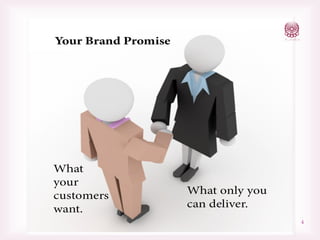
 A brand promise is what the company commits to
the people who interact with it.
 A brand promise is the statement that you make to
customers that identifies what they should expect

for all interactions with your people, products,
services and company. It is often associated with the
company’s name and/or logo.
3


4
It’s not a description of what a company does in a literal
sense. It’s a description of the company’s character. To
some extent, it’s a mission; it’s how the company creates
and delivers value. Also, it’s the feeling the company
conveys to its stakeholders. Two restaurants, for example,
may

have

similar

menus,

but

provide

different

atmospheres, different associations, and different customer
experiences based on their brand promises.
5
To Illustrate, Here are the Brand Promises from
Three Highly Successful, World-Wide Brands:



 The NFL(NATIONAL FOOTBALL LEAGUE):

 “To be the premier sports and entertainment
brand that brings people together, connecting

them socially and emotionally like no other.”

6
Coca-Cola:
 “To inspire moments of optimism and uplift.”



7
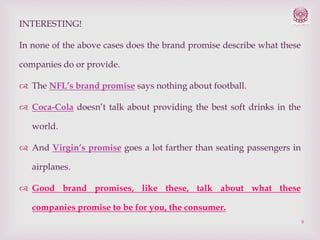
Virgin:
 “To be genuine, fun, contemporary, and
different in everything we do at a reasonable
price.”



8
INTERESTING!
In none of the above cases does the brand promise describe what these
companies do or provide.
 The NFL’s brand promise says nothing about football.
 Coca-Cola doesn’t talk about providing the best soft drinks in the
world.
 And Virgin’s promise goes a lot farther than seating passengers in
airplanes.
 Good brand promises, like these, talk about what these
companies promise to be for you, the consumer.
9
How to Develop a Brand Promise



 A company needs to answer these four questions to begin
developing a brand promise:
1.

What is the value proposition of the company to its
constituents?

2.

What are the points of parity and differentiation between
the company and its competition?

3.

What are the attributes (the values/beliefs) of the
company’s brand?

4.

What, then, is the company’s brand promise?
10
The Company’s Value Proposition


 Companies should not fall into describing what the
organization does.
 They need to consider the benefits they provide,
preferably from the viewpoint of the stakeholders.
 For example, your company may provide 24-7
customer service, but what does that mean to the
customer? What’s the specific benefit of that to
them?
11
 Companies need to remember that “stakeholders”
includes every entity that interacts with the
corporation—not just clients and customers.
 Stakeholders can include employees, vendors,
shareholders, and even government entities,
depending upon the business.

The Company’s Value Proposition

12
Points of Parity and Differentiation



 Sometimes the quickest way to determine what a
company is, is to determine what it is not, compared to
similar companies or competitors.
 how is the company in question different?

 What does the company not offer that its competition does?
And vice versa.
 What feel or character does the company offer—or not
offer—in
comparison
with
its
competition?
 Example: Gymnastics
13
Brand Attributes



 Are the values and beliefs that their brands represent.
 Describe how the brand delivers on its promise.
 Do not describe the company’s actual products or
services.
 For example Coca-Cola’s brand values say nothing about
quality drink development!
Coca-Cola: Simple pleasures, optimism, happiness,
human connections/bringing people together
14
Promise Definition



 The brand promise should never be a description of the
products or services the company offers.
 A brand promise describes how people should feel when
they interact with the brand, how the company provides
its products/services, and what sort of character the
company has.
 A brand promise is a short phrase, not a paragraph, and
is relevant to all aspects of the organization.
 Example: NFL
How to Deliver Your Brand Promise


 Strong brands possess credible,
distinctive brand promises.

relevant

and

 Social media has become a zillion-channel place
where anyone can express their opinion about your
brand.
 So, how can you deal with this? The answer is
simple: with trust.
16
Brand Proof Points


 The brand proof should at least be equal to the brand
promise to avoid disappointing the customer (Smith,
2011).
 To prove the brand promise, customers have to
experience the brand promise through all the
different channels:
 The telephone, in all the stores/locations, on the website
and in face-to-face contact, etc.
17
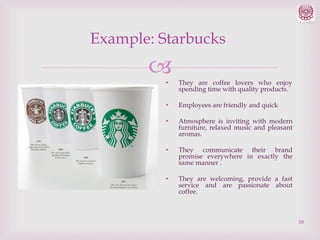
Example: Starbucks


•

They are coffee lovers who enjoy
spending time with quality products.

•

Employees are friendly and quick

•

Atmosphere is inviting with modern
furniture, relaxed music and pleasant
aromas.

•

They communicate their brand
promise everywhere in exactly the
same manner .

•

They are welcoming, provide a fast
service and are passionate about
coffee.

18
Brand Performance Model


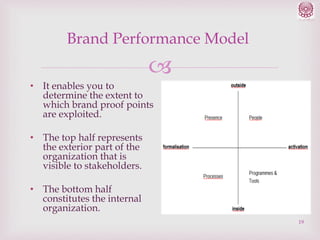
• It enables you to
determine the extent to
which brand proof points
are exploited.
• The top half represents
the exterior part of the
organization that is
visible to stakeholders.
• The bottom half
constitutes the internal
organization.
19
 ‘Presence’ is the presentation of the brand in all
expressions.
 When the presence fits with the brand, this helps
prove the brand promise.

 ‘People’ are the people who represent the brand,
usually the employees with whom customers
communicate.

Brand Performance Model

20
 ‘Processes’ are the procedures within the organization
that contribute to the applied consistency of the
brand.
 ‘Programmes & Tools’ are all the resources that are
used to provide employees with the opportunity to
apply the brand consistently through their
knowledge as well as their attitude and behavior
towards customers.

Brand Performance Model

21
 The four dimensions of the Brand Performance
Model interrelate.
 This means that when organizations have problems
with their internal organization, these will be noticed
and experienced by people outside the organization.

Brand Performance Model

22
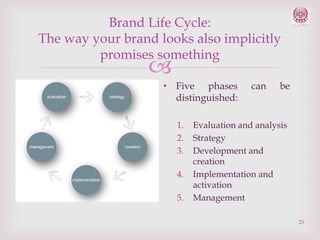
Brand Life Cycle:
The way your brand looks also implicitly
promises something



• Five phases
distinguished:
1.
2.
3.
4.
5.

can

be

Evaluation and analysis
Strategy
Development and
creation
Implementation and
activation
Management
23
Evaluation and analysis


 Monitoring how the brand performs, both internally and
externally.
 Some evaluations might lead to significant changes within
the brand, resulting in a change to the corporate visual
identity and/or brand name. This is called a rebranding.
 In these circumstances, the brand evaluation acts as a
platform for the development of a new or adjusted
organizational strategy, positioning of the brand or brand
promise
Brand Life Cycle

24
Strategy


 The organizational strategy is translated into a brand
strategy: here, the mission, vision and core values are
transformed into a clear and relevant positioning of
the brand or brand promise.
 It is vital that an organization only chooses brand
promises that it can actually keep. A beautiful brand
promise is worthless if it is not fulfilled.

Brand Life Cycle

25
Development and creation


 Here the brand promise is translated for the brand
proof points. Programs must be developed to
involve both employees and external stakeholders in
the creation of a new brand strategy.

 All forms of communication should be tailored to the
new promise, and the visual identity must be
adjusted or developed. The products and services
provided by the organization must be adapted to the
new brand promise.
Brand Life Cycle

26
Implementation and activation


 Here the design and programs developed are
implemented at each of the brand proof points.
 The introduction of a new or adjusted brand often
brings a lot of tension and uncertainty to an
organization. Internal acceptance of the new brand
is, therefore, one of the biggest challenges during a
rebranding .

Brand Life Cycle

27
 The greater the change, the larger the impact will be
on internal resistance.
 Therefore adequate communication before, during
and after the rebranding is crucial to the success of
the brand.

Brand Life Cycle Implementation And Activation

28
Management


 Proving the brand promise every day demands
organizational skills and coordination between the
front (presence and people) and the back (processes
and programmes) of an organization.

 This phase is therefore a continuous one in which the
brand is carefully managed at all the brand proof
points. This requires that the processes in an
organization connect perfectly with the brand
promise.
Brand Life Cycle

29
Conclusion



 The Brand Life Cycle is a proven model for a modern
brand management approach, across all channels.
 The Brand Performance Model is the perfect model for
checking annually whether you are still on or off track
with your brand management.
 The success of a brand does not rest solely with the
credibility, relevance and distinctiveness of the brand
promise, but also, and even more so, with the way in
which this promise is embedded in the entire
organization.
30
31

Brand promise 3

  • 1.
  • 2.
    INDEX  Definition   Example How to Develop a Brand Promise     The Company’s Value Proposition Points of Parity and Differentiation Brand Attributes Promise Definition  How to Deliver Your Brand Promise     Brand proof points Example Brand Performance Model Brand Life Cycle
  • 3.
    What’s a BrandPromise?   A brand promise is what the company commits to the people who interact with it.  A brand promise is the statement that you make to customers that identifies what they should expect for all interactions with your people, products, services and company. It is often associated with the company’s name and/or logo. 3
  • 4.
  • 5.
    It’s not adescription of what a company does in a literal sense. It’s a description of the company’s character. To some extent, it’s a mission; it’s how the company creates and delivers value. Also, it’s the feeling the company conveys to its stakeholders. Two restaurants, for example, may have similar menus, but provide different atmospheres, different associations, and different customer experiences based on their brand promises. 5
  • 6.
    To Illustrate, Hereare the Brand Promises from Three Highly Successful, World-Wide Brands:   The NFL(NATIONAL FOOTBALL LEAGUE):  “To be the premier sports and entertainment brand that brings people together, connecting them socially and emotionally like no other.” 6
  • 7.
    Coca-Cola:  “To inspiremoments of optimism and uplift.”  7
  • 8.
    Virgin:  “To begenuine, fun, contemporary, and different in everything we do at a reasonable price.”  8
  • 9.
    INTERESTING! In none ofthe above cases does the brand promise describe what these companies do or provide.  The NFL’s brand promise says nothing about football.  Coca-Cola doesn’t talk about providing the best soft drinks in the world.  And Virgin’s promise goes a lot farther than seating passengers in airplanes.  Good brand promises, like these, talk about what these companies promise to be for you, the consumer. 9
  • 10.
    How to Developa Brand Promise   A company needs to answer these four questions to begin developing a brand promise: 1. What is the value proposition of the company to its constituents? 2. What are the points of parity and differentiation between the company and its competition? 3. What are the attributes (the values/beliefs) of the company’s brand? 4. What, then, is the company’s brand promise? 10
  • 11.
    The Company’s ValueProposition   Companies should not fall into describing what the organization does.  They need to consider the benefits they provide, preferably from the viewpoint of the stakeholders.  For example, your company may provide 24-7 customer service, but what does that mean to the customer? What’s the specific benefit of that to them? 11
  • 12.
     Companies needto remember that “stakeholders” includes every entity that interacts with the corporation—not just clients and customers.  Stakeholders can include employees, vendors, shareholders, and even government entities, depending upon the business. The Company’s Value Proposition 12
  • 13.
    Points of Parityand Differentiation   Sometimes the quickest way to determine what a company is, is to determine what it is not, compared to similar companies or competitors.  how is the company in question different?  What does the company not offer that its competition does? And vice versa.  What feel or character does the company offer—or not offer—in comparison with its competition?  Example: Gymnastics 13
  • 14.
    Brand Attributes   Arethe values and beliefs that their brands represent.  Describe how the brand delivers on its promise.  Do not describe the company’s actual products or services.  For example Coca-Cola’s brand values say nothing about quality drink development! Coca-Cola: Simple pleasures, optimism, happiness, human connections/bringing people together 14
  • 15.
    Promise Definition   Thebrand promise should never be a description of the products or services the company offers.  A brand promise describes how people should feel when they interact with the brand, how the company provides its products/services, and what sort of character the company has.  A brand promise is a short phrase, not a paragraph, and is relevant to all aspects of the organization.  Example: NFL
  • 16.
    How to DeliverYour Brand Promise   Strong brands possess credible, distinctive brand promises. relevant and  Social media has become a zillion-channel place where anyone can express their opinion about your brand.  So, how can you deal with this? The answer is simple: with trust. 16
  • 17.
    Brand Proof Points  The brand proof should at least be equal to the brand promise to avoid disappointing the customer (Smith, 2011).  To prove the brand promise, customers have to experience the brand promise through all the different channels:  The telephone, in all the stores/locations, on the website and in face-to-face contact, etc. 17
  • 18.
    Example: Starbucks  • They arecoffee lovers who enjoy spending time with quality products. • Employees are friendly and quick • Atmosphere is inviting with modern furniture, relaxed music and pleasant aromas. • They communicate their brand promise everywhere in exactly the same manner . • They are welcoming, provide a fast service and are passionate about coffee. 18
  • 19.
    Brand Performance Model  •It enables you to determine the extent to which brand proof points are exploited. • The top half represents the exterior part of the organization that is visible to stakeholders. • The bottom half constitutes the internal organization. 19
  • 20.
     ‘Presence’ isthe presentation of the brand in all expressions.  When the presence fits with the brand, this helps prove the brand promise.  ‘People’ are the people who represent the brand, usually the employees with whom customers communicate. Brand Performance Model 20
  • 21.
     ‘Processes’ arethe procedures within the organization that contribute to the applied consistency of the brand.  ‘Programmes & Tools’ are all the resources that are used to provide employees with the opportunity to apply the brand consistently through their knowledge as well as their attitude and behavior towards customers. Brand Performance Model 21
  • 22.
     The fourdimensions of the Brand Performance Model interrelate.  This means that when organizations have problems with their internal organization, these will be noticed and experienced by people outside the organization. Brand Performance Model 22
  • 23.
    Brand Life Cycle: Theway your brand looks also implicitly promises something  • Five phases distinguished: 1. 2. 3. 4. 5. can be Evaluation and analysis Strategy Development and creation Implementation and activation Management 23
  • 24.
    Evaluation and analysis  Monitoring how the brand performs, both internally and externally.  Some evaluations might lead to significant changes within the brand, resulting in a change to the corporate visual identity and/or brand name. This is called a rebranding.  In these circumstances, the brand evaluation acts as a platform for the development of a new or adjusted organizational strategy, positioning of the brand or brand promise Brand Life Cycle 24
  • 25.
    Strategy   The organizationalstrategy is translated into a brand strategy: here, the mission, vision and core values are transformed into a clear and relevant positioning of the brand or brand promise.  It is vital that an organization only chooses brand promises that it can actually keep. A beautiful brand promise is worthless if it is not fulfilled. Brand Life Cycle 25
  • 26.
    Development and creation  Here the brand promise is translated for the brand proof points. Programs must be developed to involve both employees and external stakeholders in the creation of a new brand strategy.  All forms of communication should be tailored to the new promise, and the visual identity must be adjusted or developed. The products and services provided by the organization must be adapted to the new brand promise. Brand Life Cycle 26
  • 27.
    Implementation and activation  Here the design and programs developed are implemented at each of the brand proof points.  The introduction of a new or adjusted brand often brings a lot of tension and uncertainty to an organization. Internal acceptance of the new brand is, therefore, one of the biggest challenges during a rebranding . Brand Life Cycle 27
  • 28.
     The greaterthe change, the larger the impact will be on internal resistance.  Therefore adequate communication before, during and after the rebranding is crucial to the success of the brand. Brand Life Cycle Implementation And Activation 28
  • 29.
    Management   Proving thebrand promise every day demands organizational skills and coordination between the front (presence and people) and the back (processes and programmes) of an organization.  This phase is therefore a continuous one in which the brand is carefully managed at all the brand proof points. This requires that the processes in an organization connect perfectly with the brand promise. Brand Life Cycle 29
  • 30.
    Conclusion   The BrandLife Cycle is a proven model for a modern brand management approach, across all channels.  The Brand Performance Model is the perfect model for checking annually whether you are still on or off track with your brand management.  The success of a brand does not rest solely with the credibility, relevance and distinctiveness of the brand promise, but also, and even more so, with the way in which this promise is embedded in the entire organization. 30
  • 31.