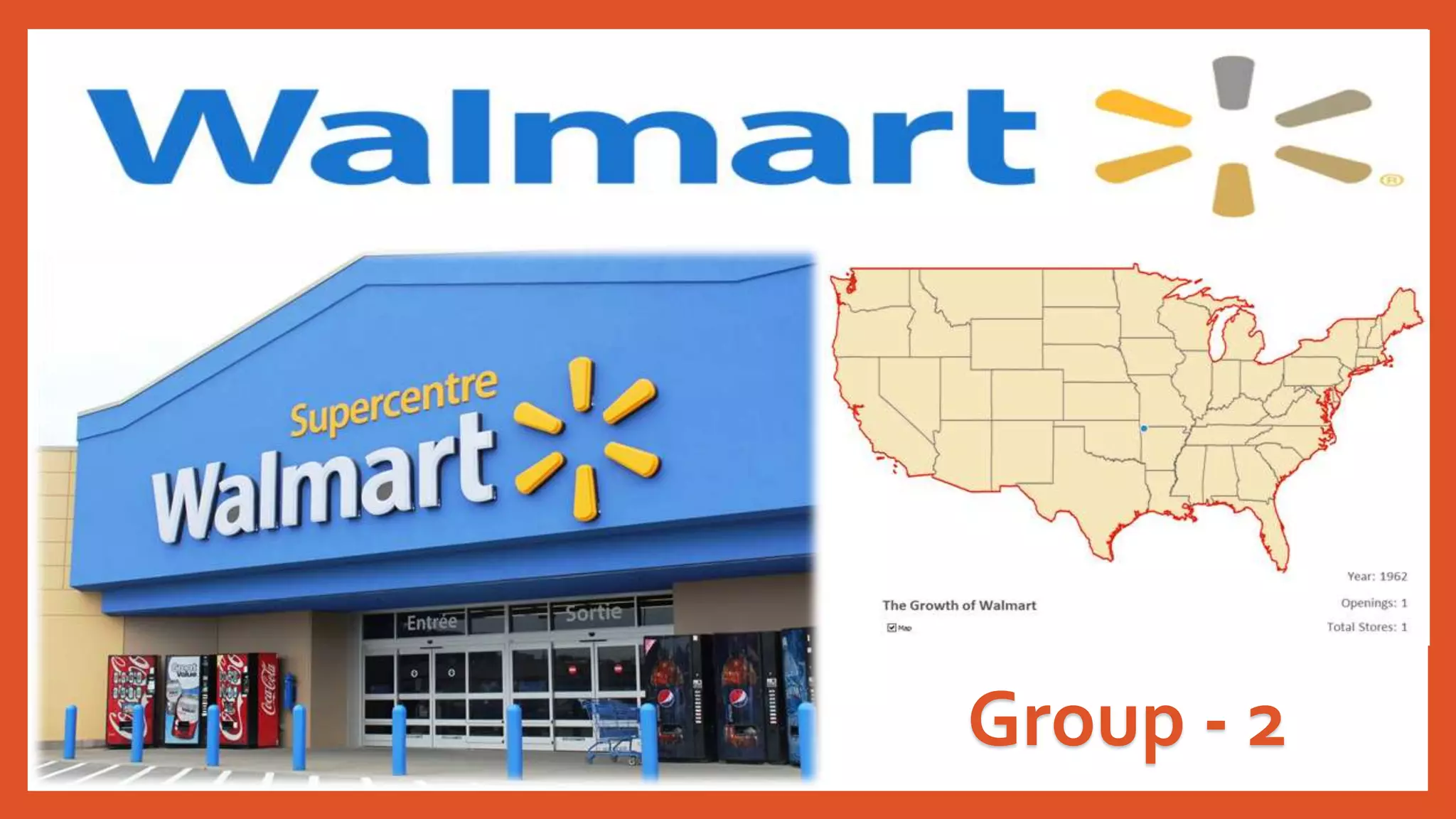
Group - 2
RESOURCES
AND
CAPABILITIES
ANALYSIS
PORTER’S
GENERIC
STRATEGY
PORTER’S FIVE
FORCES
ANALYSIS
PORTER’S
VALUE CHAIN
COMPETITIVE
ADVANTAGES
ANALYSIS
SWOT ANALYSISINTRODUCTION
Introduction
 Wal-Mart store is the second largest discount retailers and largest company (fortune ranked 2003) .
 Wal-Mart HQ in Bentonville (US)
 SamWalton , the founder ofWal-Mart and open the firstWal-Mart in Rogers,Arkansas,1962
 Products:-
 Discount stores
 Super center
 Neighborhood markets.
 Largest private employer in the world.
 No. of stores (2003)
 Discount stores( 1568)
 Supercenters(1258)
 Neighborhood markets(49)
 SAM’s Clubs(525)
 International(1288)
DISCOUNT STORES ,SUPERCENTER MARKET AND NEIGHBORHOOD MARKET
 Discount stores:- discount department stores.
 Supercenter market:- a full line grocery store and specialty departments.
 Neighborhood market:-shop for daily necessary goods.
MAJOR PLAYERS
 Wal-Mart
 K-mart
 Target
Case Synopsis
Wal-Mart has four parts to their corporate strategy-
- Dominance in the retail market
- Expansion in the U.S and international markets
- Creation of positive brand & Company recognition
- Branch out into new sectors of Retail
Wal-Mart’s Supply Chain Management
They started the practice of digitally sharing sales data with
major suppliers, allowing the company to supply the product at
shortest delivery times.
Pricing strategy
Bulk purchasing allows Wal-Mart to negotiate large discounts
with suppliers, achieve economies of scale.
Inventory Management
Warehouse are automatically replenished to optimal levels
through continuous cooperation with suppliers.
Labor Relations
Low salary Payer
Trade union membership is discouraged
Why Wal-Mart So Successful ?
 Low prices ,low expense
 Cut out the middle man and worked directly with manufactures.
 Supply chain management.
 Partnerships with suppliers.
 Locations(small town and rural areas)
 Variety of retail layout.
 Leader in a general IT- Driven transformation of retailing.
 The private satellite network.
STRENGTH
Cost Advantages.
Low Prices
Customer Oriented
Strong Supply Chain
WEAKNESS
Ignore store decoration
High employee turnover
OPPORTUNITY
New location and store type
Overseas Market
Online Sales
THREAT
Competitors Innovations
Intense Price Competition
SWOT
Q. What is the basis for Wal-Mart’s Cost
advantage?
High Volume
•At the end of Fiscal year 2003
world mart operated 4,688
stores.
•Each center serves 150 stores
within a 150 mile radius
•43 Distribution centers
internationally.
•84 distribution centers in
United States.
Cost control
•Cut out the middle man
• Inventory Turnover
• High store volume
•Management techniques
•Exclusion of unions
Wal-Mart has essentially had a low-cost, high volume strategy.
Porter’sValue Chain
Firm Infrastructure:
•High store volume
•No regional HQ
•IT support systems for managerial
decisions.
Human Resource Management:
•Lower wages than competitors
•Less people employed/store
•Higher sales volume / employee
•“Associates”
Support Activities
Technology Development:
•Benchmark of competitors successful
measure
•IT
Electronic Data Interchange (EDI) to
communicate with the supplier.
Procurement:
•High bargaining power with suppliers
•Long period for Account Payables
Support Activities
Inbound Logistics
•Disintermediation
•High bargain power
Operations
•They uniquely operate each store
•Better in-store execution than competitors
Marketing & Sales
•Unbeatable prices
Outbound Logistics
•Wal-Mart Distribution Centers
•Distribution costs 2-3% compared with 4-5%
of competitors
•Inventory Turns (7.6 compared with 6.1 –5.4
from competitors)
Services
•People Greeter
Primary Activities
Q. Has Wal-Mart been able to sustain its
competitive advantage and superior
performance over the years covered in
the case?
Yes, We think that Wal-Mart has been able to sustain its competitive advantage and superior performance.
And we divide it into five distinct competitive advantage-
-Distribution capabilities
-Partnership relationship with suppliers
-Advanced data-mining
-Workforce culture
-EDLP
• Distribution capabilities:
Efficient distribution; e.g. cross-docking, predominance of Walmart’s own distribution centers, and “inside-
out” location strategy.
- Cost savings from lower inventory levels ;Cost-savings can translate into lower prices and more customer
satisfaction
• Partnership relationship with suppliers: Wal-Mart integrates suppliers via IT and treats them well in terms
of pricing; they are more partners than “value takers” .
- Improves supply chain and lowers distribution costs
•Advanced data-mining: Active collection and usage of customer purchase behavior info
-Useful data for suppliers
- Improves customer satisfaction through more accurate forecasting of demand
- Lower costs through reduced inventory and shrinkage
- Improved matching of supply and demand creates superior sales/ sq ft
•Workforce culture: Customer-oriented workforce motivated through generous monetary participation and
belief inWal-Mart culture.
- Good customer service is not compromised by self-service and low cost structure, thereby improving
customer loyalty
- Stores can respond more quickly/ flexibly to changing demand
- Continuous improvement mindset
• EDLP: Maintenance of “every day low prices.
-Improves customer satisfaction through low prices
-Matches volume-driven strategy
- Drives down costs through less advertising
- Steady prices improve stability of supply chain
Q. How can Wal-Mart continue to
sustain its superior performance ?
Porter’s Five Forces Analysis
Industry Rivalry:
High
• The switching
cost was very low.
• Very high fixed
cost.
• Exit Barriers were
very high.
Bargaining Power
of Suppliers: Low
• There were a
number of
suppliersWal-
Mart had.
• Wal-Mart
purchased huge
quantities of
products from its
suppliers.
Bargaining Power
of Buyers: Low
• Most of the
buyers were
individual
customer, they
didn’t have
negotiation
power again such
a large company
• Customers
always made
small purchases
• Very large
customer base
Threat of New
Entrants: Low
• High capital
investment
• Distribution
channel was very
hard to build
• There was no
product
differentiation
Threat of
Substitutes: High
• There was a lot of
competition
among quality
and price.
• Substitutes
performed the
similar function
Porter’s Generic Strategy
COST LEADERSHIP
• Allows to achieve a large scale and an efficient supply
chain.
• Has its own low-cost brands, like GreatValue.
• A unique cost structure that allowsWalmart to
establish the lowest price and achieve competitive
advantage.
• Present in many different industries and market with
efficient distribution channel. (Economies of Scale)
• Very different strategy to imitate by offering a broad
quantity of products at low price as cost incurred to
quite low.
Resources and Capabilities Analysis
S1 - Assess the
main resources
and capabilities
that affect the
company and its
industry.
S2 - Use this 2/2
Matrix to show
the key strengths
and weakness of
the company.
Conclusion
 As a result of Wal-Mart's ever growing size and variety of services they offer, their public affairs department is going to
become more and more important.
 Wal-Mart need to address the public relation issues they are experiencing now as well they can expect in the future.
 Wal-Mart would greatly benefit in taking the lead and increasing the wages for their associates, enhancing the benefits
and providing better healthcare for them as well.
 In order for Wal-Mart to stay at the top of their game and follow the company strategy and achieve their key policy
goals, they need to deal better with their stakeholders and make sure they guard their reputation well.
Wal-Mart Stores in 2003 (HBS Case 9-704-430)

Wal-Mart Stores in 2003 (HBS Case 9-704-430)

  • 1.
  • 2.
  • 3.
    Introduction  Wal-Mart storeis the second largest discount retailers and largest company (fortune ranked 2003) .  Wal-Mart HQ in Bentonville (US)  SamWalton , the founder ofWal-Mart and open the firstWal-Mart in Rogers,Arkansas,1962  Products:-  Discount stores  Super center  Neighborhood markets.  Largest private employer in the world.  No. of stores (2003)  Discount stores( 1568)  Supercenters(1258)  Neighborhood markets(49)  SAM’s Clubs(525)  International(1288)
  • 4.
    DISCOUNT STORES ,SUPERCENTERMARKET AND NEIGHBORHOOD MARKET  Discount stores:- discount department stores.  Supercenter market:- a full line grocery store and specialty departments.  Neighborhood market:-shop for daily necessary goods. MAJOR PLAYERS  Wal-Mart  K-mart  Target
  • 5.
    Case Synopsis Wal-Mart hasfour parts to their corporate strategy- - Dominance in the retail market - Expansion in the U.S and international markets - Creation of positive brand & Company recognition - Branch out into new sectors of Retail
  • 6.
    Wal-Mart’s Supply ChainManagement They started the practice of digitally sharing sales data with major suppliers, allowing the company to supply the product at shortest delivery times. Pricing strategy Bulk purchasing allows Wal-Mart to negotiate large discounts with suppliers, achieve economies of scale.
  • 7.
    Inventory Management Warehouse areautomatically replenished to optimal levels through continuous cooperation with suppliers. Labor Relations Low salary Payer Trade union membership is discouraged
  • 8.
    Why Wal-Mart SoSuccessful ?  Low prices ,low expense  Cut out the middle man and worked directly with manufactures.  Supply chain management.  Partnerships with suppliers.  Locations(small town and rural areas)  Variety of retail layout.  Leader in a general IT- Driven transformation of retailing.  The private satellite network.
  • 9.
    STRENGTH Cost Advantages. Low Prices CustomerOriented Strong Supply Chain WEAKNESS Ignore store decoration High employee turnover OPPORTUNITY New location and store type Overseas Market Online Sales THREAT Competitors Innovations Intense Price Competition SWOT
  • 10.
    Q. What isthe basis for Wal-Mart’s Cost advantage?
  • 11.
    High Volume •At theend of Fiscal year 2003 world mart operated 4,688 stores. •Each center serves 150 stores within a 150 mile radius •43 Distribution centers internationally. •84 distribution centers in United States. Cost control •Cut out the middle man • Inventory Turnover • High store volume •Management techniques •Exclusion of unions Wal-Mart has essentially had a low-cost, high volume strategy.
  • 12.
  • 13.
    Firm Infrastructure: •High storevolume •No regional HQ •IT support systems for managerial decisions. Human Resource Management: •Lower wages than competitors •Less people employed/store •Higher sales volume / employee •“Associates” Support Activities
  • 14.
    Technology Development: •Benchmark ofcompetitors successful measure •IT Electronic Data Interchange (EDI) to communicate with the supplier. Procurement: •High bargaining power with suppliers •Long period for Account Payables Support Activities
  • 15.
    Inbound Logistics •Disintermediation •High bargainpower Operations •They uniquely operate each store •Better in-store execution than competitors Marketing & Sales •Unbeatable prices Outbound Logistics •Wal-Mart Distribution Centers •Distribution costs 2-3% compared with 4-5% of competitors •Inventory Turns (7.6 compared with 6.1 –5.4 from competitors) Services •People Greeter Primary Activities
  • 16.
    Q. Has Wal-Martbeen able to sustain its competitive advantage and superior performance over the years covered in the case?
  • 17.
    Yes, We thinkthat Wal-Mart has been able to sustain its competitive advantage and superior performance. And we divide it into five distinct competitive advantage- -Distribution capabilities -Partnership relationship with suppliers -Advanced data-mining -Workforce culture -EDLP • Distribution capabilities: Efficient distribution; e.g. cross-docking, predominance of Walmart’s own distribution centers, and “inside- out” location strategy. - Cost savings from lower inventory levels ;Cost-savings can translate into lower prices and more customer satisfaction • Partnership relationship with suppliers: Wal-Mart integrates suppliers via IT and treats them well in terms of pricing; they are more partners than “value takers” . - Improves supply chain and lowers distribution costs
  • 18.
    •Advanced data-mining: Activecollection and usage of customer purchase behavior info -Useful data for suppliers - Improves customer satisfaction through more accurate forecasting of demand - Lower costs through reduced inventory and shrinkage - Improved matching of supply and demand creates superior sales/ sq ft •Workforce culture: Customer-oriented workforce motivated through generous monetary participation and belief inWal-Mart culture. - Good customer service is not compromised by self-service and low cost structure, thereby improving customer loyalty - Stores can respond more quickly/ flexibly to changing demand - Continuous improvement mindset • EDLP: Maintenance of “every day low prices. -Improves customer satisfaction through low prices -Matches volume-driven strategy - Drives down costs through less advertising - Steady prices improve stability of supply chain
  • 20.
    Q. How canWal-Mart continue to sustain its superior performance ?
  • 21.
  • 22.
    Industry Rivalry: High • Theswitching cost was very low. • Very high fixed cost. • Exit Barriers were very high. Bargaining Power of Suppliers: Low • There were a number of suppliersWal- Mart had. • Wal-Mart purchased huge quantities of products from its suppliers. Bargaining Power of Buyers: Low • Most of the buyers were individual customer, they didn’t have negotiation power again such a large company • Customers always made small purchases • Very large customer base Threat of New Entrants: Low • High capital investment • Distribution channel was very hard to build • There was no product differentiation Threat of Substitutes: High • There was a lot of competition among quality and price. • Substitutes performed the similar function
  • 23.
  • 24.
    COST LEADERSHIP • Allowsto achieve a large scale and an efficient supply chain. • Has its own low-cost brands, like GreatValue. • A unique cost structure that allowsWalmart to establish the lowest price and achieve competitive advantage. • Present in many different industries and market with efficient distribution channel. (Economies of Scale) • Very different strategy to imitate by offering a broad quantity of products at low price as cost incurred to quite low.
  • 25.
  • 26.
    S1 - Assessthe main resources and capabilities that affect the company and its industry. S2 - Use this 2/2 Matrix to show the key strengths and weakness of the company.
  • 27.
    Conclusion  As aresult of Wal-Mart's ever growing size and variety of services they offer, their public affairs department is going to become more and more important.  Wal-Mart need to address the public relation issues they are experiencing now as well they can expect in the future.  Wal-Mart would greatly benefit in taking the lead and increasing the wages for their associates, enhancing the benefits and providing better healthcare for them as well.  In order for Wal-Mart to stay at the top of their game and follow the company strategy and achieve their key policy goals, they need to deal better with their stakeholders and make sure they guard their reputation well.