

Brand equity is a phrase used in
the marketing industry which describes the value of
having a well-known brand name, based on the idea
that the owner of a well-known brand name can
generate more money from products with that brand
name than from products with a less well known
name, as consumers believe that a product with a
well-known name is better than products with less
well known names.


A brand`s power derived from the goodwill and name
recognition that it has earned over time, which
translates into higher sales volume and higher profit
margins against competing brands.


Positive brand equity can help a company in a variety
of ways. The most common is the financial benefit
which enables a company to charge a price premium
for that brand. For example, the Tiffany’s brand has
enough equity that a price premium isn’t just
accepted, it’s expected.


Positive brand equity can also help to expand a
company through successful brand extensions and
expansions. And not only can brand equity help
increase sales and revenues, but it can also help
reduce costs. For example, there is little need for
awareness promotions for a brand that has deep,
positive equity. Marketing budgets can be more
strategically invested in initiatives that will drive
short-term results.


A company with strong brand equity is also positioned
for long-term success because consumers are more
likely to forgive bumps in the road when they have
deep emotional connections and loyalties to a brand.
Positive brand equity helps a company navigate
through macro-environmental challenges far more
easily than brands with little or negative brand equity
can.


Brand equity is typically the result of brand loyalty, and with
brand loyalty comes increased market share. In fact, there
are 5 stages of brand experience that lead to positive brand
equity:


Brand awareness: Consumers are aware of the brand.



Brand recognition: Consumers recognize the brand and know what it
offers versus competitors.



Brand trial: Consumers have tried the brand.



Brand preference: Consumers like the brand and become repeat
purchasers. They begin to develop emotional connections to the
brand.



Brand loyalty: Consumers demand the brand and will travel distances
to find it. As loyalty increases so do emotional connections until there
is no adequate substitute for the brand in the consumer’s mind.


Once consumers reach the brand loyalty stage, your
work isn’t done. The challenge is not only building
brand equity to reach widespread loyalty, but also to
sustain that loyalty and positive brand equity for
years to come.


The purpose of brand equity metrics is to
measure the value of a brand. A brand
encompasses the name, logo, image, and
perceptions that identify a product, service, or
provider in the minds of customers.



It takes shape in advertising, packaging, and
other marketing communications, and becomes a
focus of the relationship with consumers.



In time, a brand comes to embody a promise
about the goods it identifies—a promise about
quality, performance, or other dimensions of
value, which can influence consumers' choices
among competing products.
 There

are many ways to measure a brand.
Some measurements approaches are at the
firm level, some at the product level, and
still others are at the consumer level.
Firm Level: Firm level approaches measure 
the brand as a financial asset. In short, a
calculation is made regarding how much the
brand is worth as an intangible asset. For
example, if you were to take the value of the
firm, as derived by its market capitalization—
and then subtract tangible assets and
"measurable" intangible assets—the residual
would be the brand equity.
 Product

Level: The classic product level
brand measurement example is to compare
the price of a no-name or private label
product to an "equivalent" branded product.
 Consumer

Level: This approach seeks to map
the mind of the consumer to find out what
associations with the brand the consumer
has. This approach seeks to measure the
awareness (recall and recognition) and brand
image (the overall associations that the
brand has).


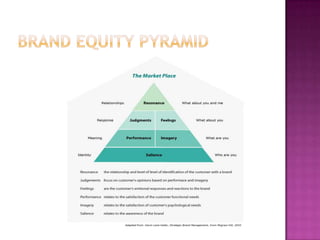
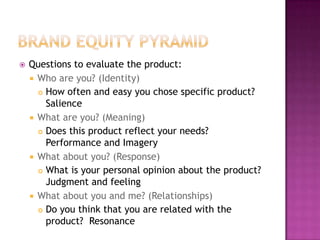
Questions to evaluate the product:
 Who are you? (Identity)
 How often and easy you chose specific product?
Salience
 What are you? (Meaning)
 Does this product reflect your needs?
Performance and Imagery
 What about you? (Response)
 What is your personal opinion about the product?
Judgment and feeling
 What about you and me? (Relationships)
 Do you think that you are related with the
product? Resonance
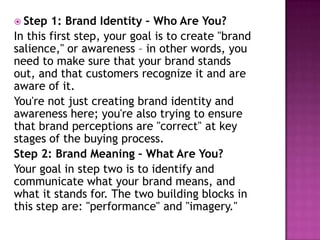
 Step

1: Brand Identity – Who Are You?
In this first step, your goal is to create "brand
salience," or awareness – in other words, you
need to make sure that your brand stands
out, and that customers recognize it and are
aware of it.
You're not just creating brand identity and
awareness here; you're also trying to ensure
that brand perceptions are "correct" at key
stages of the buying process.
Step 2: Brand Meaning – What Are You?
Your goal in step two is to identify and
communicate what your brand means, and
what it stands for. The two building blocks in
this step are: "performance" and "imagery."
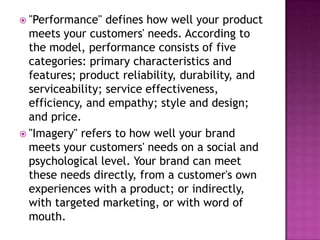
 "Performance"

defines how well your product
meets your customers' needs. According to
the model, performance consists of five
categories: primary characteristics and
features; product reliability, durability, and
serviceability; service effectiveness,
efficiency, and empathy; style and design;
and price.
 "Imagery" refers to how well your brand
meets your customers' needs on a social and
psychological level. Your brand can meet
these needs directly, from a customer's own
experiences with a product; or indirectly,
with targeted marketing, or with word of
mouth.
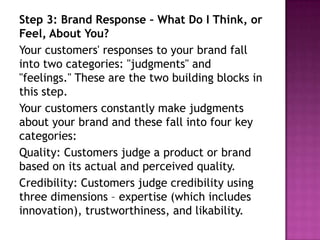
Step 3: Brand Response – What Do I Think, or
Feel, About You?
Your customers' responses to your brand fall
into two categories: "judgments" and
"feelings." These are the two building blocks in
this step.
Your customers constantly make judgments
about your brand and these fall into four key
categories:
Quality: Customers judge a product or brand
based on its actual and perceived quality.
Credibility: Customers judge credibility using
three dimensions – expertise (which includes
innovation), trustworthiness, and likability.
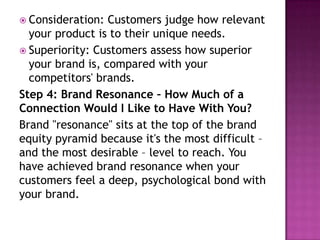
 Consideration:

Customers judge how relevant
your product is to their unique needs.
 Superiority: Customers assess how superior
your brand is, compared with your
competitors' brands.
Step 4: Brand Resonance – How Much of a
Connection Would I Like to Have With You?
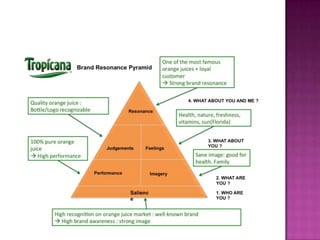
Brand "resonance" sits at the top of the brand
equity pyramid because it's the most difficult –
and the most desirable – level to reach. You
have achieved brand resonance when your
customers feel a deep, psychological bond with
your brand.
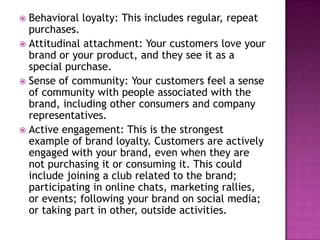
Behavioral loyalty: This includes regular, repeat
purchases.
 Attitudinal attachment: Your customers love your
brand or your product, and they see it as a
special purchase.
 Sense of community: Your customers feel a sense
of community with people associated with the
brand, including other consumers and company
representatives.
 Active engagement: This is the strongest
example of brand loyalty. Customers are actively
engaged with your brand, even when they are
not purchasing it or consuming it. This could
include joining a club related to the brand;
participating in online chats, marketing rallies,
or events; following your brand on social media;
or taking part in other, outside activities.


Brand equity model2

  • 1.
     Brand equity isa phrase used in the marketing industry which describes the value of having a well-known brand name, based on the idea that the owner of a well-known brand name can generate more money from products with that brand name than from products with a less well known name, as consumers believe that a product with a well-known name is better than products with less well known names.
  • 2.
     A brand`s powerderived from the goodwill and name recognition that it has earned over time, which translates into higher sales volume and higher profit margins against competing brands.
  • 3.
     Positive brand equitycan help a company in a variety of ways. The most common is the financial benefit which enables a company to charge a price premium for that brand. For example, the Tiffany’s brand has enough equity that a price premium isn’t just accepted, it’s expected.
  • 4.
     Positive brand equitycan also help to expand a company through successful brand extensions and expansions. And not only can brand equity help increase sales and revenues, but it can also help reduce costs. For example, there is little need for awareness promotions for a brand that has deep, positive equity. Marketing budgets can be more strategically invested in initiatives that will drive short-term results.
  • 5.
     A company withstrong brand equity is also positioned for long-term success because consumers are more likely to forgive bumps in the road when they have deep emotional connections and loyalties to a brand. Positive brand equity helps a company navigate through macro-environmental challenges far more easily than brands with little or negative brand equity can.
  • 6.
     Brand equity istypically the result of brand loyalty, and with brand loyalty comes increased market share. In fact, there are 5 stages of brand experience that lead to positive brand equity:  Brand awareness: Consumers are aware of the brand.  Brand recognition: Consumers recognize the brand and know what it offers versus competitors.  Brand trial: Consumers have tried the brand.  Brand preference: Consumers like the brand and become repeat purchasers. They begin to develop emotional connections to the brand.  Brand loyalty: Consumers demand the brand and will travel distances to find it. As loyalty increases so do emotional connections until there is no adequate substitute for the brand in the consumer’s mind.
  • 7.
     Once consumers reachthe brand loyalty stage, your work isn’t done. The challenge is not only building brand equity to reach widespread loyalty, but also to sustain that loyalty and positive brand equity for years to come.
  • 8.
     The purpose ofbrand equity metrics is to measure the value of a brand. A brand encompasses the name, logo, image, and perceptions that identify a product, service, or provider in the minds of customers.  It takes shape in advertising, packaging, and other marketing communications, and becomes a focus of the relationship with consumers.  In time, a brand comes to embody a promise about the goods it identifies—a promise about quality, performance, or other dimensions of value, which can influence consumers' choices among competing products.
  • 9.
     There are manyways to measure a brand. Some measurements approaches are at the firm level, some at the product level, and still others are at the consumer level.
  • 10.
    Firm Level: Firmlevel approaches measure  the brand as a financial asset. In short, a calculation is made regarding how much the brand is worth as an intangible asset. For example, if you were to take the value of the firm, as derived by its market capitalization— and then subtract tangible assets and "measurable" intangible assets—the residual would be the brand equity.
  • 11.
     Product Level: Theclassic product level brand measurement example is to compare the price of a no-name or private label product to an "equivalent" branded product.
  • 12.
     Consumer Level: Thisapproach seeks to map the mind of the consumer to find out what associations with the brand the consumer has. This approach seeks to measure the awareness (recall and recognition) and brand image (the overall associations that the brand has).
  • 14.
     Questions to evaluatethe product:  Who are you? (Identity)  How often and easy you chose specific product? Salience  What are you? (Meaning)  Does this product reflect your needs? Performance and Imagery  What about you? (Response)  What is your personal opinion about the product? Judgment and feeling  What about you and me? (Relationships)  Do you think that you are related with the product? Resonance
  • 16.
     Step 1: BrandIdentity – Who Are You? In this first step, your goal is to create "brand salience," or awareness – in other words, you need to make sure that your brand stands out, and that customers recognize it and are aware of it. You're not just creating brand identity and awareness here; you're also trying to ensure that brand perceptions are "correct" at key stages of the buying process. Step 2: Brand Meaning – What Are You? Your goal in step two is to identify and communicate what your brand means, and what it stands for. The two building blocks in this step are: "performance" and "imagery."
  • 17.
     "Performance" defines howwell your product meets your customers' needs. According to the model, performance consists of five categories: primary characteristics and features; product reliability, durability, and serviceability; service effectiveness, efficiency, and empathy; style and design; and price.  "Imagery" refers to how well your brand meets your customers' needs on a social and psychological level. Your brand can meet these needs directly, from a customer's own experiences with a product; or indirectly, with targeted marketing, or with word of mouth.
  • 18.
    Step 3: BrandResponse – What Do I Think, or Feel, About You? Your customers' responses to your brand fall into two categories: "judgments" and "feelings." These are the two building blocks in this step. Your customers constantly make judgments about your brand and these fall into four key categories: Quality: Customers judge a product or brand based on its actual and perceived quality. Credibility: Customers judge credibility using three dimensions – expertise (which includes innovation), trustworthiness, and likability.
  • 19.
     Consideration: Customers judgehow relevant your product is to their unique needs.  Superiority: Customers assess how superior your brand is, compared with your competitors' brands. Step 4: Brand Resonance – How Much of a Connection Would I Like to Have With You? Brand "resonance" sits at the top of the brand equity pyramid because it's the most difficult – and the most desirable – level to reach. You have achieved brand resonance when your customers feel a deep, psychological bond with your brand.
  • 20.
    Behavioral loyalty: Thisincludes regular, repeat purchases.  Attitudinal attachment: Your customers love your brand or your product, and they see it as a special purchase.  Sense of community: Your customers feel a sense of community with people associated with the brand, including other consumers and company representatives.  Active engagement: This is the strongest example of brand loyalty. Customers are actively engaged with your brand, even when they are not purchasing it or consuming it. This could include joining a club related to the brand; participating in online chats, marketing rallies, or events; following your brand on social media; or taking part in other, outside activities. 