(Imperial Tobacco Company)
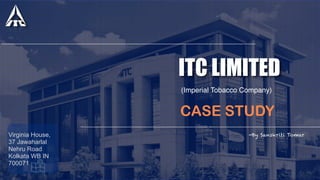
ITC LIMITED
CASE STUDY
Virginia House,
37 Jawaharlal
Nehru Road
Kolkata WB IN
700071
-By Sanskriti Tomar
Organisation Profile
01
Business Overview
02
Micro Environment Analysis
05
SWOT Analysis
06
Table of contents
Product/Service Portfolio
03
PESTLE Analysis
04
07 08 09
Problem / Solution Bibliography
Conclusion
Mission and Vision
statement
To enhance the wealth
generating capability of the
enterprise in a globalising
environment, delivering
superior and sustainable
stakeholder value.
Sustain ITCs position as one of
India s most valuable
corporations through world class
performance, creating growing
value for the Indian economy and
the Company s stakeholders
MISSION
VISION
02 Business Overview
Year of establishment : 1910
ITC Founder : British owned company registered in Kolkata
Number of Employees (2022): 23,829
Type: Public
Category: Consumer Products, Hotel and Services
Sector : FMCG
Annual Revenue (FY2022): ₹ 90,104 crore
Profit | Net income (FY 2021): ₹ 15,058 crore
Number of countries present in : 90 countries & 60 Locations in
India
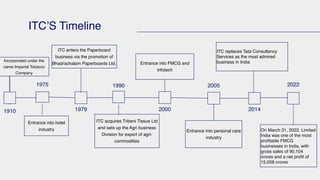
Incorporated under the
name Imperial Tobacco
Company
Entrance into hotel
industry
Entrance into FMCG and
infotech
Entrance into personal care
industry
ITC’S Timeline
1910
1975 2005 2022
ITC enters the Paperboard
business via the promotion of
Bhadrachalam Paperboards Ltd.
1979
1990
ITC acquires Tribeni Tissue Ltd
and sets up the Agri business
Division for export of agri-
commodities
2000
ITC replaces Tata Consultancy
Services as the most admired
business in India
2014
On March 31, 2022, Limited
India was one of the most
pro
fi
table FMCG
businesses in India, with
gross sales of 90,104
crores and a net pro
fi
t of
15,058 crores
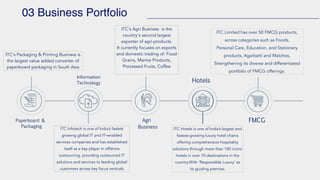
03 Business Portfolio
FMCG
Paperboard &
Packaging
Information
Technology
Agri
Business
Hotels
ITC Limited has over 50 FMCG products,
across categories such as Foods,
ITC's Packaging & Printing Business is
the largest value added converter of
paperboard packaging in South Asia
ITC Infotech is one of India’s fastest
growing global IT and IT–enabled
services companies and has established
itself as a key player in offshore
outsourcing, providing outsourced IT
solutions and services to leading global
customers across key focus verticals
ITC Hotels is one of India’s largest and
fastest-growing luxury hotel chains
offering comprehensive hospitality
solutions through more than 100 iconic
hotels in over 70 destinations in the
country.With ‘Responsible Luxury’ as
its guiding premise,
ITC's Agri Business is the
country's second largest
exporter of agri-products.
It currently focuses on exports
and domestic trading of: Food
Grains, Marine Products,
Processed Fruits, Coffee
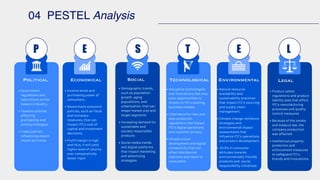
04 PESTEL Analysis
P E S T E L
Political Economical Social
• Government
regulations and
restrictions on the
tobacco industry.
• Taxation policies
affecting
profitability and
pricing strategies.
• Trade policies
influencing export-
import activities.
• Income levels and
purchasing power of
consumers.
• Government economic
policies, such as fiscal
and monetary
measures, that can
impact ITC's cost of
capital and investment
decisions.
• Profit margin is high
and thus, it will yield
higher level of returns
over comparatively
lesser input
• Demographic trends,
such as population
growth, aging
populations, and
urbanisation, that can
shape market size and
target segments
• Increasing demand for
sustainable and
socially responsible
products
• Social media trends
and digital platforms
that impact marketing
and advertising
strategies.
• Disruptive technologies
and innovations that may
pose opportunities or
threats to ITC's existing
business models.
• Cybersecurity risks and
data protection
regulations that impact
ITC's digital operations
and customer privacy.
• Infrastructure
development and digital
connectivity that can
affect distribution
channels and reach to
consumers
Technological
• Natural resource
availability and
sustainability practices
that impact ITC's sourcing
and supply chain
management.
• Climate change resilience
strategies and
environmental impact
assessments that
influence ITC's operations
and product development.
• Shifts in consumer
attitudes towards
environmentally friendly
products and social
responsibility initiatives.
• Product safety
regulations and product
liability laws that affect
ITC's manufacturing
processes and quality
control measures
• Because of the smoke
and tobacco law, the
company production
was affected
• Intellectual property
protection and
enforcement measures
to safeguard ITC's
brands and innovations.
Environmental Legal
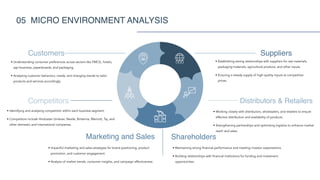
05 MICRO ENVIRONMENT ANALYSIS
Customers
Competitors
Suppliers
Distributors & Retailers
Shareholders
• Understanding consumer preferences across sectors like FMCG, hotels,
agri-business, paperboards, and packaging.
• Analysing customer behaviour, needs, and changing trends to tailor
products and services accordingly.
• Identifying and analysing competition within each business segment.
• Competitors include Hindustan Unilever, Nestle, Britannia, Marriott, Taj, and
other domestic and international companies.
• Establishing strong relationships with suppliers for raw materials,
packaging materials, agricultural produce, and other inputs.
• Ensuring a steady supply of high-quality inputs at competitive
prices.
• Working closely with distributors, wholesalers, and retailers to ensure
effective distribution and availability of products.
• Strengthening partnerships and optimising logistics to enhance market
reach and sales.
• Maintaining strong financial performance and meeting investor expectations.
• Building relationships with financial institutions for funding and investment
opportunities.
Marketing and Sales
• Impactful marketing and sales strategies for brand positioning, product
promotion, and customer engagement.
• Analysis of market trends, consumer insights, and campaign effectiveness.
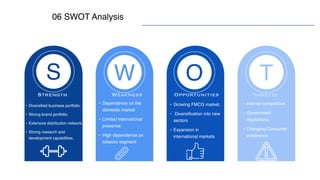
06 SWOT Analysis
O
W
S T
• Diversified business portfolio.
• Strong brand portfolio.
• Extensive distribution network.
• Strong research and
development capabilities.
• Growing FMCG market.
• Diversification into new
sectors
• Expansion in
international markets
• Intense competition.
• Government
regulations.
• Changing Consumer
preference
• Dependence on the
domestic market
• Limited international
presence
• High dependence on
tobacco segment
Strength Weakness Opportunities Threats
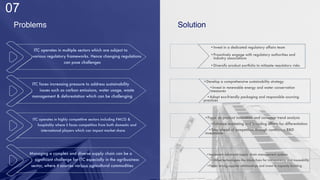
Problems Solution
ITC operates in multiple sectors which are subject to
various regulatory frameworks. Hence changing regulations
can pose challenges
ITC faces increasing pressure to address sustainability
issues such as carbon emissions, water usage, waste
management & deforestation which can be challenging
•Develop a comprehensive sustainability strategy
•Invest in renewable energy and water conservation
measures
•Adopt eco-friendly packaging and responsible sourcing
practices
ITC operates in highly competitive sectors including FMCG &
hospitality where it faces competition from both domestic and
international players which can impact market share
•Invest in a dedicated regulatory affairs team
•Proactively engage with regulatory authorities and
industry associations
•Diversify product portfolio to mitigate regulatory risks
•Focus on product innovation and consumer trend analysis
•Enhance marketing and branding efforts for differentiation
•Stay ahead of competition through continuous R&D
investments
Managing a complex and diverse supply chain can be a
significant challenge for ITC especially in the agribusiness
sector, where it sources various agricultural commodities
•Implement advanced supply chain management systems
•Utilise technologies like blockchain for transparency and traceability
•Foster strong supplier relationships and invest in capacity building
07
—Conclusion
In conclusion, ITC Limited is a resilient and dynamic conglomerate company based in India.
With its diverse portfolio, commitment to sustainability, and strategic investments, ITC has
established itself as a leader in multiple sectors. Through its social initiatives and
community development programs, the company has made a positive impact on society.
Despite challenges in a competitive market, ITC is well-positioned for future growth and
success.
08
Bibliography
ITC Ltd.
www.groww.in
www.itcportal.com
www.bstrategyhub.com
www.ukessays.com
www.mbaskool.com
www.academia.edu.com
www.angelone.in
09

ITC LIMITED CASE STUDY

  • 1.
    (Imperial Tobacco Company) ITCLIMITED CASE STUDY Virginia House, 37 Jawaharlal Nehru Road Kolkata WB IN 700071 -By Sanskriti Tomar
  • 2.
    Organisation Profile 01 Business Overview 02 MicroEnvironment Analysis 05 SWOT Analysis 06 Table of contents Product/Service Portfolio 03 PESTLE Analysis 04 07 08 09 Problem / Solution Bibliography Conclusion
  • 3.
    Mission and Vision statement Toenhance the wealth generating capability of the enterprise in a globalising environment, delivering superior and sustainable stakeholder value. Sustain ITCs position as one of India s most valuable corporations through world class performance, creating growing value for the Indian economy and the Company s stakeholders MISSION VISION
  • 4.
    02 Business Overview Yearof establishment : 1910 ITC Founder : British owned company registered in Kolkata Number of Employees (2022): 23,829 Type: Public Category: Consumer Products, Hotel and Services Sector : FMCG Annual Revenue (FY2022): ₹ 90,104 crore Profit | Net income (FY 2021): ₹ 15,058 crore Number of countries present in : 90 countries & 60 Locations in India
  • 5.
    Incorporated under the nameImperial Tobacco Company Entrance into hotel industry Entrance into FMCG and infotech Entrance into personal care industry ITC’S Timeline 1910 1975 2005 2022 ITC enters the Paperboard business via the promotion of Bhadrachalam Paperboards Ltd. 1979 1990 ITC acquires Tribeni Tissue Ltd and sets up the Agri business Division for export of agri- commodities 2000 ITC replaces Tata Consultancy Services as the most admired business in India 2014 On March 31, 2022, Limited India was one of the most pro fi table FMCG businesses in India, with gross sales of 90,104 crores and a net pro fi t of 15,058 crores
  • 6.
    03 Business Portfolio FMCG Paperboard& Packaging Information Technology Agri Business Hotels ITC Limited has over 50 FMCG products, across categories such as Foods, ITC's Packaging & Printing Business is the largest value added converter of paperboard packaging in South Asia ITC Infotech is one of India’s fastest growing global IT and IT–enabled services companies and has established itself as a key player in offshore outsourcing, providing outsourced IT solutions and services to leading global customers across key focus verticals ITC Hotels is one of India’s largest and fastest-growing luxury hotel chains offering comprehensive hospitality solutions through more than 100 iconic hotels in over 70 destinations in the country.With ‘Responsible Luxury’ as its guiding premise, ITC's Agri Business is the country's second largest exporter of agri-products. It currently focuses on exports and domestic trading of: Food Grains, Marine Products, Processed Fruits, Coffee
  • 7.
    04 PESTEL Analysis PE S T E L Political Economical Social • Government regulations and restrictions on the tobacco industry. • Taxation policies affecting profitability and pricing strategies. • Trade policies influencing export- import activities. • Income levels and purchasing power of consumers. • Government economic policies, such as fiscal and monetary measures, that can impact ITC's cost of capital and investment decisions. • Profit margin is high and thus, it will yield higher level of returns over comparatively lesser input • Demographic trends, such as population growth, aging populations, and urbanisation, that can shape market size and target segments • Increasing demand for sustainable and socially responsible products • Social media trends and digital platforms that impact marketing and advertising strategies. • Disruptive technologies and innovations that may pose opportunities or threats to ITC's existing business models. • Cybersecurity risks and data protection regulations that impact ITC's digital operations and customer privacy. • Infrastructure development and digital connectivity that can affect distribution channels and reach to consumers Technological • Natural resource availability and sustainability practices that impact ITC's sourcing and supply chain management. • Climate change resilience strategies and environmental impact assessments that influence ITC's operations and product development. • Shifts in consumer attitudes towards environmentally friendly products and social responsibility initiatives. • Product safety regulations and product liability laws that affect ITC's manufacturing processes and quality control measures • Because of the smoke and tobacco law, the company production was affected • Intellectual property protection and enforcement measures to safeguard ITC's brands and innovations. Environmental Legal
  • 8.
    05 MICRO ENVIRONMENTANALYSIS Customers Competitors Suppliers Distributors & Retailers Shareholders • Understanding consumer preferences across sectors like FMCG, hotels, agri-business, paperboards, and packaging. • Analysing customer behaviour, needs, and changing trends to tailor products and services accordingly. • Identifying and analysing competition within each business segment. • Competitors include Hindustan Unilever, Nestle, Britannia, Marriott, Taj, and other domestic and international companies. • Establishing strong relationships with suppliers for raw materials, packaging materials, agricultural produce, and other inputs. • Ensuring a steady supply of high-quality inputs at competitive prices. • Working closely with distributors, wholesalers, and retailers to ensure effective distribution and availability of products. • Strengthening partnerships and optimising logistics to enhance market reach and sales. • Maintaining strong financial performance and meeting investor expectations. • Building relationships with financial institutions for funding and investment opportunities. Marketing and Sales • Impactful marketing and sales strategies for brand positioning, product promotion, and customer engagement. • Analysis of market trends, consumer insights, and campaign effectiveness.
  • 9.
    06 SWOT Analysis O W ST • Diversified business portfolio. • Strong brand portfolio. • Extensive distribution network. • Strong research and development capabilities. • Growing FMCG market. • Diversification into new sectors • Expansion in international markets • Intense competition. • Government regulations. • Changing Consumer preference • Dependence on the domestic market • Limited international presence • High dependence on tobacco segment Strength Weakness Opportunities Threats
  • 10.
    Problems Solution ITC operatesin multiple sectors which are subject to various regulatory frameworks. Hence changing regulations can pose challenges ITC faces increasing pressure to address sustainability issues such as carbon emissions, water usage, waste management & deforestation which can be challenging •Develop a comprehensive sustainability strategy •Invest in renewable energy and water conservation measures •Adopt eco-friendly packaging and responsible sourcing practices ITC operates in highly competitive sectors including FMCG & hospitality where it faces competition from both domestic and international players which can impact market share •Invest in a dedicated regulatory affairs team •Proactively engage with regulatory authorities and industry associations •Diversify product portfolio to mitigate regulatory risks •Focus on product innovation and consumer trend analysis •Enhance marketing and branding efforts for differentiation •Stay ahead of competition through continuous R&D investments Managing a complex and diverse supply chain can be a significant challenge for ITC especially in the agribusiness sector, where it sources various agricultural commodities •Implement advanced supply chain management systems •Utilise technologies like blockchain for transparency and traceability •Foster strong supplier relationships and invest in capacity building 07
  • 11.
    —Conclusion In conclusion, ITCLimited is a resilient and dynamic conglomerate company based in India. With its diverse portfolio, commitment to sustainability, and strategic investments, ITC has established itself as a leader in multiple sectors. Through its social initiatives and community development programs, the company has made a positive impact on society. Despite challenges in a competitive market, ITC is well-positioned for future growth and success. 08
  • 12.