Aquinas College Economics Department
Inflation & Deflation
How its calculated, the causes,
consequences, and the scary
situation that is deflation
ECON4
Aquinas College Economics Department
Definitions
Inflation: a sustained increase in the general price level
Deflation: a fall in the general price level
CPI – Consumer Price Index
Aquinas College Economics Department
Inflation
A sustained increase in the price level
Normally measured in the UK through the
Consumer Price Index.
UK government target for inflation is 2%
This target has an limit of +/- 1% as it can be
difficult to bring inflation under control
Aquinas College Economics Department
Consumer Price Index
Measure of UK Inflation
Measures the prices of a basket of goods
Goods are weighted so it can reflect changes in
spending
Information from the Family Expenditure Survey
gives the information about spending paterns
Aquinas College Economics Department
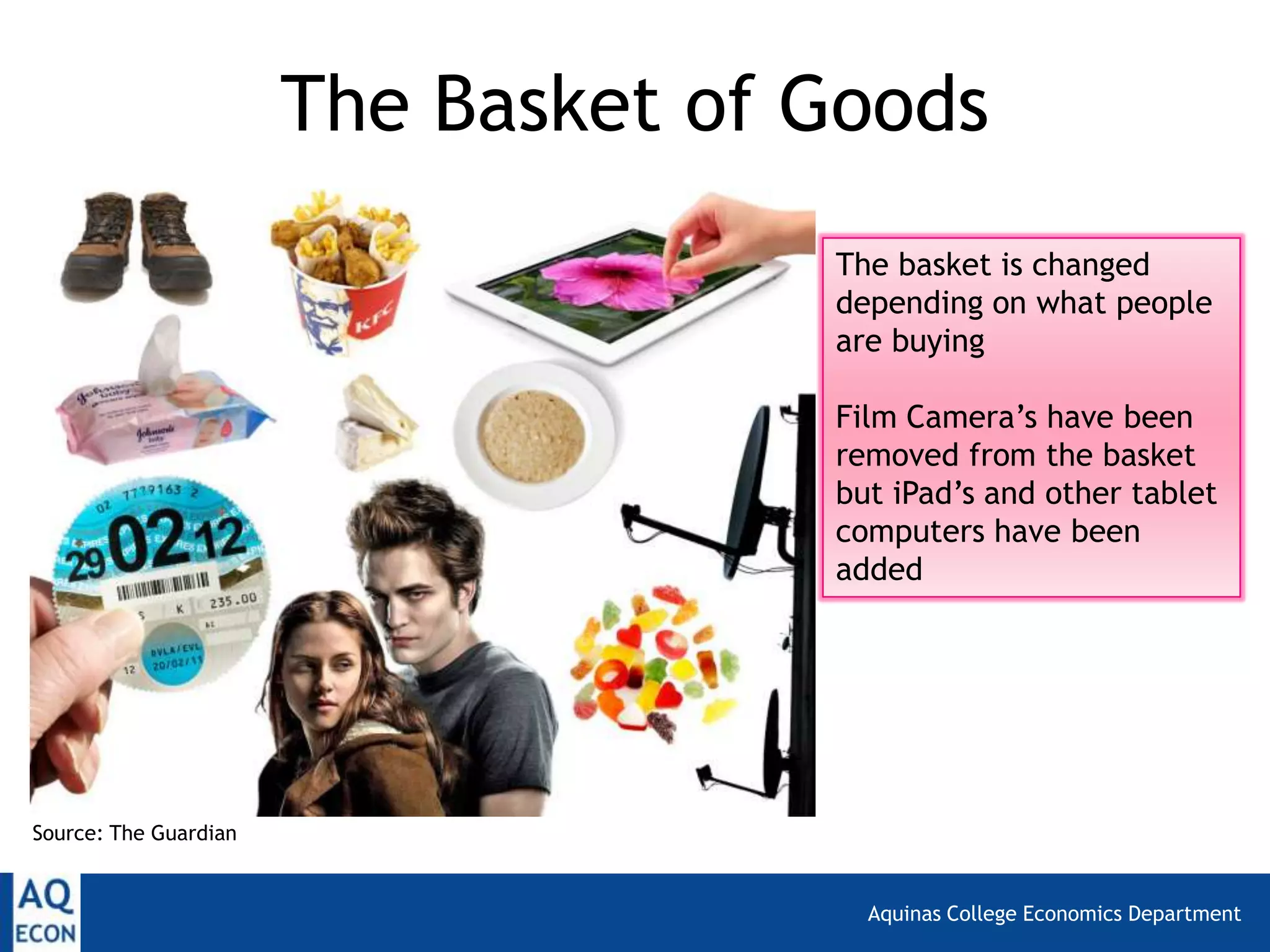
The Basket of Goods
Source: The Guardian
The basket is changed
depending on what people
are buying
Film Camera’s have been
removed from the basket
but iPad’s and other tablet
computers have been
added
Aquinas College Economics Department
Weighting
Using data from the FES government assigns
weights to each product in the basket of goods
Spending is broken down into 14 categories
If Housing costs make up 30% of total spending
then it is given a weighting of 30% in the basket
of goods
This weighting is then multiplied by the price
index for that year
Aquinas College Economics Department
Index Numbers
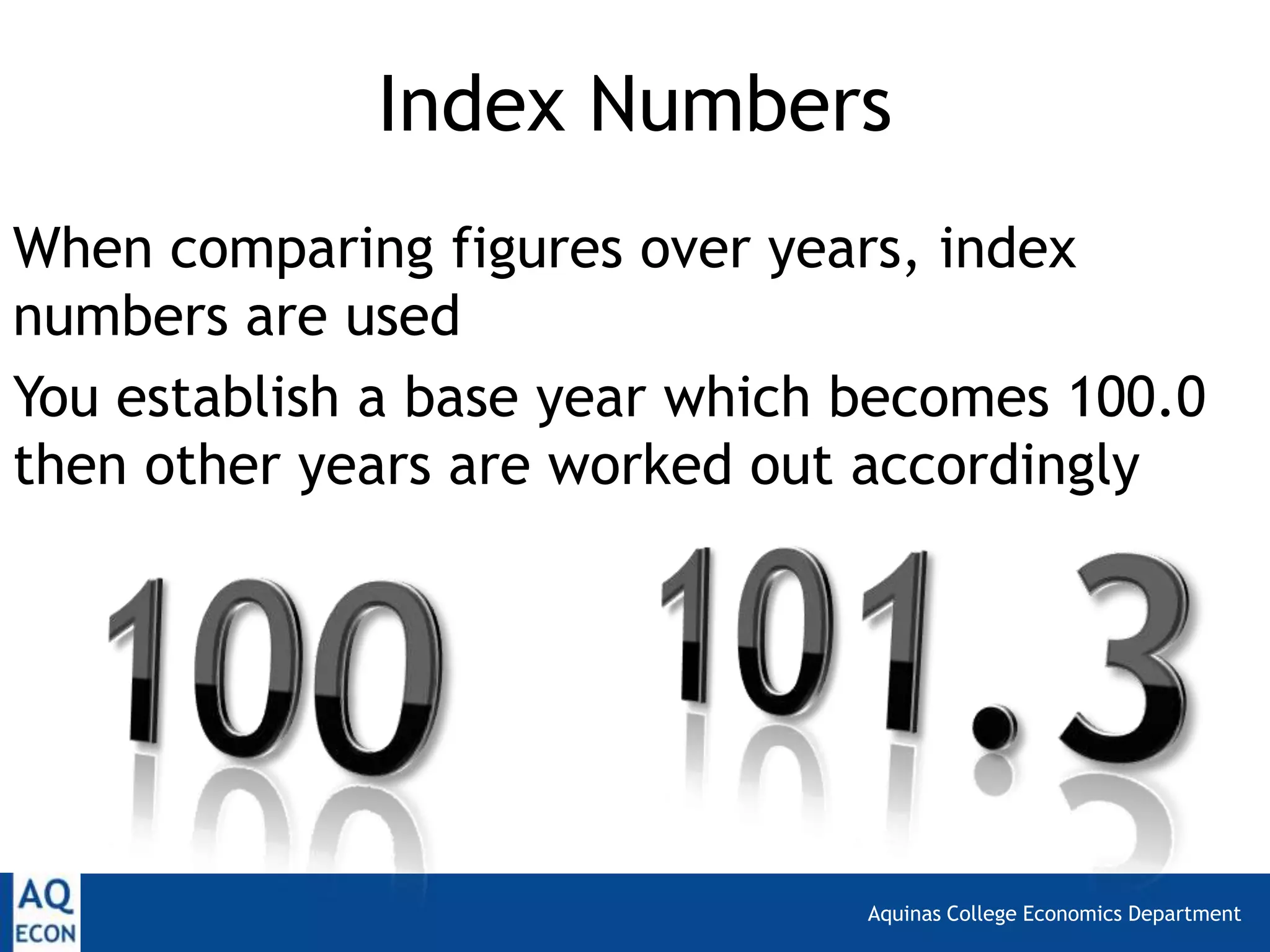
When comparing figures over years, index
numbers are used
You establish a base year which becomes 100.0
then other years are worked out accordingly
Aquinas College Economics Department
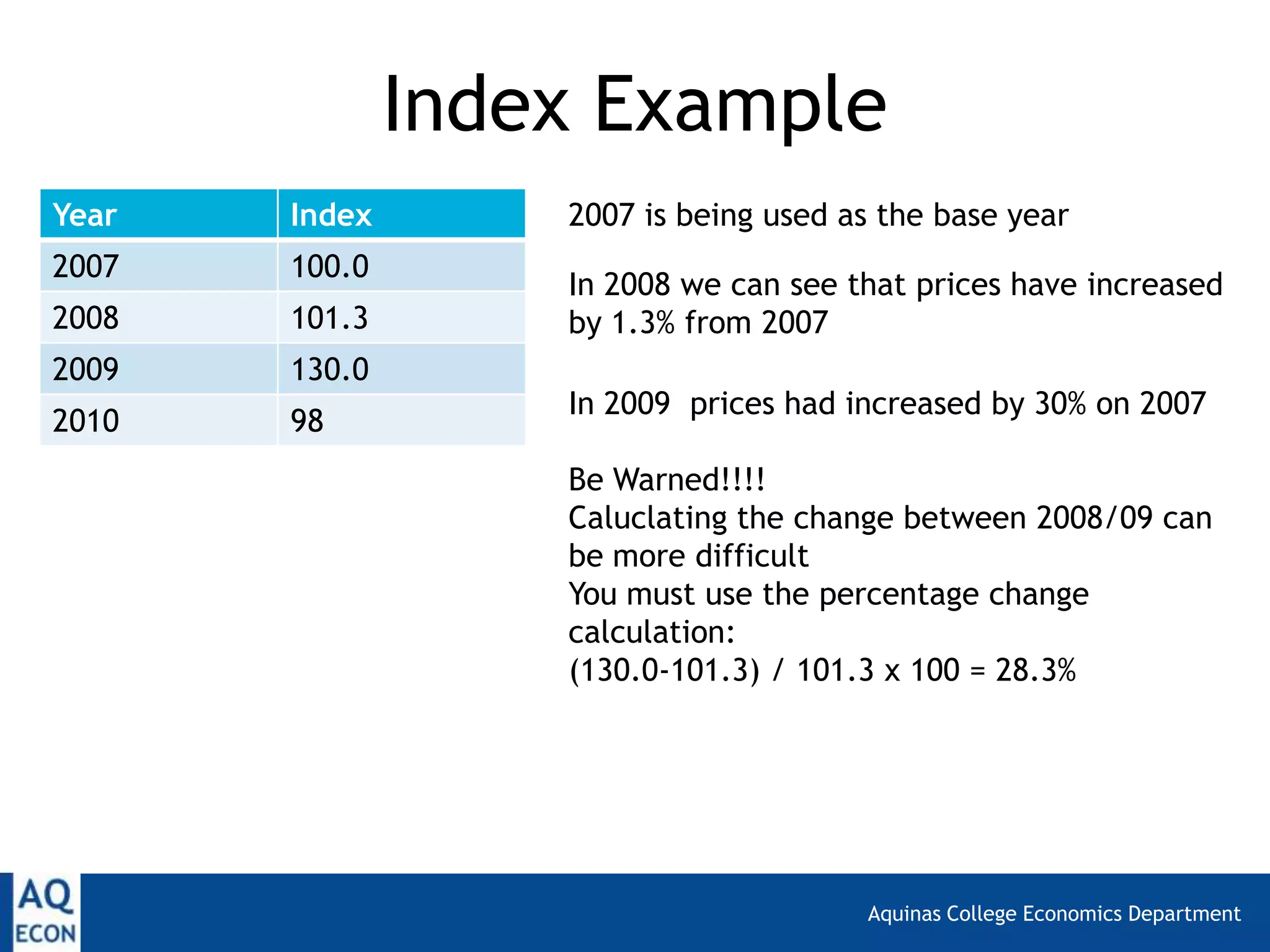
Index Example
Year Index
2007 100.0
2008 101.3
2009 130.0
2010 98
2007 is being used as the base year
In 2008 we can see that prices have increased
by 1.3% from 2007
In 2009 prices had increased by 30% on 2007
Be Warned!!!!
Caluclating the change between 2008/09 can
be more difficult
You must use the percentage change
calculation:
(130.0-101.3) / 101.3 x 100 = 28.3%
Aquinas College Economics Department
Limitations of CPI
1. It is an average so is not entirely
representative
2. House prices are not included
3. CPI doesn’t include quality of the goods so
may over-estimate the rate of inflation
experienced
Aquinas College Economics Department
Causes of Inflation
Inflation can come from within an economy or it
can come from outside the national economy
At A2 you need to know the three main ways in
which inflation is caused
Aquinas College Economics Department
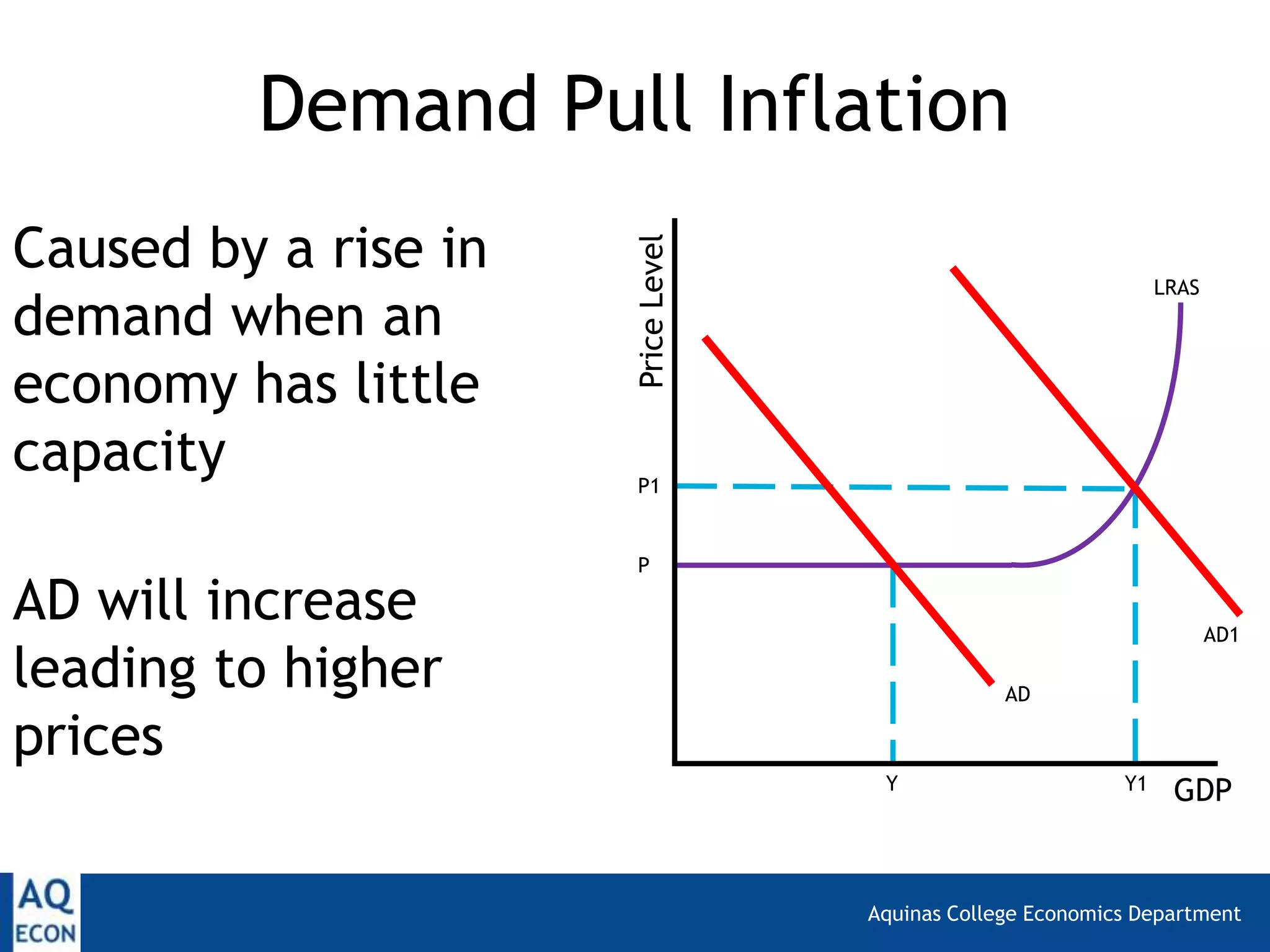
Demand Pull Inflation
Caused by a rise in
demand when an
economy has little
capacity
AD will increase
leading to higher
prices
PriceLevel
GDP
LRAS
AD
AD1
P
P1
Y Y1
Aquinas College Economics Department
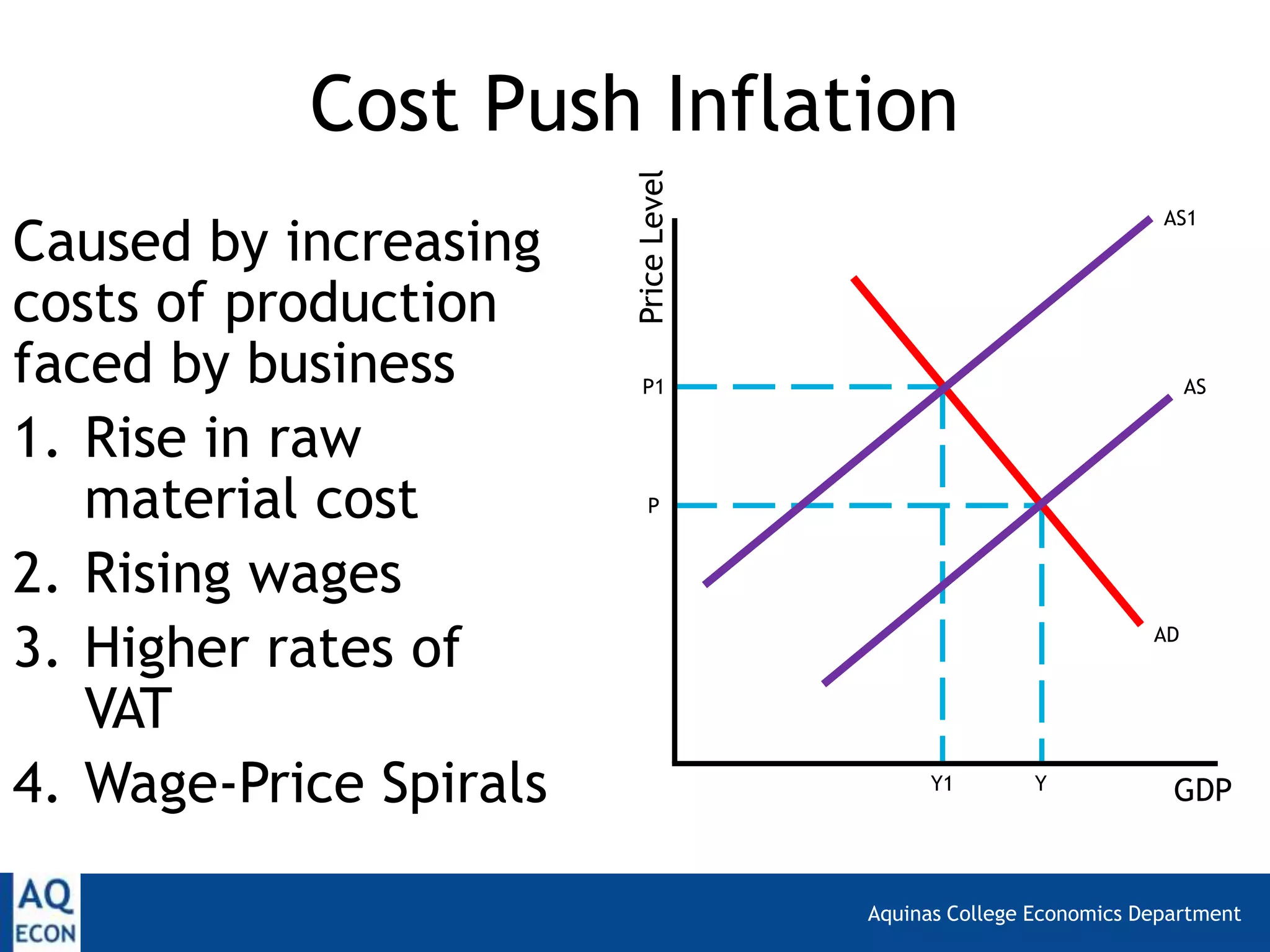
Cost Push Inflation
Caused by increasing
costs of production
faced by business
1. Rise in raw
material cost
2. Rising wages
3. Higher rates of
VAT
4. Wage-Price Spirals
PriceLevel
GDP
AS
AD
P
P1
YY1
AS1
Aquinas College Economics Department
Increase in Money Supply
Quantity Theory of Money says that an increase
in the money supply will cause price levels to
rise
Key argument of Monetarists
See separate PowerPoint on QTM
Aquinas College Economics Department
Consequences of Inflation
Consequence Explanation
Global Competitiveness Makes UK Goods more expensive on foreign
markets [BoP issues]
Investment As inflation creates uncertainty investment
levels fall
‘Menu Costs’ Admin costs to business when changing prices
‘Shoe-Leather Costs’ Cost to consumers who shop around
Distribution of Income Savers lose out with a real interest rate
Employer-Employee Relationship Workers demand higher pay, resulting in a
wage-spiral
Fiscal Drag When tax exempt amounts are not increased in
line with inflation meaning tax payers may be
dragged into the next tax band
Hyperinflation Currency is effectively worthless and a barter
economy appears
Aquinas College Economics Department
Deflation
Benign deflation: fallings prices resulting from
technological advances across the economy
e.g. Computer Prices
Malevolent Deflation: falling prices resulting
from a significant downturn in economic activity
- Real economic problem
Deflation: a fall in the general price level
Aquinas College Economics Department
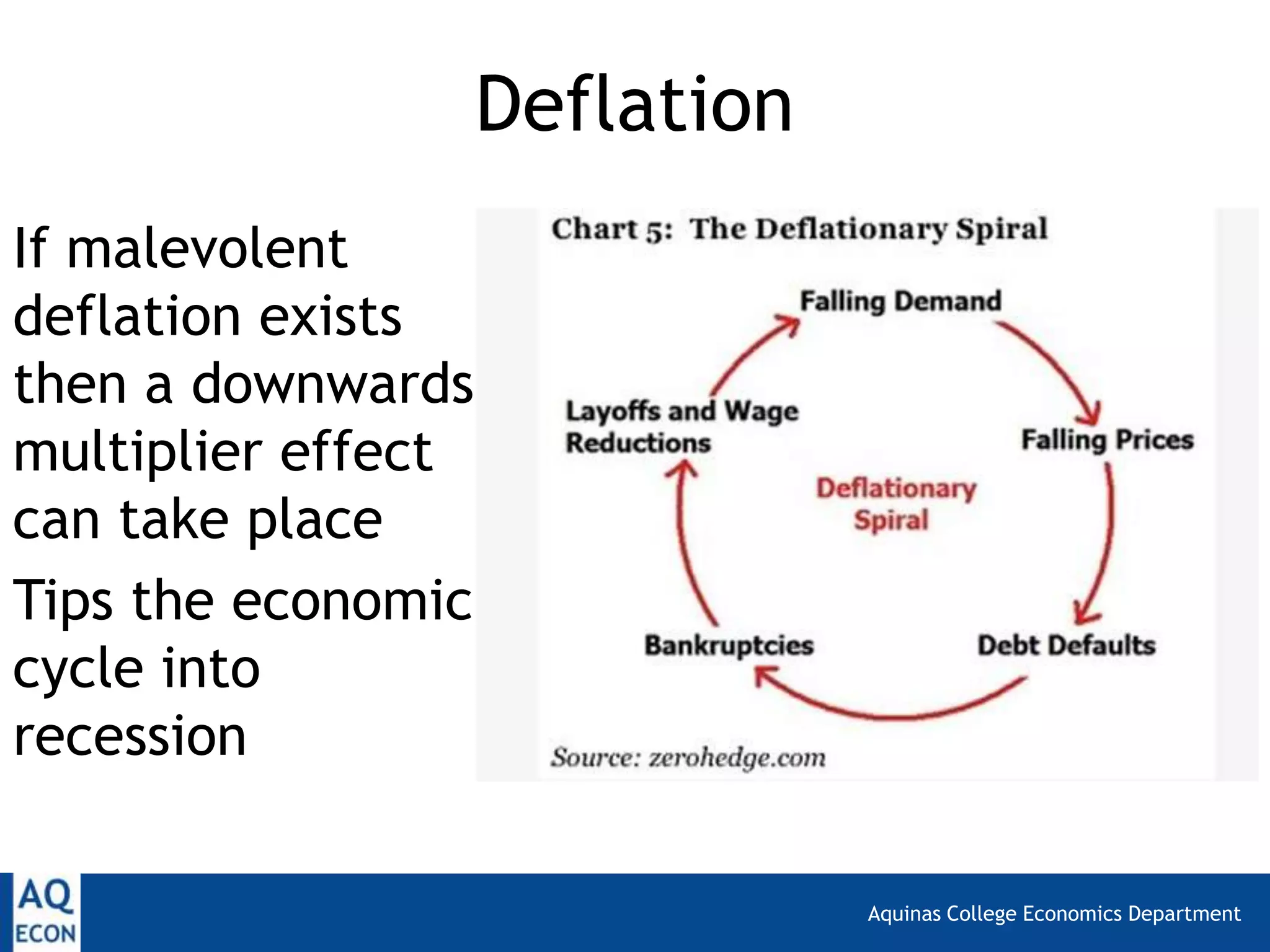
Deflation
If malevolent
deflation exists
then a downwards
multiplier effect
can take place
Tips the economic
cycle into
recession
Aquinas College Economics Department
AS Level Revision Site (ECON1, ECON2)
• http://www.aquinaseconomicsas.co.uk
A2 Level Revision Site (ECON3, ECON4)
• http://www.aquinaseconomicsa2.co.uk
Aquinas Economics on Twitter
• http://www.twitter.com/aquinaseconomic
Useful Links

Inflation and Deflation

  • 1.
    Aquinas College EconomicsDepartment Inflation & Deflation How its calculated, the causes, consequences, and the scary situation that is deflation ECON4
  • 2.
    Aquinas College EconomicsDepartment Definitions Inflation: a sustained increase in the general price level Deflation: a fall in the general price level CPI – Consumer Price Index
  • 3.
    Aquinas College EconomicsDepartment Inflation A sustained increase in the price level Normally measured in the UK through the Consumer Price Index. UK government target for inflation is 2% This target has an limit of +/- 1% as it can be difficult to bring inflation under control
  • 4.
    Aquinas College EconomicsDepartment Consumer Price Index Measure of UK Inflation Measures the prices of a basket of goods Goods are weighted so it can reflect changes in spending Information from the Family Expenditure Survey gives the information about spending paterns
  • 5.
    Aquinas College EconomicsDepartment The Basket of Goods Source: The Guardian The basket is changed depending on what people are buying Film Camera’s have been removed from the basket but iPad’s and other tablet computers have been added
  • 6.
    Aquinas College EconomicsDepartment Weighting Using data from the FES government assigns weights to each product in the basket of goods Spending is broken down into 14 categories If Housing costs make up 30% of total spending then it is given a weighting of 30% in the basket of goods This weighting is then multiplied by the price index for that year
  • 7.
    Aquinas College EconomicsDepartment Index Numbers When comparing figures over years, index numbers are used You establish a base year which becomes 100.0 then other years are worked out accordingly
  • 8.
    Aquinas College EconomicsDepartment Index Example Year Index 2007 100.0 2008 101.3 2009 130.0 2010 98 2007 is being used as the base year In 2008 we can see that prices have increased by 1.3% from 2007 In 2009 prices had increased by 30% on 2007 Be Warned!!!! Caluclating the change between 2008/09 can be more difficult You must use the percentage change calculation: (130.0-101.3) / 101.3 x 100 = 28.3%
  • 9.
    Aquinas College EconomicsDepartment Limitations of CPI 1. It is an average so is not entirely representative 2. House prices are not included 3. CPI doesn’t include quality of the goods so may over-estimate the rate of inflation experienced
  • 10.
    Aquinas College EconomicsDepartment Causes of Inflation Inflation can come from within an economy or it can come from outside the national economy At A2 you need to know the three main ways in which inflation is caused
  • 11.
    Aquinas College EconomicsDepartment Demand Pull Inflation Caused by a rise in demand when an economy has little capacity AD will increase leading to higher prices PriceLevel GDP LRAS AD AD1 P P1 Y Y1
  • 12.
    Aquinas College EconomicsDepartment Cost Push Inflation Caused by increasing costs of production faced by business 1. Rise in raw material cost 2. Rising wages 3. Higher rates of VAT 4. Wage-Price Spirals PriceLevel GDP AS AD P P1 YY1 AS1
  • 13.
    Aquinas College EconomicsDepartment Increase in Money Supply Quantity Theory of Money says that an increase in the money supply will cause price levels to rise Key argument of Monetarists See separate PowerPoint on QTM
  • 14.
    Aquinas College EconomicsDepartment Consequences of Inflation Consequence Explanation Global Competitiveness Makes UK Goods more expensive on foreign markets [BoP issues] Investment As inflation creates uncertainty investment levels fall ‘Menu Costs’ Admin costs to business when changing prices ‘Shoe-Leather Costs’ Cost to consumers who shop around Distribution of Income Savers lose out with a real interest rate Employer-Employee Relationship Workers demand higher pay, resulting in a wage-spiral Fiscal Drag When tax exempt amounts are not increased in line with inflation meaning tax payers may be dragged into the next tax band Hyperinflation Currency is effectively worthless and a barter economy appears
  • 15.
    Aquinas College EconomicsDepartment Deflation Benign deflation: fallings prices resulting from technological advances across the economy e.g. Computer Prices Malevolent Deflation: falling prices resulting from a significant downturn in economic activity - Real economic problem Deflation: a fall in the general price level
  • 16.
    Aquinas College EconomicsDepartment Deflation If malevolent deflation exists then a downwards multiplier effect can take place Tips the economic cycle into recession
  • 17.
    Aquinas College EconomicsDepartment AS Level Revision Site (ECON1, ECON2) • http://www.aquinaseconomicsas.co.uk A2 Level Revision Site (ECON3, ECON4) • http://www.aquinaseconomicsa2.co.uk Aquinas Economics on Twitter • http://www.twitter.com/aquinaseconomic Useful Links