Branch
The
Legislative
T- 1-855-694-8886
Email- info@iTutor.com
By iTutor.com
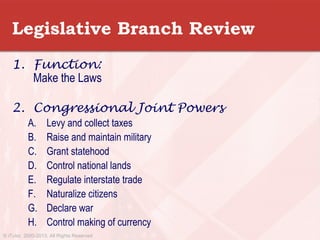
Legislative Branch Review
1. Function:
Make the Laws
2. Congressional Joint Powers
A. Levy and collect taxes
B. Raise and maintain military
C. Grant statehood
D. Control national lands
E. Regulate interstate trade
F. Naturalize citizens
G. Declare war
H. Control making of currency
© iTutor. 2000-2013. All Rights Reserved
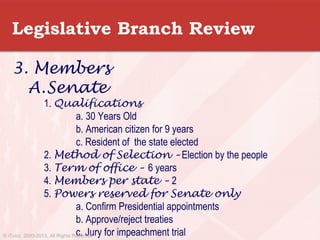
Legislative Branch Review
3. Members
A.Senate
1. Qualifications
a. 30 Years Old
b. American citizen for 9 years
c. Resident of the state elected
2. Method of Selection – Election by the people
3. Term of office – 6 years
4. Members per state – 2
5. Powers reserved for Senate only
a. Confirm Presidential appointments
b. Approve/reject treaties
c. Jury for impeachment trial© iTutor. 2000-2013. All Rights Reserved
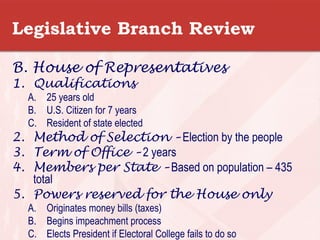
Legislative Branch Review
B. House of Representatives
1. Qualifications
A. 25 years old
B. U.S. Citizen for 7 years
C. Resident of state elected
2. Method of Selection – Election by the people
3. Term of Office – 2 years
4. Members per State – Based on population – 435
total
5. Powers reserved for the House only
A. Originates money bills (taxes)
B. Begins impeachment process
C. Elects President if Electoral College fails to do so
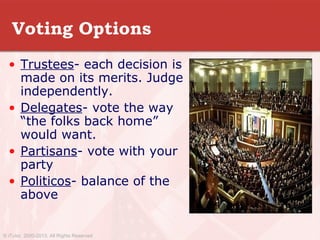
Voting Options
• Trustees- each decision is
made on its merits. Judge
independently.
• Delegates- vote the way
“the folks back home”
would want.
• Partisans- vote with your
party
• Politicos- balance of the
above
© iTutor. 2000-2013. All Rights Reserved
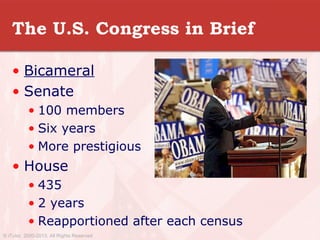
The U.S. Congress in Brief
• Bicameral
• Senate
• 100 members
• Six years
• More prestigious
• House
• 435
• 2 years
• Reapportioned after each census
© iTutor. 2000-2013. All Rights Reserved
Congressional Duties
• 1. legislatures
• 2. Committee members
• 3. Representatives of their constituents
• 4. politicians
© iTutor. 2000-2013. All Rights Reserved
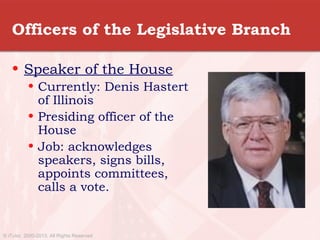
Officers of the Legislative Branch
• Speaker of the House
• Currently: Denis Hastert
of Illinois
• Presiding officer of the
House
• Job: acknowledges
speakers, signs bills,
appoints committees,
calls a vote.
© iTutor. 2000-2013. All Rights Reserved
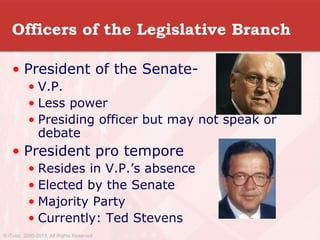
Officers of the Legislative Branch
• President of the Senate-
• V.P.
• Less power
• Presiding officer but may not speak or
debate
• President pro tempore
• Resides in V.P.’s absence
• Elected by the Senate
• Majority Party
• Currently: Ted Stevens
© iTutor. 2000-2013. All Rights Reserved
Officers of the Legislative Branch
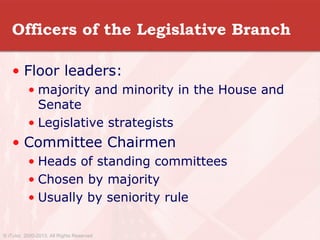
• Floor leaders:
• majority and minority in the House and
Senate
• Legislative strategists
• Committee Chairmen
• Heads of standing committees
• Chosen by majority
• Usually by seniority rule
© iTutor. 2000-2013. All Rights Reserved
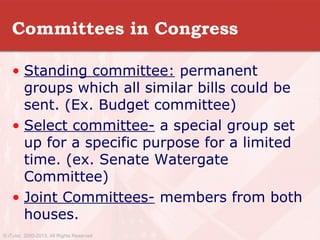
Committees in Congress
• Standing committee: permanent
groups which all similar bills could be
sent. (Ex. Budget committee)
• Select committee- a special group set
up for a specific purpose for a limited
time. (ex. Senate Watergate
Committee)
• Joint Committees- members from both
houses.
© iTutor. 2000-2013. All Rights Reserved
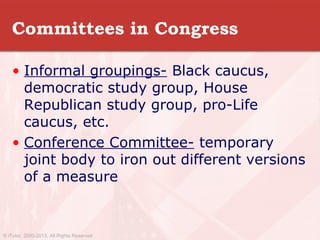
Committees in Congress
• Informal groupings- Black caucus,
democratic study group, House
Republican study group, pro-Life
caucus, etc.
• Conference Committee- temporary
joint body to iron out different versions
of a measure
© iTutor. 2000-2013. All Rights Reserved
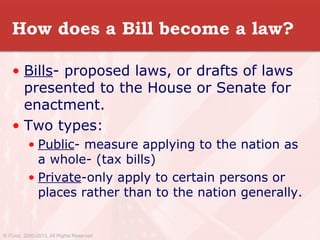
How does a Bill become a law?
• Bills- proposed laws, or drafts of laws
presented to the House or Senate for
enactment.
• Two types:
• Public- measure applying to the nation as
a whole- (tax bills)
• Private-only apply to certain persons or
places rather than to the nation generally.
© iTutor. 2000-2013. All Rights Reserved
How does a Bill become a law?
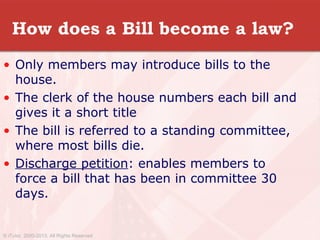
• Only members may introduce bills to the
house.
• The clerk of the house numbers each bill and
gives it a short title
• The bill is referred to a standing committee,
where most bills die.
• Discharge petition: enables members to
force a bill that has been in committee 30
days.
© iTutor. 2000-2013. All Rights Reserved
How does a Bill become a law?
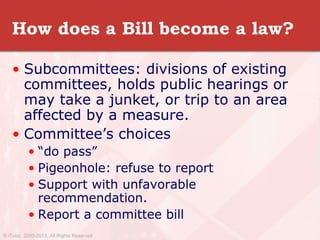
• Subcommittees: divisions of existing
committees, holds public hearings or
may take a junket, or trip to an area
affected by a measure.
• Committee’s choices
• “do pass”
• Pigeonhole: refuse to report
• Support with unfavorable
recommendation.
• Report a committee bill
© iTutor. 2000-2013. All Rights Reserved
How does a Bill become a law?
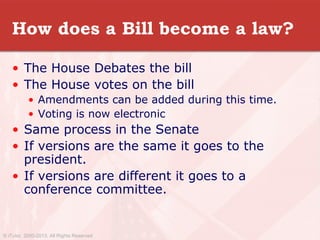
• The House Debates the bill
• The House votes on the bill
• Amendments can be added during this time.
• Voting is now electronic
• Same process in the Senate
• If versions are the same it goes to the
president.
• If versions are different it goes to a
conference committee.
© iTutor. 2000-2013. All Rights Reserved
• Filibuster: an attempt to “talk a bill to death.” in the
senate.
• Record: Senator Strom Thurmond: held the floor for
24 hours in an attempt to kill the Civil Rights Act of
1957.
© iTutor. 2000-2013. All Rights Reserved
Call us for more Information:
www.iTutor.com
1-855-694-8886
Visit

The Legislative Branch

  • 1.
  • 2.
    Legislative Branch Review 1.Function: Make the Laws 2. Congressional Joint Powers A. Levy and collect taxes B. Raise and maintain military C. Grant statehood D. Control national lands E. Regulate interstate trade F. Naturalize citizens G. Declare war H. Control making of currency © iTutor. 2000-2013. All Rights Reserved
  • 3.
    Legislative Branch Review 3.Members A.Senate 1. Qualifications a. 30 Years Old b. American citizen for 9 years c. Resident of the state elected 2. Method of Selection – Election by the people 3. Term of office – 6 years 4. Members per state – 2 5. Powers reserved for Senate only a. Confirm Presidential appointments b. Approve/reject treaties c. Jury for impeachment trial© iTutor. 2000-2013. All Rights Reserved
  • 4.
    Legislative Branch Review B.House of Representatives 1. Qualifications A. 25 years old B. U.S. Citizen for 7 years C. Resident of state elected 2. Method of Selection – Election by the people 3. Term of Office – 2 years 4. Members per State – Based on population – 435 total 5. Powers reserved for the House only A. Originates money bills (taxes) B. Begins impeachment process C. Elects President if Electoral College fails to do so
  • 5.
    Voting Options • Trustees-each decision is made on its merits. Judge independently. • Delegates- vote the way “the folks back home” would want. • Partisans- vote with your party • Politicos- balance of the above © iTutor. 2000-2013. All Rights Reserved
  • 6.
    The U.S. Congressin Brief • Bicameral • Senate • 100 members • Six years • More prestigious • House • 435 • 2 years • Reapportioned after each census © iTutor. 2000-2013. All Rights Reserved
  • 7.
    Congressional Duties • 1.legislatures • 2. Committee members • 3. Representatives of their constituents • 4. politicians © iTutor. 2000-2013. All Rights Reserved
  • 8.
    Officers of theLegislative Branch • Speaker of the House • Currently: Denis Hastert of Illinois • Presiding officer of the House • Job: acknowledges speakers, signs bills, appoints committees, calls a vote. © iTutor. 2000-2013. All Rights Reserved
  • 9.
    Officers of theLegislative Branch • President of the Senate- • V.P. • Less power • Presiding officer but may not speak or debate • President pro tempore • Resides in V.P.’s absence • Elected by the Senate • Majority Party • Currently: Ted Stevens © iTutor. 2000-2013. All Rights Reserved
  • 10.
    Officers of theLegislative Branch • Floor leaders: • majority and minority in the House and Senate • Legislative strategists • Committee Chairmen • Heads of standing committees • Chosen by majority • Usually by seniority rule © iTutor. 2000-2013. All Rights Reserved
  • 11.
    Committees in Congress •Standing committee: permanent groups which all similar bills could be sent. (Ex. Budget committee) • Select committee- a special group set up for a specific purpose for a limited time. (ex. Senate Watergate Committee) • Joint Committees- members from both houses. © iTutor. 2000-2013. All Rights Reserved
  • 12.
    Committees in Congress •Informal groupings- Black caucus, democratic study group, House Republican study group, pro-Life caucus, etc. • Conference Committee- temporary joint body to iron out different versions of a measure © iTutor. 2000-2013. All Rights Reserved
  • 13.
    How does aBill become a law? • Bills- proposed laws, or drafts of laws presented to the House or Senate for enactment. • Two types: • Public- measure applying to the nation as a whole- (tax bills) • Private-only apply to certain persons or places rather than to the nation generally. © iTutor. 2000-2013. All Rights Reserved
  • 14.
    How does aBill become a law? • Only members may introduce bills to the house. • The clerk of the house numbers each bill and gives it a short title • The bill is referred to a standing committee, where most bills die. • Discharge petition: enables members to force a bill that has been in committee 30 days. © iTutor. 2000-2013. All Rights Reserved
  • 15.
    How does aBill become a law? • Subcommittees: divisions of existing committees, holds public hearings or may take a junket, or trip to an area affected by a measure. • Committee’s choices • “do pass” • Pigeonhole: refuse to report • Support with unfavorable recommendation. • Report a committee bill © iTutor. 2000-2013. All Rights Reserved
  • 16.
    How does aBill become a law? • The House Debates the bill • The House votes on the bill • Amendments can be added during this time. • Voting is now electronic • Same process in the Senate • If versions are the same it goes to the president. • If versions are different it goes to a conference committee. © iTutor. 2000-2013. All Rights Reserved
  • 17.
    • Filibuster: anattempt to “talk a bill to death.” in the senate. • Record: Senator Strom Thurmond: held the floor for 24 hours in an attempt to kill the Civil Rights Act of 1957. © iTutor. 2000-2013. All Rights Reserved Call us for more Information: www.iTutor.com 1-855-694-8886 Visit