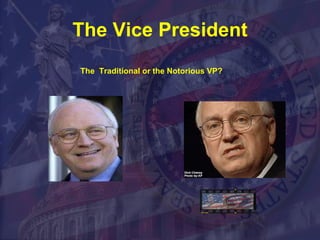
The Executive Branch What makes the president the most power person in the world? How does the executive branch enforce policy? How does vice president Dick Chaney deter from the traditional role of the vice presidency?
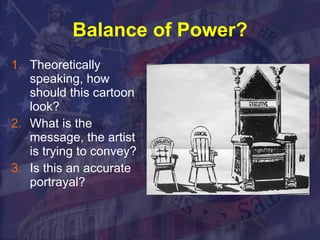
Balance of Power? Theoretically speaking, how should this cartoon  look? What is the message, the artist is trying to convey?  Is this an accurate portrayal?
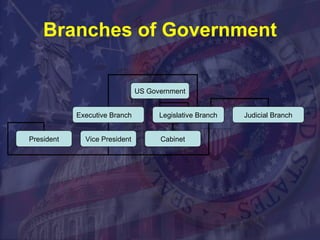
Branches of Government US Government Executive Branch Legislative Branch Judicial Branch President Vice President Cabinet
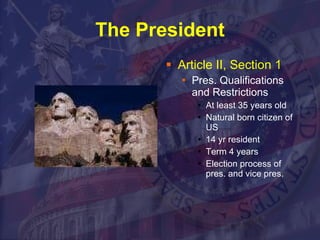
The President Article II, Section 1 Pres. Qualifications and Restrictions At least 35 years old Natural born citizen of US 14 yr resident Term 4 years Election process of pres. and vice pres.
Beginning of the President’s Term Amendment 20 The Oath of office was moved from March 4 to January 20, which indicates the beginning of a new presidency and the end of the old. Congress’ term begins on Jan. 3 rd . Reduces the lame duck period.
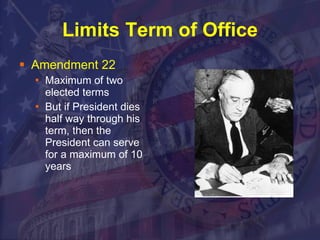
Limits Term of Office Amendment 22 Maximum of two elected terms But if President dies half way through his term, then the President can serve for a maximum of 10 years
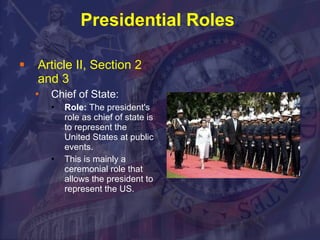
Presidential Roles  Article II, Section 2  and 3 Chief of State: Role:  The president's role as chief of state is to represent the United States at public events. This is mainly a ceremonial role that allows the president to represent the US.
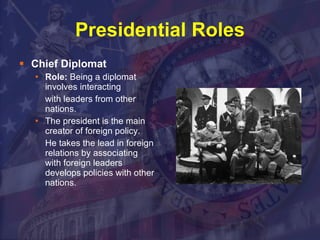
Presidential Roles Chief Diplomat Role:  Being a diplomat involves interacting with leaders from other nations.  The president is the main creator of foreign policy.  He takes the lead in foreign relations by associating with foreign leaders develops policies with other nations.
Presidential Roles Chief Executive Role: The president is the chief executive, empowered to administer the laws and affairs of the nation. While the president does not make the laws, his agencies have the responsibility and authority to carry out the laws. The president is the head of the Executive Branch, and has highest authority.
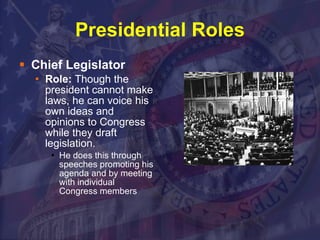
Presidential Roles Chief Legislator Role:  Though the president cannot make laws, he can voice his own ideas and opinions to Congress while they draft legislation.  He does this through speeches promoting his agenda and by meeting with individual Congress members
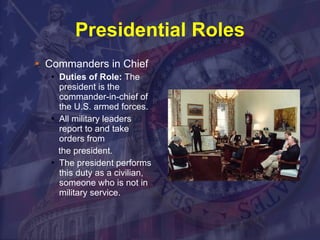
Presidential Roles Commanders in Chief Duties of Role:  The president is the commander-in-chief of the U.S. armed forces.  All military leaders report to and take orders from the president.  The president performs this duty as a civilian, someone who is not in military service.
Presidential Roles Chief of Party: Party Leader Duties this role, the president helps members of his political party get elected or appointed to office. The president campaigns for those members who have supported his policies. At the end of a term the president may campaign for reelection with his party’s support.
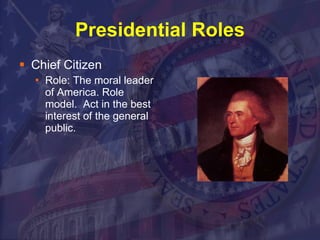
Presidential Roles Chief Citizen Role: The moral leader of America. Role model.  Act in the best interest of the general public.
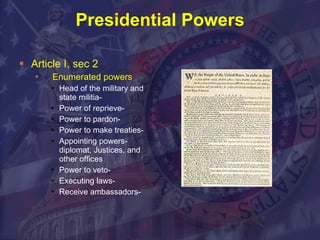
Presidential Powers Article I, sec 2 Enumerated powers  Head of the military and state militia- Power of reprieve- Power to pardon- Power to make treaties- Appointing powers- diplomat, Justices, and other offices Power to veto- Executing laws- Receive ambassadors-
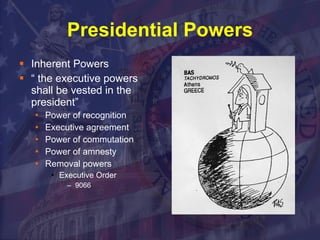
Presidential Powers Inherent Powers “  the executive powers shall be vested in the president” Power of recognition Executive agreement Power of commutation Power of amnesty Removal powers Executive Order 9066
Presidential Powers Implied Powers Executive Privilege Wartimes Powers Power to suggest legislation
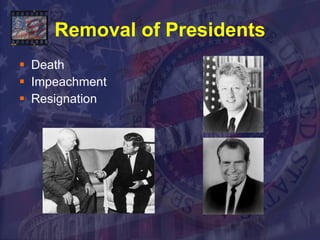
Removal of Presidents Death Impeachment Resignation
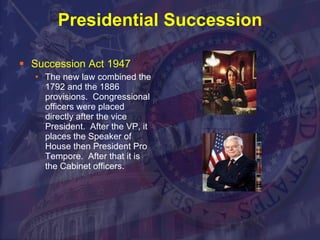
Presidential Succession Succession Act 1947 The new law combined the 1792 and the 1886 provisions.  Congressional officers were placed directly after the vice President.  After the VP, it places the Speaker of House then President Pro Tempore.  After that it is the Cabinet officers.
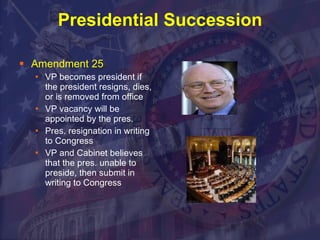
Presidential Succession Amendment 25 VP becomes president if the president resigns, dies, or is removed from office VP vacancy will be appointed by the pres. Pres. resignation in writing to Congress VP and Cabinet believes that the pres. unable to preside, then submit in writing to Congress
The Vice President “My country has in its wisdom contrived for me the most insignificant office that ever the invention of man contrived or his imagination conceive.”  -John Adams  The Vice Presidency is a -“warm bucket of spit”.  -John Nance Garner
The Vice President The  Traditional or the Notorious VP?
The Vice President Article I, sec 3  Role and Duties Limited power or authority Constitution provides VP to be the president of the Senate Can only vote in cases of a tie in the Senate
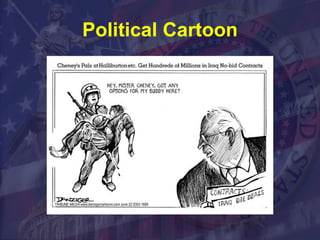
Political Cartoon
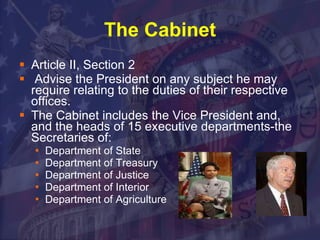
The Cabinet Article II, Section 2 Advise the President on any subject he may require relating to the duties of their respective offices.  The Cabinet includes the Vice President and, and the heads of 15 executive departments-the Secretaries of:  Department of State Department of Treasury Department of Justice Department of Interior Department of Agriculture
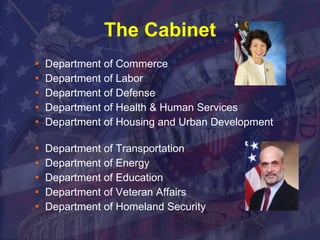
The Cabinet Department of Commerce Department of Labor Department of Defense Department of Health & Human Services Department of Housing and Urban Development  Department of Transportation Department of Energy Department of Education Department of Veteran Affairs Department of Homeland Security
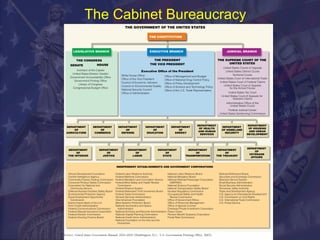
The Cabinet Bureaucracy
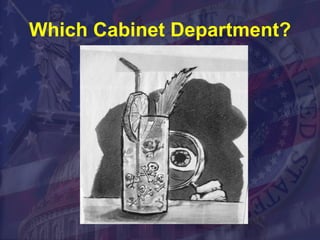
Which Cabinet Department?
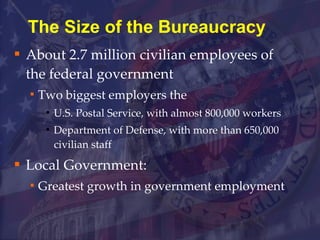
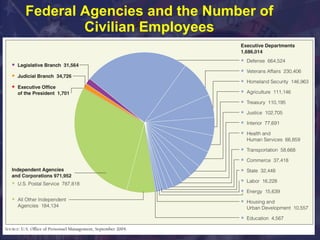
The Size of the Bureaucracy About 2.7 million civilian employees of the federal government  Two biggest employers the  U.S. Postal Service, with almost 800,000 workers Department of Defense, with more than 650,000 civilian staff Local Government:  Greatest growth in government employment
Federal Agencies and the Number of Civilian Employees
Executive Agencies Independent Agencies and Government Corporations The agencies and corporations manage much of the day-to-day business of government The U.S. Postal Service, Small Business Administration, Social Security Administration, CIA, EPA, NASA, FEMA and the National Transportation Safety Board are just a few examples
Regulatory Agencies FDA, EPA, OSHA and at least 50 others empowered to create and enforce rules - regulations  Rules and regulations carry the full force of a law Entities can be fined, sanctioned, forced to close, and even jailed for violating federal regulations
Quiz Based on the video, do you think the president has too much power?

The Executive Branch

  • 1.
    The Executive BranchWhat makes the president the most power person in the world? How does the executive branch enforce policy? How does vice president Dick Chaney deter from the traditional role of the vice presidency?
  • 2.
    Balance of Power?Theoretically speaking, how should this cartoon look? What is the message, the artist is trying to convey? Is this an accurate portrayal?
  • 3.
    Branches of GovernmentUS Government Executive Branch Legislative Branch Judicial Branch President Vice President Cabinet
  • 4.
    The President ArticleII, Section 1 Pres. Qualifications and Restrictions At least 35 years old Natural born citizen of US 14 yr resident Term 4 years Election process of pres. and vice pres.
  • 5.
    Beginning of thePresident’s Term Amendment 20 The Oath of office was moved from March 4 to January 20, which indicates the beginning of a new presidency and the end of the old. Congress’ term begins on Jan. 3 rd . Reduces the lame duck period.
  • 6.
    Limits Term ofOffice Amendment 22 Maximum of two elected terms But if President dies half way through his term, then the President can serve for a maximum of 10 years
  • 7.
    Presidential Roles Article II, Section 2 and 3 Chief of State: Role: The president's role as chief of state is to represent the United States at public events. This is mainly a ceremonial role that allows the president to represent the US.
  • 8.
    Presidential Roles ChiefDiplomat Role: Being a diplomat involves interacting with leaders from other nations. The president is the main creator of foreign policy. He takes the lead in foreign relations by associating with foreign leaders develops policies with other nations.
  • 9.
    Presidential Roles ChiefExecutive Role: The president is the chief executive, empowered to administer the laws and affairs of the nation. While the president does not make the laws, his agencies have the responsibility and authority to carry out the laws. The president is the head of the Executive Branch, and has highest authority.
  • 10.
    Presidential Roles ChiefLegislator Role: Though the president cannot make laws, he can voice his own ideas and opinions to Congress while they draft legislation. He does this through speeches promoting his agenda and by meeting with individual Congress members
  • 11.
    Presidential Roles Commandersin Chief Duties of Role: The president is the commander-in-chief of the U.S. armed forces. All military leaders report to and take orders from the president. The president performs this duty as a civilian, someone who is not in military service.
  • 12.
    Presidential Roles Chiefof Party: Party Leader Duties this role, the president helps members of his political party get elected or appointed to office. The president campaigns for those members who have supported his policies. At the end of a term the president may campaign for reelection with his party’s support.
  • 13.
    Presidential Roles ChiefCitizen Role: The moral leader of America. Role model. Act in the best interest of the general public.
  • 14.
    Presidential Powers ArticleI, sec 2 Enumerated powers Head of the military and state militia- Power of reprieve- Power to pardon- Power to make treaties- Appointing powers- diplomat, Justices, and other offices Power to veto- Executing laws- Receive ambassadors-
  • 15.
    Presidential Powers InherentPowers “ the executive powers shall be vested in the president” Power of recognition Executive agreement Power of commutation Power of amnesty Removal powers Executive Order 9066
  • 16.
    Presidential Powers ImpliedPowers Executive Privilege Wartimes Powers Power to suggest legislation
  • 17.
    Removal of PresidentsDeath Impeachment Resignation
  • 18.
    Presidential Succession SuccessionAct 1947 The new law combined the 1792 and the 1886 provisions. Congressional officers were placed directly after the vice President. After the VP, it places the Speaker of House then President Pro Tempore. After that it is the Cabinet officers.
  • 19.
    Presidential Succession Amendment25 VP becomes president if the president resigns, dies, or is removed from office VP vacancy will be appointed by the pres. Pres. resignation in writing to Congress VP and Cabinet believes that the pres. unable to preside, then submit in writing to Congress
  • 20.
    The Vice President“My country has in its wisdom contrived for me the most insignificant office that ever the invention of man contrived or his imagination conceive.” -John Adams The Vice Presidency is a -“warm bucket of spit”. -John Nance Garner
  • 21.
    The Vice PresidentThe Traditional or the Notorious VP?
  • 22.
    The Vice PresidentArticle I, sec 3 Role and Duties Limited power or authority Constitution provides VP to be the president of the Senate Can only vote in cases of a tie in the Senate
  • 23.
  • 24.
    The Cabinet ArticleII, Section 2 Advise the President on any subject he may require relating to the duties of their respective offices. The Cabinet includes the Vice President and, and the heads of 15 executive departments-the Secretaries of: Department of State Department of Treasury Department of Justice Department of Interior Department of Agriculture
  • 25.
    The Cabinet Departmentof Commerce Department of Labor Department of Defense Department of Health & Human Services Department of Housing and Urban Development Department of Transportation Department of Energy Department of Education Department of Veteran Affairs Department of Homeland Security
  • 26.
  • 27.
  • 28.
    The Size ofthe Bureaucracy About 2.7 million civilian employees of the federal government Two biggest employers the U.S. Postal Service, with almost 800,000 workers Department of Defense, with more than 650,000 civilian staff Local Government: Greatest growth in government employment
  • 29.
    Federal Agencies andthe Number of Civilian Employees
  • 30.
    Executive Agencies IndependentAgencies and Government Corporations The agencies and corporations manage much of the day-to-day business of government The U.S. Postal Service, Small Business Administration, Social Security Administration, CIA, EPA, NASA, FEMA and the National Transportation Safety Board are just a few examples
  • 31.
    Regulatory Agencies FDA,EPA, OSHA and at least 50 others empowered to create and enforce rules - regulations Rules and regulations carry the full force of a law Entities can be fined, sanctioned, forced to close, and even jailed for violating federal regulations
  • 32.
    Quiz Based onthe video, do you think the president has too much power?