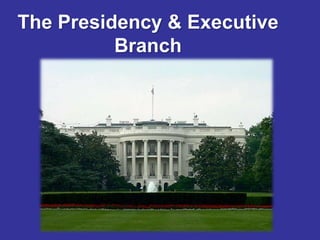
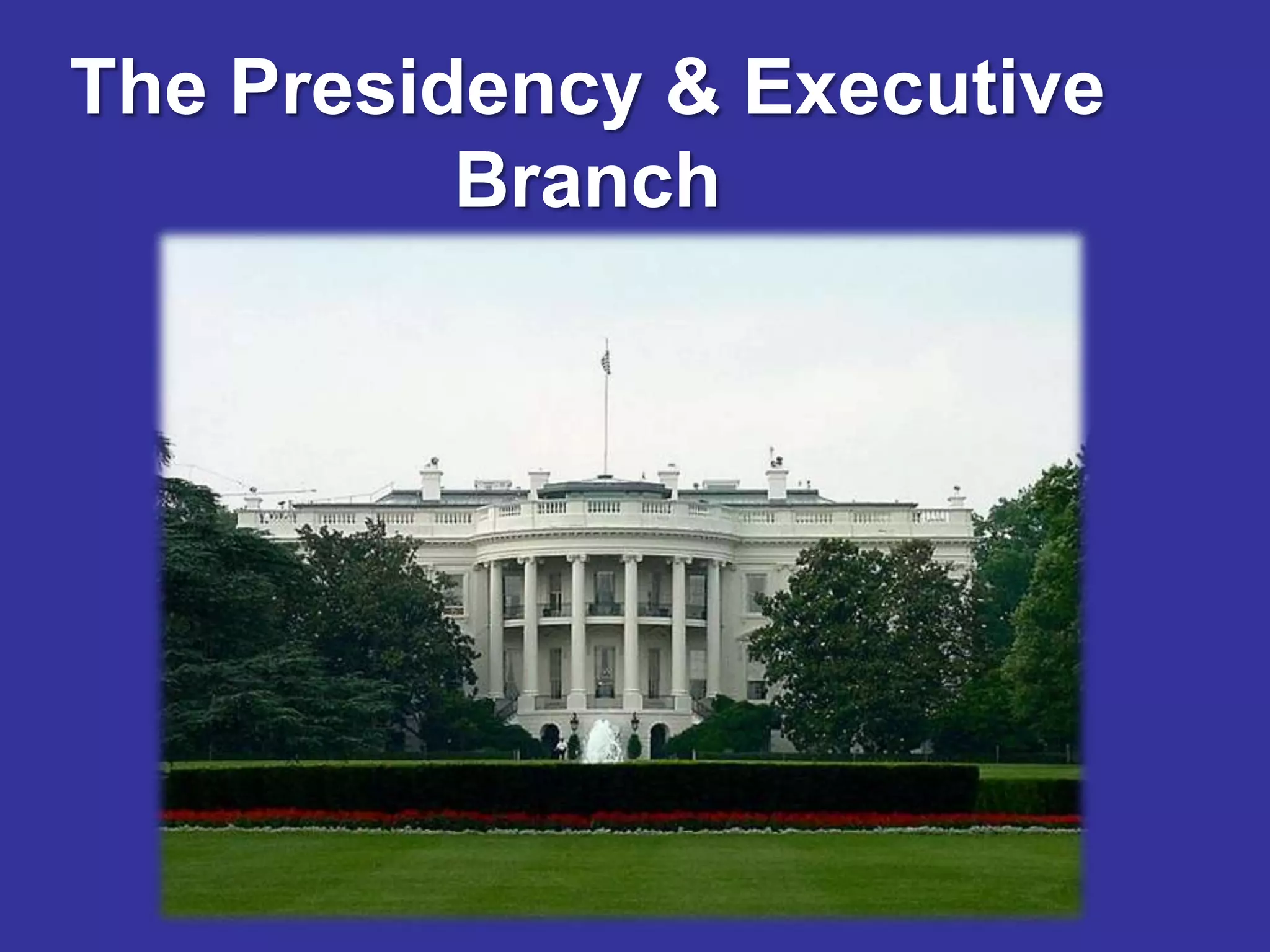
The Presidency & Executive
          Branch
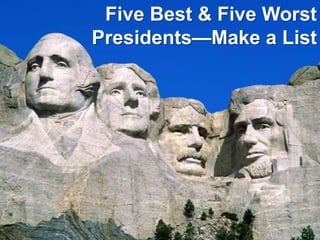
Five Best & Five Worst
Presidents—Make a List
The Executive Branch
• Powers listed in Article II
• Main duty: Enforce Laws
• Includes:
       The President
       Vice-President
       President’s Cabinet
Qualifications
To be the President or Vice
  President:
• At least 35 years of age
• Born in the U.S.
• Resident for 14 years
Terms
• 22nd Amendment:
     -Limits the President to two
      terms or 10 years
Salary
• $400,000 per year
• $50,000 a year allowance
• Lives in the White House
  (132 rooms, 18.3 acres)
• Air Force One
• Plus other benefits
Powers & Limitations
   of the President
ROLE: CHIEF OF STATE
1. Ceremonial head of the U.S.
   government & people
2. KIND OF like a king or queen
Powers & Limitations
  of the President
ROLE: CHIEF EXECUTIVE
1. enforces federal law, treaties,
   court decisions
2. Executive orders
3. Appoints cabinet members,
   commissions, federal judges
   A. Senate approval needed for
   appointments
Powers & Limitations of
   the President
ROLE: CHIEF ADMINISTRATOR
  1. Employs more than 2.7
  million civilians.
  2. Spends more than 2.5
  trillion dollars a year.
Powers & Limitations
   of the President
ROLE: CHIEF DIPLOMAT
1. general charge of foreign policy
2. appoints ambassadors
3. executive agreements
4. negotiates treaties
5. recognition of foreign governments
    A. Senate must approve appointments
    B. Senate must approve treaties (2/3
    vote)
Powers & Limitations
   of the President
ROLE: COMMANDER IN CHIEF
1. civilian authority over the
   military (1.4 million)
   A. War Powers Resolution
   1973 (what is this?)
   B. Congress declares war
Powers & Limitations
  of the President
ROLE: CHIEF LEGISLATOR
1. Veto
2. outlines legislative proposals
  (ex. The Federal Budget)
3. calls special sessions of
  Congress
  A. 2/3- both houses of Congress
  can override a veto
  B. Congress is not obligated to
  pass the president’s proposals
Powers & Limitations
   of the President
ROLE: HEAD OF POLITICAL
  PARTY
1. Political patronage
  A. Face of the party
  B. Party tied to success or
  failure of the President
Powers & Limitations
    of the President
ROLE: CHIEF CITIZEN
1. “the Representative of all the
   people”
2. Certain moral obligations
The Federal
     Bureaucracy
• All of the agencies, people, and
  procedures through which the
  Federal Government operates.
• The means by which the
  government makes and
  administers public policy.
• The Constitution makes the
  President the Chief Administrator.
• Constitution is relatively silent on
  the organization of the Executive
  Branch.
Executive Office of
    the President
• Established in 1939 and
  changed by each
  administration since.
• The “inner circle” of the
  President (400)
     • Chief of staff
     • Press secretary
     • Physician
     • Counselor / Senior
       advisors
Executive Office of
    the President
• National Security Council
  (NSC)
• Office of Homeland Security
   – Work closely with the
     President on security
     issues
   – CIA, military chiefs, etc.
Executive Office of
   the President
• Office of Management and
  Budget (OMB)
• Office of National Drug
  Control Policy
• Office of Science and
  Technology
• Trade, Economy,
  Environment, etc.
The Executive
Departments (Cabinet)
• In 1789, Congress created 3
• Today there are 15
  departments
• Each department is headed
  by a secretary except the
  Department of Justice
  (attorney general)
• Departments are divided into
  subunits.
Choosing
Department Leaders
• Nominated by President,
  confirmed by the Senate
• Party patronage (campaign
  influence)
• Professional qualifications
• Regional balance
  (Geography)
• Interest group pressure
Independent
       Agencies
• 150 agencies independent
  of the Cabinet (not the
  President)
• Some do not fit into
  departments
• Congress wanted them
  independent to escape
  influence
Independent
          Agencies
• FTC- Federal Trade Commission
• SEC- Securities and Exchange
  Commission
• FCC- Federal Communications
  Commission
• SSA- Social Security
  Administration
• Peace Corps
• FEC- Federal Election Commission
• USPS- United States Postal Service
• FDIC- Federal Deposit Insurance
  Corporation

Executive Branch

  • 1.
    The Presidency &Executive Branch
  • 2.
    Five Best &Five Worst Presidents—Make a List
  • 3.
    The Executive Branch •Powers listed in Article II • Main duty: Enforce Laws • Includes: The President Vice-President President’s Cabinet
  • 4.
    Qualifications To be thePresident or Vice President: • At least 35 years of age • Born in the U.S. • Resident for 14 years
  • 5.
    Terms • 22nd Amendment: -Limits the President to two terms or 10 years
  • 6.
    Salary • $400,000 peryear • $50,000 a year allowance • Lives in the White House (132 rooms, 18.3 acres) • Air Force One • Plus other benefits
  • 7.
    Powers & Limitations of the President ROLE: CHIEF OF STATE 1. Ceremonial head of the U.S. government & people 2. KIND OF like a king or queen
  • 8.
    Powers & Limitations of the President ROLE: CHIEF EXECUTIVE 1. enforces federal law, treaties, court decisions 2. Executive orders 3. Appoints cabinet members, commissions, federal judges A. Senate approval needed for appointments
  • 9.
    Powers & Limitationsof the President ROLE: CHIEF ADMINISTRATOR 1. Employs more than 2.7 million civilians. 2. Spends more than 2.5 trillion dollars a year.
  • 10.
    Powers & Limitations of the President ROLE: CHIEF DIPLOMAT 1. general charge of foreign policy 2. appoints ambassadors 3. executive agreements 4. negotiates treaties 5. recognition of foreign governments A. Senate must approve appointments B. Senate must approve treaties (2/3 vote)
  • 11.
    Powers & Limitations of the President ROLE: COMMANDER IN CHIEF 1. civilian authority over the military (1.4 million) A. War Powers Resolution 1973 (what is this?) B. Congress declares war
  • 12.
    Powers & Limitations of the President ROLE: CHIEF LEGISLATOR 1. Veto 2. outlines legislative proposals (ex. The Federal Budget) 3. calls special sessions of Congress A. 2/3- both houses of Congress can override a veto B. Congress is not obligated to pass the president’s proposals
  • 13.
    Powers & Limitations of the President ROLE: HEAD OF POLITICAL PARTY 1. Political patronage A. Face of the party B. Party tied to success or failure of the President
  • 14.
    Powers & Limitations of the President ROLE: CHIEF CITIZEN 1. “the Representative of all the people” 2. Certain moral obligations
  • 15.
    The Federal Bureaucracy • All of the agencies, people, and procedures through which the Federal Government operates. • The means by which the government makes and administers public policy. • The Constitution makes the President the Chief Administrator. • Constitution is relatively silent on the organization of the Executive Branch.
  • 16.
    Executive Office of the President • Established in 1939 and changed by each administration since. • The “inner circle” of the President (400) • Chief of staff • Press secretary • Physician • Counselor / Senior advisors
  • 17.
    Executive Office of the President • National Security Council (NSC) • Office of Homeland Security – Work closely with the President on security issues – CIA, military chiefs, etc.
  • 18.
    Executive Office of the President • Office of Management and Budget (OMB) • Office of National Drug Control Policy • Office of Science and Technology • Trade, Economy, Environment, etc.
  • 19.
    The Executive Departments (Cabinet) •In 1789, Congress created 3 • Today there are 15 departments • Each department is headed by a secretary except the Department of Justice (attorney general) • Departments are divided into subunits.
  • 20.
    Choosing Department Leaders • Nominatedby President, confirmed by the Senate • Party patronage (campaign influence) • Professional qualifications • Regional balance (Geography) • Interest group pressure
  • 21.
    Independent Agencies • 150 agencies independent of the Cabinet (not the President) • Some do not fit into departments • Congress wanted them independent to escape influence
  • 22.
    Independent Agencies • FTC- Federal Trade Commission • SEC- Securities and Exchange Commission • FCC- Federal Communications Commission • SSA- Social Security Administration • Peace Corps • FEC- Federal Election Commission • USPS- United States Postal Service • FDIC- Federal Deposit Insurance Corporation