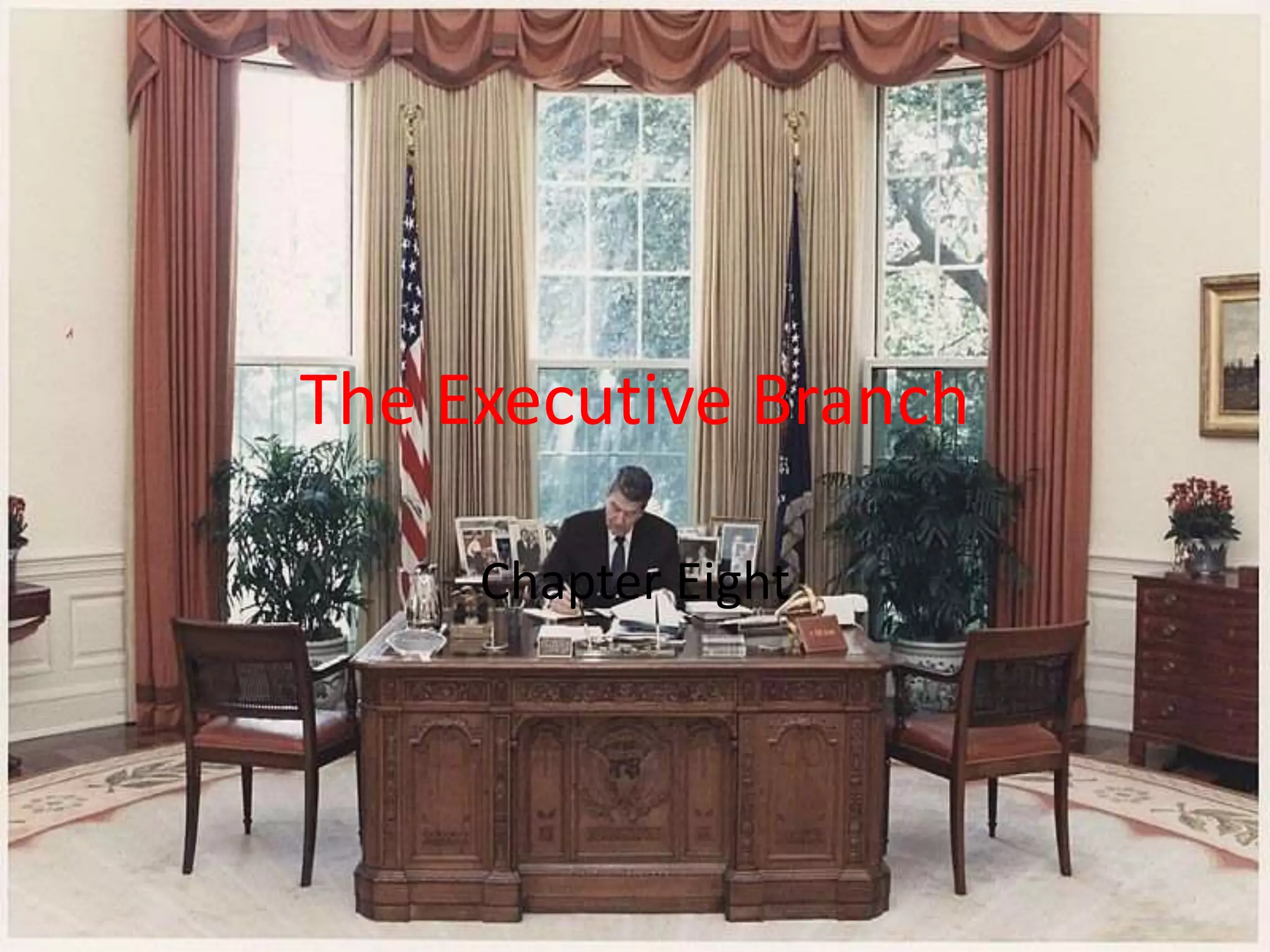
The Executive Branch
Chapter Eight
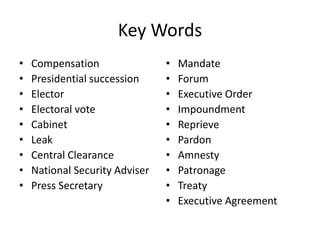
Key Words
• Compensation
• Presidential succession
• Elector
• Electoral vote
• Cabinet
• Leak
• Central Clearance
• National Security Adviser
• Press Secretary
• Mandate
• Forum
• Executive Order
• Impoundment
• Reprieve
• Pardon
• Amnesty
• Patronage
• Treaty
• Executive Agreement
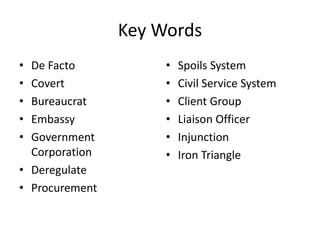
Key Words
• De Facto
• Covert
• Bureaucrat
• Embassy
• Government
Corporation
• Deregulate
• Procurement
• Spoils System
• Civil Service System
• Client Group
• Liaison Officer
• Injunction
• Iron Triangle
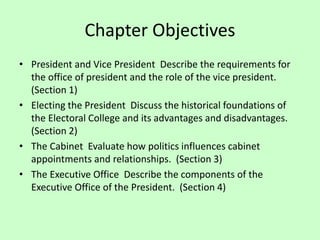
Chapter Objectives
• President and Vice President Describe the requirements for
the office of president and the role of the vice president.
(Section 1)
• Electing the President Discuss the historical foundations of
the Electoral College and its advantages and disadvantages.
(Section 2)
• The Cabinet Evaluate how politics influences cabinet
appointments and relationships. (Section 3)
• The Executive Office Describe the components of the
Executive Office of the President. (Section 4)
Section One
The President
Formal Requirements:
• Must be 35 years old
• Must have resided in
U.S. for 14 years
• Natural born citizen
– Informal “Requirements”:
• White (except current
President)
• Male
• Protestant (except one)
– All manner of professions,
but mostly political ones
(former state governors, for
example)
Election: The Normal Road to the
White House
• Once elected, the president
serves a term of four years.
• In 1951, the 22nd Amendment
limited the number of terms to
two.
• Most Presidents have been
elected to office.
Salary and Benefits
• The Constitution did not
specify the amount of
the president’s
compensation, or
salary, but left the
matter for Congress to
determine
• The President earns a
$400,000 annual salary,
along with a $50,000
annual expense
account, a $100,000
non-taxable travel
account and $19,000
for entertainment.
Other Benefits
• the Secret Service, which is responsible for
protecting the president
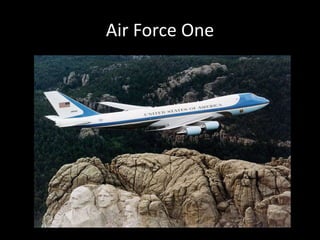
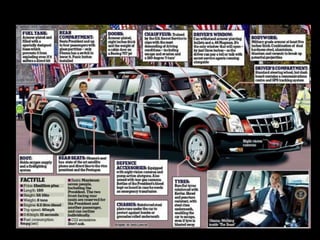
• Air Force One, a specially equipped jet, as well as
other planes, helicopters, and limousines
• free medical, dental, and health care
• residency in the White House, a 132-room
mansion with a swimming pool, bowling alley,
private movie theater, and tennis courts
• a domestic staff which does the cooking,
shopping, cleaning, and other chores for the
president’s family
Air Force One
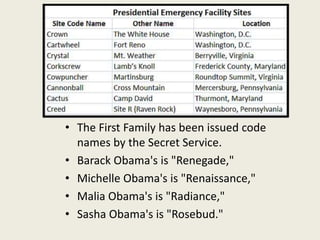
• The First Family has been issued code
names by the Secret Service.
• Barack Obama's is "Renegade,"
• Michelle Obama's is "Renaissance,"
• Malia Obama's is "Radiance,"
• Sasha Obama's is "Rosebud."
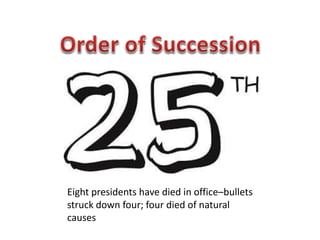
Eight presidents have died in office–bullets
struck down four; four died of natural
causes
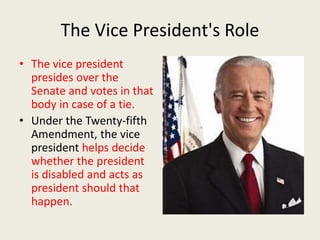
The Vice President's Role
• The vice president
presides over the
Senate and votes in that
body in case of a tie.
• Under the Twenty-fifth
Amendment, the vice
president helps decide
whether the president
is disabled and acts as
president should that
happen.
Modern Responsibilities
• Vice presidents today often
represent the president
overseas, attending state
funerals and other
ceremonial functions. They
serve in a diplomatic role
and visit with heads of
state.
• In addition, vice presidents
may make speeches around
the country defending the
president’s policies and
decisions.
Section Two
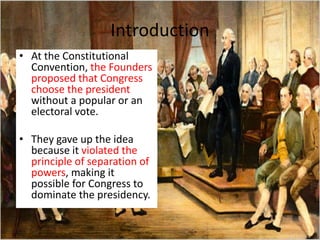
Introduction
• At the Constitutional
Convention, the Founders
proposed that Congress
choose the president
without a popular or an
electoral vote.
• They gave up the idea
because it violated the
principle of separation of
powers, making it
possible for Congress to
dominate the presidency.
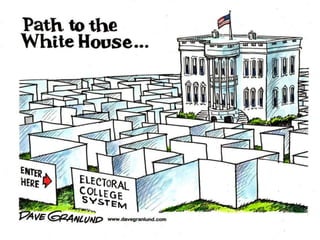
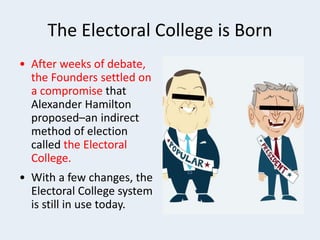
The Electoral College is Born
• After weeks of debate,
the Founders settled on
a compromise that
Alexander Hamilton
proposed–an indirect
method of election
called the Electoral
College.
• With a few changes, the
Electoral College system
is still in use today.
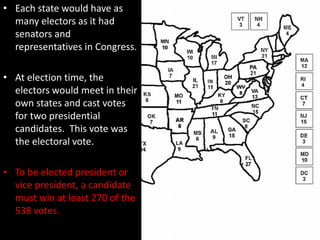
• Each state would have as
many electors as it had
senators and
representatives in Congress.
• At election time, the
electors would meet in their
own states and cast votes
for two presidential
candidates. This vote was
the electoral vote.
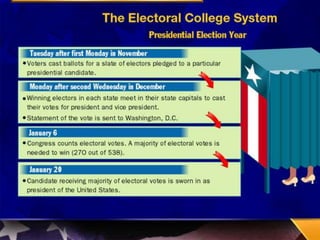
• To be elected president or
vice president, a candidate
must win at least 270 of the
538 votes.
Tie
• The amendment also
provides that if no
candidate receives a
majority of the electoral
votes, the House
chooses from the three
candidates who have
the largest number of
electoral votes.
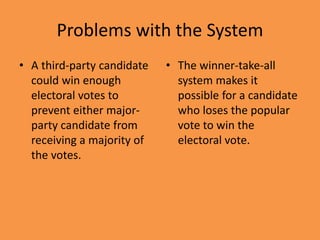
Problems with the System
• A third-party candidate
could win enough
electoral votes to
prevent either major-
party candidate from
receiving a majority of
the votes.
• The winner-take-all
system makes it
possible for a candidate
who loses the popular
vote to win the
electoral vote.
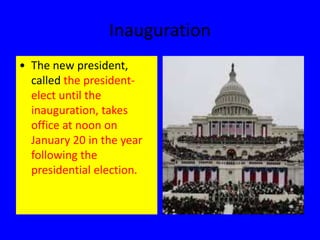
Inauguration
• The new president,
called the president-
elect until the
inauguration, takes
office at noon on
January 20 in the year
following the
presidential election.
Section Three
The Cabinet
Introduction
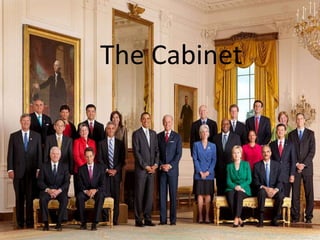
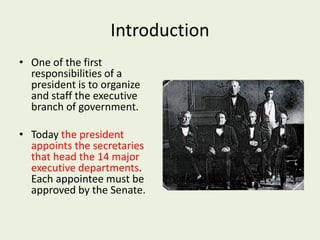
• One of the first
responsibilities of a
president is to organize
and staff the executive
branch of government.
• Today the president
appoints the secretaries
that head the 14 major
executive departments.
Each appointee must be
approved by the Senate.
The Selection Process
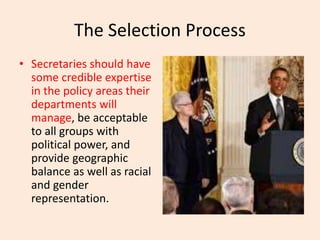
• Secretaries should have
some credible expertise
in the policy areas their
departments will
manage, be acceptable
to all groups with
political power, and
provide geographic
balance as well as racial
and gender
representation.
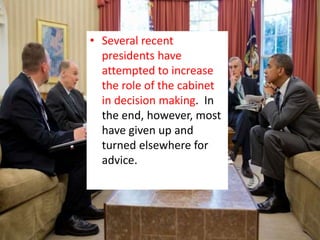
• Several recent
presidents have
attempted to increase
the role of the cabinet
in decision making. In
the end, however, most
have given up and
turned elsewhere for
advice.
Loyalty
• Even though the
president appoints
them, cabinet officials
have three other
constituencies that
require loyalty
1. career officials in
their own
department
2. members of
Congress
3. special-interest
groups
Cabinet level positions qualify for Level
I pay, which was set at an annual salary
of $199,700 in 2011. Some Cabinet-
level officials, including the Vice
President and the White House Chief
of Staff, have their salaries determined
differently.
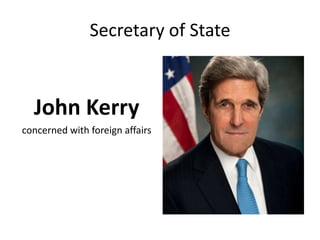
Secretary of State
John Kerry
concerned with foreign affairs
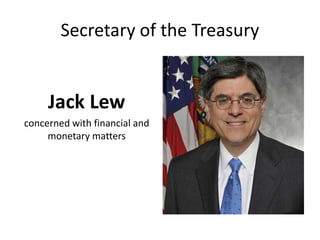
Secretary of the Treasury
Jack Lew
concerned with financial and
monetary matters
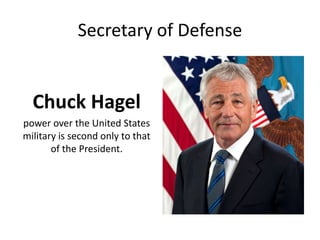
Secretary of Defense
Chuck Hagel
power over the United States
military is second only to that
of the President.
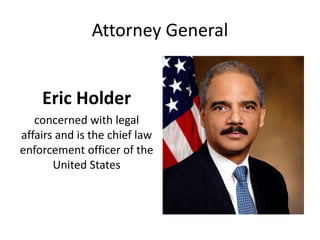
Attorney General
Eric Holder
concerned with legal
affairs and is the chief law
enforcement officer of the
United States
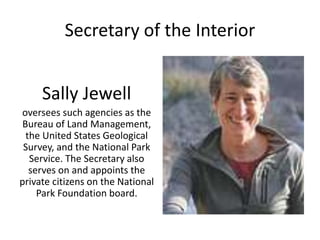
Secretary of the Interior
Sally Jewell
oversees such agencies as the
Bureau of Land Management,
the United States Geological
Survey, and the National Park
Service. The Secretary also
serves on and appoints the
private citizens on the National
Park Foundation board.
Secretary of Agriculture
Tom Vilsack
The 297,000 mi2 (770,000
km²) of national forests and
grasslands are managed by the
United States Forest Service.
The safety of food produced
that are produced in the
United States and sold here is
ensured by the United States
Food Safety and Inspection
Service.[3] The Food Stamp
Program
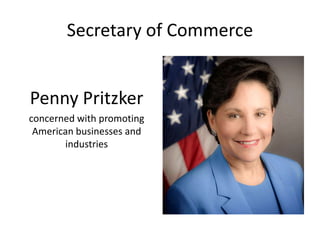
Secretary of Commerce
Penny Pritzker
concerned with promoting
American businesses and
industries
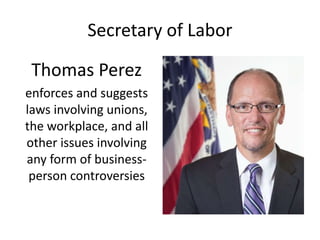
Secretary of Labor
Thomas Perez
enforces and suggests
laws involving unions,
the workplace, and all
other issues involving
any form of business-
person controversies
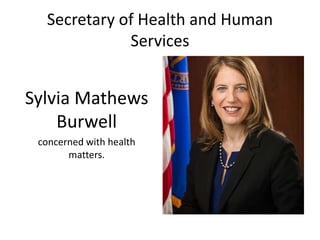
Secretary of Health and Human
Services
Sylvia Mathews
Burwell
concerned with health
matters.
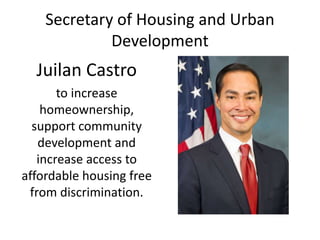
Secretary of Housing and Urban
Development
Juilan Castro
to increase
homeownership,
support community
development and
increase access to
affordable housing free
from discrimination.
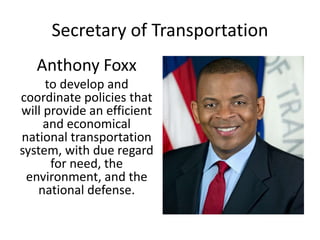
Secretary of Transportation
Anthony Foxx
to develop and
coordinate policies that
will provide an efficient
and economical
national transportation
system, with due regard
for need, the
environment, and the
national defense.
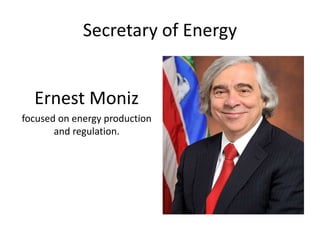
Secretary of Energy
Ernest Moniz
focused on energy production
and regulation.
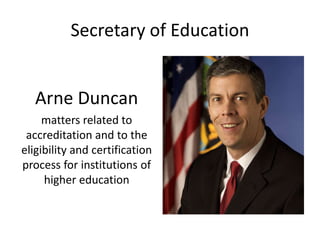
Secretary of Education
Arne Duncan
matters related to
accreditation and to the
eligibility and certification
process for institutions of
higher education
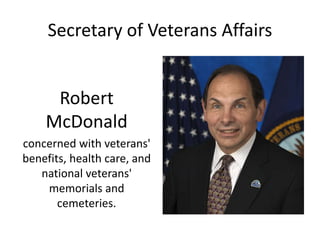
Secretary of Veterans Affairs
Robert
McDonald
concerned with veterans'
benefits, health care, and
national veterans'
memorials and
cemeteries.
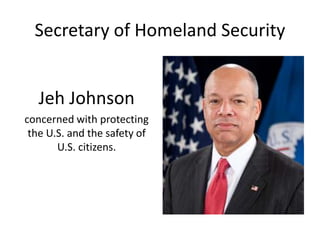
Secretary of Homeland Security
Jeh Johnson
concerned with protecting
the U.S. and the safety of
U.S. citizens.
CHAPTER NINE
Presidential Leadership
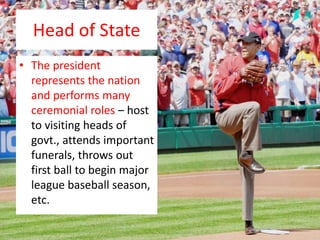
Head of State
• The president
represents the nation
and performs many
ceremonial roles – host
to visiting heads of
govt., attends important
funerals, throws out
first ball to begin major
league baseball season,
etc.
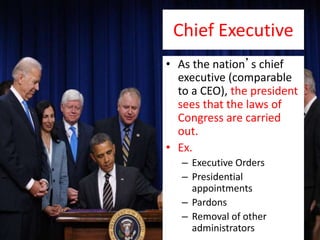
Chief Executive
• As the nation’s chief
executive (comparable
to a CEO), the president
sees that the laws of
Congress are carried
out.
• Ex.
– Executive Orders
– Presidential
appointments
– Pardons
– Removal of other
administrators
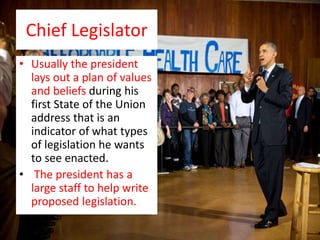
Chief Legislator
• Usually the president
lays out a plan of values
and beliefs during his
first State of the Union
address that is an
indicator of what types
of legislation he wants
to see enacted.
• The president has a
large staff to help write
proposed legislation.
Party Leader
• President is expected to
campaign for his
party’s candidates.
• President selects
party’s national
chairperson.
• Presidents are
expected to appoint
members of their party
to available government
jobs – patronage.
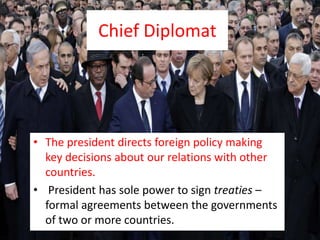
Chief Diplomat
• The president directs foreign policy making
key decisions about our relations with other
countries.
• President has sole power to sign treaties –
formal agreements between the governments
of two or more countries.
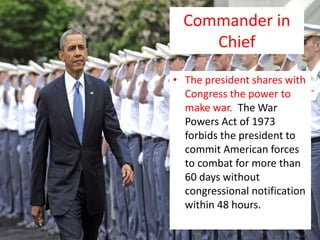
Commander in
Chief
• The president shares with
Congress the power to
make war. The War
Powers Act of 1973
forbids the president to
commit American forces
to combat for more than
60 days without
congressional notification
within 48 hours.
Head of State
Chief Legislator
Party Leader
Chief Diplomat
Commander in Chief

The Executive Branch

  • 1.
  • 2.
    Key Words • Compensation •Presidential succession • Elector • Electoral vote • Cabinet • Leak • Central Clearance • National Security Adviser • Press Secretary • Mandate • Forum • Executive Order • Impoundment • Reprieve • Pardon • Amnesty • Patronage • Treaty • Executive Agreement
  • 3.
    Key Words • DeFacto • Covert • Bureaucrat • Embassy • Government Corporation • Deregulate • Procurement • Spoils System • Civil Service System • Client Group • Liaison Officer • Injunction • Iron Triangle
  • 4.
    Chapter Objectives • Presidentand Vice President Describe the requirements for the office of president and the role of the vice president. (Section 1) • Electing the President Discuss the historical foundations of the Electoral College and its advantages and disadvantages. (Section 2) • The Cabinet Evaluate how politics influences cabinet appointments and relationships. (Section 3) • The Executive Office Describe the components of the Executive Office of the President. (Section 4)
  • 5.
  • 6.
    The President Formal Requirements: •Must be 35 years old • Must have resided in U.S. for 14 years • Natural born citizen – Informal “Requirements”: • White (except current President) • Male • Protestant (except one) – All manner of professions, but mostly political ones (former state governors, for example)
  • 7.
    Election: The NormalRoad to the White House • Once elected, the president serves a term of four years. • In 1951, the 22nd Amendment limited the number of terms to two. • Most Presidents have been elected to office.
  • 8.
    Salary and Benefits •The Constitution did not specify the amount of the president’s compensation, or salary, but left the matter for Congress to determine • The President earns a $400,000 annual salary, along with a $50,000 annual expense account, a $100,000 non-taxable travel account and $19,000 for entertainment.
  • 9.
    Other Benefits • theSecret Service, which is responsible for protecting the president • Air Force One, a specially equipped jet, as well as other planes, helicopters, and limousines • free medical, dental, and health care • residency in the White House, a 132-room mansion with a swimming pool, bowling alley, private movie theater, and tennis courts • a domestic staff which does the cooking, shopping, cleaning, and other chores for the president’s family
  • 10.
  • 12.
    • The FirstFamily has been issued code names by the Secret Service. • Barack Obama's is "Renegade," • Michelle Obama's is "Renaissance," • Malia Obama's is "Radiance," • Sasha Obama's is "Rosebud."
  • 13.
    Eight presidents havedied in office–bullets struck down four; four died of natural causes
  • 14.
    The Vice President'sRole • The vice president presides over the Senate and votes in that body in case of a tie. • Under the Twenty-fifth Amendment, the vice president helps decide whether the president is disabled and acts as president should that happen.
  • 15.
    Modern Responsibilities • Vicepresidents today often represent the president overseas, attending state funerals and other ceremonial functions. They serve in a diplomatic role and visit with heads of state. • In addition, vice presidents may make speeches around the country defending the president’s policies and decisions.
  • 16.
  • 18.
    Introduction • At theConstitutional Convention, the Founders proposed that Congress choose the president without a popular or an electoral vote. • They gave up the idea because it violated the principle of separation of powers, making it possible for Congress to dominate the presidency.
  • 19.
    The Electoral Collegeis Born • After weeks of debate, the Founders settled on a compromise that Alexander Hamilton proposed–an indirect method of election called the Electoral College. • With a few changes, the Electoral College system is still in use today.
  • 20.
    • Each statewould have as many electors as it had senators and representatives in Congress. • At election time, the electors would meet in their own states and cast votes for two presidential candidates. This vote was the electoral vote. • To be elected president or vice president, a candidate must win at least 270 of the 538 votes.
  • 21.
    Tie • The amendmentalso provides that if no candidate receives a majority of the electoral votes, the House chooses from the three candidates who have the largest number of electoral votes.
  • 23.
    Problems with theSystem • A third-party candidate could win enough electoral votes to prevent either major- party candidate from receiving a majority of the votes. • The winner-take-all system makes it possible for a candidate who loses the popular vote to win the electoral vote.
  • 24.
    Inauguration • The newpresident, called the president- elect until the inauguration, takes office at noon on January 20 in the year following the presidential election.
  • 25.
  • 26.
  • 27.
    Introduction • One ofthe first responsibilities of a president is to organize and staff the executive branch of government. • Today the president appoints the secretaries that head the 14 major executive departments. Each appointee must be approved by the Senate.
  • 28.
    The Selection Process •Secretaries should have some credible expertise in the policy areas their departments will manage, be acceptable to all groups with political power, and provide geographic balance as well as racial and gender representation.
  • 29.
    • Several recent presidentshave attempted to increase the role of the cabinet in decision making. In the end, however, most have given up and turned elsewhere for advice.
  • 30.
    Loyalty • Even thoughthe president appoints them, cabinet officials have three other constituencies that require loyalty 1. career officials in their own department 2. members of Congress 3. special-interest groups
  • 31.
    Cabinet level positionsqualify for Level I pay, which was set at an annual salary of $199,700 in 2011. Some Cabinet- level officials, including the Vice President and the White House Chief of Staff, have their salaries determined differently.
  • 32.
    Secretary of State JohnKerry concerned with foreign affairs
  • 33.
    Secretary of theTreasury Jack Lew concerned with financial and monetary matters
  • 34.
    Secretary of Defense ChuckHagel power over the United States military is second only to that of the President.
  • 35.
    Attorney General Eric Holder concernedwith legal affairs and is the chief law enforcement officer of the United States
  • 36.
    Secretary of theInterior Sally Jewell oversees such agencies as the Bureau of Land Management, the United States Geological Survey, and the National Park Service. The Secretary also serves on and appoints the private citizens on the National Park Foundation board.
  • 37.
    Secretary of Agriculture TomVilsack The 297,000 mi2 (770,000 km²) of national forests and grasslands are managed by the United States Forest Service. The safety of food produced that are produced in the United States and sold here is ensured by the United States Food Safety and Inspection Service.[3] The Food Stamp Program
  • 38.
    Secretary of Commerce PennyPritzker concerned with promoting American businesses and industries
  • 39.
    Secretary of Labor ThomasPerez enforces and suggests laws involving unions, the workplace, and all other issues involving any form of business- person controversies
  • 40.
    Secretary of Healthand Human Services Sylvia Mathews Burwell concerned with health matters.
  • 41.
    Secretary of Housingand Urban Development Juilan Castro to increase homeownership, support community development and increase access to affordable housing free from discrimination.
  • 42.
    Secretary of Transportation AnthonyFoxx to develop and coordinate policies that will provide an efficient and economical national transportation system, with due regard for need, the environment, and the national defense.
  • 43.
    Secretary of Energy ErnestMoniz focused on energy production and regulation.
  • 44.
    Secretary of Education ArneDuncan matters related to accreditation and to the eligibility and certification process for institutions of higher education
  • 45.
    Secretary of VeteransAffairs Robert McDonald concerned with veterans' benefits, health care, and national veterans' memorials and cemeteries.
  • 46.
    Secretary of HomelandSecurity Jeh Johnson concerned with protecting the U.S. and the safety of U.S. citizens.
  • 47.
  • 48.
    Head of State •The president represents the nation and performs many ceremonial roles – host to visiting heads of govt., attends important funerals, throws out first ball to begin major league baseball season, etc.
  • 49.
    Chief Executive • Asthe nation’s chief executive (comparable to a CEO), the president sees that the laws of Congress are carried out. • Ex. – Executive Orders – Presidential appointments – Pardons – Removal of other administrators
  • 50.
    Chief Legislator • Usuallythe president lays out a plan of values and beliefs during his first State of the Union address that is an indicator of what types of legislation he wants to see enacted. • The president has a large staff to help write proposed legislation.
  • 51.
    Party Leader • Presidentis expected to campaign for his party’s candidates. • President selects party’s national chairperson. • Presidents are expected to appoint members of their party to available government jobs – patronage.
  • 52.
    Chief Diplomat • Thepresident directs foreign policy making key decisions about our relations with other countries. • President has sole power to sign treaties – formal agreements between the governments of two or more countries.
  • 53.
    Commander in Chief • Thepresident shares with Congress the power to make war. The War Powers Act of 1973 forbids the president to commit American forces to combat for more than 60 days without congressional notification within 48 hours.
  • 54.
    Head of State ChiefLegislator Party Leader Chief Diplomat Commander in Chief