THE EXECUTIVE BRANCH
By: Christian, Kristina, and Zoe
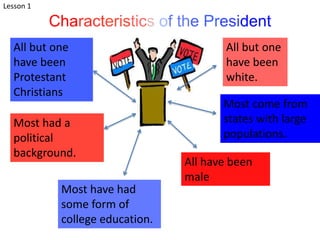
Characteristics of the President
Lesson 1
All have been
male
All but one
have been
Protestant
Christians
Most have had
some form of
college education.
Most had a
political
background.
Most come from
states with large
populations.
All but one
have been
white.
The Election Process
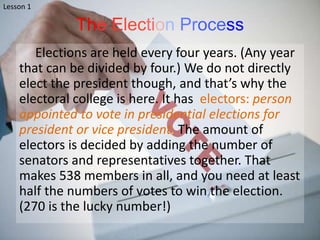
Elections are held every four years. (Any year
that can be divided by four.) We do not directly
elect the president though, and that’s why the
electoral college is here. It has electors: person
appointed to vote in presidential elections for
president or vice president. The amount of
electors is decided by adding the number of
senators and representatives together. That
makes 538 members in all, and you need at least
half the numbers of votes to win the election.
(270 is the lucky number!)
Lesson 1
The Election Process (Continued)
The electors are usually chosen by the leading
political party in each state by a convention or
committee meeting, and always vote for their
political party. The results are displayed: or shown
in November.
The method used for the electoral vote from
each state is called: winner-takes-all.
If it is a tie, the small states can add votes to find
the outcome: or result. And if there is still a tie, the
house of representatives gets to vote. Although
this has only happened twice in our history.
Lesson 1
Terms in Office and Benefits.
• The president can serve up to 2
four year terms. This was
decided with the 22 amendment
in 1951, that way no president
could hold too much power and
stay in office for too long.
• The president is paid 400,000
dollars as a salary, but can
receive more for vacations and
what not.
• He lives in the white house, (in
which he has 80 staff members)
and has use of Camp David.
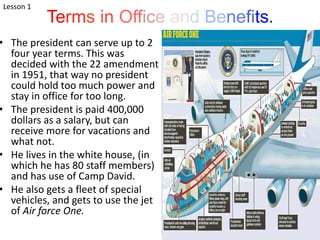
• He also gets a fleet of special
vehicles, and gets to use the jet
of Air force One.
Lesson 1
The Vice President
• The Vice President is voted for by the electoral
college the same time and procedure as the
president is.
• Although there isn't much power handed to
the vice president, the constitution gives
him/her the power to:
– Over see the Senate
– Can vote in the case of a tie
– Takes the place of president if need be
– Makes sure the president isn't disabled in office.
Lesson 1
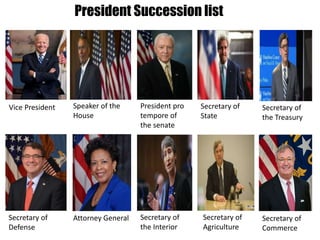
Presidential Succession
In the event that the president dies, or
resigns: gives up his/her position. The
Presidential Succession Act, and the 25
amendment made it clear what would happen
in the event of the president leaving his
position. On the next slide is the list of
succession! 
Lesson 1
President Succession list
Vice President Speaker of the
House
President pro
tempore of
the senate
Secretary of
State
Secretary of
the Treasury
Secretary of
Defense
Attorney General Secretary of
the Interior
Secretary of
Agriculture
Secretary of
Commerce
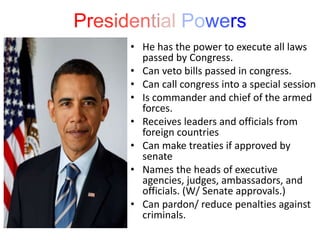
Presidential Powers
• He has the power to execute all laws
passed by Congress.
• Can veto bills passed in congress.
• Can call congress into a special session
• Is commander and chief of the armed
forces.
• Receives leaders and officials from
foreign countries
• Can make treaties if approved by
senate
• Names the heads of executive
agencies, judges, ambassadors, and
officials. (W/ Senate approvals.)
• Can pardon/ reduce penalties against
criminals.
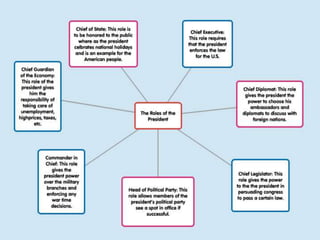
What is the Presidents Job?
The president has more jobs than the powers
listed on the previous slide, for one, he/she is the
head of the Executive Branch, and is one of the 2
government officials elected by the nation. It is
also his/her job to represent, and be a symbol of
our country, he/she is also required: to have a
need for or to order by the Constitution, to tell
congress the “state of the union.”
Chief Executive Duties
The presidents foremost job is to carry out the
nations laws. To help him/her accomplish this
heavy task he has a cabinet of 15 different
departments or agencies. The president uses
executive order: A rule or command the President
gives out that has the same power and force as
law. He/she uses executive law to help carry out
the policies set out by congress and make fast
decisions when necessary. He/she also pick
Supreme Court justices, which usually share the
same ideals as him/her.
Power to Grant Pardons
• Other Powers given to the president are:
• Pardon: declares forgiveness and freedom
from punishment
• Reprieve: Order delays punishing a person
until a higher court can hear the case
• Amnesty: a pardon for a large group of
people.
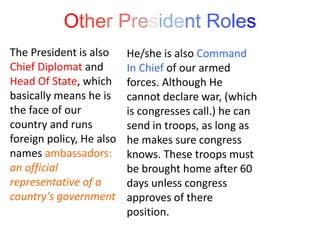
Other President Roles
The President is also
Chief Diplomat and
Head Of State, which
basically means he is
the face of our
country and runs
foreign policy, He also
names ambassadors:
an official
representative of a
country's government
He/she is also Command
In Chief of our armed
forces. Although He
cannot declare war, (which
is congresses call.) he can
send in troops, as long as
he makes sure congress
knows. These troops must
be brought home after 60
days unless congress
approves of there
position.
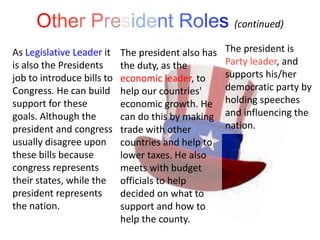
Other President Roles (continued)
As Legislative Leader it
is also the Presidents
job to introduce bills to
Congress. He can build
support for these
goals. Although the
president and congress
usually disagree upon
these bills because
congress represents
their states, while the
president represents
the nation.
The president also has
the duty, as the
economic leader, to
help our countries'
economic growth. He
can do this by making
trade with other
countries and help to
lower taxes. He also
meets with budget
officials to help
decided on what to
support and how to
help the county.
The president is
Party leader, and
supports his/her
democratic party by
holding speeches
and influencing the
nation.
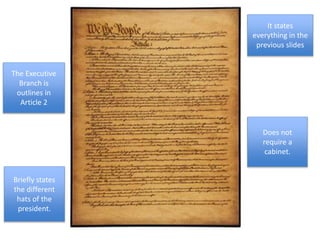
The Executive
Branch is
outlines in
Article 2
It states
everything in the
previous slides
Does not
require a
cabinet.
Briefly states
the different
hats of the
president.
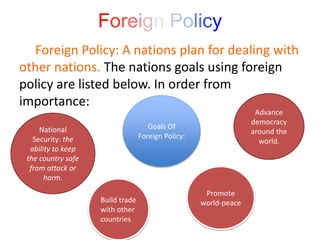
Foreign Policy
Foreign Policy: A nations plan for dealing with
other nations. The nations goals using foreign
policy are listed below. In order from
importance:
Goals Of
Foreign Policy:
Promote
world-peaceBuild trade
with other
countries
National
Security: the
ability to keep
the country safe
from attack or
harm.
Advance
democracy
around the
world.
Foreign Policy Team
The foreign Policy team is made up of:
- The National Security Advisor
-The state Department
- The defense Department
- The National Security Council
- The Office of the Director of National
Intelligence (ODNI)
-Central Intelligence Agency (CIA)
Congress Vs. The President
Because the constitution doesn't state how the
executive branch and congress should work together,
they often argue about who controls what powers.
Things like the Vietnam War tipped things off balance,
the scale is constantly tipping back and fourth
between who has what amount of power. They both
have different methods: or procedures which include:
reaching agreements with other countries and
naming ambassadors. Other methods include giving
foreign aid, making trade policy, and, when needed,
using the military.
Executive Agreements
The president makes treaties: Formal agreements
between the governments of 2 or more countries.
with other countries. Treaties are made aiming for
the goals discussed on the previous slide.
To keep the balance the Senate must approve
any treaty by a 2/3’s vote, in which the senate
makes an executive agreement: And agreement
between the president and the leader of another
country.
Ambassador/Foreign Aid
• The president appoints about 150
• They have to be confirmed by the senate
• They represent our country when the president
cant make an appointment.
• Foreign aid is a toll used to help carry out foreign
policy.
• It consist of food, money, military help, and other
supplies.
International Trade
• Blocking trade is a good way to convince a
nation to change its policies.
• Trade sanctions: effort to punish another
nation by imposing trade barriers. Trade
sanctions are one way to help stop trade.
– One type of trade sanction is embargo: an
agreement among a group of nations that
prohibits them all from trading with a target
nation
– A target nation: is the selected country receiving
the action of another.
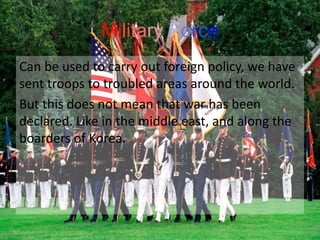
Military Force
Can be used to carry out foreign policy, we have
sent troops to troubled areas around the world.
But this does not mean that war has been
declared. Like in the middle east, and along the
boarders of Korea.
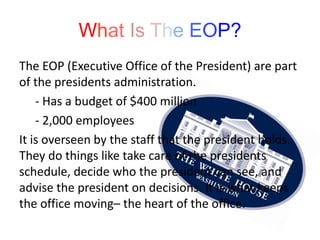
What Is The EOP?
The EOP (Executive Office of the President) are part
of the presidents administration.
- Has a budget of $400 million
- 2,000 employees
It is overseen by the staff that the president holds.
They do things like take care of the presidents
schedule, decide who the president can see, and
advise the president on decisions. It is what keeps
the office moving– the heart of the office.
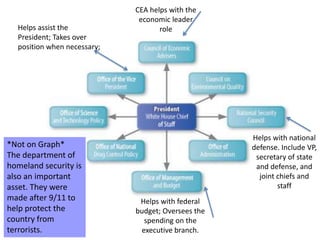
CEA helps with the
economic leader
role
Helps with national
defense. Include VP,
secretary of state
and defense, and
joint chiefs and
staff
Helps with federal
budget; Oversees the
spending on the
executive branch.
Helps assist the
President; Takes over
position when necessary;
*Not on Graph*
The department of
homeland security is
also an important
asset. They were
made after 9/11 to
help protect the
country from
terrorists.
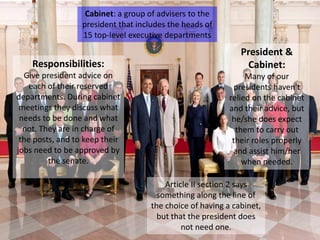
Cabinet: a group of advisers to the
president that includes the heads of
15 top-level executive departments
Article II section 2 says
something along the line of
the choice of having a cabinet,
but that the president does
not need one.
Responsibilities:
Give president advice on
each of their reserved
departments. During cabinet
meetings they discuss what
needs to be done and what
not. They are in charge of
the posts, and to keep their
jobs need to be approved by
the senate.
President &
Cabinet:
Many of our
presidents haven't
relied on the cabinet
and their advice, but
he/she does expect
them to carry out
their roles properly
and assist him/her
when needed.
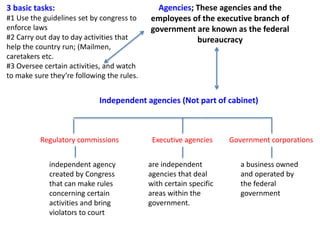
Agencies; These agencies and the
employees of the executive branch of
government are known as the federal
bureaucracy
3 basic tasks:
#1 Use the guidelines set by congress to
enforce laws
#2 Carry out day to day activities that
help the country run; (Mailmen,
caretakers etc.
#3 Oversee certain activities, and watch
to make sure they’re following the rules.
Independent agencies (Not part of cabinet)
Executive agencies Government corporationsRegulatory commissions
are independent
agencies that deal
with certain specific
areas within the
government.
a business owned
and operated by
the federal
government
independent agency
created by Congress
that can make rules
concerning certain
activities and bring
violators to court
Government workers
political appointee
a person appointed to a federal position by the
president; They usually get the top jobs in their
agency. But most times they leave the office the
same time as the president does.
civil service system
the practice of hiring government workers on the
basis of open, competitive examinations and merit;
These people make up about 90% of government
workers, and have more permanent jobs.
spoils system
rewarding people with government jobs on the basis
of their political support; this made hiring unfair and
unqualified and so congress passed the Civil Service
Reform Act of 1883, which created the civil service
system to help protect the people. The cicil service
system is a merit system: hiring people into
government jobs on the basis of their qualifications
Credits
• http://b-i.forbesimg.com/reuvencohen/files/2013/05/300px-US-OfficeOfManagementAndBudget-Seal.svg_.png
• http://www.awesomedanner.com/uploads/5/8/6/4/5864055/9652369_orig.png?237
• http://images.clipartpanda.com/ms-office-clipart-292945.jpg
• http://www.unh.edu/news/releases/2015/02/images/vp_portrait-2441_360.jpg
• https://usatelections.files.wordpress.com/2015/01/boehner-2015.jpg?w=1000&h=667
• http://upload.wikimedia.org/wikipedia/commons/8/8a/Orrin_Hatch,_official_110th_Congress_photo.jpg
• https://lintvwavy.files.wordpress.com/2015/05/ec51c7c71fc09814750f6a706700feb8.jpg?w=512
• http://www.brookings.edu/~/media/Multimedia/Video/Thumbnails/2015/01/20150121_Hutcins.jpg
• http://upload.wikimedia.org/wikipedia/commons/8/89/Ash_Carter_DOD_Secretary_Portrait.jpg
• http://www.sfweekly.com/imager/b/blog/3363284/a827/Loretta_Lynch.jpg?cb=1422481548
• http://www.usnews.com/dims4/USNEWS/eb9ef15/2147483647/resize/652x%3E/quality/85/?url=%2Fcmsmedia%2F5a%2Fe0%2F3625dda44f3db49
0c89aad7b3dac%2F150317-jewell-editorial.jpg
• http://www.gannett-cdn.com/-mm-/43b40dfca22c36bfd36b35b1ac30ebe153ba5340/c=301-0-4897-3456&r=x404&c=534x401/local/-
/media/DesMoines/2015/01/19/B9315930267Z.1_20150119191857_000_GID9NIIKA.1-0.jpg
• https://www.nccommerce.com/Portals/0/Images/MgmtTeamHeadshots/John-E-Skvarla-200x250.png
• http://upload.wikimedia.org/wikipedia/commons/e/e9/Official_portrait_of_Barack_Obama.jpg
• http://upload.wikimedia.org/wikipedia/commons/b/b2/United_States_Capitol_-_west_front.jpg
• http://cdn.diginomica.com/wp-content/uploads/2014/09/vote.jpg
• http://newswave.eu/wordpress/wp-content/uploads/2014/07/voting.jpg
• http://tamil.drivespark.com/img/2015/01/x20-1421749124-air-force-one-03.jpg.pagespeed.ic.nLQVp0vztQ.jpg
• http://sr.photos2.fotosearch.com/bthumb/FSD/FSD090/x16090630.jpg
• http://www.outsidethebeltway.com/wp-content/uploads/2012/07/obama-boehner-pelosi.jpg
• http://upload.wikimedia.org/wikipedia/commons/f/fa/US_Cabinet_official_group_photo_July_26,_2012.jpg

Executive branch presentation

  • 1.
    THE EXECUTIVE BRANCH By:Christian, Kristina, and Zoe
  • 2.
    Characteristics of thePresident Lesson 1 All have been male All but one have been Protestant Christians Most have had some form of college education. Most had a political background. Most come from states with large populations. All but one have been white.
  • 3.
    The Election Process Electionsare held every four years. (Any year that can be divided by four.) We do not directly elect the president though, and that’s why the electoral college is here. It has electors: person appointed to vote in presidential elections for president or vice president. The amount of electors is decided by adding the number of senators and representatives together. That makes 538 members in all, and you need at least half the numbers of votes to win the election. (270 is the lucky number!) Lesson 1
  • 4.
    The Election Process(Continued) The electors are usually chosen by the leading political party in each state by a convention or committee meeting, and always vote for their political party. The results are displayed: or shown in November. The method used for the electoral vote from each state is called: winner-takes-all. If it is a tie, the small states can add votes to find the outcome: or result. And if there is still a tie, the house of representatives gets to vote. Although this has only happened twice in our history. Lesson 1
  • 5.
    Terms in Officeand Benefits. • The president can serve up to 2 four year terms. This was decided with the 22 amendment in 1951, that way no president could hold too much power and stay in office for too long. • The president is paid 400,000 dollars as a salary, but can receive more for vacations and what not. • He lives in the white house, (in which he has 80 staff members) and has use of Camp David. • He also gets a fleet of special vehicles, and gets to use the jet of Air force One. Lesson 1
  • 6.
    The Vice President •The Vice President is voted for by the electoral college the same time and procedure as the president is. • Although there isn't much power handed to the vice president, the constitution gives him/her the power to: – Over see the Senate – Can vote in the case of a tie – Takes the place of president if need be – Makes sure the president isn't disabled in office. Lesson 1
  • 7.
    Presidential Succession In theevent that the president dies, or resigns: gives up his/her position. The Presidential Succession Act, and the 25 amendment made it clear what would happen in the event of the president leaving his position. On the next slide is the list of succession!  Lesson 1
  • 8.
    President Succession list VicePresident Speaker of the House President pro tempore of the senate Secretary of State Secretary of the Treasury Secretary of Defense Attorney General Secretary of the Interior Secretary of Agriculture Secretary of Commerce
  • 9.
    Presidential Powers • Hehas the power to execute all laws passed by Congress. • Can veto bills passed in congress. • Can call congress into a special session • Is commander and chief of the armed forces. • Receives leaders and officials from foreign countries • Can make treaties if approved by senate • Names the heads of executive agencies, judges, ambassadors, and officials. (W/ Senate approvals.) • Can pardon/ reduce penalties against criminals.
  • 10.
    What is thePresidents Job? The president has more jobs than the powers listed on the previous slide, for one, he/she is the head of the Executive Branch, and is one of the 2 government officials elected by the nation. It is also his/her job to represent, and be a symbol of our country, he/she is also required: to have a need for or to order by the Constitution, to tell congress the “state of the union.”
  • 11.
    Chief Executive Duties Thepresidents foremost job is to carry out the nations laws. To help him/her accomplish this heavy task he has a cabinet of 15 different departments or agencies. The president uses executive order: A rule or command the President gives out that has the same power and force as law. He/she uses executive law to help carry out the policies set out by congress and make fast decisions when necessary. He/she also pick Supreme Court justices, which usually share the same ideals as him/her.
  • 12.
    Power to GrantPardons • Other Powers given to the president are: • Pardon: declares forgiveness and freedom from punishment • Reprieve: Order delays punishing a person until a higher court can hear the case • Amnesty: a pardon for a large group of people.
  • 13.
    Other President Roles ThePresident is also Chief Diplomat and Head Of State, which basically means he is the face of our country and runs foreign policy, He also names ambassadors: an official representative of a country's government He/she is also Command In Chief of our armed forces. Although He cannot declare war, (which is congresses call.) he can send in troops, as long as he makes sure congress knows. These troops must be brought home after 60 days unless congress approves of there position.
  • 14.
    Other President Roles(continued) As Legislative Leader it is also the Presidents job to introduce bills to Congress. He can build support for these goals. Although the president and congress usually disagree upon these bills because congress represents their states, while the president represents the nation. The president also has the duty, as the economic leader, to help our countries' economic growth. He can do this by making trade with other countries and help to lower taxes. He also meets with budget officials to help decided on what to support and how to help the county. The president is Party leader, and supports his/her democratic party by holding speeches and influencing the nation.
  • 16.
    The Executive Branch is outlinesin Article 2 It states everything in the previous slides Does not require a cabinet. Briefly states the different hats of the president.
  • 17.
    Foreign Policy Foreign Policy:A nations plan for dealing with other nations. The nations goals using foreign policy are listed below. In order from importance: Goals Of Foreign Policy: Promote world-peaceBuild trade with other countries National Security: the ability to keep the country safe from attack or harm. Advance democracy around the world.
  • 18.
    Foreign Policy Team Theforeign Policy team is made up of: - The National Security Advisor -The state Department - The defense Department - The National Security Council - The Office of the Director of National Intelligence (ODNI) -Central Intelligence Agency (CIA)
  • 19.
    Congress Vs. ThePresident Because the constitution doesn't state how the executive branch and congress should work together, they often argue about who controls what powers. Things like the Vietnam War tipped things off balance, the scale is constantly tipping back and fourth between who has what amount of power. They both have different methods: or procedures which include: reaching agreements with other countries and naming ambassadors. Other methods include giving foreign aid, making trade policy, and, when needed, using the military.
  • 20.
    Executive Agreements The presidentmakes treaties: Formal agreements between the governments of 2 or more countries. with other countries. Treaties are made aiming for the goals discussed on the previous slide. To keep the balance the Senate must approve any treaty by a 2/3’s vote, in which the senate makes an executive agreement: And agreement between the president and the leader of another country.
  • 21.
    Ambassador/Foreign Aid • Thepresident appoints about 150 • They have to be confirmed by the senate • They represent our country when the president cant make an appointment. • Foreign aid is a toll used to help carry out foreign policy. • It consist of food, money, military help, and other supplies.
  • 22.
    International Trade • Blockingtrade is a good way to convince a nation to change its policies. • Trade sanctions: effort to punish another nation by imposing trade barriers. Trade sanctions are one way to help stop trade. – One type of trade sanction is embargo: an agreement among a group of nations that prohibits them all from trading with a target nation – A target nation: is the selected country receiving the action of another.
  • 23.
    Military Force Can beused to carry out foreign policy, we have sent troops to troubled areas around the world. But this does not mean that war has been declared. Like in the middle east, and along the boarders of Korea.
  • 24.
    What Is TheEOP? The EOP (Executive Office of the President) are part of the presidents administration. - Has a budget of $400 million - 2,000 employees It is overseen by the staff that the president holds. They do things like take care of the presidents schedule, decide who the president can see, and advise the president on decisions. It is what keeps the office moving– the heart of the office.
  • 25.
    CEA helps withthe economic leader role Helps with national defense. Include VP, secretary of state and defense, and joint chiefs and staff Helps with federal budget; Oversees the spending on the executive branch. Helps assist the President; Takes over position when necessary; *Not on Graph* The department of homeland security is also an important asset. They were made after 9/11 to help protect the country from terrorists.
  • 26.
    Cabinet: a groupof advisers to the president that includes the heads of 15 top-level executive departments Article II section 2 says something along the line of the choice of having a cabinet, but that the president does not need one. Responsibilities: Give president advice on each of their reserved departments. During cabinet meetings they discuss what needs to be done and what not. They are in charge of the posts, and to keep their jobs need to be approved by the senate. President & Cabinet: Many of our presidents haven't relied on the cabinet and their advice, but he/she does expect them to carry out their roles properly and assist him/her when needed.
  • 27.
    Agencies; These agenciesand the employees of the executive branch of government are known as the federal bureaucracy 3 basic tasks: #1 Use the guidelines set by congress to enforce laws #2 Carry out day to day activities that help the country run; (Mailmen, caretakers etc. #3 Oversee certain activities, and watch to make sure they’re following the rules. Independent agencies (Not part of cabinet) Executive agencies Government corporationsRegulatory commissions are independent agencies that deal with certain specific areas within the government. a business owned and operated by the federal government independent agency created by Congress that can make rules concerning certain activities and bring violators to court
  • 28.
    Government workers political appointee aperson appointed to a federal position by the president; They usually get the top jobs in their agency. But most times they leave the office the same time as the president does. civil service system the practice of hiring government workers on the basis of open, competitive examinations and merit; These people make up about 90% of government workers, and have more permanent jobs. spoils system rewarding people with government jobs on the basis of their political support; this made hiring unfair and unqualified and so congress passed the Civil Service Reform Act of 1883, which created the civil service system to help protect the people. The cicil service system is a merit system: hiring people into government jobs on the basis of their qualifications
  • 29.
    Credits • http://b-i.forbesimg.com/reuvencohen/files/2013/05/300px-US-OfficeOfManagementAndBudget-Seal.svg_.png • http://www.awesomedanner.com/uploads/5/8/6/4/5864055/9652369_orig.png?237 •http://images.clipartpanda.com/ms-office-clipart-292945.jpg • http://www.unh.edu/news/releases/2015/02/images/vp_portrait-2441_360.jpg • https://usatelections.files.wordpress.com/2015/01/boehner-2015.jpg?w=1000&h=667 • http://upload.wikimedia.org/wikipedia/commons/8/8a/Orrin_Hatch,_official_110th_Congress_photo.jpg • https://lintvwavy.files.wordpress.com/2015/05/ec51c7c71fc09814750f6a706700feb8.jpg?w=512 • http://www.brookings.edu/~/media/Multimedia/Video/Thumbnails/2015/01/20150121_Hutcins.jpg • http://upload.wikimedia.org/wikipedia/commons/8/89/Ash_Carter_DOD_Secretary_Portrait.jpg • http://www.sfweekly.com/imager/b/blog/3363284/a827/Loretta_Lynch.jpg?cb=1422481548 • http://www.usnews.com/dims4/USNEWS/eb9ef15/2147483647/resize/652x%3E/quality/85/?url=%2Fcmsmedia%2F5a%2Fe0%2F3625dda44f3db49 0c89aad7b3dac%2F150317-jewell-editorial.jpg • http://www.gannett-cdn.com/-mm-/43b40dfca22c36bfd36b35b1ac30ebe153ba5340/c=301-0-4897-3456&r=x404&c=534x401/local/- /media/DesMoines/2015/01/19/B9315930267Z.1_20150119191857_000_GID9NIIKA.1-0.jpg • https://www.nccommerce.com/Portals/0/Images/MgmtTeamHeadshots/John-E-Skvarla-200x250.png • http://upload.wikimedia.org/wikipedia/commons/e/e9/Official_portrait_of_Barack_Obama.jpg • http://upload.wikimedia.org/wikipedia/commons/b/b2/United_States_Capitol_-_west_front.jpg • http://cdn.diginomica.com/wp-content/uploads/2014/09/vote.jpg • http://newswave.eu/wordpress/wp-content/uploads/2014/07/voting.jpg • http://tamil.drivespark.com/img/2015/01/x20-1421749124-air-force-one-03.jpg.pagespeed.ic.nLQVp0vztQ.jpg • http://sr.photos2.fotosearch.com/bthumb/FSD/FSD090/x16090630.jpg • http://www.outsidethebeltway.com/wp-content/uploads/2012/07/obama-boehner-pelosi.jpg • http://upload.wikimedia.org/wikipedia/commons/f/fa/US_Cabinet_official_group_photo_July_26,_2012.jpg