Aquinas College Economics Department
International Trade
Trade between nations and the
Theories of Absolute and
Comparative Advantage
ECON4
Aquinas College Economics Department
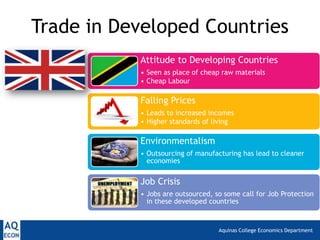
Trade in Developed Countries
Attitude to Developing Countries
• Seen as place of cheap raw materials
• Cheap Labour
Falling Prices
• Leads to increased incomes
• Higher standards of living
Environmentalism
• Outsourcing of manufacturing has lead to cleaner
economies
Job Crisis
• Jobs are outsourced, so some call for Job Protection
in these developed countries
Aquinas College Economics Department
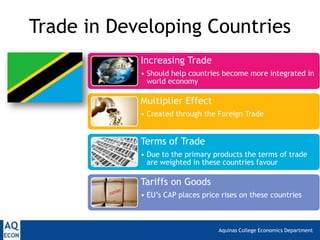
Trade in Developing Countries
Increasing Trade
• Should help countries become more integrated in
world economy
Multiplier Effect
• Created through the Foreign Trade
Terms of Trade
• Due to the primary products the terms of trade
are weighted in these countries favour
Tariffs on Goods
• EU’s CAP places price rises on these countries
Aquinas College Economics Department
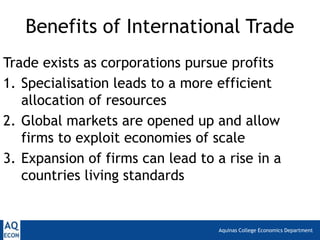
Benefits of International Trade
Trade exists as corporations pursue profits
1. Specialisation leads to a more efficient
allocation of resources
2. Global markets are opened up and allow
firms to exploit economies of scale
3. Expansion of firms can lead to a rise in a
countries living standards
Aquinas College Economics Department
Theory of Absolute Advantage
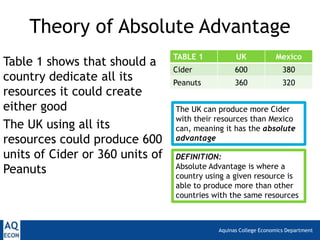
TABLE 1 UK Mexico
Cider 600 380
Peanuts 360 320
Table 1 shows that should a
country dedicate all its
resources it could create
either good
The UK using all its
resources could produce 600
units of Cider or 360 units of
Peanuts
The UK can produce more Cider
with their resources than Mexico
can, meaning it has the absolute
advantage
DEFINITION:
Absolute Advantage is where a
country using a given resource is
able to produce more than other
countries with the same resources
Aquinas College Economics Department
Self Sufficiency
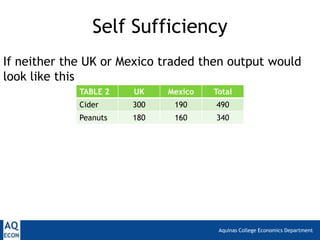
TABLE 2 UK Mexico Total
Cider 300 190 490
Peanuts 180 160 340
If neither the UK or Mexico traded then output would
look like this
Aquinas College Economics Department
Theory of Comparative Advantage
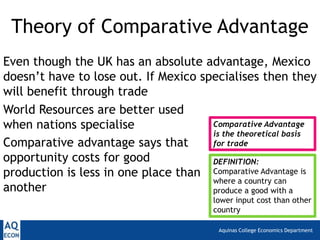
Even though the UK has an absolute advantage, Mexico
doesn’t have to lose out. If Mexico specialises then they
will benefit through trade
DEFINITION:
Comparative Advantage is
where a country can
produce a good with a
lower input cost than other
country
Comparative Advantage
is the theoretical basis
for trade
World Resources are better used
when nations specialise
Comparative advantage says that
opportunity costs for good
production is less in one place than
another
Aquinas College Economics Department
Comparative Advantage
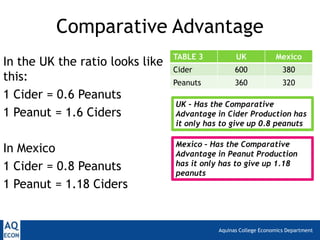
TABLE 3 UK Mexico
Cider 600 380
Peanuts 360 320
In the UK the ratio looks like
this:
1 Cider = 0.6 Peanuts
1 Peanut = 1.6 Ciders
In Mexico
1 Cider = 0.8 Peanuts
1 Peanut = 1.18 Ciders
UK – Has the Comparative
Advantage in Cider Production has
it only has to give up 0.8 peanuts
Mexico – Has the Comparative
Advantage in Peanut Production
has it only has to give up 1.18
peanuts
Aquinas College Economics Department
Comparative Advantage
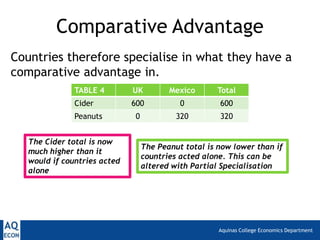
TABLE 4 UK Mexico Total
Cider 600 0 600
Peanuts 0 320 320
Countries therefore specialise in what they have a
comparative advantage in.
The Cider total is now
much higher than it
would if countries acted
alone
The Peanut total is now lower than if
countries acted alone. This can be
altered with Partial Specialisation
Aquinas College Economics Department
Partial Specialisation
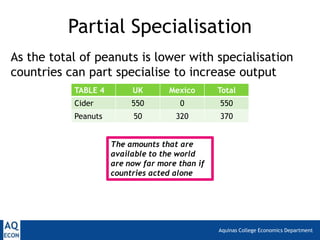
TABLE 4 UK Mexico Total
Cider 550 0 550
Peanuts 50 320 370
As the total of peanuts is lower with specialisation
countries can part specialise to increase output
The amounts that are
available to the world
are now far more than if
countries acted alone

International Trade

  • 1.
    Aquinas College EconomicsDepartment International Trade Trade between nations and the Theories of Absolute and Comparative Advantage ECON4
  • 2.
    Aquinas College EconomicsDepartment Trade in Developed Countries Attitude to Developing Countries • Seen as place of cheap raw materials • Cheap Labour Falling Prices • Leads to increased incomes • Higher standards of living Environmentalism • Outsourcing of manufacturing has lead to cleaner economies Job Crisis • Jobs are outsourced, so some call for Job Protection in these developed countries
  • 3.
    Aquinas College EconomicsDepartment Trade in Developing Countries Increasing Trade • Should help countries become more integrated in world economy Multiplier Effect • Created through the Foreign Trade Terms of Trade • Due to the primary products the terms of trade are weighted in these countries favour Tariffs on Goods • EU’s CAP places price rises on these countries
  • 4.
    Aquinas College EconomicsDepartment Benefits of International Trade Trade exists as corporations pursue profits 1. Specialisation leads to a more efficient allocation of resources 2. Global markets are opened up and allow firms to exploit economies of scale 3. Expansion of firms can lead to a rise in a countries living standards
  • 5.
    Aquinas College EconomicsDepartment Theory of Absolute Advantage TABLE 1 UK Mexico Cider 600 380 Peanuts 360 320 Table 1 shows that should a country dedicate all its resources it could create either good The UK using all its resources could produce 600 units of Cider or 360 units of Peanuts The UK can produce more Cider with their resources than Mexico can, meaning it has the absolute advantage DEFINITION: Absolute Advantage is where a country using a given resource is able to produce more than other countries with the same resources
  • 6.
    Aquinas College EconomicsDepartment Self Sufficiency TABLE 2 UK Mexico Total Cider 300 190 490 Peanuts 180 160 340 If neither the UK or Mexico traded then output would look like this
  • 7.
    Aquinas College EconomicsDepartment Theory of Comparative Advantage Even though the UK has an absolute advantage, Mexico doesn’t have to lose out. If Mexico specialises then they will benefit through trade DEFINITION: Comparative Advantage is where a country can produce a good with a lower input cost than other country Comparative Advantage is the theoretical basis for trade World Resources are better used when nations specialise Comparative advantage says that opportunity costs for good production is less in one place than another
  • 8.
    Aquinas College EconomicsDepartment Comparative Advantage TABLE 3 UK Mexico Cider 600 380 Peanuts 360 320 In the UK the ratio looks like this: 1 Cider = 0.6 Peanuts 1 Peanut = 1.6 Ciders In Mexico 1 Cider = 0.8 Peanuts 1 Peanut = 1.18 Ciders UK – Has the Comparative Advantage in Cider Production has it only has to give up 0.8 peanuts Mexico – Has the Comparative Advantage in Peanut Production has it only has to give up 1.18 peanuts
  • 9.
    Aquinas College EconomicsDepartment Comparative Advantage TABLE 4 UK Mexico Total Cider 600 0 600 Peanuts 0 320 320 Countries therefore specialise in what they have a comparative advantage in. The Cider total is now much higher than it would if countries acted alone The Peanut total is now lower than if countries acted alone. This can be altered with Partial Specialisation
  • 10.
    Aquinas College EconomicsDepartment Partial Specialisation TABLE 4 UK Mexico Total Cider 550 0 550 Peanuts 50 320 370 As the total of peanuts is lower with specialisation countries can part specialise to increase output The amounts that are available to the world are now far more than if countries acted alone