TYPES OF MEDIA
Different Types of Media
• Print Media
• Broadcast Media or Mass Media
• Internet Media
• Out of Home Media
Add a Slide Title - 1
PRINT MEDIA
Print Media
• is the oldest form of media, and it used to be the only medium
of entertainment back in the 80s and 90s. People depended on
different types of print news media like magazines, newspapers,
and books for all kinds of political, social, entertainment, and
informative news.
• one of the most effective media types to know all kinds of
information about the world or a country. Print media includes
newspapers, magazines, books, and direct mail (including flyers
and postcards).
Newspapers
There are national, regional, and newspapers of specific interest
made by news and organizations for the masses to know about the
world. They spread a large amount of information, to the readers,
especially at low prices.
Newspapers provide instant delivery of news and information and
certain unique features that might interest the readers.
Advantage
• Newspapers enjoy a large number of readers.
• The target audience is local and national.
Disadvantage
• The paper quality is low and cheap.
Magazines
• Magazines are the medium of specialized advertising,
resulting in paying higher for advertisements than
newspapers. Magazines can be categorized into two types
consumer magazines, and business magazines.
• Consumer magazines include information about lifestyle,
glamour, special interests, and the world of entertainment.
Advantage
• Magazines use high-quality paper, unlike newspapers.
• The level of reader engagement is high.
Disadvantage
• Magazines can also prove to be expensive.
Direct Mail
• It is a type of media that delivers informational flyers or performs
promotions through postcards. It ensures the delivery of
information to the customers at their business or home address.
Advantage
• It personalizes the emails for advertisers.
• The audiences are primarily specific.
Disadvantage
• It can be expensive and requires planning.
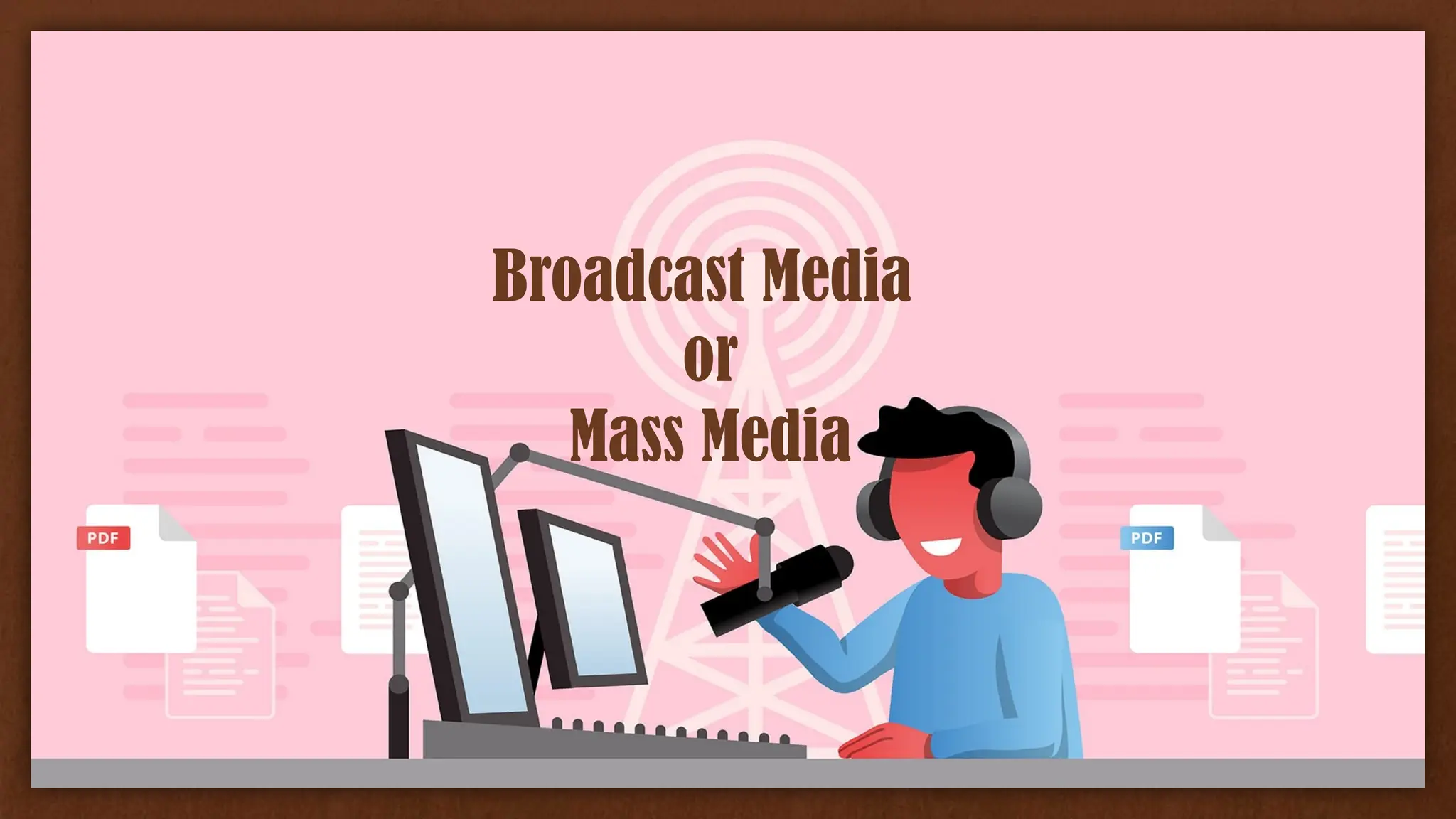
Broadcast Media
or
Mass Media
Broadcast Media or Mass Media
• Broadcast media or mass media also eases the expansion of
information by disseminating it to a larger audience.
• It can conveniently reach illiterate people as it requires just the
visual and auditory sense organs to understand the news played
on radio, television, or movies. Audios, videos, and the written
content are included in broadcasting or mass media.
Television
The invention of the television was done long after the
newspapers were considered the original form of media. It
turned out to be one of the most effective mediums of delivering
information as it was used for various purposes. There were very
few channels available on television for the audience in the past.
However, the tv channels are now largely numbered and are
categorized according to news, drama, children, movies,
entertainment, sports, etc., making it the number one media of
broadcasting.
Merits
• Television has a high rate of viewers.
• Viewers can watch advertisements without extra effort.
Demerits
• Advertisements played on tv cost high.
Radio
The radio waves deliver the news by transmitting the
content to the public. Radio has a high audience reach, so it is
widely used for advertisements of products and brands.
It is the oldest type of media, and people use it today
for knowing weather forecasts and traffic. Radio has extended
coverage as it enjoys millions of listeners across the nation.
Merits
• They have an engaged audience.
• There are few distractions in movie theatres.
Demerits
• The ads played in movies are expensive.
Internet Media /Online
Media/ New Media
Tim Berners Lee invented the World Wide Web in 1989, and
since then, the internet has been taking over other types of
media drastically. It is also known as Digital Media or New
Media.
It is an attractive two-way communication where the users get
to stay active and produce information. The video or audio
content delivered and communicated online comes in Internet
Media. Graphics, interactive elements, words, and images can
be included in this type of media.
Emails
Emails help companies to quickly and easily reach their
customers. They require less research as one doesn’t need to
search for a customer’s email address as they frequently
provide it at sales.
On the other hand, people also have the facility to open or not
open the mails. So few of them might open and visit the
advertising site. Most of them might not prefer even opening
the mail, let alone seeing the site.
Merits
• The sending and receiving messages are free.
• They are pretty easy to create.
Demerits
• The competition is high for advertising.
Social Media
Social media or social networking sites are Instagram,
Facebook, Twitter, Snapchat, YouTube, Quora, etc. People
across the globe frequently and widely use this type of media.
So, it becomes an important medium for companies to market
their products as it is popular and has longevity. Social media
aim to establish interaction and communication, so the ads can
also be quite interactive, increasing the chances of user
engagement.
Merits
• The advertisements on social media are targeted.
• Interacting with customers is free of cost.
Demerits
• Creating a brand and advertising consumes time.
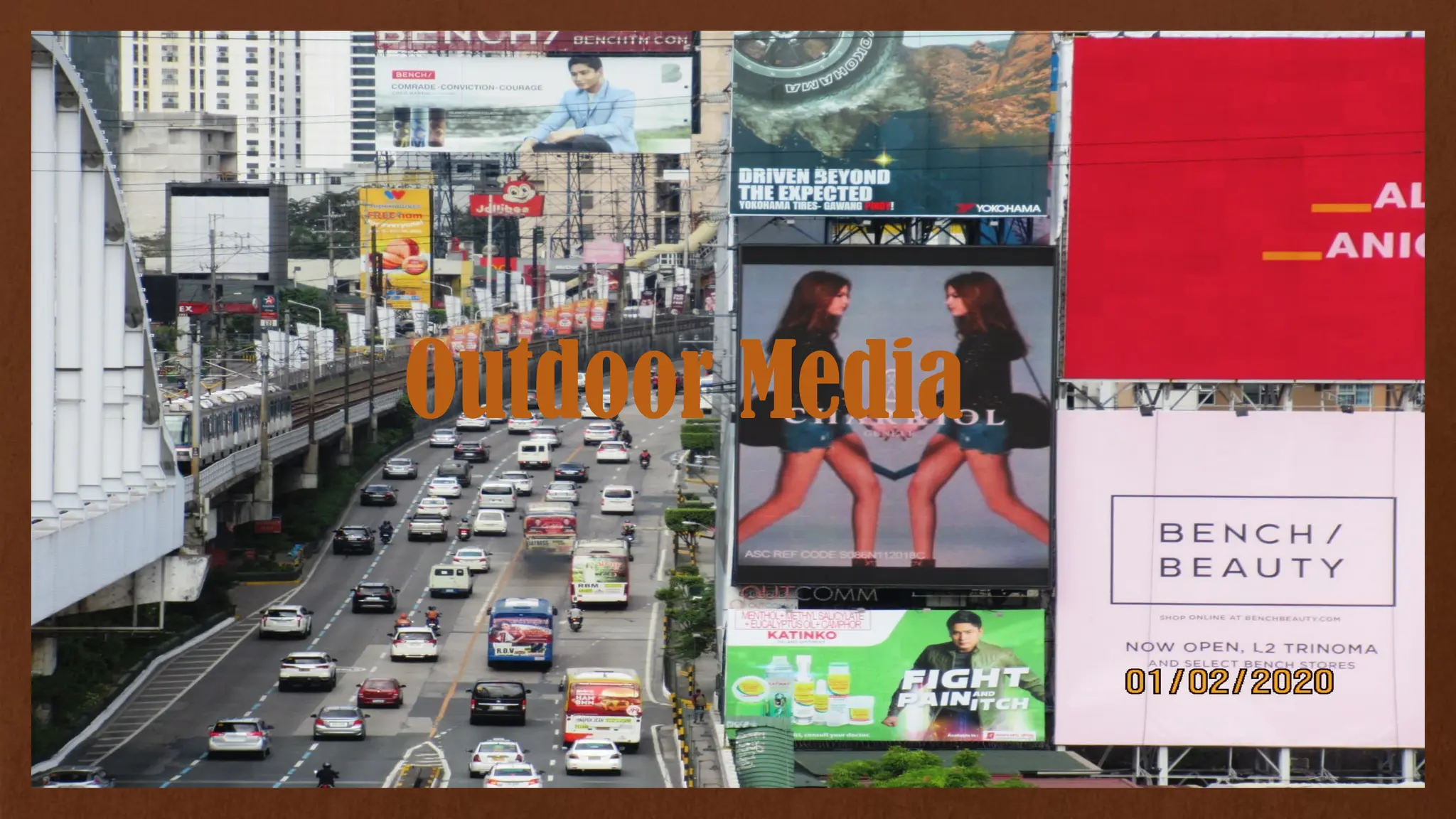
Outdoor Media
Outdoor Media
It is also known as outdoor media and is one of the most prominent
types of media. Home media focuses on delivering the news or
information to the public when they are outdoors.
Advertisements are promoted through display on vehicles, streets, etc.,
which also acquaints the customers with the new arrival of products.
They help in encouraging the masses to contribute to a social cause or
a development in society. It is highly used for advertisements
associated with public welfare and commercials in general.
Billboards
• They make advertising for a product or a cause easier, as they
attract the people who pass by them.
• Billboards are large advertisements created with the help of
computers. They can be found on streets, city sidewalks,
recreation centers, etc.
Merits
• Billboards provide a wider reach for advertisements.
• They can help create impactful messages.
Demerits
• The response rate on billboards is low.
Transit Station Advertisements
Transit media focuses on advertising and delivering
information to people when traveling in public places or are
in transit. It displays the ads on vehicles and other modes of
transportation.
Transit media has the aim of “driving home a message,”
through which it attracts millions of people roaming around
the streets or traveling the world. It might seem like a
traditional method of advertising, but it is effective to date.
Merits
• The reach of transit media is broad.
• They help in impactful messaging.
Demerits
• The performance rate is challenging to measure.
Factors to Consider while choosing Types of Media
• Size, nature, and market presence of business
• Nature or product or service
• Availability of target audiences
• Market requirements
• Availability of media channels
• Competitors’ preferred media types
• Marketing or advertising objectives
• Marketing and advertising budgets
• Nature of message and appeal
• Distribution strategy, etc.
• What do you think is the impact or change that the different types of media
had brought to our lives?
• What do you think is the importance of knowing about the different types of
media?
• What are the differences and similarities of the four types of media?
Learning activity 1: By Understanding the lesson, the students will answer the following questions:
1. In this type of media, people relied on newspapers and magazines to learn everything, from recipes and entertainment
news to important information about the country or the world.
a. Print media
b. Broadcast media
c. Digital/New media
2. In this type of media, contents are categorized and distributed on digital platforms.
d. Print media
e. Broadcast media
f. Digital media
3. Media such as radio and television that reach target audiences using airwaves as transmission medium.
a. Print media
b. Broadcast media
c. Digital media
4. Media consisting of paper and ink, reproduced in a printing process.
d. Print media
e. Broadcast media
f. Digital media
5. Satellite is an example of what type of media?
g. Print media
h. Digital media
i. Broadcast media
6. What type of media does magazine belongs to?
a. Digital media
b. Print media
c. Broadcast media
7. Contrary to print media, this type of media airs audio and video materials for the public's interest, information, or leisure.
d. Digital media
e. Broadcast media
f. Print media
8. Newspaper belongs to what type of media?
g. Broadcast media
h. Print media
i. Digital media
9. Internet belongs to what type of media?
a. Print media
b. Broadcast media
c. New media
10. From the given choices, which one is an example of new media?
d. cellphone
e. brochure
f. radio
•Enumerate and explain the four different types of
media based on your understanding. 10pts.

Chapter 4 - Event Management Different types of Media

  • 1.
  • 2.
    Different Types ofMedia • Print Media • Broadcast Media or Mass Media • Internet Media • Out of Home Media
  • 3.
    Add a SlideTitle - 1 PRINT MEDIA
  • 4.
    Print Media • isthe oldest form of media, and it used to be the only medium of entertainment back in the 80s and 90s. People depended on different types of print news media like magazines, newspapers, and books for all kinds of political, social, entertainment, and informative news. • one of the most effective media types to know all kinds of information about the world or a country. Print media includes newspapers, magazines, books, and direct mail (including flyers and postcards).
  • 5.
    Newspapers There are national,regional, and newspapers of specific interest made by news and organizations for the masses to know about the world. They spread a large amount of information, to the readers, especially at low prices. Newspapers provide instant delivery of news and information and certain unique features that might interest the readers.
  • 6.
    Advantage • Newspapers enjoya large number of readers. • The target audience is local and national. Disadvantage • The paper quality is low and cheap.
  • 7.
    Magazines • Magazines arethe medium of specialized advertising, resulting in paying higher for advertisements than newspapers. Magazines can be categorized into two types consumer magazines, and business magazines. • Consumer magazines include information about lifestyle, glamour, special interests, and the world of entertainment.
  • 8.
    Advantage • Magazines usehigh-quality paper, unlike newspapers. • The level of reader engagement is high. Disadvantage • Magazines can also prove to be expensive.
  • 9.
    Direct Mail • Itis a type of media that delivers informational flyers or performs promotions through postcards. It ensures the delivery of information to the customers at their business or home address. Advantage • It personalizes the emails for advertisers. • The audiences are primarily specific. Disadvantage • It can be expensive and requires planning.
  • 10.
  • 11.
    Broadcast Media orMass Media • Broadcast media or mass media also eases the expansion of information by disseminating it to a larger audience. • It can conveniently reach illiterate people as it requires just the visual and auditory sense organs to understand the news played on radio, television, or movies. Audios, videos, and the written content are included in broadcasting or mass media.
  • 12.
    Television The invention ofthe television was done long after the newspapers were considered the original form of media. It turned out to be one of the most effective mediums of delivering information as it was used for various purposes. There were very few channels available on television for the audience in the past. However, the tv channels are now largely numbered and are categorized according to news, drama, children, movies, entertainment, sports, etc., making it the number one media of broadcasting.
  • 13.
    Merits • Television hasa high rate of viewers. • Viewers can watch advertisements without extra effort. Demerits • Advertisements played on tv cost high.
  • 14.
    Radio The radio wavesdeliver the news by transmitting the content to the public. Radio has a high audience reach, so it is widely used for advertisements of products and brands. It is the oldest type of media, and people use it today for knowing weather forecasts and traffic. Radio has extended coverage as it enjoys millions of listeners across the nation.
  • 15.
    Merits • They havean engaged audience. • There are few distractions in movie theatres. Demerits • The ads played in movies are expensive.
  • 16.
  • 17.
    Tim Berners Leeinvented the World Wide Web in 1989, and since then, the internet has been taking over other types of media drastically. It is also known as Digital Media or New Media. It is an attractive two-way communication where the users get to stay active and produce information. The video or audio content delivered and communicated online comes in Internet Media. Graphics, interactive elements, words, and images can be included in this type of media.
  • 18.
    Emails Emails help companiesto quickly and easily reach their customers. They require less research as one doesn’t need to search for a customer’s email address as they frequently provide it at sales. On the other hand, people also have the facility to open or not open the mails. So few of them might open and visit the advertising site. Most of them might not prefer even opening the mail, let alone seeing the site.
  • 19.
    Merits • The sendingand receiving messages are free. • They are pretty easy to create. Demerits • The competition is high for advertising.
  • 20.
    Social Media Social mediaor social networking sites are Instagram, Facebook, Twitter, Snapchat, YouTube, Quora, etc. People across the globe frequently and widely use this type of media. So, it becomes an important medium for companies to market their products as it is popular and has longevity. Social media aim to establish interaction and communication, so the ads can also be quite interactive, increasing the chances of user engagement.
  • 21.
    Merits • The advertisementson social media are targeted. • Interacting with customers is free of cost. Demerits • Creating a brand and advertising consumes time.
  • 22.
  • 23.
    Outdoor Media It isalso known as outdoor media and is one of the most prominent types of media. Home media focuses on delivering the news or information to the public when they are outdoors. Advertisements are promoted through display on vehicles, streets, etc., which also acquaints the customers with the new arrival of products. They help in encouraging the masses to contribute to a social cause or a development in society. It is highly used for advertisements associated with public welfare and commercials in general.
  • 24.
    Billboards • They makeadvertising for a product or a cause easier, as they attract the people who pass by them. • Billboards are large advertisements created with the help of computers. They can be found on streets, city sidewalks, recreation centers, etc.
  • 25.
    Merits • Billboards providea wider reach for advertisements. • They can help create impactful messages. Demerits • The response rate on billboards is low.
  • 26.
    Transit Station Advertisements Transitmedia focuses on advertising and delivering information to people when traveling in public places or are in transit. It displays the ads on vehicles and other modes of transportation. Transit media has the aim of “driving home a message,” through which it attracts millions of people roaming around the streets or traveling the world. It might seem like a traditional method of advertising, but it is effective to date.
  • 27.
    Merits • The reachof transit media is broad. • They help in impactful messaging. Demerits • The performance rate is challenging to measure.
  • 28.
    Factors to Considerwhile choosing Types of Media • Size, nature, and market presence of business • Nature or product or service • Availability of target audiences • Market requirements • Availability of media channels • Competitors’ preferred media types • Marketing or advertising objectives • Marketing and advertising budgets • Nature of message and appeal • Distribution strategy, etc.
  • 29.
    • What doyou think is the impact or change that the different types of media had brought to our lives? • What do you think is the importance of knowing about the different types of media? • What are the differences and similarities of the four types of media?
  • 30.
    Learning activity 1:By Understanding the lesson, the students will answer the following questions: 1. In this type of media, people relied on newspapers and magazines to learn everything, from recipes and entertainment news to important information about the country or the world. a. Print media b. Broadcast media c. Digital/New media 2. In this type of media, contents are categorized and distributed on digital platforms. d. Print media e. Broadcast media f. Digital media
  • 31.
    3. Media suchas radio and television that reach target audiences using airwaves as transmission medium. a. Print media b. Broadcast media c. Digital media 4. Media consisting of paper and ink, reproduced in a printing process. d. Print media e. Broadcast media f. Digital media 5. Satellite is an example of what type of media? g. Print media h. Digital media i. Broadcast media
  • 32.
    6. What typeof media does magazine belongs to? a. Digital media b. Print media c. Broadcast media 7. Contrary to print media, this type of media airs audio and video materials for the public's interest, information, or leisure. d. Digital media e. Broadcast media f. Print media 8. Newspaper belongs to what type of media? g. Broadcast media h. Print media i. Digital media
  • 33.
    9. Internet belongsto what type of media? a. Print media b. Broadcast media c. New media 10. From the given choices, which one is an example of new media? d. cellphone e. brochure f. radio
  • 34.
    •Enumerate and explainthe four different types of media based on your understanding. 10pts.