Prepared by:
Reistel Jhaena Pacariem
Samuel Mata Jr.
Melody Gray Blanco
Rochelle Del Rosario
Ranzel Antalan
Jeric Bigsot
SSSJames Baldugo
The New Media: The World
Wide Web
Where ordinary people can go on their
computer screens and with a few clicks of
a mouse button, find a vast array of
information and entertainment that
originates all around the world. Tim
Berners-Lee invented it back in 1989.
Characteristics of new media
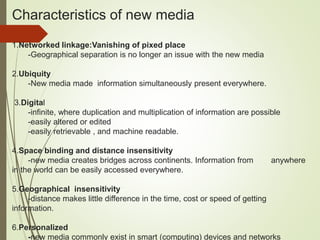
1.Networked linkage:Vanishing of pixed place
-Geographical separation is no longer an issue with the new media
2.Ubiquity
-New media made information simultaneously present everywhere.
3.Digital
-infinite, where duplication and multiplication of information are possible
-easily altered or edited
-easily retrievable , and machine readable.
4.Space binding and distance insensitivity
-new media creates bridges across continents. Information from anywhere
in the world can be easily accessed everywhere.
5.Geographical insensitivity
-distance makes little difference in the time, cost or speed of getting
information.
6.Personalized
-new media commonly exist in smart (computing) devices and networks
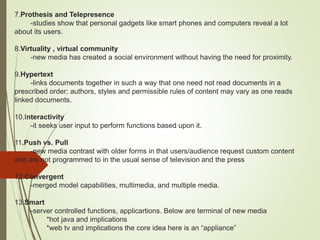
7.Prothesis and Telepresence
-studies show that personal gadgets like smart phones and computers reveal a lot
about its users.
8.Virtuality , virtual community
-new media has created a social environment without having the need for proximity.
9.Hypertext
-links documents together in such a way that one need not read documents in a
prescribed order; authors, styles and permissible rules of content may vary as one reads
linked documents.
10.Interactivity
-it seeks user input to perform functions based upon it.
11.Push vs. Pull
-new media contrast with older forms in that users/audience request custom content
and are not programmed to in the usual sense of television and the press
12.Convergent
-merged model capabilities, multimedia, and multiple media.
13.Smart
-server controlled functions, applicartions. Below are terminal of new media
*hot java and implications
*web tv and implications the core idea here is an “appliance”
computer for web access.
*secure modes and transactions central here are conducting financial and
personal transactions in privacy and free from possible fraud by the electronic
intercept
14.Wired,Wireless,Terrestial and satellite-based
-the digital and smart character of new media make them more easily
configured for a variety of transmission methods.
15.Electromagnetic vs. optical
-in brief, electromagnets systems are more fragile, are often bulkier for a given
capacity, more subject to interference, and often can be more easily tapped.
The Avenues Of New Media:
Social Media Networking Sites
FACEBOOK
•The world’s largest and most visited social networking site with more than
900 million users, FB is the easiest way to connect and share moments with
family and friends online.
•Facebook was created by MARK ZUCKERBERG and fellow Harvard
university students, EDUARDO SAVERIN, ANDREW McCOLLUM,
DUSTIN MOSKOVITZ, and CHRIS HUGHES in february 2004.
TWITTER
•Twitter is one of the most visited sites. It is an online social networking and
microblogging service that enables users to send and read text-based
messages.
•It was created in march 2006 by JACK DORSEY was launched by july.
INSTAGRAM
•Instagram or more commonly known as “IG” was originally created to
be a photo-sharing site.
•It was created by KEVIN SYSTROM and MIKE KRIEGER and was
launched in october 2010.
Y0UTUBE
•Popularly known to be a video-sharing website, YouTube was created in
february 2005 by former PayPal employees.
•Users can upload, view and share videos online.
TUMBLR
•A blog site that enables users to post multimedia contents, tumblr is one of
the social media sites that contains a variety of funny pictures and videos
which can be shared and re-shared thru the dashboard interface and to other
social media sites.
The convergence of media in the age
of information
The age of information has posed
threats to the traditional media
platforms (print, radio, and TV). In
time when the internet has become
the media platform of choice for many,
the traditional have expanded their
horizons to keep up with the good
times.
Digital Print Media
There has been a considerable
continuous decline in readership
among all print mediums throughout
the years. Although print has
remained to have a solid foothold in
society, the need to revolutionize
their methods has never been more
necessary than its today.
 Newspaper business like the manila bulletin, Philippines daily inquirer, and
Philippine star have gone digital.
 Magazines have also evolved and joined the digital revolution.
Another example under this category is rappler. Rappler is a native to the
digital print media sector .
 Teleradio the two mass media technologies of the industrial age which are radio
and television have formed an alliance in the form of teleradio. Teleradio or
television-radio is a program that combines the visual aspects of television with AM
or new radio. One example of this media convergence is teleradio DZBB super radio
and AM radio station run by the GMA network
 Stream media refers to the transmission of television or radio content online
 Mass media and social media billions of people from all over the world are
connected to several social media websites and apps at any given time of the day.
Mass media platforms sough to take advantage of these numbers and bring their
content to a wider audience.

GR2 THE NEWMEDIA(THE WORLD WIDE WEB).pptx

  • 1.
    Prepared by: Reistel JhaenaPacariem Samuel Mata Jr. Melody Gray Blanco Rochelle Del Rosario Ranzel Antalan Jeric Bigsot SSSJames Baldugo
  • 2.
    The New Media:The World Wide Web Where ordinary people can go on their computer screens and with a few clicks of a mouse button, find a vast array of information and entertainment that originates all around the world. Tim Berners-Lee invented it back in 1989.
  • 3.
    Characteristics of newmedia 1.Networked linkage:Vanishing of pixed place -Geographical separation is no longer an issue with the new media 2.Ubiquity -New media made information simultaneously present everywhere. 3.Digital -infinite, where duplication and multiplication of information are possible -easily altered or edited -easily retrievable , and machine readable. 4.Space binding and distance insensitivity -new media creates bridges across continents. Information from anywhere in the world can be easily accessed everywhere. 5.Geographical insensitivity -distance makes little difference in the time, cost or speed of getting information. 6.Personalized -new media commonly exist in smart (computing) devices and networks
  • 4.
    7.Prothesis and Telepresence -studiesshow that personal gadgets like smart phones and computers reveal a lot about its users. 8.Virtuality , virtual community -new media has created a social environment without having the need for proximity. 9.Hypertext -links documents together in such a way that one need not read documents in a prescribed order; authors, styles and permissible rules of content may vary as one reads linked documents. 10.Interactivity -it seeks user input to perform functions based upon it. 11.Push vs. Pull -new media contrast with older forms in that users/audience request custom content and are not programmed to in the usual sense of television and the press 12.Convergent -merged model capabilities, multimedia, and multiple media. 13.Smart -server controlled functions, applicartions. Below are terminal of new media *hot java and implications *web tv and implications the core idea here is an “appliance”
  • 5.
    computer for webaccess. *secure modes and transactions central here are conducting financial and personal transactions in privacy and free from possible fraud by the electronic intercept 14.Wired,Wireless,Terrestial and satellite-based -the digital and smart character of new media make them more easily configured for a variety of transmission methods. 15.Electromagnetic vs. optical -in brief, electromagnets systems are more fragile, are often bulkier for a given capacity, more subject to interference, and often can be more easily tapped.
  • 6.
    The Avenues OfNew Media: Social Media Networking Sites
  • 7.
    FACEBOOK •The world’s largestand most visited social networking site with more than 900 million users, FB is the easiest way to connect and share moments with family and friends online. •Facebook was created by MARK ZUCKERBERG and fellow Harvard university students, EDUARDO SAVERIN, ANDREW McCOLLUM, DUSTIN MOSKOVITZ, and CHRIS HUGHES in february 2004.
  • 8.
    TWITTER •Twitter is oneof the most visited sites. It is an online social networking and microblogging service that enables users to send and read text-based messages. •It was created in march 2006 by JACK DORSEY was launched by july.
  • 9.
    INSTAGRAM •Instagram or morecommonly known as “IG” was originally created to be a photo-sharing site. •It was created by KEVIN SYSTROM and MIKE KRIEGER and was launched in october 2010.
  • 10.
    Y0UTUBE •Popularly known tobe a video-sharing website, YouTube was created in february 2005 by former PayPal employees. •Users can upload, view and share videos online.
  • 11.
    TUMBLR •A blog sitethat enables users to post multimedia contents, tumblr is one of the social media sites that contains a variety of funny pictures and videos which can be shared and re-shared thru the dashboard interface and to other social media sites.
  • 12.
    The convergence ofmedia in the age of information The age of information has posed threats to the traditional media platforms (print, radio, and TV). In time when the internet has become the media platform of choice for many, the traditional have expanded their horizons to keep up with the good times.
  • 13.
    Digital Print Media Therehas been a considerable continuous decline in readership among all print mediums throughout the years. Although print has remained to have a solid foothold in society, the need to revolutionize their methods has never been more necessary than its today.
  • 14.
     Newspaper businesslike the manila bulletin, Philippines daily inquirer, and Philippine star have gone digital.  Magazines have also evolved and joined the digital revolution. Another example under this category is rappler. Rappler is a native to the digital print media sector .  Teleradio the two mass media technologies of the industrial age which are radio and television have formed an alliance in the form of teleradio. Teleradio or television-radio is a program that combines the visual aspects of television with AM or new radio. One example of this media convergence is teleradio DZBB super radio and AM radio station run by the GMA network  Stream media refers to the transmission of television or radio content online  Mass media and social media billions of people from all over the world are connected to several social media websites and apps at any given time of the day. Mass media platforms sough to take advantage of these numbers and bring their content to a wider audience.