ISDBS 213
Prepared By:
Ms. Minerva V. Magbitang
Dr. Rosemarie S. Guirre
The Database Environment and
Development Process
IS-DBS 213-1
Meaningful facts and unprocessed items
which can include text, graphics, images,
sound, video segments
DATA
A collection of individual responses from
a marketing research
Prepared By: Ms. Minerva V. Magbitang| Dr. Rosemarie S. Guirre
ISDBS 213
The Database Environment and
Development Process
IS-DBS 213-1
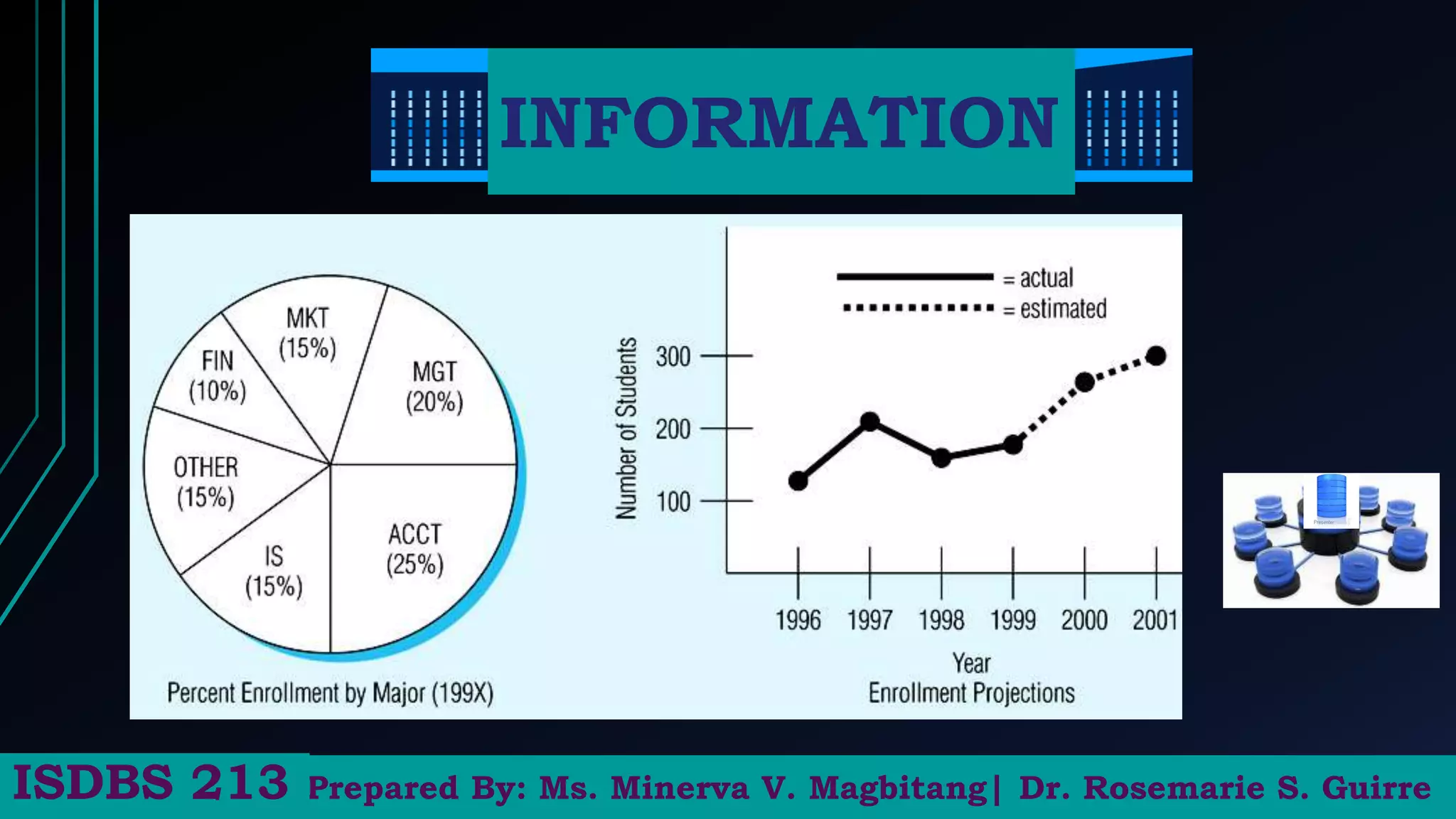
Data processed to be useful
in decision making
INFORMATION
Pattern of geographical buying
habit based on analysis of a
marketing research
Prepared By: Ms. Minerva V. Magbitang| Dr. Rosemarie S. Guirre
ISDBS 213
DB and DBMS
Data processed to be useful
in decision making
DATABASE
collection of data organized in a
manner that allows access, retrieval,
and use of that data
Prepared By: Ms. Minerva V. Magbitang| Dr. Rosemarie S. Guirre
ISDBS 213
Prepared By: Ms. Minerva V. Magbitang| Dr. Rosemarie S. Guirre
A SHARED COLLECTION OF RELATED DATA
WHICH WILL BE USED TO SUPPORT THE
ACTIVITIES OF PARTICULAR
ORGANIZATION. DATABASE CAN BE
VIEWED AS A REPOSITORY OF DATA THAT
IS DEFINED ONCE AND THEN IS ACCESSED
BY VARIOUS USERS.
ISDBS 213
DATABASE
DB and DBMS
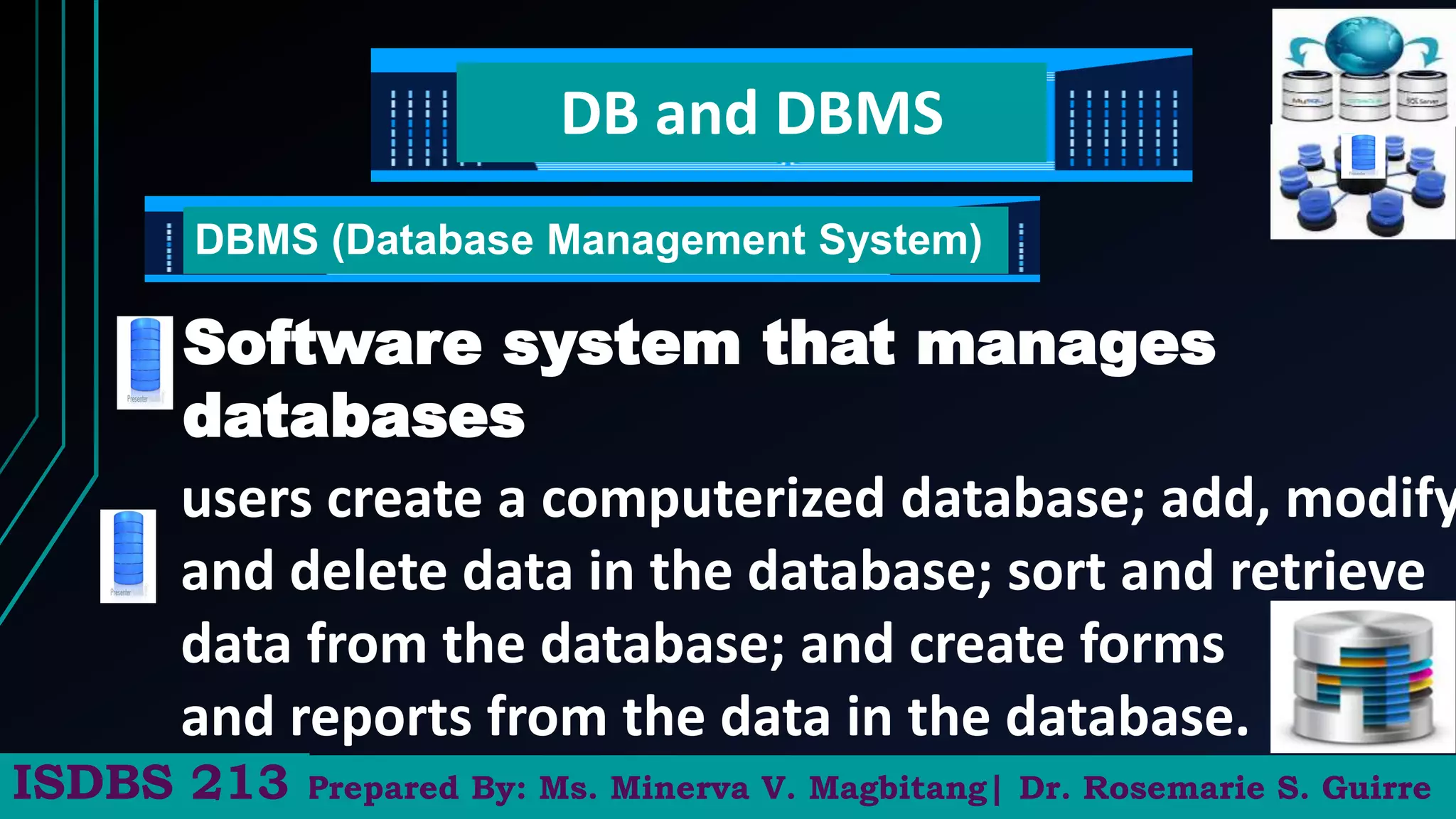
Software system that manages
databases
DBMS (Database Management System)
Prepared By: Ms. Minerva V. Magbitang| Dr. Rosemarie S. Guirre
ISDBS 213
users create a computerized database; add, modify
and delete data in the database; sort and retrieve
data from the database; and create forms
and reports from the data in the database.
Database Systems
Collection of electronic data
Central repository of shared
data
Stored in a standardized,
convenient form.
Requires a Database
Management System (DBMS)
Prepared By: Ms. Minerva V. Magbitang| Dr. Rosemarie S. Guirre
ISDBS 213
WHY DBMS?
Security
Can handle many users with
good performance
Allows for concurrency while
keeping data consistent
Protects from disaster
Prepared By: Dr. Rosemarie S. Guirre | IS-DBS 313-1
Database is logical coherent and
internally consistent.
Database is designed, built, and populated with
data for a specific purpose.
Prepared By: Ms. Minerva V. Magbitang| Dr. Rosemarie S. Guirre
ISDBS 213
Database Management System (DBMS) is a
collection of programs that enable users to
create, maintain database and control all the
access to the database. The primary goal of
the DBMS is to provide an environment that
is both convenient and efficient for user to
retrieve and store information.
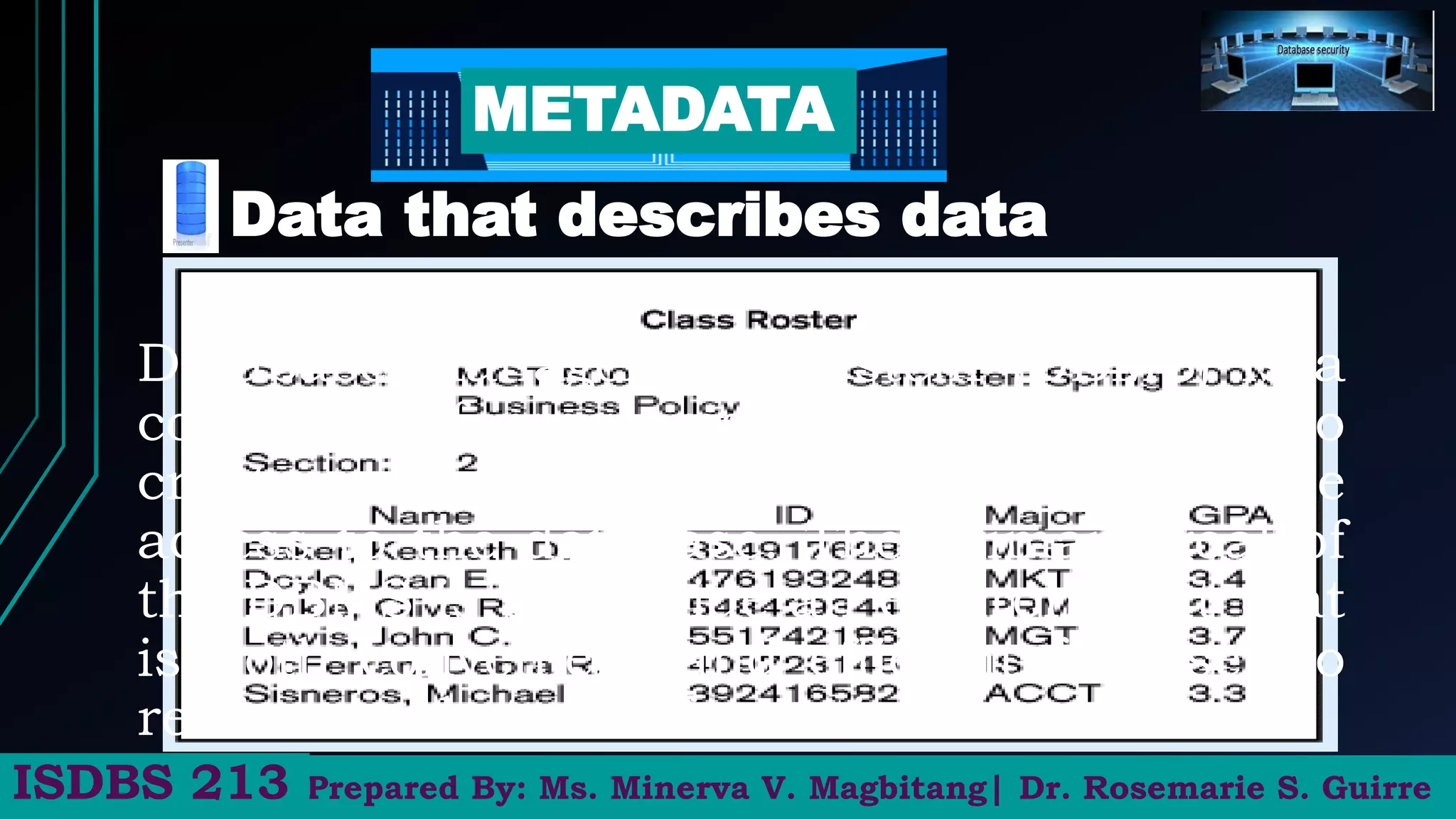
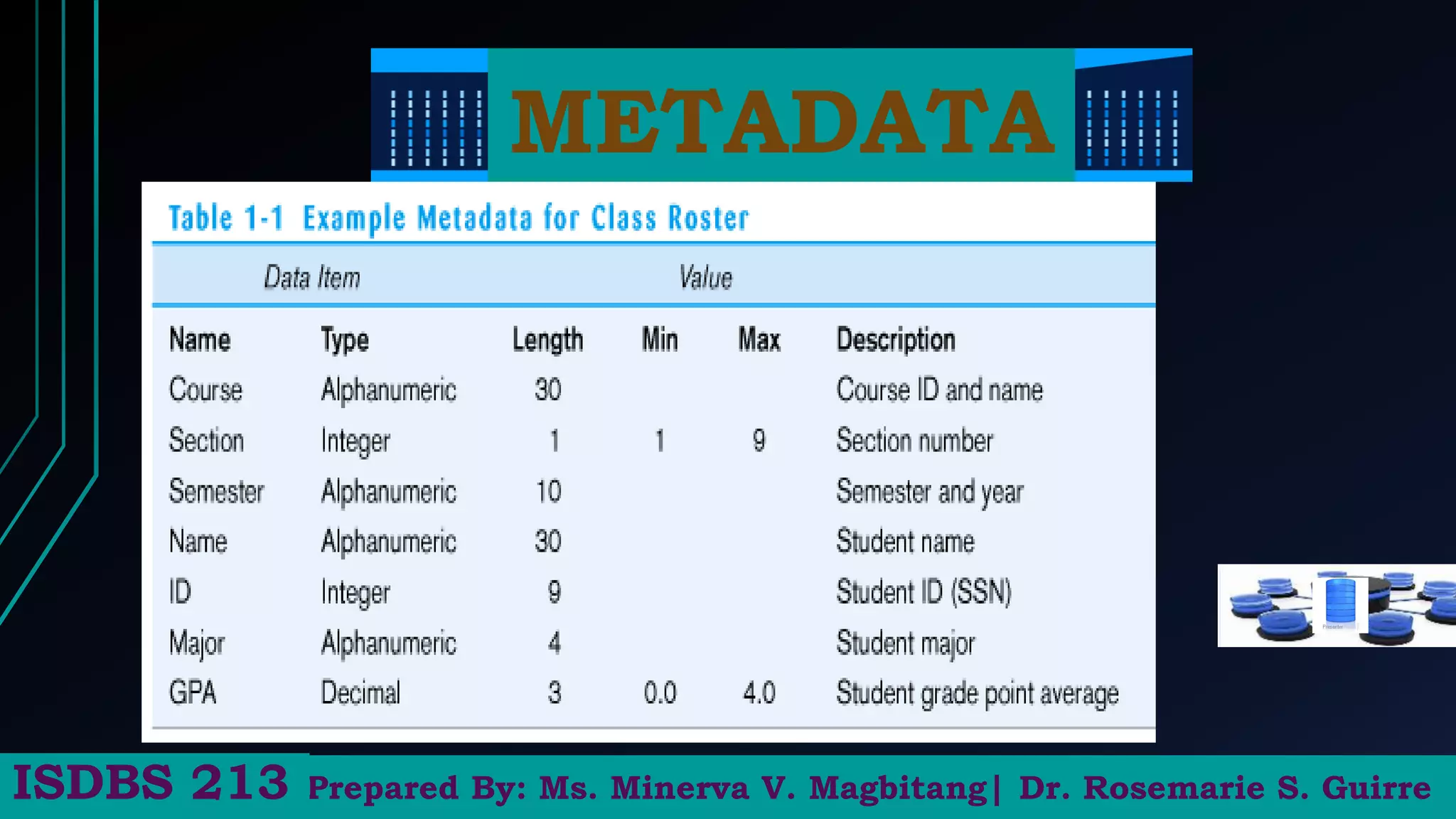
Data that describes data
METADATA
Prepared By: Ms. Minerva V. Magbitang| Dr. Rosemarie S. Guirre
ISDBS 213
Database Management System (DBMS) is a
collection of programs that enable users to
create, maintain database and control all the
access to the database. The primary goal of
the DBMS is to provide an environment that
is both convenient and efficient for user to
retrieve and store information.
INFORMATION
Prepared By: Ms. Minerva V. Magbitang| Dr. Rosemarie S. Guirre
ISDBS 213
METADATA
Prepared By: Ms. Minerva V. Magbitang| Dr. Rosemarie S. Guirre
ISDBS 213
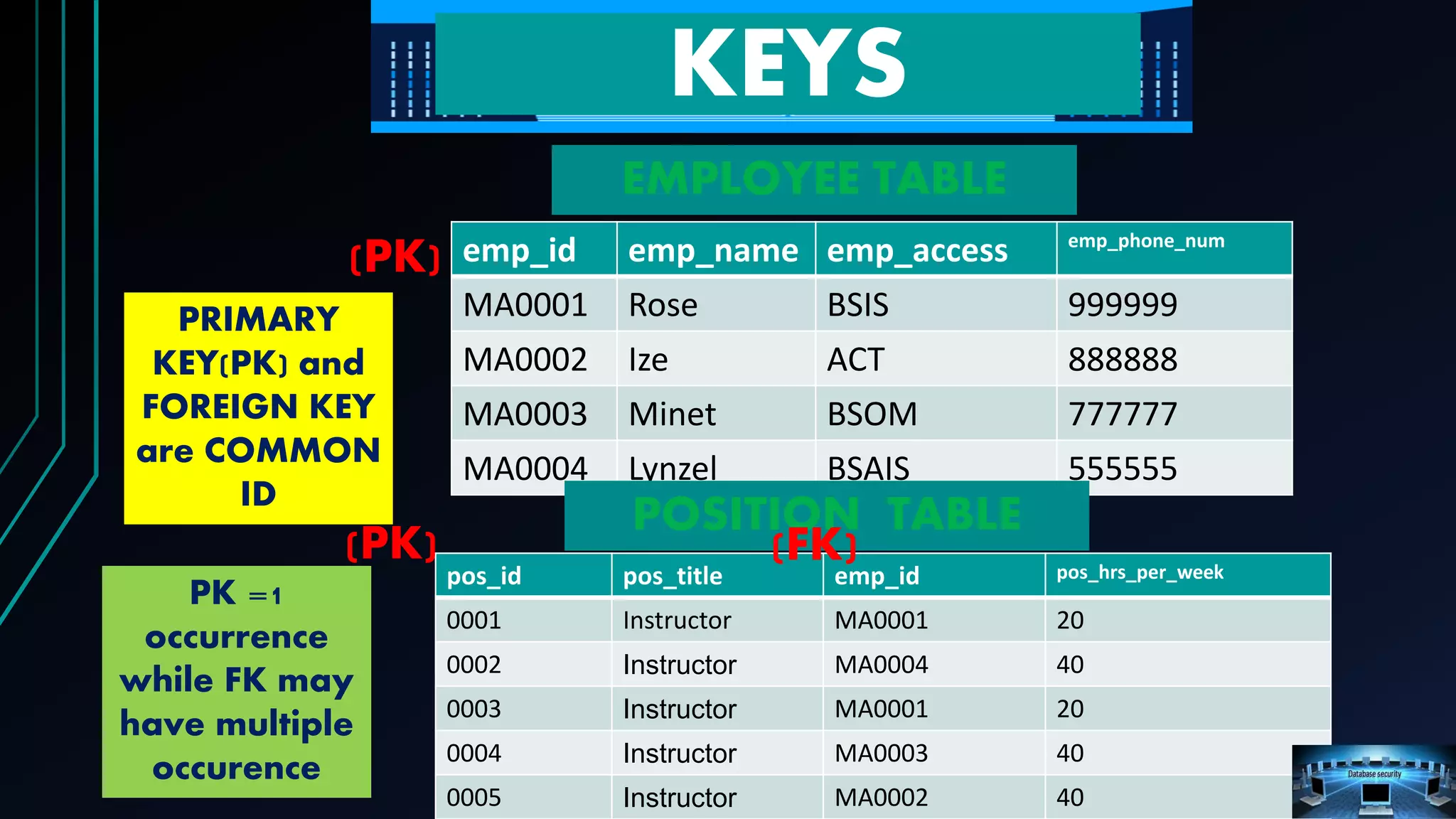
pos_id pos_title emp_id pos_hrs_per_week
0001 Instructor MA0001 20
0002 Instructor MA0004 40
0003 Instructor MA0001 20
0004 Instructor MA0003 40
0005 Instructor MA0002 40
KEYS
emp_id emp_name emp_access emp_phone_num
MA0001 Rose BSIS 999999
MA0002 Ize ACT 888888
MA0003 Minet BSOM 777777
MA0004 Lynzel BSAIS 555555
(PK)
PRIMARY
KEY(PK) and
FOREIGN KEY
are COMMON
ID
EMPLOYEE TABLE
POSITION TABLE
(FK)
(PK)
PK =1
occurrence
while FK may
have multiple
occurence
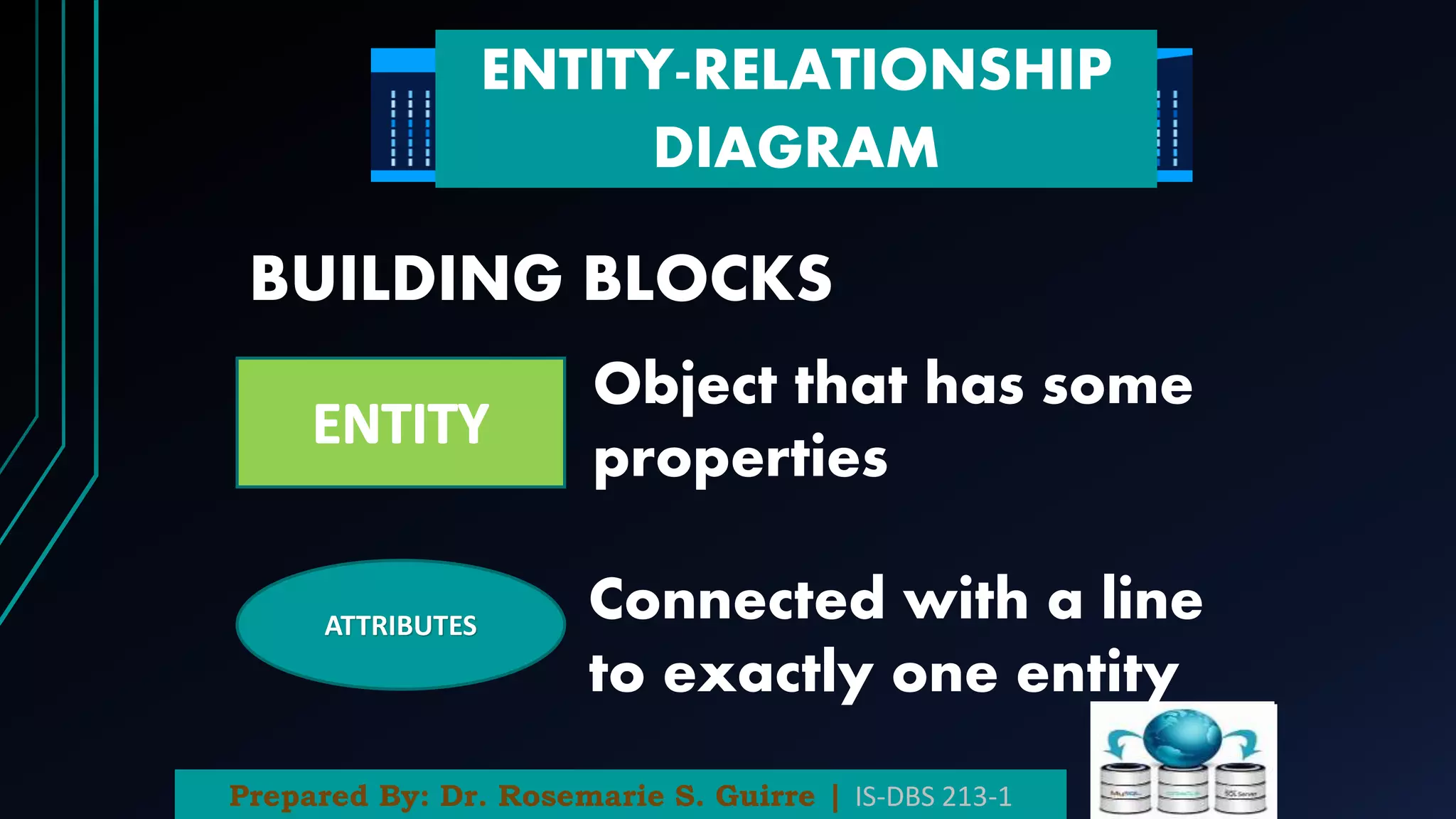
ENTITY-RELATIONSHIP
DIAGRAM
BUILDING BLOCKS
ATTRIBUTES
Object that has some
properties
Connected with a line
to exactly one entity
Prepared By: Dr. Rosemarie S. Guirre | IS-DBS 213-1
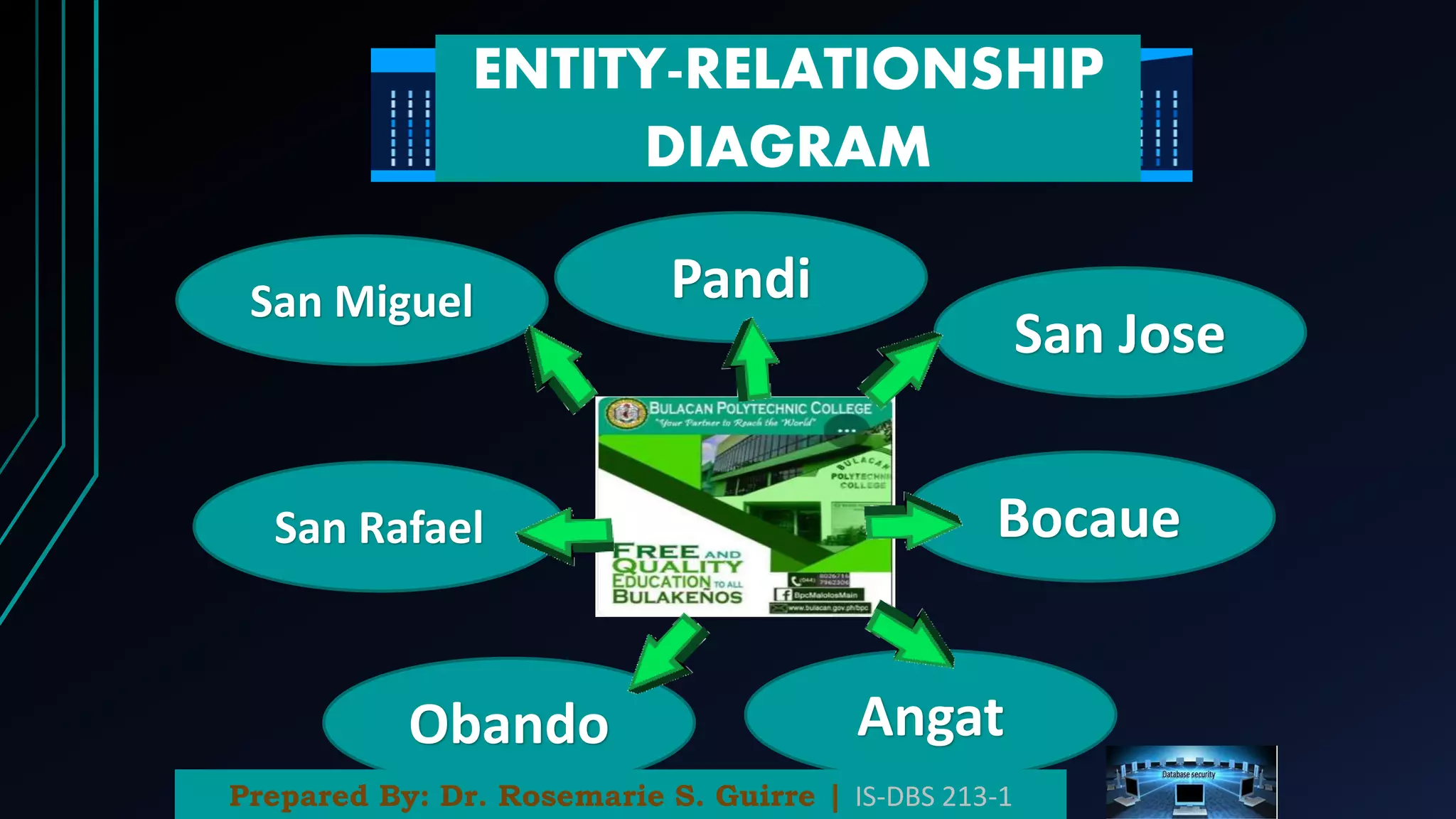
ENTITY-RELATIONSHIP
DIAGRAM
San Miguel
San Rafael
Obando Angat
Bocaue
San Jose
Pandi
Prepared By: Dr. Rosemarie S. Guirre | IS-DBS 213-1
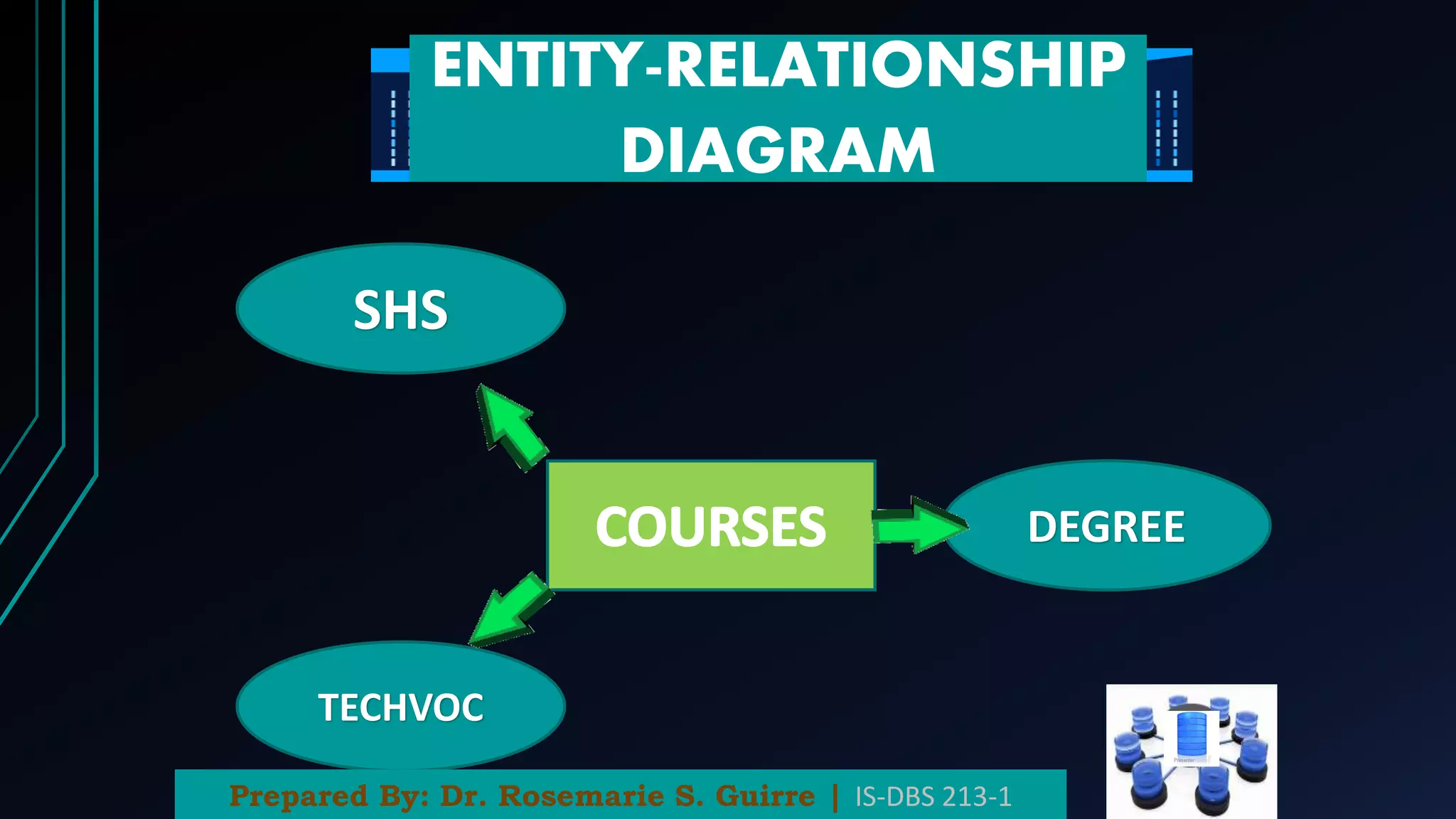
ENTITY-RELATIONSHIP
DIAGRAM
TECHVOC
SHS
DEGREE
Prepared By: Dr. Rosemarie S. Guirre | IS-DBS 213-1
ACTIVITY
You are given 5 minutes.
Open
Prepared By: Dr. Rosemarie S. Guirre | IS-DBS 213-1
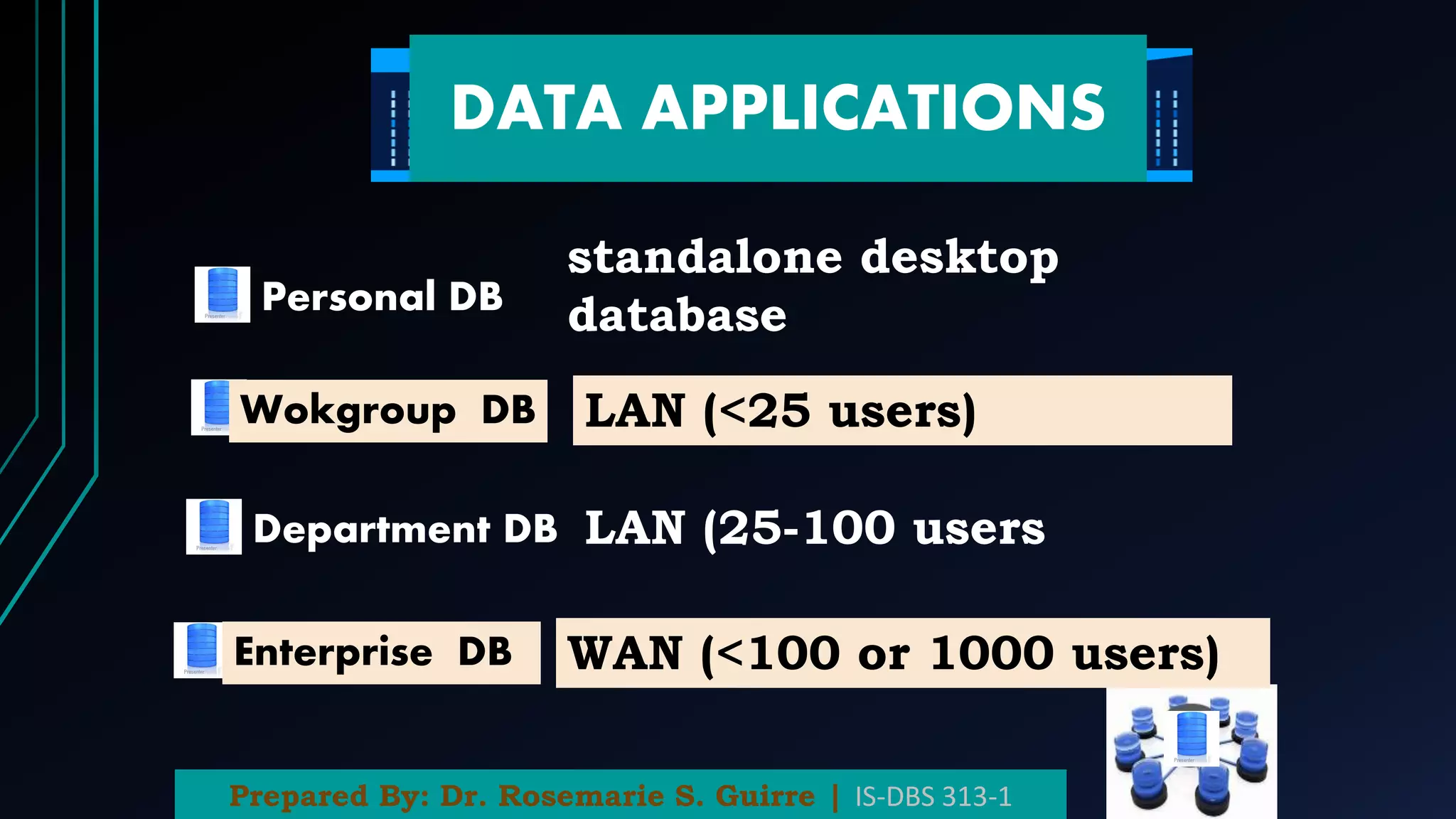
DATA APPLICATIONS
Personal DB
standalone desktop
database
Wokgroup DB LAN (<25 users)
Department DB LAN (25-100 users
Enterprise DB WAN (<100 or 1000 users)
Prepared By: Dr. Rosemarie S. Guirre | IS-DBS 313-1
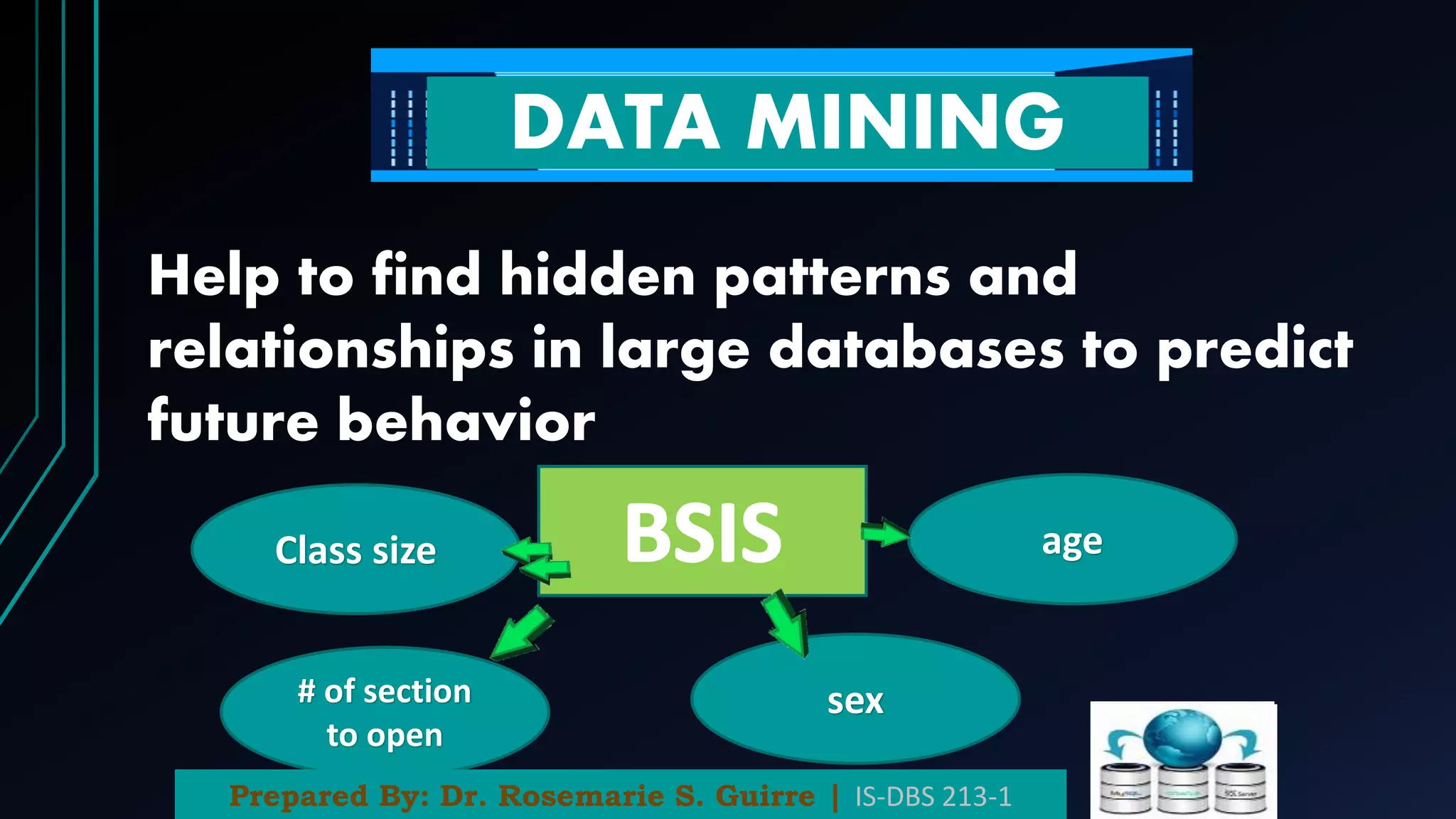
DATA MINING
IS-DBS 313-1
Help to find hidden patterns and
relationships in large databases to predict
future behavior
sex
# of section
to open
age
Class size
Prepared By: Dr. Rosemarie S. Guirre | IS-DBS 213-1
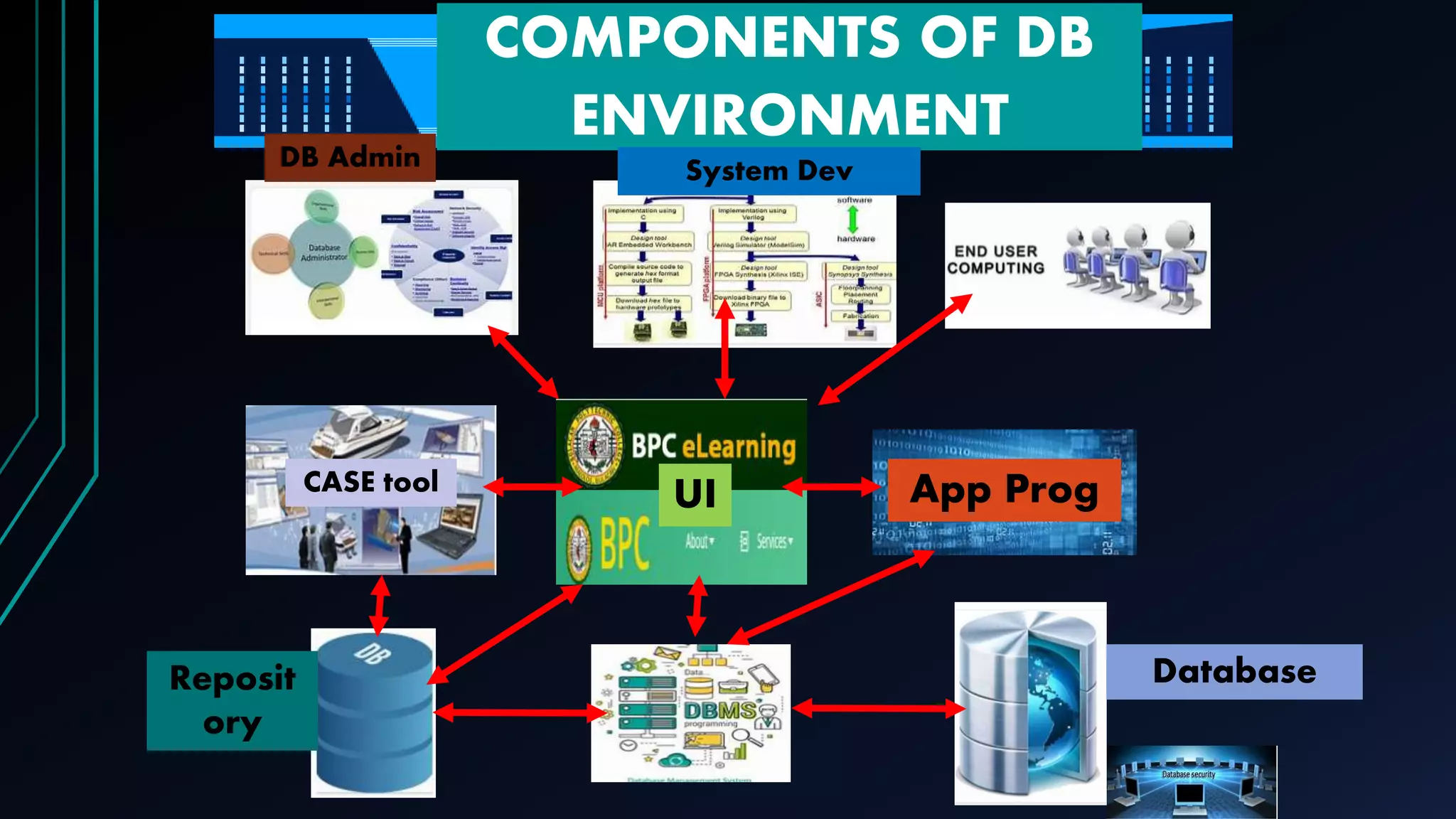
COMPONENTS OF DB
ENVIRONMENT
UI App Prog
CASE tool
Reposit
ory
Database
DB Admin System Dev
DATA DICTIONARY
Descriptions of the
properties or characteristics
of the data, including data
types, field sizes, allowable
values, and documentation
Prepared By: Dr. Rosemarie S. Guirre | IS-DBS 213-1
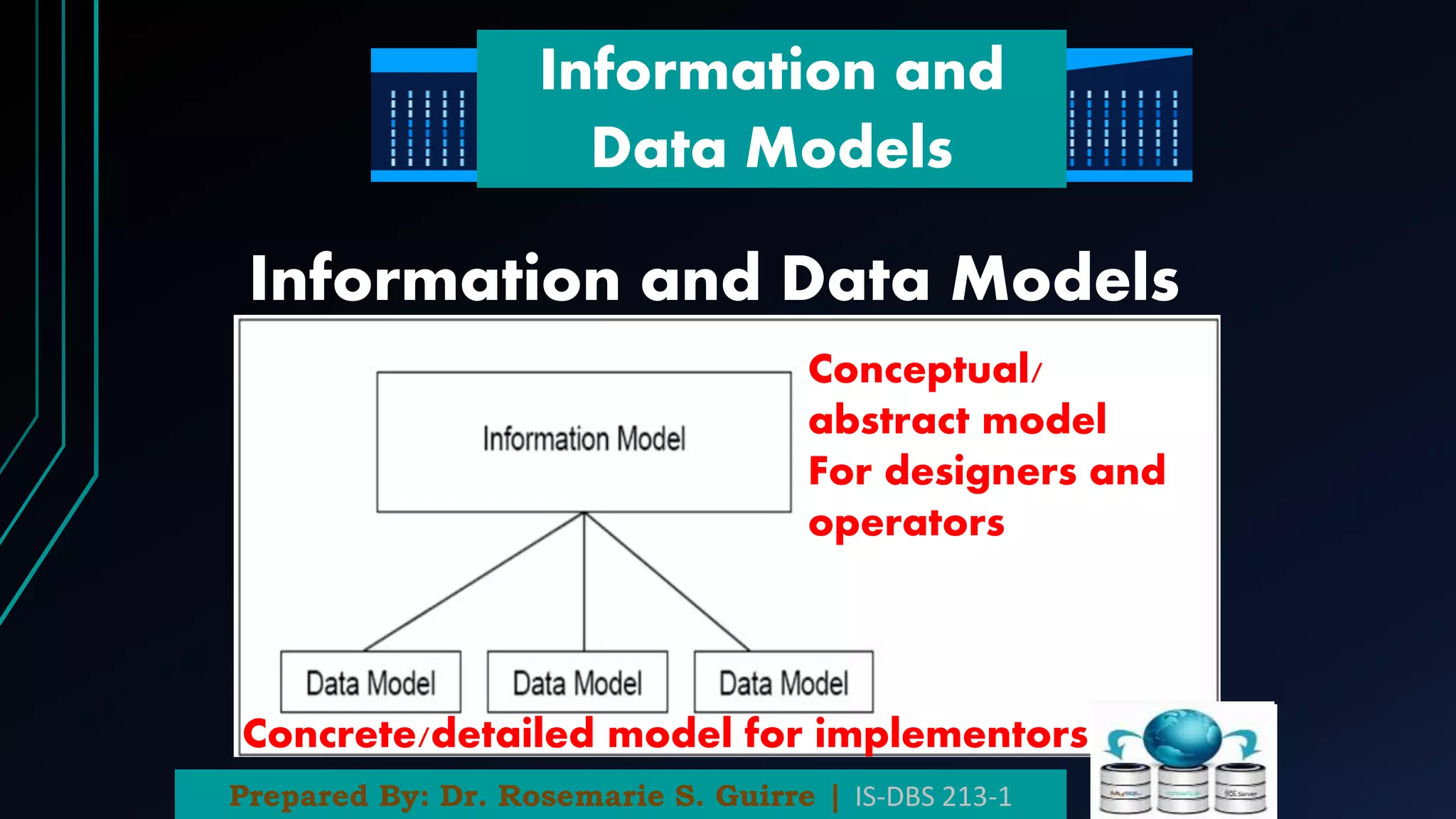
Information and
Data Models
Information and Data Models
Conceptual/
abstract model
For designers and
operators
Concrete/detailed model for implementors
Prepared By: Dr. Rosemarie S. Guirre | IS-DBS 213-1
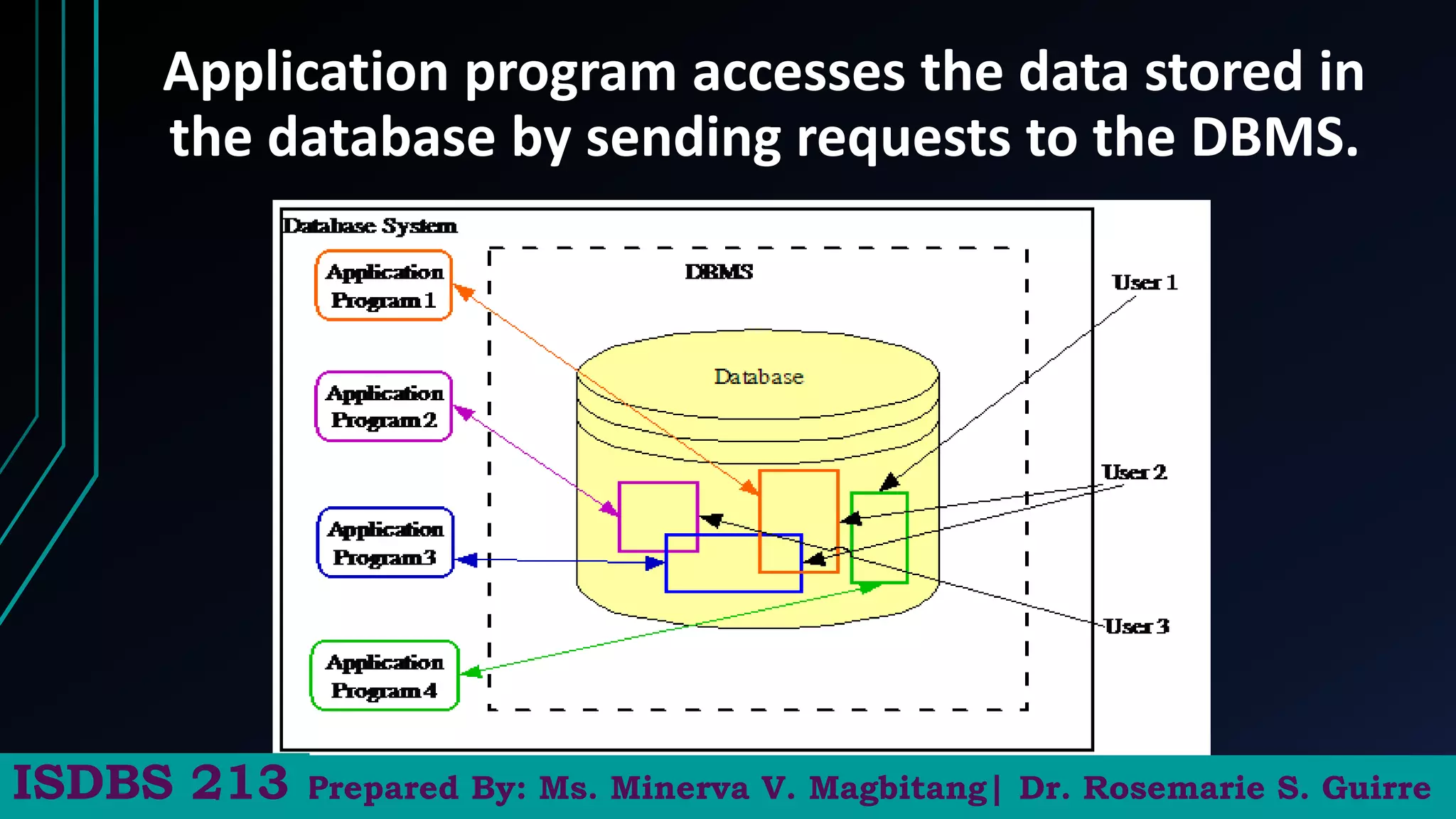
Application program accesses the data stored in
the database by sending requests to the DBMS.
Prepared By: Ms. Minerva V. Magbitang| Dr. Rosemarie S. Guirre
ISDBS 213
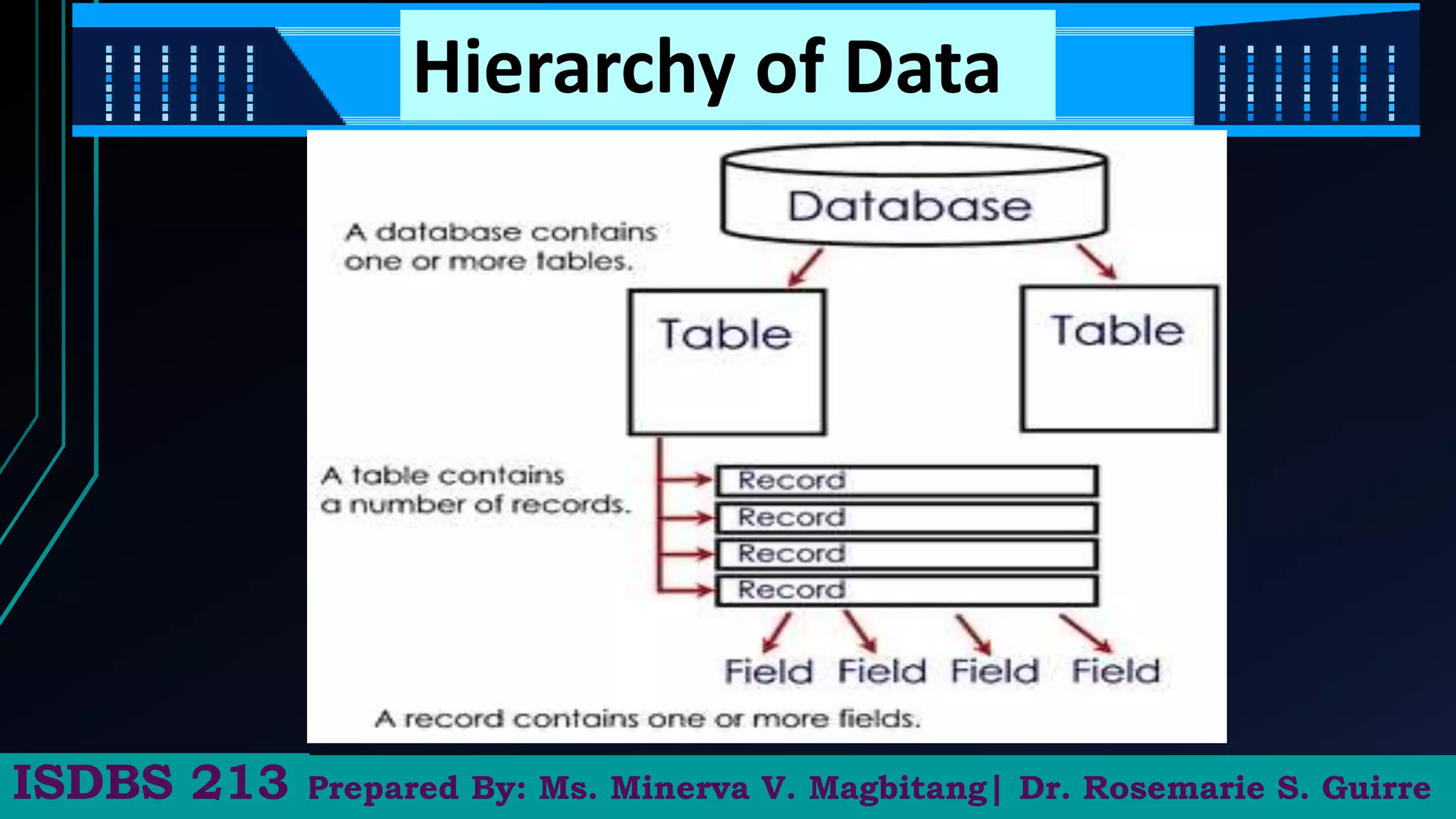
Hierarchy of Data
Prepared By: Ms. Minerva V. Magbitang| Dr. Rosemarie S. Guirre
ISDBS 213
ADD A SLIDE TITLE - 5
Prepared By: Ms. Minerva V. Magbitang| Dr. Rosemarie S. Guirre
ISDBS 213
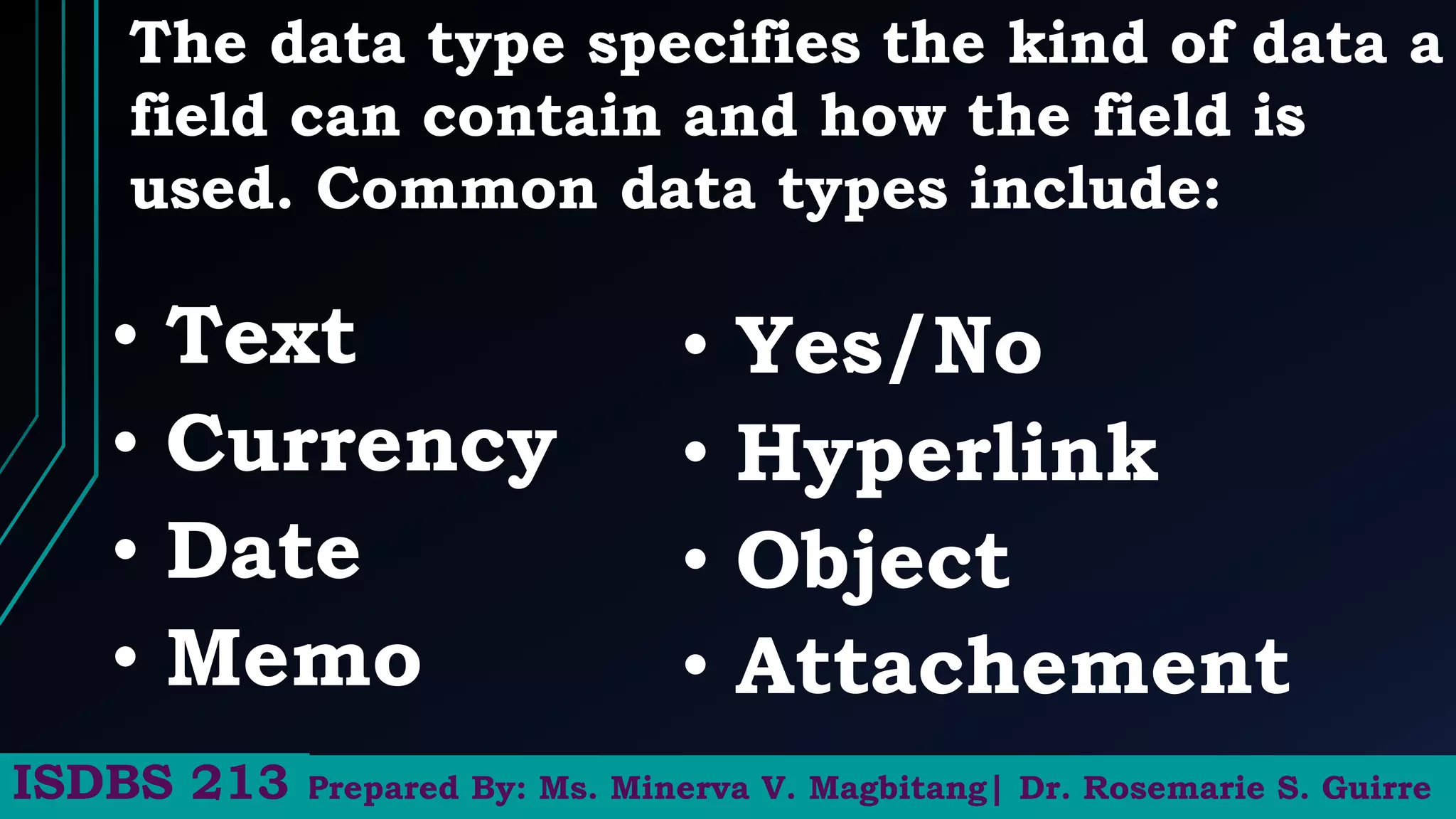
The data type specifies the kind of data a
field can contain and how the field is
used. Common data types include:
Prepared By: Ms. Minerva V. Magbitang| Dr. Rosemarie S. Guirre
ISDBS 213
• Text
• Currency
• Date
• Memo
• Yes/No
• Hyperlink
• Object
• Attachement
Hierarchy of Data
•Characters
• In the ASCII coding scheme, each byte
represents a single character, which
can be a number (4), letter (R), space,
punctuation mark (?), or other symbol
(&).
Prepared By: Ms. Minerva V. Magbitang| Dr. Rosemarie S. Guirre
ISDBS 213
A field is a combination of
one or more related
characters or bytes and is the
smallest unit of data a user
access.
Prepared By: Ms. Minerva V. Magbitang| Dr. Rosemarie S. Guirre
ISDBS 213
A field name uniquely identifies each
field. The field size defines the maximum
number of characters a field can contain.
RECORDS
A record is a group of related
fields.
Prepared By: Ms. Minerva V. Magbitang| Dr. Rosemarie S. Guirre
ISDBS 213
For example, a student record
includes a set of fields about
one student.
A primary key is a field that uniquely
identifies each record in a file. In some
tables, the primary key consists of
multiple fields, called a composite key.
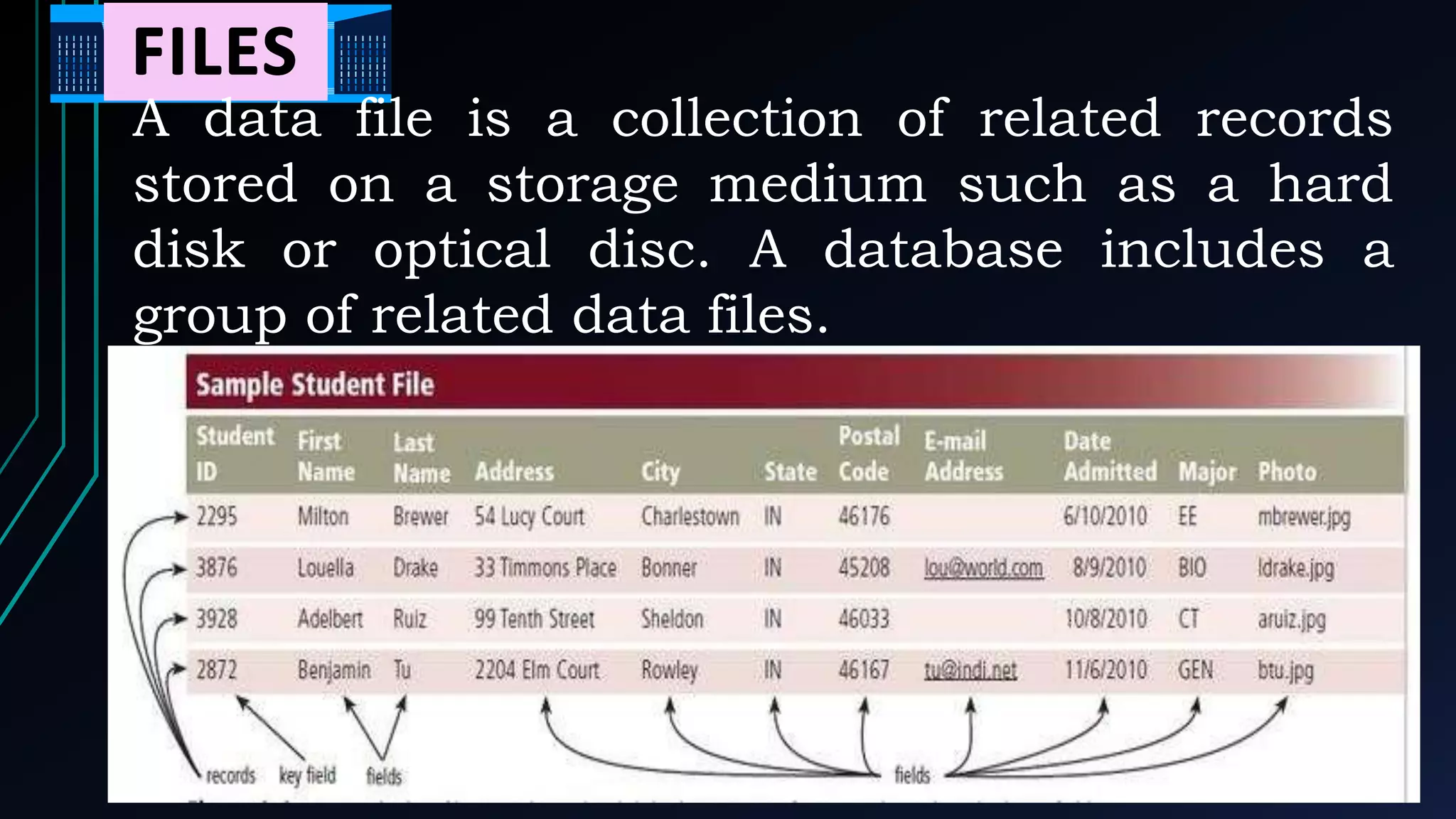
A data file is a collection of related records
stored on a storage medium such as a hard
disk or optical disc. A database includes a
group of related data files.
Garbage in, garbage out
is a computing phrase that
points out the accuracy of a
computer’s output depends on
the accuracy of the input.
Prepared By: Ms. Minerva V. Magbitang| Dr. Rosemarie S. Guirre
ISDBS 213
QUALITIES OF VALUABLE INFORMATION
• Accurate information is error free.
Prepared By: Ms. Minerva V. Magbitang| Dr. Rosemarie S. Guirre
ISDBS 213
• Verifiable information can be proven as
correct or incorrect.
• Timely information has an age suited to its
use.
• Organized information is arranged to suit
the needs and requirements of the decision
maker.
QUALITIES OF VALUABLE INFORMATION
• Accessible information is available
when the decision maker needs it.
Prepared By: Ms. Minerva V. Magbitang| Dr. Rosemarie S. Guirre
ISDBS 213
• Useful information has meaning to
the person who receives it.
• Cost-effective information should
give more value than it costs to
produce.
Prepared By: Ms. Minerva V. Magbitang| Dr. Rosemarie S. Guirre
ISDBS 213
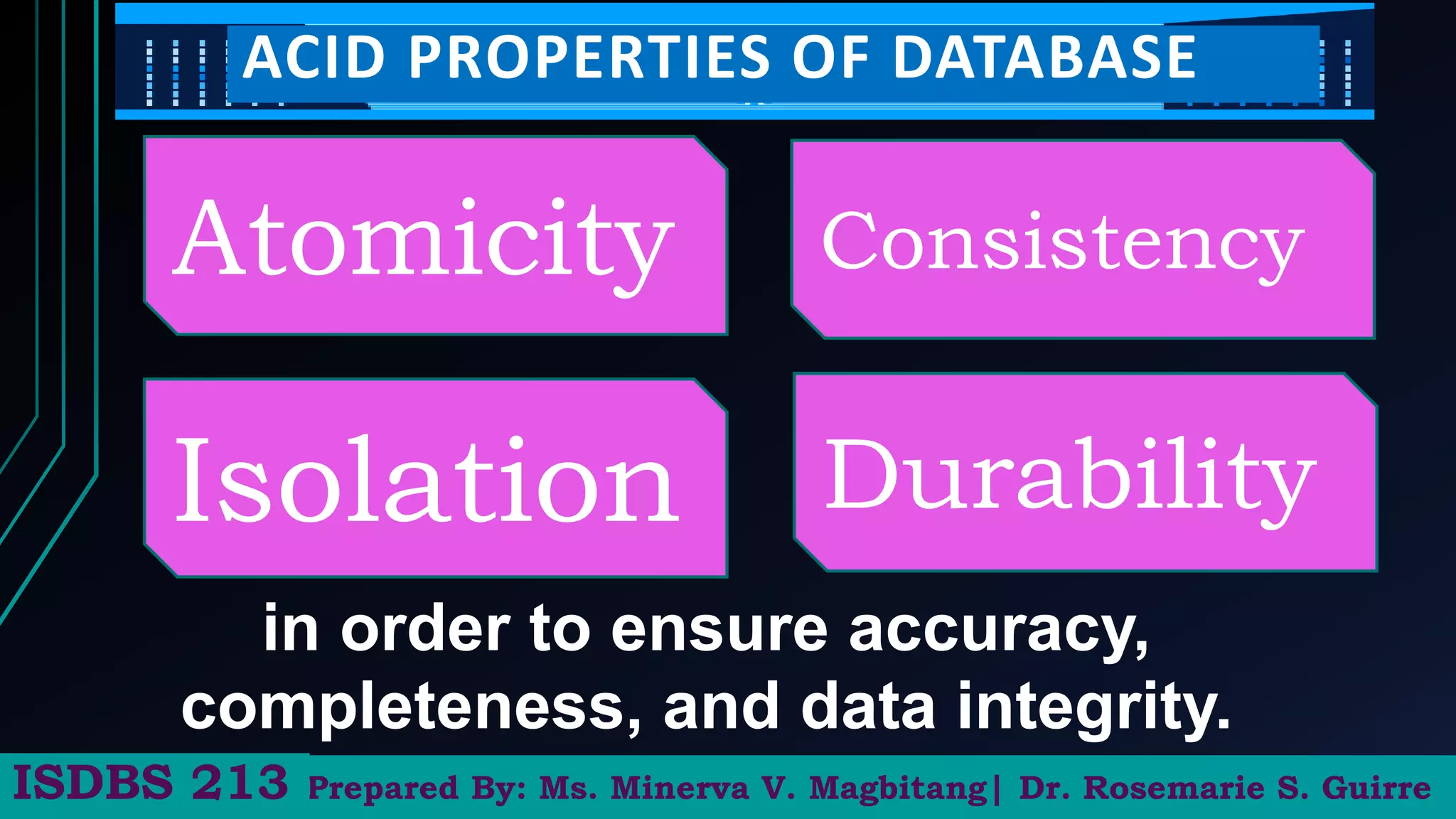
ACID PROPERTIES OF DATABASE
Atomicity Consistency
Durability
Isolation
in order to ensure accuracy,
completeness, and data integrity.
Prepared By: Ms. Minerva V. Magbitang| Dr. Rosemarie S. Guirre
ISDBS 213
ACID PROPERTIES OF DATABASE
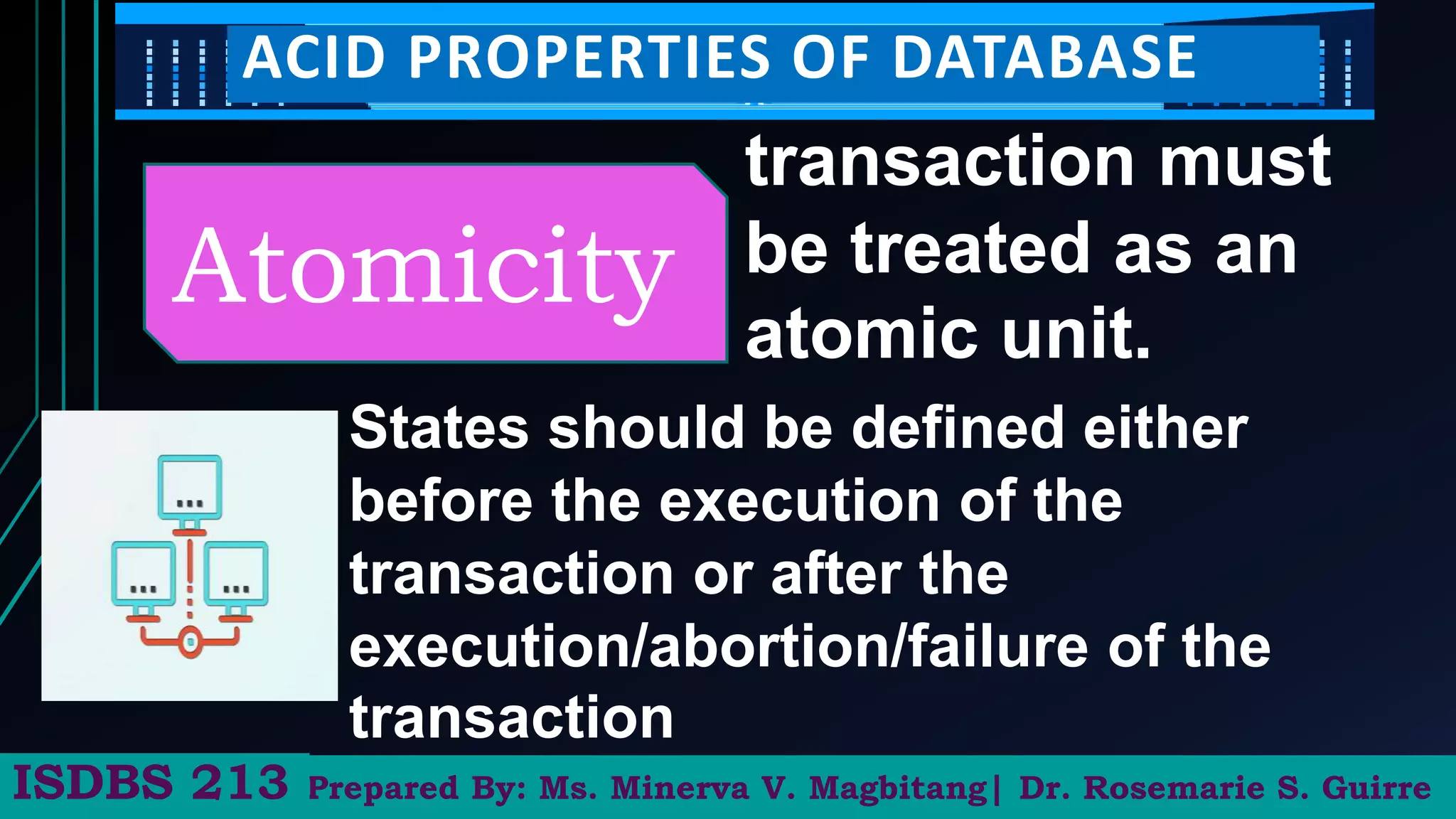
Atomicity
transaction must
be treated as an
atomic unit.
States should be defined either
before the execution of the
transaction or after the
execution/abortion/failure of the
transaction
Prepared By: Ms. Minerva V. Magbitang| Dr. Rosemarie S. Guirre
ISDBS 213
ACID PROPERTIES OF DATABASE
Consistency
the database must remain
in a consistent state after
any transaction
If the database was in a consistent
state before the execution of a
transaction, it must remain consistent
after the execution of the transaction
as well.
Prepared By: Ms. Minerva V. Magbitang| Dr. Rosemarie S. Guirre
ISDBS 213
ACID PROPERTIES OF DATABASE
Isolation
where more than one
transaction are being
executed simultaneously
and in parallel
No transaction will affect the
existence of any other
transaction.
Prepared By: Ms. Minerva V. Magbitang| Dr. Rosemarie S. Guirre
ISDBS 213
ACID PROPERTIES OF DATABASE
DURABILITY
The database should be
durable enough to hold all
its latest updates even if
the system fails or restarts
If a transaction updates a chunk
of data in a database and
commits, then the database will
hold the modified data.
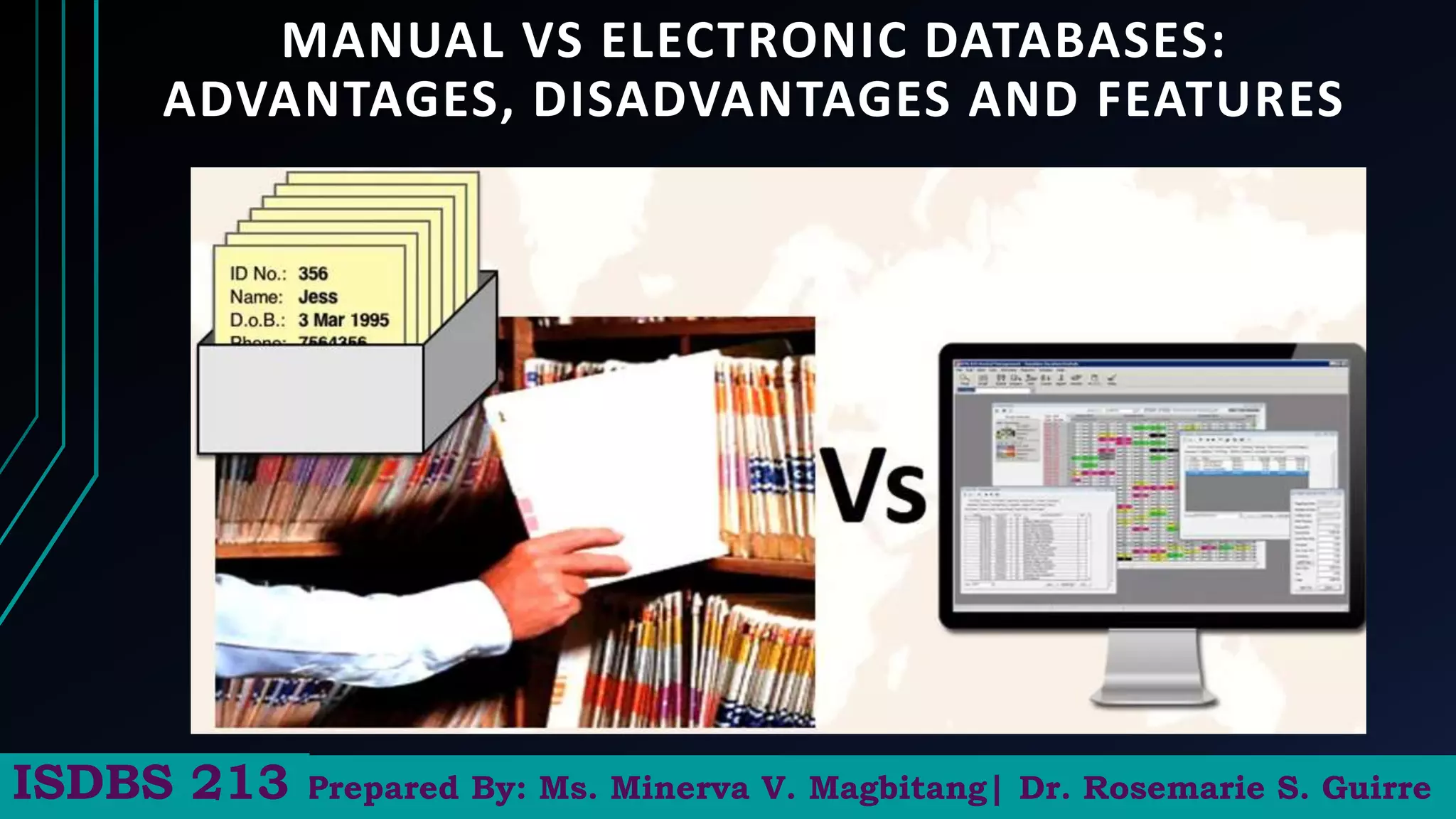
MANUAL VS ELECTRONIC DATABASES:
ADVANTAGES, DISADVANTAGES AND FEATURES
Prepared By: Ms. Minerva V. Magbitang| Dr. Rosemarie S. Guirre
ISDBS 213
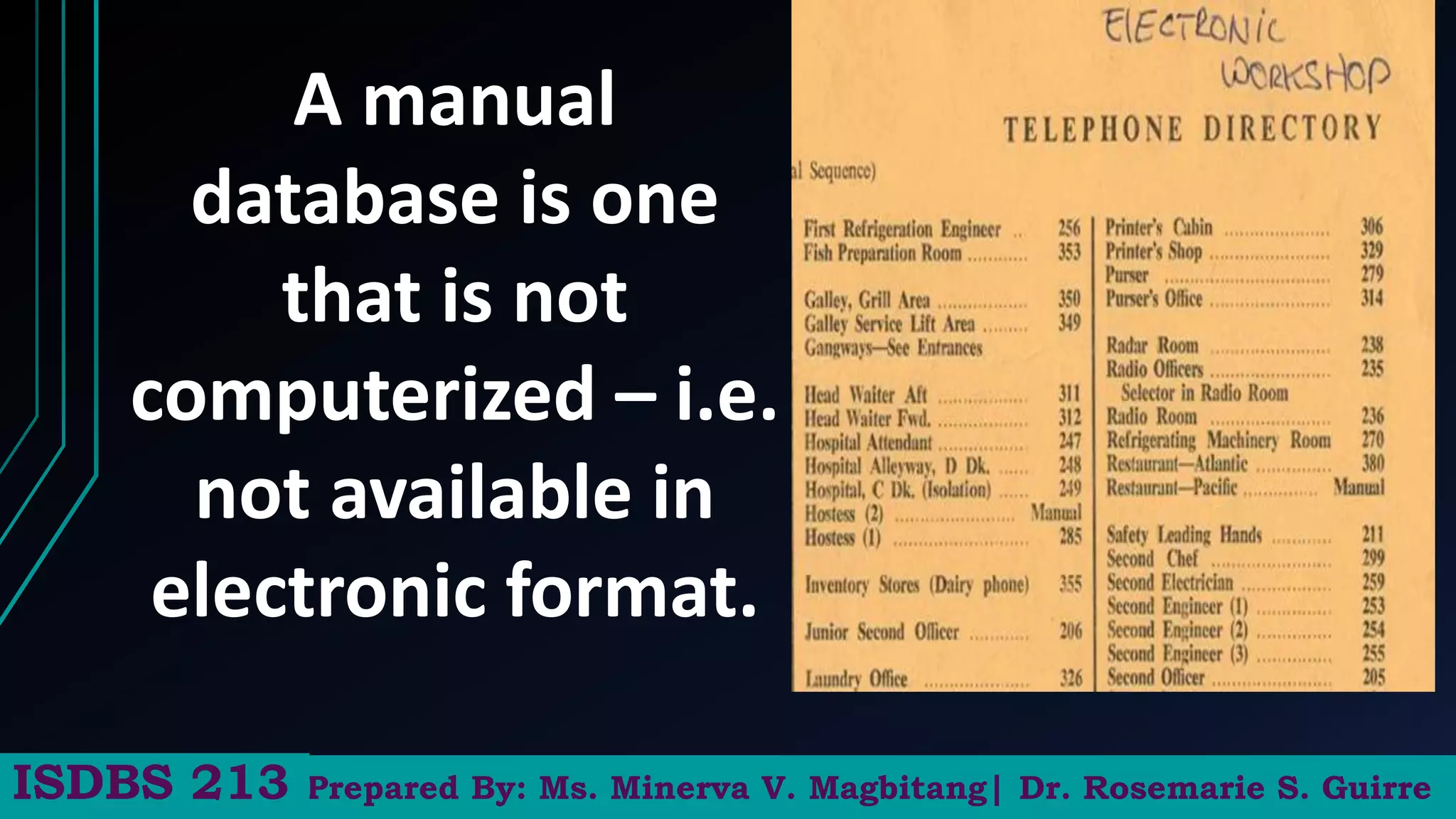
A manual
database is one
that is not
computerized – i.e.
not available in
electronic format.
Prepared By: Ms. Minerva V. Magbitang| Dr. Rosemarie S. Guirre
ISDBS 213
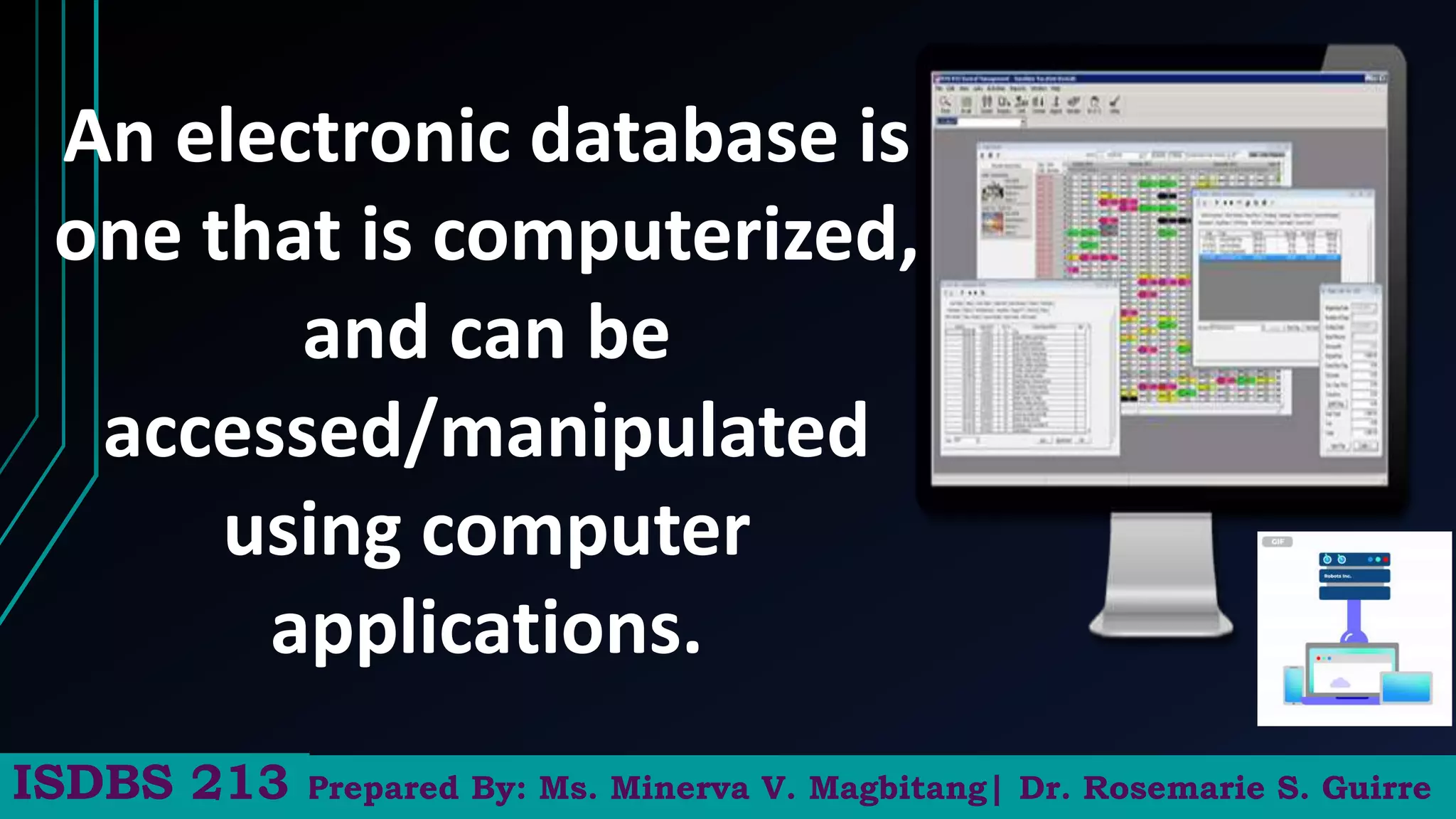
An electronic database is
one that is computerized,
and can be
accessed/manipulated
using computer
applications.
Prepared By: Ms. Minerva V. Magbitang| Dr. Rosemarie S. Guirre
ISDBS 213
ADVANTAGES OF ELECTRONIC
DATABASES OVER MANUAL DATABASES
store very large
amounts of data
allow easy input and
editing of data
enable automatic
updating and recalculating of data
make it easier to
query, search, filter and retrieve required
data.
Prepared By: Ms. Minerva V. Magbitang| Dr. Rosemarie S. Guirre
ISDBS 213
5. format, arrange and
present information in customizable ways.
6. can easily share the
information with other software
applications/programs.
7. allow centralized use
of information amongst many users over a
network and therefore reduce duplication, e.g
in banks.
Prepared By: Ms. Minerva V. Magbitang| Dr. Rosemarie S. Guirre
ISDBS 213
1.Complexity: expect of a good database makes it
complex to set up.
2.Cost of setting up a database: varies significantly,
depending on the hardware, software and
functionality required.
3.The need for conversion & difficult transition:
converting existing applications to run on the new
DBMS and hardware plus the cost of training staff
to use these new systems.
Prepared By: Ms. Minerva V. Magbitang| Dr. Rosemarie S. Guirre
ISDBS 213
4. Performance: Typically, a file-based system is
written for a specific application, such as
invoicing. As a result, performance is generally
very good.
5. Higher impact of a failure: The
centralization of resources increases the
vulnerability of the system.
Prepared By: Ms. Minerva V. Magbitang| Dr. Rosemarie S. Guirre
ISDBS 213
END OF MODULE 1
Prepared By: Ms. Minerva V. Magbitang| Dr. Rosemarie S. Guirre
ISDBS 213

The Database Environment and Development Process

  • 1.
    ISDBS 213 Prepared By: Ms.Minerva V. Magbitang Dr. Rosemarie S. Guirre
  • 2.
    The Database Environmentand Development Process IS-DBS 213-1 Meaningful facts and unprocessed items which can include text, graphics, images, sound, video segments DATA A collection of individual responses from a marketing research Prepared By: Ms. Minerva V. Magbitang| Dr. Rosemarie S. Guirre ISDBS 213
  • 3.
    The Database Environmentand Development Process IS-DBS 213-1 Data processed to be useful in decision making INFORMATION Pattern of geographical buying habit based on analysis of a marketing research Prepared By: Ms. Minerva V. Magbitang| Dr. Rosemarie S. Guirre ISDBS 213
  • 4.
    DB and DBMS Dataprocessed to be useful in decision making DATABASE collection of data organized in a manner that allows access, retrieval, and use of that data Prepared By: Ms. Minerva V. Magbitang| Dr. Rosemarie S. Guirre ISDBS 213
  • 5.
    Prepared By: Ms.Minerva V. Magbitang| Dr. Rosemarie S. Guirre A SHARED COLLECTION OF RELATED DATA WHICH WILL BE USED TO SUPPORT THE ACTIVITIES OF PARTICULAR ORGANIZATION. DATABASE CAN BE VIEWED AS A REPOSITORY OF DATA THAT IS DEFINED ONCE AND THEN IS ACCESSED BY VARIOUS USERS. ISDBS 213 DATABASE
  • 6.
    DB and DBMS Softwaresystem that manages databases DBMS (Database Management System) Prepared By: Ms. Minerva V. Magbitang| Dr. Rosemarie S. Guirre ISDBS 213 users create a computerized database; add, modify and delete data in the database; sort and retrieve data from the database; and create forms and reports from the data in the database.
  • 7.
    Database Systems Collection ofelectronic data Central repository of shared data Stored in a standardized, convenient form. Requires a Database Management System (DBMS) Prepared By: Ms. Minerva V. Magbitang| Dr. Rosemarie S. Guirre ISDBS 213
  • 8.
    WHY DBMS? Security Can handlemany users with good performance Allows for concurrency while keeping data consistent Protects from disaster Prepared By: Dr. Rosemarie S. Guirre | IS-DBS 313-1
  • 9.
    Database is logicalcoherent and internally consistent. Database is designed, built, and populated with data for a specific purpose. Prepared By: Ms. Minerva V. Magbitang| Dr. Rosemarie S. Guirre ISDBS 213 Database Management System (DBMS) is a collection of programs that enable users to create, maintain database and control all the access to the database. The primary goal of the DBMS is to provide an environment that is both convenient and efficient for user to retrieve and store information.
  • 10.
    Data that describesdata METADATA Prepared By: Ms. Minerva V. Magbitang| Dr. Rosemarie S. Guirre ISDBS 213 Database Management System (DBMS) is a collection of programs that enable users to create, maintain database and control all the access to the database. The primary goal of the DBMS is to provide an environment that is both convenient and efficient for user to retrieve and store information.
  • 11.
    INFORMATION Prepared By: Ms.Minerva V. Magbitang| Dr. Rosemarie S. Guirre ISDBS 213
  • 12.
    METADATA Prepared By: Ms.Minerva V. Magbitang| Dr. Rosemarie S. Guirre ISDBS 213
  • 13.
    pos_id pos_title emp_idpos_hrs_per_week 0001 Instructor MA0001 20 0002 Instructor MA0004 40 0003 Instructor MA0001 20 0004 Instructor MA0003 40 0005 Instructor MA0002 40 KEYS emp_id emp_name emp_access emp_phone_num MA0001 Rose BSIS 999999 MA0002 Ize ACT 888888 MA0003 Minet BSOM 777777 MA0004 Lynzel BSAIS 555555 (PK) PRIMARY KEY(PK) and FOREIGN KEY are COMMON ID EMPLOYEE TABLE POSITION TABLE (FK) (PK) PK =1 occurrence while FK may have multiple occurence
  • 14.
    ENTITY-RELATIONSHIP DIAGRAM BUILDING BLOCKS ATTRIBUTES Object thathas some properties Connected with a line to exactly one entity Prepared By: Dr. Rosemarie S. Guirre | IS-DBS 213-1
  • 15.
    ENTITY-RELATIONSHIP DIAGRAM San Miguel San Rafael ObandoAngat Bocaue San Jose Pandi Prepared By: Dr. Rosemarie S. Guirre | IS-DBS 213-1
  • 16.
  • 17.
    ACTIVITY You are given5 minutes. Open Prepared By: Dr. Rosemarie S. Guirre | IS-DBS 213-1
  • 18.
    DATA APPLICATIONS Personal DB standalonedesktop database Wokgroup DB LAN (<25 users) Department DB LAN (25-100 users Enterprise DB WAN (<100 or 1000 users) Prepared By: Dr. Rosemarie S. Guirre | IS-DBS 313-1
  • 19.
    DATA MINING IS-DBS 313-1 Helpto find hidden patterns and relationships in large databases to predict future behavior sex # of section to open age Class size Prepared By: Dr. Rosemarie S. Guirre | IS-DBS 213-1
  • 20.
    COMPONENTS OF DB ENVIRONMENT UIApp Prog CASE tool Reposit ory Database DB Admin System Dev
  • 21.
    DATA DICTIONARY Descriptions ofthe properties or characteristics of the data, including data types, field sizes, allowable values, and documentation Prepared By: Dr. Rosemarie S. Guirre | IS-DBS 213-1
  • 22.
    Information and Data Models Informationand Data Models Conceptual/ abstract model For designers and operators Concrete/detailed model for implementors Prepared By: Dr. Rosemarie S. Guirre | IS-DBS 213-1
  • 23.
    Application program accessesthe data stored in the database by sending requests to the DBMS. Prepared By: Ms. Minerva V. Magbitang| Dr. Rosemarie S. Guirre ISDBS 213
  • 24.
    Hierarchy of Data PreparedBy: Ms. Minerva V. Magbitang| Dr. Rosemarie S. Guirre ISDBS 213
  • 25.
    ADD A SLIDETITLE - 5 Prepared By: Ms. Minerva V. Magbitang| Dr. Rosemarie S. Guirre ISDBS 213
  • 26.
    The data typespecifies the kind of data a field can contain and how the field is used. Common data types include: Prepared By: Ms. Minerva V. Magbitang| Dr. Rosemarie S. Guirre ISDBS 213 • Text • Currency • Date • Memo • Yes/No • Hyperlink • Object • Attachement
  • 27.
    Hierarchy of Data •Characters •In the ASCII coding scheme, each byte represents a single character, which can be a number (4), letter (R), space, punctuation mark (?), or other symbol (&). Prepared By: Ms. Minerva V. Magbitang| Dr. Rosemarie S. Guirre ISDBS 213
  • 28.
    A field isa combination of one or more related characters or bytes and is the smallest unit of data a user access. Prepared By: Ms. Minerva V. Magbitang| Dr. Rosemarie S. Guirre ISDBS 213 A field name uniquely identifies each field. The field size defines the maximum number of characters a field can contain.
  • 29.
    RECORDS A record isa group of related fields. Prepared By: Ms. Minerva V. Magbitang| Dr. Rosemarie S. Guirre ISDBS 213 For example, a student record includes a set of fields about one student. A primary key is a field that uniquely identifies each record in a file. In some tables, the primary key consists of multiple fields, called a composite key.
  • 30.
    A data fileis a collection of related records stored on a storage medium such as a hard disk or optical disc. A database includes a group of related data files.
  • 31.
    Garbage in, garbageout is a computing phrase that points out the accuracy of a computer’s output depends on the accuracy of the input. Prepared By: Ms. Minerva V. Magbitang| Dr. Rosemarie S. Guirre ISDBS 213
  • 32.
    QUALITIES OF VALUABLEINFORMATION • Accurate information is error free. Prepared By: Ms. Minerva V. Magbitang| Dr. Rosemarie S. Guirre ISDBS 213 • Verifiable information can be proven as correct or incorrect. • Timely information has an age suited to its use. • Organized information is arranged to suit the needs and requirements of the decision maker.
  • 33.
    QUALITIES OF VALUABLEINFORMATION • Accessible information is available when the decision maker needs it. Prepared By: Ms. Minerva V. Magbitang| Dr. Rosemarie S. Guirre ISDBS 213 • Useful information has meaning to the person who receives it. • Cost-effective information should give more value than it costs to produce.
  • 34.
    Prepared By: Ms.Minerva V. Magbitang| Dr. Rosemarie S. Guirre ISDBS 213 ACID PROPERTIES OF DATABASE Atomicity Consistency Durability Isolation in order to ensure accuracy, completeness, and data integrity.
  • 35.
    Prepared By: Ms.Minerva V. Magbitang| Dr. Rosemarie S. Guirre ISDBS 213 ACID PROPERTIES OF DATABASE Atomicity transaction must be treated as an atomic unit. States should be defined either before the execution of the transaction or after the execution/abortion/failure of the transaction
  • 36.
    Prepared By: Ms.Minerva V. Magbitang| Dr. Rosemarie S. Guirre ISDBS 213 ACID PROPERTIES OF DATABASE Consistency the database must remain in a consistent state after any transaction If the database was in a consistent state before the execution of a transaction, it must remain consistent after the execution of the transaction as well.
  • 37.
    Prepared By: Ms.Minerva V. Magbitang| Dr. Rosemarie S. Guirre ISDBS 213 ACID PROPERTIES OF DATABASE Isolation where more than one transaction are being executed simultaneously and in parallel No transaction will affect the existence of any other transaction.
  • 38.
    Prepared By: Ms.Minerva V. Magbitang| Dr. Rosemarie S. Guirre ISDBS 213 ACID PROPERTIES OF DATABASE DURABILITY The database should be durable enough to hold all its latest updates even if the system fails or restarts If a transaction updates a chunk of data in a database and commits, then the database will hold the modified data.
  • 39.
    MANUAL VS ELECTRONICDATABASES: ADVANTAGES, DISADVANTAGES AND FEATURES Prepared By: Ms. Minerva V. Magbitang| Dr. Rosemarie S. Guirre ISDBS 213
  • 40.
    A manual database isone that is not computerized – i.e. not available in electronic format. Prepared By: Ms. Minerva V. Magbitang| Dr. Rosemarie S. Guirre ISDBS 213
  • 41.
    An electronic databaseis one that is computerized, and can be accessed/manipulated using computer applications. Prepared By: Ms. Minerva V. Magbitang| Dr. Rosemarie S. Guirre ISDBS 213
  • 42.
    ADVANTAGES OF ELECTRONIC DATABASESOVER MANUAL DATABASES store very large amounts of data allow easy input and editing of data enable automatic updating and recalculating of data make it easier to query, search, filter and retrieve required data. Prepared By: Ms. Minerva V. Magbitang| Dr. Rosemarie S. Guirre ISDBS 213
  • 43.
    5. format, arrangeand present information in customizable ways. 6. can easily share the information with other software applications/programs. 7. allow centralized use of information amongst many users over a network and therefore reduce duplication, e.g in banks. Prepared By: Ms. Minerva V. Magbitang| Dr. Rosemarie S. Guirre ISDBS 213
  • 44.
    1.Complexity: expect ofa good database makes it complex to set up. 2.Cost of setting up a database: varies significantly, depending on the hardware, software and functionality required. 3.The need for conversion & difficult transition: converting existing applications to run on the new DBMS and hardware plus the cost of training staff to use these new systems. Prepared By: Ms. Minerva V. Magbitang| Dr. Rosemarie S. Guirre ISDBS 213
  • 45.
    4. Performance: Typically,a file-based system is written for a specific application, such as invoicing. As a result, performance is generally very good. 5. Higher impact of a failure: The centralization of resources increases the vulnerability of the system. Prepared By: Ms. Minerva V. Magbitang| Dr. Rosemarie S. Guirre ISDBS 213
  • 46.
    END OF MODULE1 Prepared By: Ms. Minerva V. Magbitang| Dr. Rosemarie S. Guirre ISDBS 213

Editor's Notes

  • #5 The terms “Database”, “DBMS”, “data server”, “database server” often used interchangeably to refer to a DBMS
  • #7 The terms “Database”, “DBMS”, “data server”, “database server” often used interchangeably to refer to a DBMS
  • #9 The terms “Database”, “DBMS”, “data server”, “database server” often used interchangeably to refer to a DBMS A Database Management System (DBMS) is a software program used to create and manage an electronic database. It provides users with tools used to add, delete, access, modify, and analyze data stored in one location. Examples of DBMS software include: Microsoft Office Access, dBase, SQL Server, Oracle, MySQL, Informix, DB2, Paradox, FoxBase, FileMaker Pro, Lotus Approach, etc.
  • #14 ENTITY-NOUN ATTRIBUTES-CERTAIN PROPERTIES OF THE ENTITY
  • #15 Entity-relationship diagrams (ERDs) are very popular in support of the relational model. The building blocks of an ERD are Entities and Attributes. An entity is drawn as rectangles and attributes are drawn as ovals as can be seen in this chart. Attributes are connected with a line to exactly one entity. An entity is an object that has some properties.
  • #16 ENTITY-NOUN ATTRIBUTES-CERTAIN PROPERTIES OF THE ENTITY
  • #18 The relational data model is simple and elegant. It has a solid mathematic foundation based on sets theory and predicate calculus and is the most used data model for databases today.
  • #21 User Interface – text and graphical displays to users CASE Tools – computer-aided software engineering Repository (data dictionary) – centralized storehouse of metadata Database Management System (DBMS) – software for managing the database Database – storage of the data Application Programs – software using the data Database Administrators (DBA) – personnel responsible for maintaining the database System Developers – personnel responsible for designing databases and software End Users – people who use the applications and databases
  • #23 An information model is an abstract, formal representation of entities that includes their properties, relationships and the operations that can be performed on them. The main purpose of an Information Model is to model managed objects objects at a conceptual level, independent of any specific implementations or protocols used to transport the data. Data Models, on the other hand, are defined at a more concrete level and include many details. They are intended for software developers and include protocol-specific constructs. A data model is the blueprint of any database system. The figure illustrates the relationship between an Information Model and a Data Model.
  • #32 Garbage in, garbage out (GIGO) is a computing phrase that points out the accuracy of a computer’s output depends on the accuracy of the input. If you enter incorrect data into a computer (garbage in), the computer will produce incorrect information (garbage out).
  • #35 https://www.tutorialspoint.com/dbms/dbms_transaction.htm A transaction is a very small unit of a program and it may contain several low level tasks. A transaction in a database system must maintain Atomicity, Consistency, Isolation, and Durability − commonly known as ACID properties − in order to ensure accuracy, completeness, and data integrity.
  • #36  This property states that a transaction must be treated as an atomic unit, that is, either all of its operations are executed or none. There must be no state in a database where a transaction is left partially completed. States should be defined either before the execution of the transaction or after the execution/abortion/failure of the transaction.
  • #37  the database must remain in a consistent state after any transaction. No transaction should have any adverse effect on the data residing in the database. If the database was in a consistent state before the execution of a transaction, it must remain consistent after the execution of the transaction as well.
  • #38 In a database system where more than one transaction are being executed simultaneously and in parallel, the property of isolation states that all the transactions will be carried out and executed as if it is the only transaction in the system. No transaction will affect the existence of any other transaction.
  • #39 The database should be durable enough to hold all its latest updates even if the system fails or restarts. If a transaction updates a chunk of data in a database and commits, then the database will hold the modified data. If a transaction commits but the system fails before the data could be written on to the disk, then that data will be updated once the system springs back into action.
  • #45 Complexity: The provision of the functionality expect of a good database makes it complex to set up. Cost of setting up a database: The cost of setting up an electronic database varies significantly, depending on the hardware, software and functionality required. The need for conversion & difficult transition: This includes the cost of converting existing applications to run on the new DBMS and hardware plus the cost of training staff to use these new systems.
  • #46 4. Performance: Typically, a file-based system is written for a specific application, such as invoicing. As a result, performance is generally very good. However, the DBMS is written to be more general, to cater for many applications rather than just one. The effect is that some applications may not run as fast as they used to. 5. Higher impact of a failure: The centralization of resources increases the vulnerability of the system.