Advance Database Management Systems : 3
Main Characteristics of the Database Approach
Prof Neeraj Bhargava
Vaibhav Khanna
Department of Computer Science
School of Engineering and Systems Sciences
Maharshi Dayanand Saraswati University Ajmer
Slide 1- 2
Main Characteristics of the Database
Approach
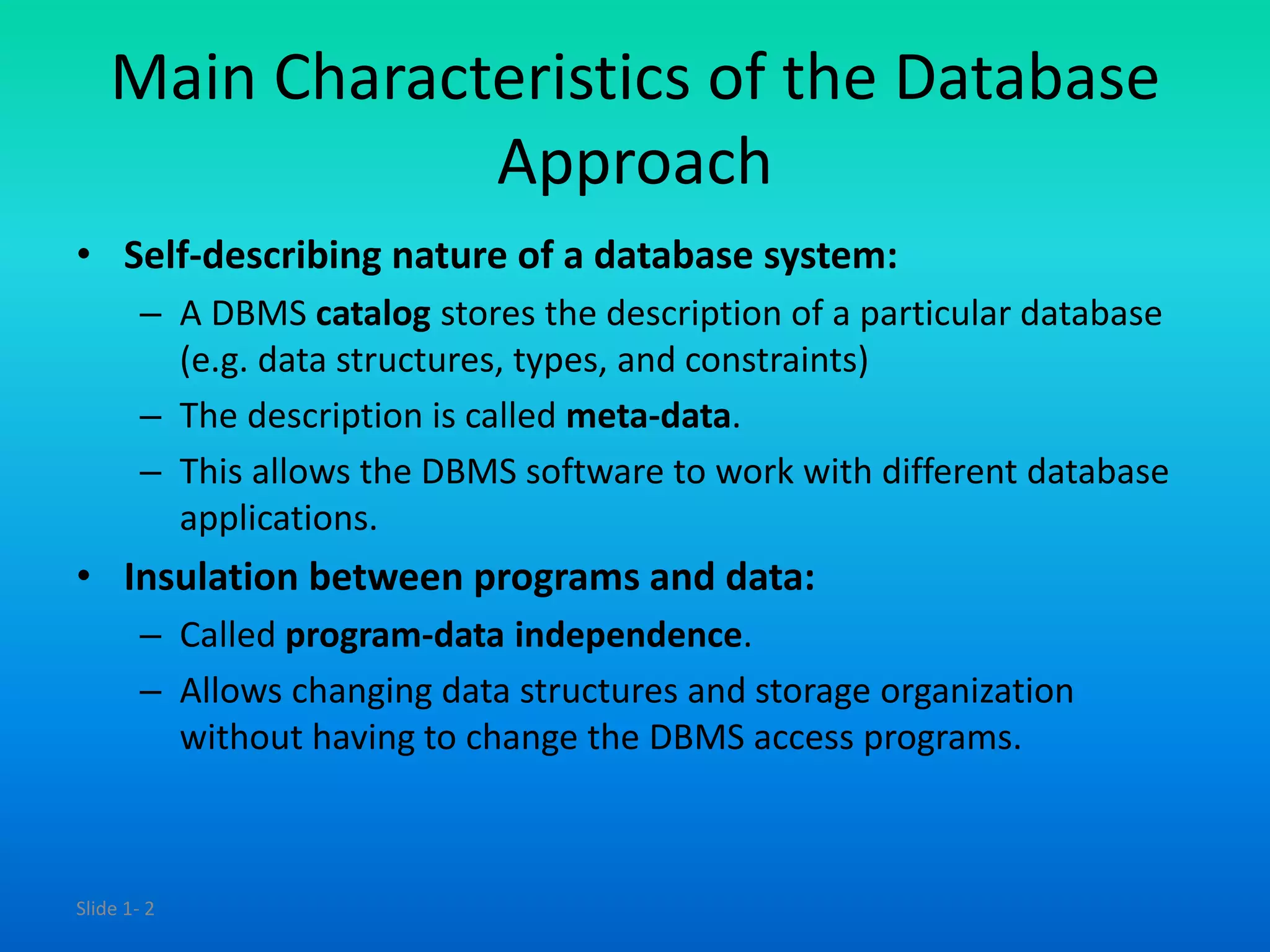
• Self-describing nature of a database system:
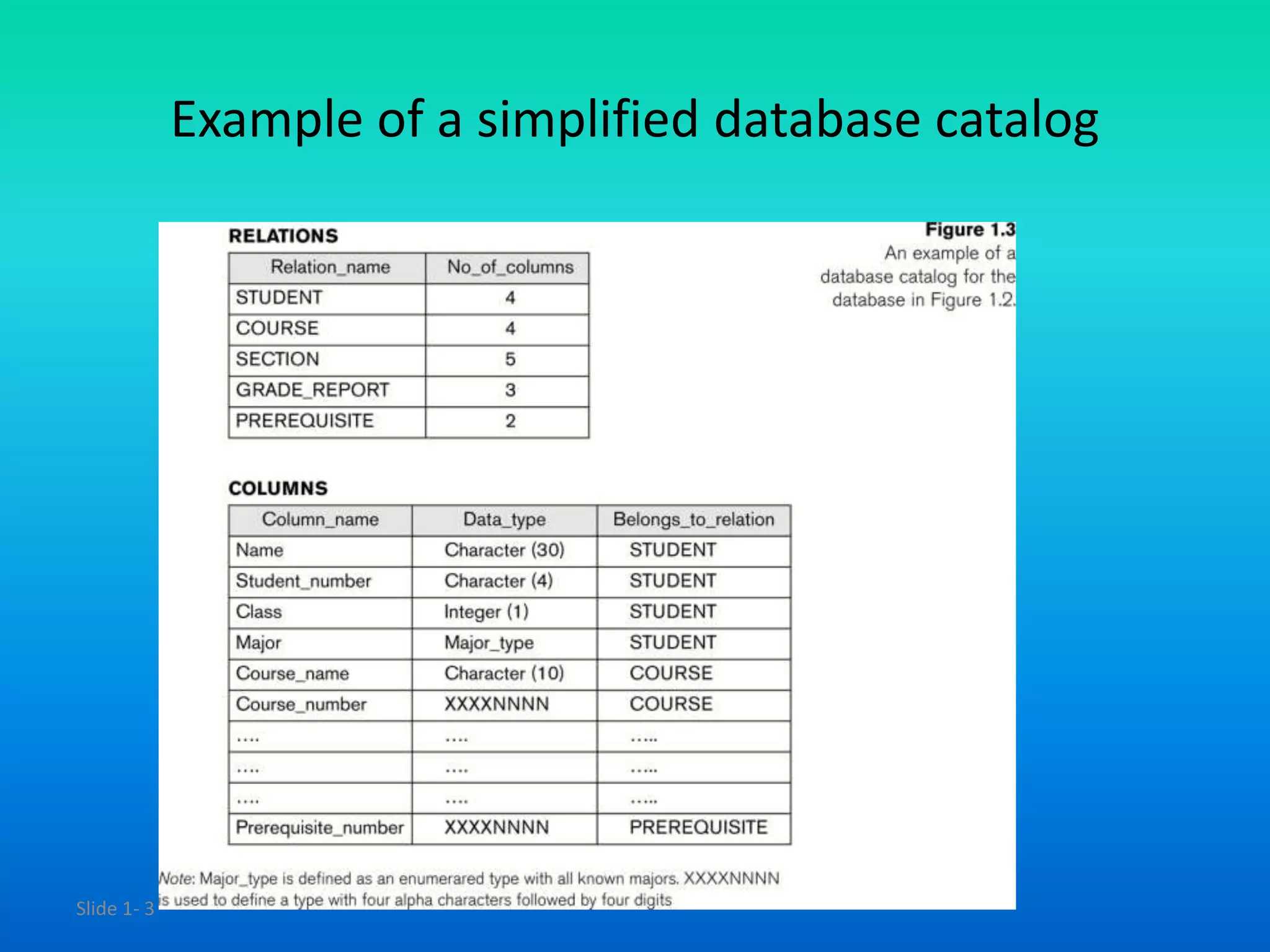
– A DBMS catalog stores the description of a particular database
(e.g. data structures, types, and constraints)
– The description is called meta-data.
– This allows the DBMS software to work with different database
applications.
• Insulation between programs and data:
– Called program-data independence.
– Allows changing data structures and storage organization
without having to change the DBMS access programs.
Slide 1- 3
Example of a simplified database catalog
Slide 1- 4
Main Characteristics of the Database
Approach (continued)
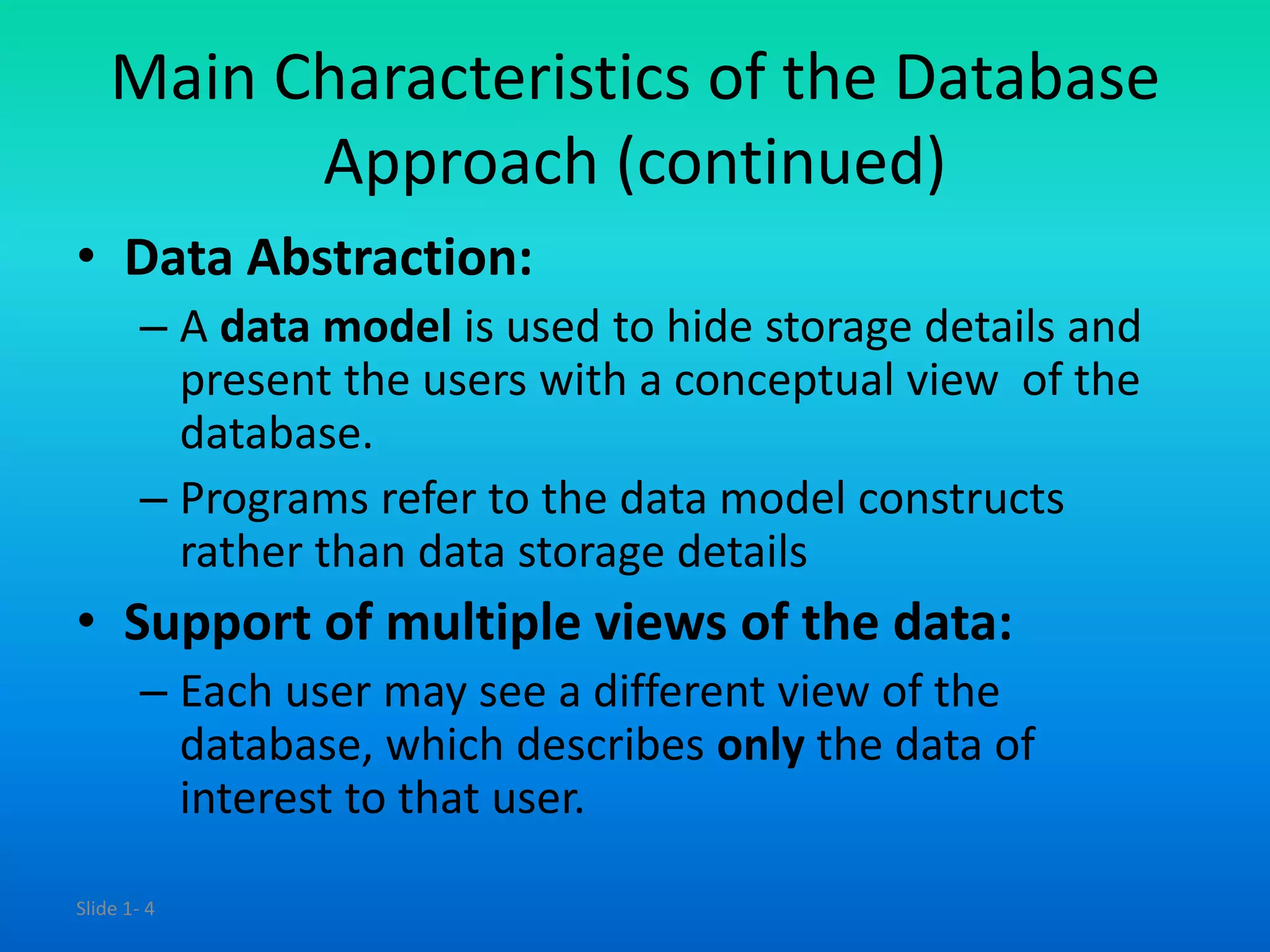
• Data Abstraction:
– A data model is used to hide storage details and
present the users with a conceptual view of the
database.
– Programs refer to the data model constructs
rather than data storage details
• Support of multiple views of the data:
– Each user may see a different view of the
database, which describes only the data of
interest to that user.
Slide 1- 5
Main Characteristics of the Database
Approach (continued)
• Sharing of data and multi-user transaction processing:
– Allowing a set of concurrent users to retrieve from and to
update the database.
– Concurrency control within the DBMS guarantees that each
transaction is correctly executed or aborted
– Recovery subsystem ensures each completed transaction has its
effect permanently recorded in the database
– OLTP (Online Transaction Processing) is a major part of database
applications. This allows hundreds of concurrent transactions to
execute per second.
Slide 1- 6
Database Users
• Users may be divided into
– Those who actually use and control the database
content, and those who design, develop and
maintain database applications (called “Actors on
the Scene”), and
– Those who design and develop the DBMS
software and related tools, and the computer
systems operators (called “Workers Behind the
Scene”).
Slide 1- 7
Database Users
• Actors on the scene
– Database administrators:
• Responsible for authorizing access to the database, for
coordinating and monitoring its use, acquiring software
and hardware resources, controlling its use and
monitoring efficiency of operations.
– Database Designers:
• Responsible to define the content, the structure, the
constraints, and functions or transactions against the
database. They must communicate with the end-users
and understand their needs.
Slide 1- 8
Categories of End-users
• Actors on the scene (continued)
– End-users: They use the data for queries, reports
and some of them update the database content.
End-users can be categorized into:
• Casual: access database occasionally when needed
• Naïve or Parametric: they make up a large section of
the end-user population.
– They use previously well-defined functions in the form of
“canned transactions” against the database.
– Examples are bank-tellers or reservation clerks who do this
activity for an entire shift of operations.
Slide 1- 9
Categories of End-users (continued)
• Sophisticated:
– These include business analysts, scientists, engineers, others
thoroughly familiar with the system capabilities.
– Many use tools in the form of software packages that work
closely with the stored database.
• Stand-alone:
– Mostly maintain personal databases using ready-to-use
packaged applications.
– An example is a tax program user that creates its own internal
database.
– Another example is a user that maintains an address book
Slide 1- 10
Advantages of Using the Database
Approach
• Controlling redundancy in data storage and in
development and maintenance efforts.
– Sharing of data among multiple users.
• Restricting unauthorized access to data.
• Providing persistent storage for program
Objects
– In Object-oriented DBMSs – see Chapters 20-22
• Providing Storage Structures (e.g. indexes) for
efficient Query Processing
Slide 1- 11
Advantages of Using the Database
Approach (continued)
• Providing backup and recovery services.
• Providing multiple interfaces to different
classes of users.
• Representing complex relationships among
data.
• Enforcing integrity constraints on the
database.
• Drawing inferences and actions from the
stored data using deductive and active rules
Slide 1- 12
Additional Implications of Using the
Database Approach
• Potential for enforcing standards:
– This is very crucial for the success of database
applications in large organizations. Standards refer
to data item names, display formats, screens,
report structures, meta-data (description of data),
Web page layouts, etc.
• Reduced application development time:
– Incremental time to add each new application is
reduced.
Slide 1- 13
Additional Implications of Using the
Database Approach (continued)
• Flexibility to change data structures:
– Database structure may evolve as new requirements
are defined.
• Availability of current information:
– Extremely important for on-line transaction systems
such as airline, hotel, car reservations.
• Economies of scale:
– Wasteful overlap of resources and personnel can be
avoided by consolidating data and applications across
departments.
Assignment
• What are the main characteristics of the
Database Approach
• What are the advantages of using the
Database Approach

Adbms 3 main characteristics of the database approach

  • 1.
    Advance Database ManagementSystems : 3 Main Characteristics of the Database Approach Prof Neeraj Bhargava Vaibhav Khanna Department of Computer Science School of Engineering and Systems Sciences Maharshi Dayanand Saraswati University Ajmer
  • 2.
    Slide 1- 2 MainCharacteristics of the Database Approach • Self-describing nature of a database system: – A DBMS catalog stores the description of a particular database (e.g. data structures, types, and constraints) – The description is called meta-data. – This allows the DBMS software to work with different database applications. • Insulation between programs and data: – Called program-data independence. – Allows changing data structures and storage organization without having to change the DBMS access programs.
  • 3.
    Slide 1- 3 Exampleof a simplified database catalog
  • 4.
    Slide 1- 4 MainCharacteristics of the Database Approach (continued) • Data Abstraction: – A data model is used to hide storage details and present the users with a conceptual view of the database. – Programs refer to the data model constructs rather than data storage details • Support of multiple views of the data: – Each user may see a different view of the database, which describes only the data of interest to that user.
  • 5.
    Slide 1- 5 MainCharacteristics of the Database Approach (continued) • Sharing of data and multi-user transaction processing: – Allowing a set of concurrent users to retrieve from and to update the database. – Concurrency control within the DBMS guarantees that each transaction is correctly executed or aborted – Recovery subsystem ensures each completed transaction has its effect permanently recorded in the database – OLTP (Online Transaction Processing) is a major part of database applications. This allows hundreds of concurrent transactions to execute per second.
  • 6.
    Slide 1- 6 DatabaseUsers • Users may be divided into – Those who actually use and control the database content, and those who design, develop and maintain database applications (called “Actors on the Scene”), and – Those who design and develop the DBMS software and related tools, and the computer systems operators (called “Workers Behind the Scene”).
  • 7.
    Slide 1- 7 DatabaseUsers • Actors on the scene – Database administrators: • Responsible for authorizing access to the database, for coordinating and monitoring its use, acquiring software and hardware resources, controlling its use and monitoring efficiency of operations. – Database Designers: • Responsible to define the content, the structure, the constraints, and functions or transactions against the database. They must communicate with the end-users and understand their needs.
  • 8.
    Slide 1- 8 Categoriesof End-users • Actors on the scene (continued) – End-users: They use the data for queries, reports and some of them update the database content. End-users can be categorized into: • Casual: access database occasionally when needed • Naïve or Parametric: they make up a large section of the end-user population. – They use previously well-defined functions in the form of “canned transactions” against the database. – Examples are bank-tellers or reservation clerks who do this activity for an entire shift of operations.
  • 9.
    Slide 1- 9 Categoriesof End-users (continued) • Sophisticated: – These include business analysts, scientists, engineers, others thoroughly familiar with the system capabilities. – Many use tools in the form of software packages that work closely with the stored database. • Stand-alone: – Mostly maintain personal databases using ready-to-use packaged applications. – An example is a tax program user that creates its own internal database. – Another example is a user that maintains an address book
  • 10.
    Slide 1- 10 Advantagesof Using the Database Approach • Controlling redundancy in data storage and in development and maintenance efforts. – Sharing of data among multiple users. • Restricting unauthorized access to data. • Providing persistent storage for program Objects – In Object-oriented DBMSs – see Chapters 20-22 • Providing Storage Structures (e.g. indexes) for efficient Query Processing
  • 11.
    Slide 1- 11 Advantagesof Using the Database Approach (continued) • Providing backup and recovery services. • Providing multiple interfaces to different classes of users. • Representing complex relationships among data. • Enforcing integrity constraints on the database. • Drawing inferences and actions from the stored data using deductive and active rules
  • 12.
    Slide 1- 12 AdditionalImplications of Using the Database Approach • Potential for enforcing standards: – This is very crucial for the success of database applications in large organizations. Standards refer to data item names, display formats, screens, report structures, meta-data (description of data), Web page layouts, etc. • Reduced application development time: – Incremental time to add each new application is reduced.
  • 13.
    Slide 1- 13 AdditionalImplications of Using the Database Approach (continued) • Flexibility to change data structures: – Database structure may evolve as new requirements are defined. • Availability of current information: – Extremely important for on-line transaction systems such as airline, hotel, car reservations. • Economies of scale: – Wasteful overlap of resources and personnel can be avoided by consolidating data and applications across departments.
  • 14.
    Assignment • What arethe main characteristics of the Database Approach • What are the advantages of using the Database Approach