Database Management: Introduction Ray R. Larson University of California, Berkeley School of Information IS 257: Database Management
Overview Announcements Course Description Database Concepts and Terminology Database Models Database Life Cycle
Course Overview Description of the Course Assignments Readings Grading Schedule Web site:  http://courses.ischool.berkeley.edu/i257/f09
Course Description This course is concerned with the design of the database itself -- not with the design of database system software. We will discuss DBMS internals only as they relate to the database and its design and structure We will spend a fair amount time on database application design, especially on options for Web application database support -- but this will not be primary focus.
Assignments Two kinds of assignments Using a pre-built database for search and retrieval and database modification queries Designing, populating, and running queries against your  own personal (or group)   database Types of database project Individual Work related Course only Projects from around campus that need doing… Group Course related Final Master’s project
Readings Textbook is: Jeffrey A. Hoffer, Mary B. Prescott and Heikki Topi.  Modern Database Management (Ninth Edition).  Prentice Hall (Pearson Educational) : Upper Saddle River, NJ, 2008.  ISBN 978-0-13-600391-5
Grading Grades will be based on: Assignments (30%) Personal/Group Database project (60%) Class participation (10%) (No midterm or final)
Schedule On website: http://courses.ischool.berkeley.edu/i257/f09/
Overview Announcements Course Description Database Concepts and Terminology Database Models Database Life Cycle
What is a Database? ?
Files and Databases File: A collection of records or documents dealing with one organization, person, area or subject. (Rowley) Manual (paper) files Computer files Database: A collection of similar records with relationships between the records. (Rowley) bibliographic, statistical, business data, images, etc.
Database A Database is a collection of stored operational data used by the application systems of some particular enterprise. (C.J. Date) Paper “Databases” Still contain a large portion of the world’s knowledge Changing as, for example, book scanning projects like Google Books and the Open Content Aliance convert paper docs File-Based Data Processing Systems Early batch processing of (primarily) business data would not be too surprised to find some these still out there Database Management Systems (DBMS) Some old ones still in use, but most modern DBMS are relational, object or object-relational
Terms and Concepts Database Management System -- DBMS Software system used to define, create, maintain and provide controlled access to the database and  its metadata
Terms and Concepts Data Dictionary AKA  Repository (old usage) The place where all  metadata  for a particular database is stored may also include information on relationships between files or tables in a particular database
Terms and Concepts Metadata Data about data  In DBMS means all of the characteristics describing the attributes of an entity, E.G.: name of attribute data type of attribute size of the attribute format or special characteristics Characteristics of files or relations name, content,  notes, etc.
Why DBMS? History 50’s and 60’s all applications were custom built for particular needs File based Many similar/duplicative applications dealing with collections of business data Early DBMS were extensions of programming languages 1970 - E.F. Codd and the Relational Model 1979 - Ashton-Tate & first Microcomputer DBMS
From File Systems to DBMS Problems with File Processing systems Inconsistent Data Inflexibility Limited Data Sharing Poor enforcement of standards Excessive program maintenance
DBMS Benefits Minimal Data Redundancy Consistency of Data Integration of Data Sharing of Data Ease of Application Development Uniform Security, Privacy, and Integrity Controls Data Accessibility and Responsiveness Data Independence Reduced Program Maintenance
Terms and Concepts Data Independence Physical representation and location of data and the use of that data are separated The application doesn’t need to know how or where the database has stored the data, but just how to ask for it. Moving a database from one DBMS to another should not have a material effect on application program Recoding, adding fields, etc. in the database should not affect applications
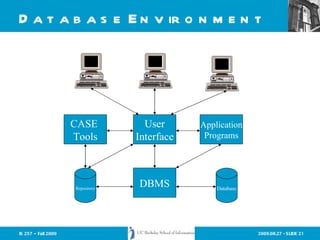
Database Environment CASE  Tools DBMS User Interface Application Programs Repository Database
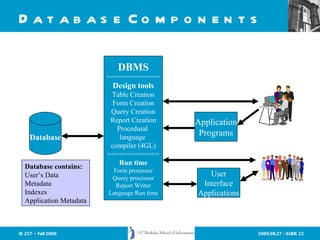
Database Components DBMS =============== Design tools Table Creation Form Creation Query Creation Report Creation Procedural  language  compiler (4GL) ============= Run time Form processor Query processor Report Writer Language Run time User Interface Applications Application Programs Database Database contains: User’s Data Metadata Indexes Application Metadata
Types of Database Systems PC Databases Centralized Database Client/Server Databases Distributed Databases Database Models
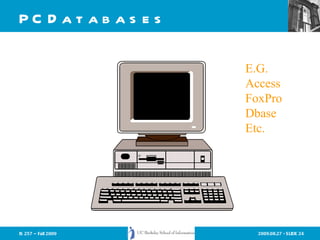
PC Databases E.G. Access FoxPro Dbase Etc.
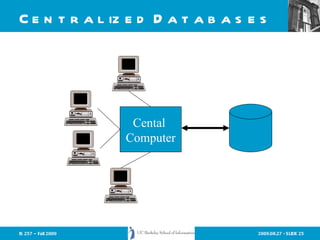
Centralized Databases Cental  Computer
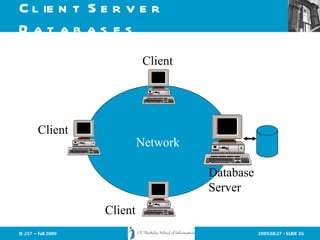
Client Server Databases Network Client Client Client Database Server
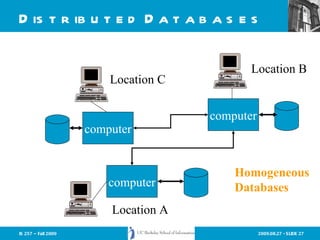
Distributed Databases computer computer computer Location A Location C Location B Homogeneous Databases
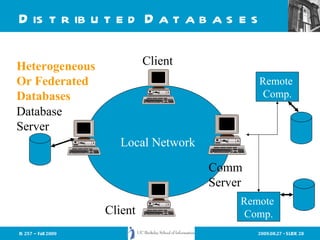
Distributed Databases Local Network Database Server Client Client Comm Server Remote  Comp. Remote  Comp. Heterogeneous Or Federated Databases
Terms and Concepts Database activities: Create Add new data to the database Read Read current data from the database Update Update or modify current database data Delete Remove current data from the database
Terms and Concepts Database Application An application program (or set of related programs) that is used to perform a series of database activities: Create Read Update Delete On behalf of database users
Range of Database Applications PC databases Usually for individual  WorkGroup databases Small group use where everyone has access to the database over a LAN Departmental databases Larger than a workgroup – but similar Enterprises databases For the entire organization over an intranet (or sometimes the internet)
Terms and Concepts Enterprise Organization Entity Person, Place, Thing, Event, Concept... Attributes Data elements (facts) about some entity Also sometimes called fields or items or domains Data values instances of a particular attribute for a particular entity
Terms and Concepts Records The set of values for all attributes of a particular entity AKA “tuples” or “rows” in relational DBMS File Collection of records  AKA “Relation” or “Table” in relational DBMS
Terms and Concepts Key an attribute or set of attributes used to identify or locate records in a file Primary Key an attribute or set of attributes that  uniquely  identifies each record in a file
Terms and Concepts DA Data adminstrator - person responsible for the Data Administration function in an organization Sometimes may be the CIO -- Chief Information Officer DBA Database Administrator - person responsible for the Database Administration Function
Terms and Concepts Models (1) Levels or views of the Database Conceptual, logical, physical (2) DBMS types Relational, Hierarchic, Network, Object-Oriented, Object-Relational
Overview Announcements Course Description Database Concepts and Terminology Database Models Database Life Cycle
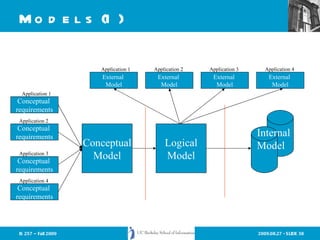
Models (1) Conceptual Model Logical Model External  Model Conceptual  requirements Conceptual  requirements Conceptual  requirements Conceptual  requirements Application 1 Application 1 Application 2 Application 3 Application 4 Application 2 Application 3 Application 4 External  Model External  Model External  Model Internal Model
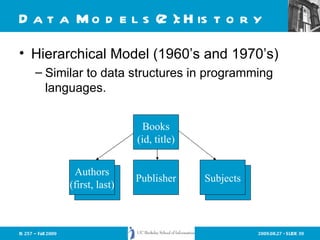
Data Models(2): History Hierarchical Model (1960’s and 1970’s) Similar to data structures in programming languages. Books (id, title) Publisher Subjects Authors (first, last)
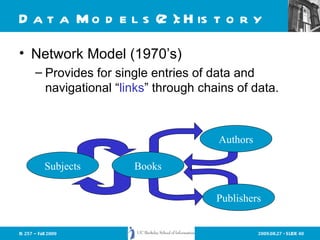
Data Models(2): History Network Model (1970’s) Provides for single entries of data and navigational “ links ” through chains of data. Subjects Books Authors Publishers
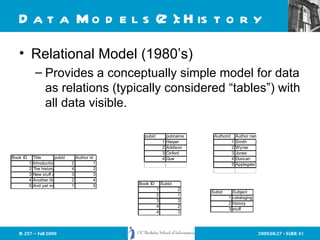
Data Models(2): History Relational Model (1980’s) Provides a conceptually simple model for data as relations (typically considered “tables”) with all data visible.
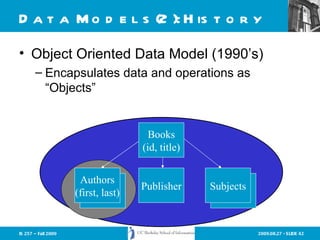
Data Models(2): History Object Oriented Data Model (1990’s) Encapsulates data and operations as “Objects” Books (id, title) Publisher Subjects Authors (first, last)
Data Models(2): History Object-Relational Model (1990’s) Combines the well-known properties of the Relational Model with such OO features as: User-defined datatypes User-defined functions Inheritance and sub-classing
Overview Announcements Course Description Database Concepts and Terminology Database Models Database Life Cycle
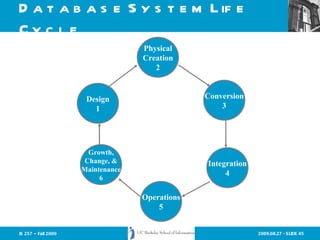
Database System Life Cycle Growth, Change, & Maintenance 6 Operations 5 Integration 4 Design 1 Conversion 3 Physical Creation 2
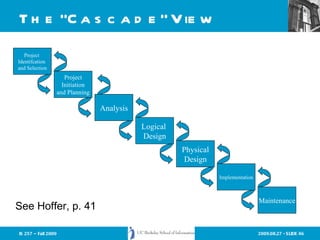
The “Cascade” View See Hoffer, p. 41 Project  Identifcation  and Selection Project Initiation and Planning Analysis Logical  Design Physical Design Implementation Maintenance
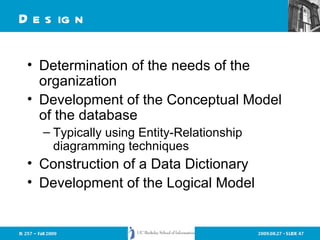
Design Determination of the needs of the organization Development of the Conceptual Model of the database Typically using Entity-Relationship diagramming techniques Construction of a Data Dictionary Development of the Logical Model
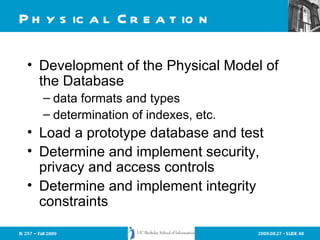
Physical Creation Development of the Physical Model of the Database data formats and types determination of indexes, etc. Load a prototype database and test Determine and implement security, privacy and access controls Determine and implement integrity constraints
Conversion Convert existing data sets and applications to use the new database May need programs, conversion utilities to convert old data to new formats.
Integration Overlaps with Phase 3 Integration of converted applications and new applications into the new database
Operations All applications run full-scale Privacy, security, access control must be in place. Recovery and Backup procedures must be established and used
Growth, Change & Maintenance Change is a way of life Applications, data requirements, reports, etc. will all change as new needs and requirements are found The Database and applications and will need to be modified to meet the needs of changes
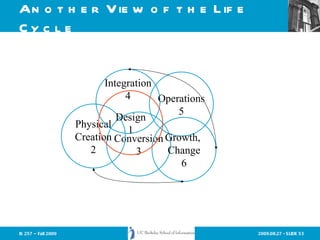
Another View of the Life Cycle Operations 5 Conversion 3 Physical Creation 2 Growth,  Change 6 Integration 4 Design 1
Next Time Introduction to the Diveshop database Introduction to Database Design

Lecture01 257

  • 1.
    Database Management: IntroductionRay R. Larson University of California, Berkeley School of Information IS 257: Database Management
  • 2.
    Overview Announcements CourseDescription Database Concepts and Terminology Database Models Database Life Cycle
  • 3.
    Overview Announcements CourseDescription Database Concepts and Terminology Database Models Database Life Cycle
  • 4.
    Course Overview Descriptionof the Course Assignments Readings Grading Schedule Web site: http://courses.ischool.berkeley.edu/i257/f09
  • 5.
    Course Description Thiscourse is concerned with the design of the database itself -- not with the design of database system software. We will discuss DBMS internals only as they relate to the database and its design and structure We will spend a fair amount time on database application design, especially on options for Web application database support -- but this will not be primary focus.
  • 6.
    Assignments Two kindsof assignments Using a pre-built database for search and retrieval and database modification queries Designing, populating, and running queries against your own personal (or group) database Types of database project Individual Work related Course only Projects from around campus that need doing… Group Course related Final Master’s project
  • 7.
    Readings Textbook is:Jeffrey A. Hoffer, Mary B. Prescott and Heikki Topi. Modern Database Management (Ninth Edition). Prentice Hall (Pearson Educational) : Upper Saddle River, NJ, 2008. ISBN 978-0-13-600391-5
  • 8.
    Grading Grades willbe based on: Assignments (30%) Personal/Group Database project (60%) Class participation (10%) (No midterm or final)
  • 9.
    Schedule On website:http://courses.ischool.berkeley.edu/i257/f09/
  • 10.
    Overview Announcements CourseDescription Database Concepts and Terminology Database Models Database Life Cycle
  • 11.
    What is aDatabase? ?
  • 12.
    Files and DatabasesFile: A collection of records or documents dealing with one organization, person, area or subject. (Rowley) Manual (paper) files Computer files Database: A collection of similar records with relationships between the records. (Rowley) bibliographic, statistical, business data, images, etc.
  • 13.
    Database A Databaseis a collection of stored operational data used by the application systems of some particular enterprise. (C.J. Date) Paper “Databases” Still contain a large portion of the world’s knowledge Changing as, for example, book scanning projects like Google Books and the Open Content Aliance convert paper docs File-Based Data Processing Systems Early batch processing of (primarily) business data would not be too surprised to find some these still out there Database Management Systems (DBMS) Some old ones still in use, but most modern DBMS are relational, object or object-relational
  • 14.
    Terms and ConceptsDatabase Management System -- DBMS Software system used to define, create, maintain and provide controlled access to the database and its metadata
  • 15.
    Terms and ConceptsData Dictionary AKA Repository (old usage) The place where all metadata for a particular database is stored may also include information on relationships between files or tables in a particular database
  • 16.
    Terms and ConceptsMetadata Data about data In DBMS means all of the characteristics describing the attributes of an entity, E.G.: name of attribute data type of attribute size of the attribute format or special characteristics Characteristics of files or relations name, content, notes, etc.
  • 17.
    Why DBMS? History50’s and 60’s all applications were custom built for particular needs File based Many similar/duplicative applications dealing with collections of business data Early DBMS were extensions of programming languages 1970 - E.F. Codd and the Relational Model 1979 - Ashton-Tate & first Microcomputer DBMS
  • 18.
    From File Systemsto DBMS Problems with File Processing systems Inconsistent Data Inflexibility Limited Data Sharing Poor enforcement of standards Excessive program maintenance
  • 19.
    DBMS Benefits MinimalData Redundancy Consistency of Data Integration of Data Sharing of Data Ease of Application Development Uniform Security, Privacy, and Integrity Controls Data Accessibility and Responsiveness Data Independence Reduced Program Maintenance
  • 20.
    Terms and ConceptsData Independence Physical representation and location of data and the use of that data are separated The application doesn’t need to know how or where the database has stored the data, but just how to ask for it. Moving a database from one DBMS to another should not have a material effect on application program Recoding, adding fields, etc. in the database should not affect applications
  • 21.
    Database Environment CASE Tools DBMS User Interface Application Programs Repository Database
  • 22.
    Database Components DBMS=============== Design tools Table Creation Form Creation Query Creation Report Creation Procedural language compiler (4GL) ============= Run time Form processor Query processor Report Writer Language Run time User Interface Applications Application Programs Database Database contains: User’s Data Metadata Indexes Application Metadata
  • 23.
    Types of DatabaseSystems PC Databases Centralized Database Client/Server Databases Distributed Databases Database Models
  • 24.
    PC Databases E.G.Access FoxPro Dbase Etc.
  • 25.
  • 26.
    Client Server DatabasesNetwork Client Client Client Database Server
  • 27.
    Distributed Databases computercomputer computer Location A Location C Location B Homogeneous Databases
  • 28.
    Distributed Databases LocalNetwork Database Server Client Client Comm Server Remote Comp. Remote Comp. Heterogeneous Or Federated Databases
  • 29.
    Terms and ConceptsDatabase activities: Create Add new data to the database Read Read current data from the database Update Update or modify current database data Delete Remove current data from the database
  • 30.
    Terms and ConceptsDatabase Application An application program (or set of related programs) that is used to perform a series of database activities: Create Read Update Delete On behalf of database users
  • 31.
    Range of DatabaseApplications PC databases Usually for individual WorkGroup databases Small group use where everyone has access to the database over a LAN Departmental databases Larger than a workgroup – but similar Enterprises databases For the entire organization over an intranet (or sometimes the internet)
  • 32.
    Terms and ConceptsEnterprise Organization Entity Person, Place, Thing, Event, Concept... Attributes Data elements (facts) about some entity Also sometimes called fields or items or domains Data values instances of a particular attribute for a particular entity
  • 33.
    Terms and ConceptsRecords The set of values for all attributes of a particular entity AKA “tuples” or “rows” in relational DBMS File Collection of records AKA “Relation” or “Table” in relational DBMS
  • 34.
    Terms and ConceptsKey an attribute or set of attributes used to identify or locate records in a file Primary Key an attribute or set of attributes that uniquely identifies each record in a file
  • 35.
    Terms and ConceptsDA Data adminstrator - person responsible for the Data Administration function in an organization Sometimes may be the CIO -- Chief Information Officer DBA Database Administrator - person responsible for the Database Administration Function
  • 36.
    Terms and ConceptsModels (1) Levels or views of the Database Conceptual, logical, physical (2) DBMS types Relational, Hierarchic, Network, Object-Oriented, Object-Relational
  • 37.
    Overview Announcements CourseDescription Database Concepts and Terminology Database Models Database Life Cycle
  • 38.
    Models (1) ConceptualModel Logical Model External Model Conceptual requirements Conceptual requirements Conceptual requirements Conceptual requirements Application 1 Application 1 Application 2 Application 3 Application 4 Application 2 Application 3 Application 4 External Model External Model External Model Internal Model
  • 39.
    Data Models(2): HistoryHierarchical Model (1960’s and 1970’s) Similar to data structures in programming languages. Books (id, title) Publisher Subjects Authors (first, last)
  • 40.
    Data Models(2): HistoryNetwork Model (1970’s) Provides for single entries of data and navigational “ links ” through chains of data. Subjects Books Authors Publishers
  • 41.
    Data Models(2): HistoryRelational Model (1980’s) Provides a conceptually simple model for data as relations (typically considered “tables”) with all data visible.
  • 42.
    Data Models(2): HistoryObject Oriented Data Model (1990’s) Encapsulates data and operations as “Objects” Books (id, title) Publisher Subjects Authors (first, last)
  • 43.
    Data Models(2): HistoryObject-Relational Model (1990’s) Combines the well-known properties of the Relational Model with such OO features as: User-defined datatypes User-defined functions Inheritance and sub-classing
  • 44.
    Overview Announcements CourseDescription Database Concepts and Terminology Database Models Database Life Cycle
  • 45.
    Database System LifeCycle Growth, Change, & Maintenance 6 Operations 5 Integration 4 Design 1 Conversion 3 Physical Creation 2
  • 46.
    The “Cascade” ViewSee Hoffer, p. 41 Project Identifcation and Selection Project Initiation and Planning Analysis Logical Design Physical Design Implementation Maintenance
  • 47.
    Design Determination ofthe needs of the organization Development of the Conceptual Model of the database Typically using Entity-Relationship diagramming techniques Construction of a Data Dictionary Development of the Logical Model
  • 48.
    Physical Creation Developmentof the Physical Model of the Database data formats and types determination of indexes, etc. Load a prototype database and test Determine and implement security, privacy and access controls Determine and implement integrity constraints
  • 49.
    Conversion Convert existingdata sets and applications to use the new database May need programs, conversion utilities to convert old data to new formats.
  • 50.
    Integration Overlaps withPhase 3 Integration of converted applications and new applications into the new database
  • 51.
    Operations All applicationsrun full-scale Privacy, security, access control must be in place. Recovery and Backup procedures must be established and used
  • 52.
    Growth, Change &Maintenance Change is a way of life Applications, data requirements, reports, etc. will all change as new needs and requirements are found The Database and applications and will need to be modified to meet the needs of changes
  • 53.
    Another View ofthe Life Cycle Operations 5 Conversion 3 Physical Creation 2 Growth, Change 6 Integration 4 Design 1
  • 54.
    Next Time Introductionto the Diveshop database Introduction to Database Design