Redemption Sounds
A Call for Reform
Francisco Jimenez (Ximenez) de Cisneros:
 An austere Franciscan.
 Personal confessor of Isabella, of Castile.
 Was imprisoned for ten years as a result of his
decision to shun the corrupt practices of his day.
 Became learned in biblical language; was also
familiar with humanist writings.
 Reluctantly accepted the office of archbishop.
 Founded the University of Alcala; printed a Greek
New Testament and led in the composition of the
Compultensian Polyglot.
Queen Isabella:
 Became queen in 1474.
 Saw the Church in her realm as being in dire
need of reform.
 Desired to bring about necessary reform.
 Sought and got permission from the pope to fill
ecclesiastical vacancies.
 Worked closely with Cardinal Jimenez in
bringing about reforms
Some Reforms of Isabella and Jimenez:
 Monastic reforms were done by personally
visiting some of the most lax ones and making a
stern call for a return to monastic vows.
 Got political support from the pope in monastic
reforms.
 Encouraged learning among the clergy.
 Gave support to custom and moral reforms.
 Unfortunately they also engaged in forced
conversions among the Jews and the Moors.
 Jimenez eventually became the Grand Inquisitor
of the Spanish Inquisition.
Reforming Orders
The Discalced Carmelites:
 Founded by Teresa of Avila; later joined by John of the
Cross.
 Teresa is said to have received a series of visions from
Jesus directing her to leave the convent of which she
was a part and from a new one.
 Emphasized the importance of devotion.
 Promoted strict obedience to the monastic rules of the
Carmelites.
 Teresa taught a form of mysticism:
 Outlined ways of attaining sanctification
 Prayer of recollection
 Union - soul overcome with love for the
divine
 Ecstasy - soul married with Christ
 Teresa is the only Catholic woman to found
monastic orders for both men and women.
The Society of Jesus:
 Founded by Ignatius Loyola.
 Had a spiritual experience as a result of reading
devotional writings while convalescing from a
wounded leg.
 He had a desire to find inner peace since his heart
was troubled by his sense of his sinfulness.
 Pledged himself to loyal service to the Church; saw
that as the avenue whereby he would find peace.
 Wrote the Spiritual Exercises as a guide for his
adherents.
 Intended that his order be a missionary one.
 Members took vows of “poverty, chastity, and
obedience to the pope.”
 Jesuits became very focused upon promoting
education, fighting against heresy and foreign
missionary activities.
 His order was highly organized and efficient;
became a most powerful tool of the papacy in its
offensive against Protestantism.
The Council of Trent
 Council of Trent 1545-1563
• Called by Pope Paul III
• 1545-1547 - various doctrinal questions
 Declared Bible alone not final authority for faithful
 Justification
 Seven sacraments reaffirmed
 Reformers of ecclesiastical abuses formulated
The Council of Trent
Important decisions of Trent:
 Declared that a council does not have authority above
the pope.
 Issued decrees bringing about clerical reforms:
 Bishops were to live within their sees.
 Outlawed pluralism.
 Formulated a clear list of obligations of the clergy.
 Introduced regulations to deal with relics,
indulgences, etc.
 Ordered that seminaries be established for the
purpose of training priests.
Theological decrees:
 Thomism was declared to be the official theology
of the Church.
 Accepted the Vulgate as being the authoritative
translation of the Church as regards matters of
dogma.
 Tradition was declared as having authority equal
to Scripture.
 The seven sacraments were reaffirmed along
with the attendant sacramental theology.
 Transubstantiation was reaffirmed. Communion
in both kinds was seen as not being a necessity.
Soteriology:
 Saw original sin as being the retention of the
consequences of sin.
 Justification comes about through collaboration
between good works and grace.
 Defended the Augustinian view that justification is the
process of regeneration and renewal within human
nature which brings about a change in both the outer
status and the inner nature of the sinner.
 Justification includes the idea of regeneration. Not
only remission of sins but sanctification and renewal
of the inner person through reception of grace and
gifts by which an unrighteous person becomes
righteous.
Ultimate results:
 Did not restore unity within the Christian
Church.
 Strengthened the papacy.
 Marked a change in Catholicism; birth of the
modern version.
 Strengthened the belief system of Roman
Catholicism.
• 1564 – Papal bull issued
 summary of council
 known as Tridentine Profession of Faith
 all clergy, teachers and converts required to subscribe
 Swear “true obedience to the Pope”
The Inquisition and The Index
 Inquisition
• Originated in struggle against Albigenses in southern
France - early thirteenth century
• Established by papal license – 1480 – in Spain under
Thomas Torquemadas (1420-1498)
• Roman Inquisition 1542 and abolished in 1854
Guilty until proven innocent
Never confronted by accusers; tortured for
confession
Punished by loss of property, imprisonment, death
The Inquisition and The Index
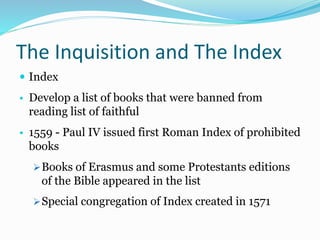
 Index
• Develop a list of books that were banned from
reading list of faithful
• 1559 - Paul IV issued first Roman Index of prohibited
books
Books of Erasmus and some Protestants editions
of the Bible appeared in the list
Special congregation of Index created in 1571
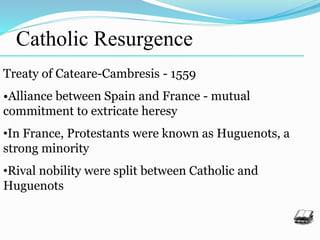
Catholic Resurgence
Treaty of Cateare-Cambresis - 1559
•Alliance between Spain and France - mutual
commitment to extricate heresy
•In France, Protestants were known as Huguenots, a
strong minority
•Rival nobility were split between Catholic and
Huguenots
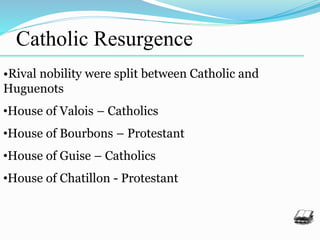
Catholic Resurgence
•Rival nobility were split between Catholic and
Huguenots
•House of Valois – Catholics
•House of Bourbons – Protestant
•House of Guise – Catholics
•House of Chatillon - Protestant
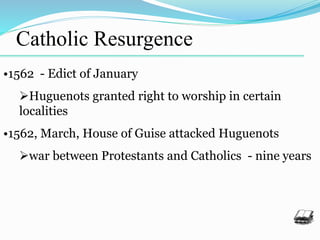
Catholic Resurgence
•1562 - Edict of January
Huguenots granted right to worship in certain
localities
•1562, March, House of Guise attacked Huguenots
war between Protestants and Catholics - nine years
Catholic Resurgence
• Catherine sought peace; marriage of Margaret to
Henry of Navarre-Huguenot
1572 – Massacre of Bartholomew, Paris
• 1598 - Henry Navarre becomes king, returns to
Catholicism
Edict of Nantes
Revocation of Edict of Nantes

The counter reformation

  • 1.
  • 2.
    A Call forReform Francisco Jimenez (Ximenez) de Cisneros:  An austere Franciscan.  Personal confessor of Isabella, of Castile.  Was imprisoned for ten years as a result of his decision to shun the corrupt practices of his day.  Became learned in biblical language; was also familiar with humanist writings.  Reluctantly accepted the office of archbishop.  Founded the University of Alcala; printed a Greek New Testament and led in the composition of the Compultensian Polyglot.
  • 3.
    Queen Isabella:  Becamequeen in 1474.  Saw the Church in her realm as being in dire need of reform.  Desired to bring about necessary reform.  Sought and got permission from the pope to fill ecclesiastical vacancies.  Worked closely with Cardinal Jimenez in bringing about reforms
  • 4.
    Some Reforms ofIsabella and Jimenez:  Monastic reforms were done by personally visiting some of the most lax ones and making a stern call for a return to monastic vows.  Got political support from the pope in monastic reforms.  Encouraged learning among the clergy.  Gave support to custom and moral reforms.  Unfortunately they also engaged in forced conversions among the Jews and the Moors.  Jimenez eventually became the Grand Inquisitor of the Spanish Inquisition.
  • 5.
    Reforming Orders The DiscalcedCarmelites:  Founded by Teresa of Avila; later joined by John of the Cross.  Teresa is said to have received a series of visions from Jesus directing her to leave the convent of which she was a part and from a new one.  Emphasized the importance of devotion.  Promoted strict obedience to the monastic rules of the Carmelites.
  • 6.
     Teresa taughta form of mysticism:  Outlined ways of attaining sanctification  Prayer of recollection  Union - soul overcome with love for the divine  Ecstasy - soul married with Christ  Teresa is the only Catholic woman to found monastic orders for both men and women.
  • 7.
    The Society ofJesus:  Founded by Ignatius Loyola.  Had a spiritual experience as a result of reading devotional writings while convalescing from a wounded leg.  He had a desire to find inner peace since his heart was troubled by his sense of his sinfulness.  Pledged himself to loyal service to the Church; saw that as the avenue whereby he would find peace.
  • 8.
     Wrote theSpiritual Exercises as a guide for his adherents.  Intended that his order be a missionary one.  Members took vows of “poverty, chastity, and obedience to the pope.”  Jesuits became very focused upon promoting education, fighting against heresy and foreign missionary activities.  His order was highly organized and efficient; became a most powerful tool of the papacy in its offensive against Protestantism.
  • 9.
    The Council ofTrent  Council of Trent 1545-1563 • Called by Pope Paul III • 1545-1547 - various doctrinal questions  Declared Bible alone not final authority for faithful  Justification  Seven sacraments reaffirmed  Reformers of ecclesiastical abuses formulated
  • 10.
    The Council ofTrent Important decisions of Trent:  Declared that a council does not have authority above the pope.  Issued decrees bringing about clerical reforms:  Bishops were to live within their sees.  Outlawed pluralism.  Formulated a clear list of obligations of the clergy.  Introduced regulations to deal with relics, indulgences, etc.  Ordered that seminaries be established for the purpose of training priests.
  • 11.
    Theological decrees:  Thomismwas declared to be the official theology of the Church.  Accepted the Vulgate as being the authoritative translation of the Church as regards matters of dogma.  Tradition was declared as having authority equal to Scripture.  The seven sacraments were reaffirmed along with the attendant sacramental theology.  Transubstantiation was reaffirmed. Communion in both kinds was seen as not being a necessity.
  • 12.
    Soteriology:  Saw originalsin as being the retention of the consequences of sin.  Justification comes about through collaboration between good works and grace.  Defended the Augustinian view that justification is the process of regeneration and renewal within human nature which brings about a change in both the outer status and the inner nature of the sinner.  Justification includes the idea of regeneration. Not only remission of sins but sanctification and renewal of the inner person through reception of grace and gifts by which an unrighteous person becomes righteous.
  • 13.
    Ultimate results:  Didnot restore unity within the Christian Church.  Strengthened the papacy.  Marked a change in Catholicism; birth of the modern version.  Strengthened the belief system of Roman Catholicism.
  • 14.
    • 1564 –Papal bull issued  summary of council  known as Tridentine Profession of Faith  all clergy, teachers and converts required to subscribe  Swear “true obedience to the Pope”
  • 15.
    The Inquisition andThe Index  Inquisition • Originated in struggle against Albigenses in southern France - early thirteenth century • Established by papal license – 1480 – in Spain under Thomas Torquemadas (1420-1498) • Roman Inquisition 1542 and abolished in 1854 Guilty until proven innocent Never confronted by accusers; tortured for confession Punished by loss of property, imprisonment, death
  • 16.
    The Inquisition andThe Index  Index • Develop a list of books that were banned from reading list of faithful • 1559 - Paul IV issued first Roman Index of prohibited books Books of Erasmus and some Protestants editions of the Bible appeared in the list Special congregation of Index created in 1571
  • 17.
    Catholic Resurgence Treaty ofCateare-Cambresis - 1559 •Alliance between Spain and France - mutual commitment to extricate heresy •In France, Protestants were known as Huguenots, a strong minority •Rival nobility were split between Catholic and Huguenots
  • 18.
    Catholic Resurgence •Rival nobilitywere split between Catholic and Huguenots •House of Valois – Catholics •House of Bourbons – Protestant •House of Guise – Catholics •House of Chatillon - Protestant
  • 19.
    Catholic Resurgence •1562 -Edict of January Huguenots granted right to worship in certain localities •1562, March, House of Guise attacked Huguenots war between Protestants and Catholics - nine years
  • 20.
    Catholic Resurgence • Catherinesought peace; marriage of Margaret to Henry of Navarre-Huguenot 1572 – Massacre of Bartholomew, Paris • 1598 - Henry Navarre becomes king, returns to Catholicism Edict of Nantes Revocation of Edict of Nantes