THE SECOND GREAT AWAKENING
Hark, Hark, It’s Time To Repent!
INTRODUCTION
 The Second Great Awakening occurred in
the US between the 1790s-1840s.
 Unlike the First Great Awakening, this revival
was Armenian.
 Main Christian groups involved were the
Baptists and Methodists.
 By the end of this period of revival Baptists
and Methodists overtook Congregationalists
and Anglicans as the largest Christian
bodies.
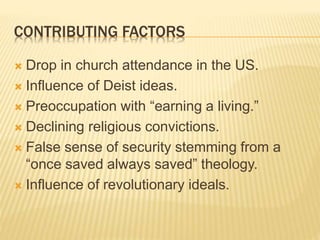
CONTRIBUTING FACTORS
 Drop in church attendance in the US.
 Influence of Deist ideas.
 Preoccupation with “earning a living.”
 Declining religious convictions.
 False sense of security stemming from a
“once saved always saved” theology.
 Influence of revolutionary ideals.
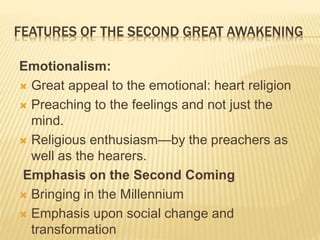
FEATURES OF THE SECOND GREAT AWAKENING
Emotionalism:
 Great appeal to the emotional: heart religion
 Preaching to the feelings and not just the
mind.
 Religious enthusiasm—by the preachers as
well as the hearers.
Emphasis on the Second Coming
 Bringing in the Millennium
 Emphasis upon social change and
transformation
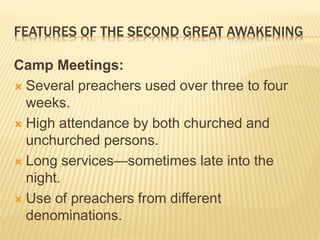
FEATURES OF THE SECOND GREAT AWAKENING
Camp Meetings:
 Several preachers used over three to four
weeks.
 High attendance by both churched and
unchurched persons.
 Long services—sometimes late into the
night.
 Use of preachers from different
denominations.
FEATURES OF THE SECOND GREAT AWAKENING
Use of Itinerant Preachers:
 Methodists especially mastered this method.
 Lay preachers were often used.
Armenian Soteriology:
 Free will emphasized
 Salvation is available to all
 Emphasis upon living a transformed life.
FEATURES OF THE SECOND GREAT AWAKENING
Egalitarian:
 Use of women preachers
 Use of African Americans
Restorationist Impulse:
 Desire to return to primitive Christianity
 Anti-Trinitarian and averse to formal
organization.
SOME PROMINENT PREACHERS
 Barton W. Stone: non Calvinist Presbyterian
 Alexander Campbell: Presbyterian and early
Restorationists
 Thomas Campbell: Presbyterian and early
Restorationists
 Richard Allen: Founder of AME Church
 Jarena Lee: African American Methodist
Episcopal
 Antoinette Brown Blackwell: first ordained
female minister in the US.
 Charles Finney: anti-Calvinist Presbyterian
RESULTS
 Growth in the membership of Methodists and
Baptists
 Development of new denominations such as:
 AME
 Advent Christians
 Mormons
 Seventh-day Adventists

The second great awakening

  • 1.
    THE SECOND GREATAWAKENING Hark, Hark, It’s Time To Repent!
  • 2.
    INTRODUCTION  The SecondGreat Awakening occurred in the US between the 1790s-1840s.  Unlike the First Great Awakening, this revival was Armenian.  Main Christian groups involved were the Baptists and Methodists.  By the end of this period of revival Baptists and Methodists overtook Congregationalists and Anglicans as the largest Christian bodies.
  • 3.
    CONTRIBUTING FACTORS  Dropin church attendance in the US.  Influence of Deist ideas.  Preoccupation with “earning a living.”  Declining religious convictions.  False sense of security stemming from a “once saved always saved” theology.  Influence of revolutionary ideals.
  • 4.
    FEATURES OF THESECOND GREAT AWAKENING Emotionalism:  Great appeal to the emotional: heart religion  Preaching to the feelings and not just the mind.  Religious enthusiasm—by the preachers as well as the hearers. Emphasis on the Second Coming  Bringing in the Millennium  Emphasis upon social change and transformation
  • 5.
    FEATURES OF THESECOND GREAT AWAKENING Camp Meetings:  Several preachers used over three to four weeks.  High attendance by both churched and unchurched persons.  Long services—sometimes late into the night.  Use of preachers from different denominations.
  • 6.
    FEATURES OF THESECOND GREAT AWAKENING Use of Itinerant Preachers:  Methodists especially mastered this method.  Lay preachers were often used. Armenian Soteriology:  Free will emphasized  Salvation is available to all  Emphasis upon living a transformed life.
  • 7.
    FEATURES OF THESECOND GREAT AWAKENING Egalitarian:  Use of women preachers  Use of African Americans Restorationist Impulse:  Desire to return to primitive Christianity  Anti-Trinitarian and averse to formal organization.
  • 8.
    SOME PROMINENT PREACHERS Barton W. Stone: non Calvinist Presbyterian  Alexander Campbell: Presbyterian and early Restorationists  Thomas Campbell: Presbyterian and early Restorationists  Richard Allen: Founder of AME Church  Jarena Lee: African American Methodist Episcopal  Antoinette Brown Blackwell: first ordained female minister in the US.  Charles Finney: anti-Calvinist Presbyterian
  • 9.
    RESULTS  Growth inthe membership of Methodists and Baptists  Development of new denominations such as:  AME  Advent Christians  Mormons  Seventh-day Adventists