Catholic ReformationWorld History: Patterns of Interaction
St. Ignatius de LoyolaGrew up in Loyola, Spain1521, during his recovery from a war injury, he thought about his past sins and about the life of Jesus.According to him, it was his daily devotions that cleansed his sould.
Spiritual Exercises of St. Ignatius de LoyolaIt is a day-by-day plan of meditation, prayer, and study.It compares spiritual and physical exercise.Bodily ExercisesSpiritual ExercisesWalking, preparing the soul to remove ill-ordered affections, traveling, seeking and finding the will of God with respect to the ordering of one’s own life,running, and salvation of one’s soul.
In 1540, the Pope (Paul III) made Ignatius’s followers a religious order. The order would be known as the Society of Jesus. Members of this order is known as the Jesuits.
Three Missions of the Society of JesusFIRST: Founded superb schools throughout Europe.With teachers rigorously trained in both classical studies and theology.
Jesuit Schools in America
Jesuit Schools in the Philippines
SECOND: Converted non-Christians to CatholicismThat is by sending out missionaries like Francis Xavier (India) and Matteo Ricci (China)
THIRD: Stopped Protestantism from spreading.
Two Reforming PopesPaul III					     Paul IV
Paul IIIHe was born Alessandro FarneseDirected a council of cardinals to investigate indulgence selling and other abuses within the church.He approved the Jesuit orderHe used the Inquisition to seek out and punish heresy in papal territory.Decided to call a great council of church leaders to meet in Trent. (Northern Italy)
Paul IVBorn Giovanni PietroCarafa.Carried out the Council’s decreesIn 1559, there existed a list of books considered dangerous to the Catholic faith. The Index of Forbidden Books
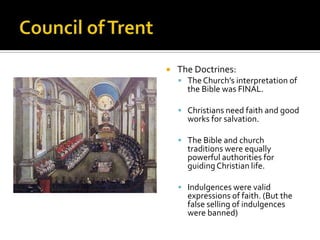
Council of TrentThe Doctrines:The Church’s interpretation of the Bible was FINAL.Christians need faith and good works for salvation.The Bible and church traditions were equally powerful authorities for guiding Christian life.Indulgences were valid expressions of faith. (But the false selling of indulgences were banned)

Catholic reformation

  • 1.
    Catholic ReformationWorld History:Patterns of Interaction
  • 2.
    St. Ignatius deLoyolaGrew up in Loyola, Spain1521, during his recovery from a war injury, he thought about his past sins and about the life of Jesus.According to him, it was his daily devotions that cleansed his sould.
  • 3.
    Spiritual Exercises ofSt. Ignatius de LoyolaIt is a day-by-day plan of meditation, prayer, and study.It compares spiritual and physical exercise.Bodily ExercisesSpiritual ExercisesWalking, preparing the soul to remove ill-ordered affections, traveling, seeking and finding the will of God with respect to the ordering of one’s own life,running, and salvation of one’s soul.
  • 4.
    In 1540, thePope (Paul III) made Ignatius’s followers a religious order. The order would be known as the Society of Jesus. Members of this order is known as the Jesuits.
  • 5.
    Three Missions ofthe Society of JesusFIRST: Founded superb schools throughout Europe.With teachers rigorously trained in both classical studies and theology.
  • 6.
  • 8.
    Jesuit Schools inthe Philippines
  • 9.
    SECOND: Converted non-Christiansto CatholicismThat is by sending out missionaries like Francis Xavier (India) and Matteo Ricci (China)
  • 10.
  • 11.
  • 12.
    Paul IIIHe wasborn Alessandro FarneseDirected a council of cardinals to investigate indulgence selling and other abuses within the church.He approved the Jesuit orderHe used the Inquisition to seek out and punish heresy in papal territory.Decided to call a great council of church leaders to meet in Trent. (Northern Italy)
  • 13.
    Paul IVBorn GiovanniPietroCarafa.Carried out the Council’s decreesIn 1559, there existed a list of books considered dangerous to the Catholic faith. The Index of Forbidden Books
  • 14.
    Council of TrentTheDoctrines:The Church’s interpretation of the Bible was FINAL.Christians need faith and good works for salvation.The Bible and church traditions were equally powerful authorities for guiding Christian life.Indulgences were valid expressions of faith. (But the false selling of indulgences were banned)