Historical-Cultural and
Contextual Analysis
Chapter 3
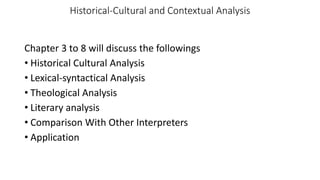
Historical-Cultural and Contextual Analysis
Chapter 3 to 8 will discuss the followings
• Historical Cultural Analysis
• Lexical-syntactical Analysis
• Theological Analysis
• Literary analysis
• Comparison With Other Interpreters
• Application
Historical-Cultural and Contextual Analysis
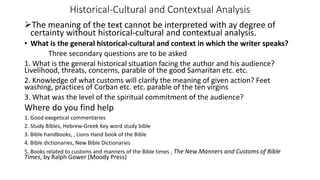
The meaning of the text cannot be interpreted with ay degree of
certainty without historical-cultural and contextual analysis.
• What is the general historical-cultural and context in which the writer speaks?
Three secondary questions are to be asked
1. What is the general historical situation facing the author and his audience?
Livelihood, threats, concerns, parable of the good Samaritan etc. etc.
2. Knowledge of what customs will clarify the meaning of given action? Feet
washing, practices of Corban etc. etc. parable of the ten virgins
3. What was the level of the spiritual commitment of the audience?
Where do you find help
1. Good exegetical commentaries
2. Study Bibles, Hebrew-Greek Key word study bible
3. Bible handbooks, , Lions Hand book of the Bible
4. Bible dictionaries, New Bible Dictionaries
5. Books related to customs and manners of the Bible times , The New Manners and Customs of Bible
Times, by Ralph Gower (Moody Press)
Historical-Cultural and Contextual Analysis
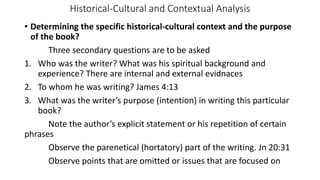
• Determining the specific historical-cultural context and the purpose
of the book?
Three secondary questions are to be asked
1. Who was the writer? What was his spiritual background and
experience? There are internal and external evidnaces
2. To whom he was writing? James 4:13
3. What was the writer’s purpose (intention) in writing this particular
book?
Note the author’s explicit statement or his repetition of certain
phrases
Observe the parenetical (hortatory) part of the writing. Jn 20:31
Observe points that are omitted or issues that are focused on
Historical-Cultural and Contextual Analysis
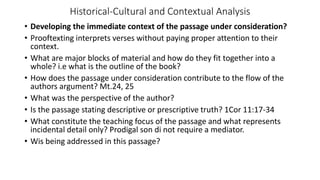
• Developing the immediate context of the passage under consideration?
• Prooftexting interprets verses without paying proper attention to their
context.
• What are major blocks of material and how do they fit together into a
whole? i.e what is the outline of the book?
• How does the passage under consideration contribute to the flow of the
authors argument? Mt.24, 25
• What was the perspective of the author?
• Is the passage stating descriptive or prescriptive truth? 1Cor 11:17-34
• What constitute the teaching focus of the passage and what represents
incidental detail only? Prodigal son di not require a mediator.
• Wis being addressed in this passage?

Historical cultural and contextual analysis

  • 1.
  • 2.
    Historical-Cultural and ContextualAnalysis Chapter 3 to 8 will discuss the followings • Historical Cultural Analysis • Lexical-syntactical Analysis • Theological Analysis • Literary analysis • Comparison With Other Interpreters • Application
  • 3.
    Historical-Cultural and ContextualAnalysis The meaning of the text cannot be interpreted with ay degree of certainty without historical-cultural and contextual analysis. • What is the general historical-cultural and context in which the writer speaks? Three secondary questions are to be asked 1. What is the general historical situation facing the author and his audience? Livelihood, threats, concerns, parable of the good Samaritan etc. etc. 2. Knowledge of what customs will clarify the meaning of given action? Feet washing, practices of Corban etc. etc. parable of the ten virgins 3. What was the level of the spiritual commitment of the audience? Where do you find help 1. Good exegetical commentaries 2. Study Bibles, Hebrew-Greek Key word study bible 3. Bible handbooks, , Lions Hand book of the Bible 4. Bible dictionaries, New Bible Dictionaries 5. Books related to customs and manners of the Bible times , The New Manners and Customs of Bible Times, by Ralph Gower (Moody Press)
  • 4.
    Historical-Cultural and ContextualAnalysis • Determining the specific historical-cultural context and the purpose of the book? Three secondary questions are to be asked 1. Who was the writer? What was his spiritual background and experience? There are internal and external evidnaces 2. To whom he was writing? James 4:13 3. What was the writer’s purpose (intention) in writing this particular book? Note the author’s explicit statement or his repetition of certain phrases Observe the parenetical (hortatory) part of the writing. Jn 20:31 Observe points that are omitted or issues that are focused on
  • 5.
    Historical-Cultural and ContextualAnalysis • Developing the immediate context of the passage under consideration? • Prooftexting interprets verses without paying proper attention to their context. • What are major blocks of material and how do they fit together into a whole? i.e what is the outline of the book? • How does the passage under consideration contribute to the flow of the authors argument? Mt.24, 25 • What was the perspective of the author? • Is the passage stating descriptive or prescriptive truth? 1Cor 11:17-34 • What constitute the teaching focus of the passage and what represents incidental detail only? Prodigal son di not require a mediator. • Wis being addressed in this passage?