Reformation and Religious Wars Protestantism and Inquisition
Warm Up What problems was the Catholic Church facing before & during the Renaissance?
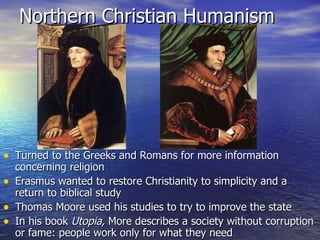
Northern Christian Humanism Turned to the Greeks and Romans for more information concerning religion Erasmus wanted to restore Christianity to simplicity and a return to biblical study Thomas Moore used his studies to try to improve the state In his book  Utopia,  More describes a society without corruption or fame: people work only for what they need
Causes of the Reformation Papal Leadership Catholic Wealth Indulgences and Relics Heresy vs. Reform
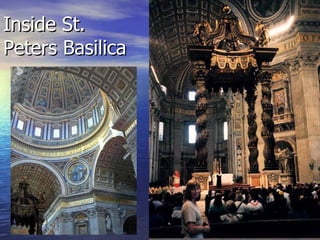
Papal Leadership Failure of Renaissance popes to provide leadership Corruption and secular power of Popes Pope’s primary concern was with raising money New churches (St. Peters Basilica) Supporting the large Catholic bureaucracy
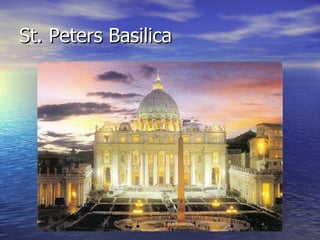
St. Peters Basilica
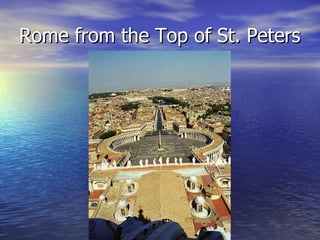
Rome from the Top of St. Peters
Inside St. Peters Basilica
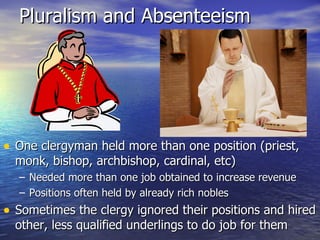
Pluralism and Absenteeism One clergyman held more than one position (priest, monk, bishop, archbishop, cardinal, etc) Needed more than one job obtained to increase revenue Positions often held by already rich nobles Sometimes the clergy ignored their positions and hired other, less qualified underlings to do job for them
Indulgences and Relics Indulgences were basically passes into heaven for one’s self or family member No biblical basis; fundraising alone Prince Fredrick of Saxony had 19,000 relics whose combined might could relieve one of 2 million years in purgatory simply by paying to visit them Relics were fake more often than not, but since the church backed them, they were perceived as real.
Heresy vs. Reform People were searching for meaningful religious expression and certainty of salvation Many, especially among laymen, were looking for leadership, but found only power hungry clerics All Reformers were sure of the certainty and perfection of the Catholic Church, at first… Any challenge to the canon, beliefs, and supremacy of the Catholic Church was seen as heresy they could not be wrong as God’s representatives on Earth
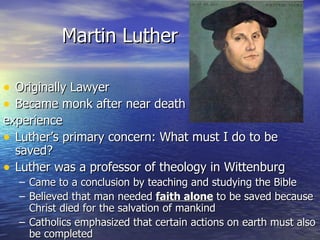
Martin Luther Originally Lawyer Became monk after near death experience Luther’s primary concern: What must I do to be saved? Luther was a professor of theology in Wittenburg Came to a conclusion by teaching and studying the Bible Believed that man needed  faith alone  to be saved because Christ died for the salvation of mankind Catholics emphasized that certain actions on earth must also be completed
Luther was a Catholic Monk! He was not interested in starting a new religion He wanted to help fix the problems that he saw in the Catholic Church Cast out as a heretic for challenging beliefs over indulgences Religion spread in part due to backing by German princes such as Saxony’s Prince Fredrick Lutheranism appealed to German princes Catholic land No control from outside sources Lutheranism also spread to Northern Europe as well
Luther’s Focus on Reform All religious practices (including sacraments) must be biblically based All religious laws must be biblically based Salvation through faith alone Priesthood is there for guidance, not dictatorship Church should not concern itself with amassing wealth
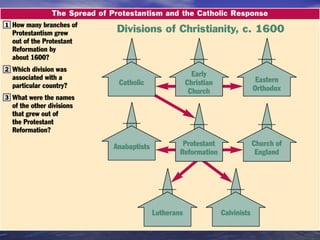
Other Protestant Movements Zwinglianism Anabaptists Anglicanism Calvinism
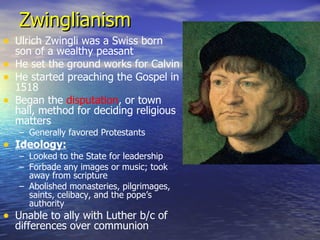
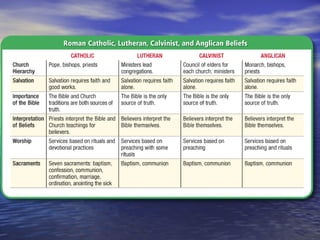
Zwinglianism Ulrich Zwingli was a Swiss born son of a wealthy peasant He set the ground works for Calvin He started preaching the Gospel in 1518 Began the  disputation , or town hall, method for deciding religious matters Generally favored Protestants Ideology: Looked to the State for leadership Forbade any images or music; took away from scripture Abolished monasteries, pilgrimages, saints, celibacy, and the pope’s authority Unable to ally with Luther b/c of differences over communion
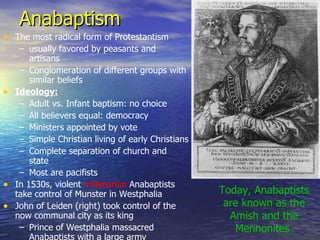
Anabaptism The most radical form of Protestantism usually favored by peasants and artisans Conglomeration of different groups with similar beliefs Ideology: Adult vs. Infant baptism: no choice All believers equal: democracy Ministers appointed by vote Simple Christian living of early Christians Complete separation of church and state Most are pacifists In 1530s, violent  millenarian  Anabaptists take control of Munster in Westphalia John of Leiden (right) took control of the now communal city as its king Prince of Westphalia massacred Anabaptists with a large army Today, Anabaptists are known as the Amish and the Mennonites
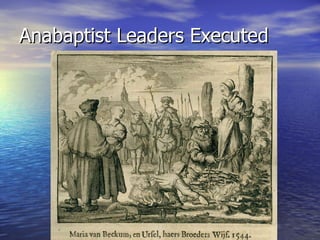
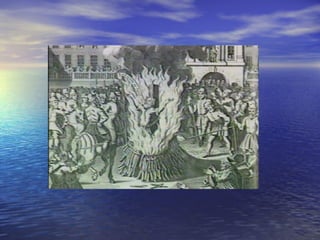
Anabaptist Leaders Executed
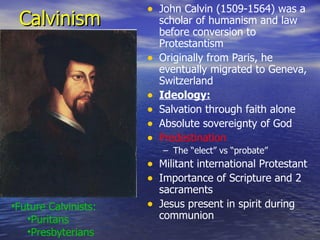
Calvinism John Calvin (1509-1564) was a scholar of humanism and law before conversion to Protestantism Originally from Paris, he eventually migrated to Geneva, Switzerland Ideology: Salvation through faith alone Absolute sovereignty of God Predestination The “elect” vs “probate” Militant international Protestant Importance of Scripture and 2 sacraments Jesus present in spirit during communion Future Calvinists: Puritans Presbyterians
Religious Wars Very little unity between Protestant churches They become separated and easily defeatable Schmalkaldic Wars Charles V vs. Lutheran Princes Survives due to alliance with French Catholic Henry II Peace of Augsburg Zwinglian’s influence creates war between Catholics and  Protestants Zwinglian’s forces defeated; Z killed, cut up and burned Anabaptists create widespread revolution, leaders executed Calvin’s Geneva seeks purity leading to severe punishments for “sinners”
French Wars of Religion Period lasting between 1562 and 1598 Huguenots vs. Ultra-Catholics Henry of Navarre vs. Duke of Guise Huguenots were 10% of population but 50% of the nobles Well organized and well funded Third group called  politiques  or people more interested in the state than religion Catherine de Medici ruled France as regent for unstable sons of King Henry II (died in an accident)
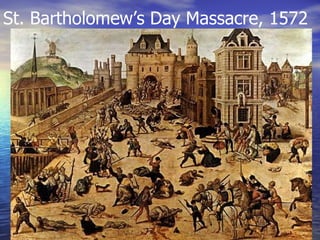
St. Bartholomew’s Day Massacre, 1572
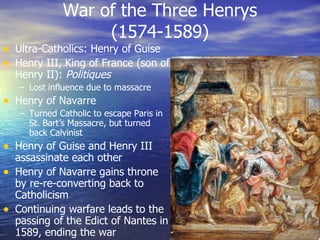
War of the Three Henrys (1574-1589) Ultra-Catholics: Henry of Guise Henry III, King of France (son of Henry II):  Politiques Lost influence due to massacre Henry of Navarre Turned Catholic to escape Paris in St. Bart’s Massacre, but turned back Calvinist Henry of Guise and Henry III assassinate each other Henry of Navarre gains throne by re-re-converting back to Catholicism Continuing warfare leads to the passing of the Edict of Nantes in 1589, ending the war
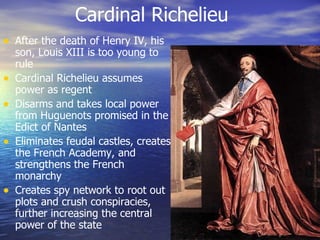
Cardinal Richelieu After the death of Henry IV, his son, Louis XIII is too young to rule Cardinal Richelieu assumes power as regent Disarms and takes local power from Huguenots promised in the Edict of Nantes Eliminates feudal castles, creates the French Academy, and strengthens the French monarchy Creates spy network to root out plots and crush conspiracies, further increasing the central power of the state
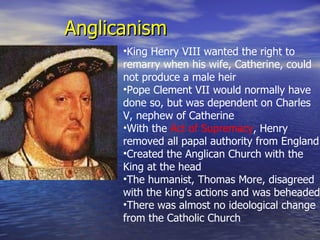
Anglicanism King Henry VIII wanted the right to remarry when his wife, Catherine, could not produce a male heir Pope Clement VII would normally have done so, but was dependent on Charles V, nephew of Catherine With the  Act of Supremacy , Henry removed all papal authority from England Created the Anglican Church with the King at the head The humanist, Thomas More, disagreed with the king’s actions and was beheaded There was almost no ideological change from the Catholic Church
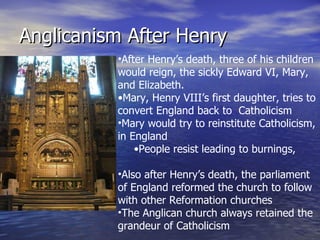
Anglicanism After Henry After Henry’s death, three of his children would reign, the sickly Edward VI, Mary, and Elizabeth. Mary, Henry VIII’s first daughter, tries to convert England back to  Catholicism Mary would try to reinstitute Catholicism, in England People resist leading to burnings, murders, and vodka drinks Also after Henry’s death, the parliament of England reformed the church to follow with other Reformation churches The Anglican church always retained the grandeur of Catholicism
 
 
Catholic Reformation Council of Trent Revival of the Old Renewed Papacy Jesuits Inquisition: Malleus Malificarum
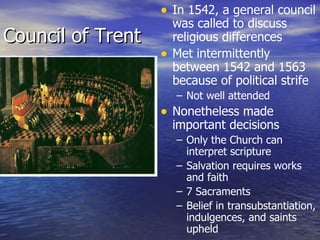
Council of Trent In 1542, a general council was called to discuss religious differences Met intermittently between 1542 and 1563 because of political strife Not well attended Nonetheless made important decisions Only the Church can interpret scripture Salvation requires works and faith 7 Sacraments Belief in transubstantiation, indulgences, and saints upheld
Catholic Reforms in Trent Priests must be officially trained at a seminary in one’s diocese Illegal to forcefully push indulgences Scripture and the Bible placed on equal footing Latin upheld as the churches language Eliminated pluralism and absenteeism Gave bishops authority to enforce local rules of the church
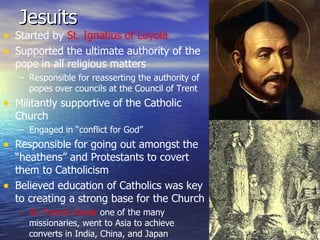
Jesuits Started by  St. Ignatius of Loyola Supported the ultimate authority of the pope in all religious matters Responsible for reasserting the authority of popes over councils at the Council of Trent Militantly supportive of the Catholic Church Engaged in “conflict for God” Responsible for going out amongst the “heathens” and Protestants to covert them to Catholicism Believed education of Catholics was key to creating a strong base for the Church St. Francis Xavier  one of the many missionaries, went to Asia to achieve converts in India, China, and Japan
Other Monastic Orders Reformed Franciscans  returned to poverty and simplicity of St. Francis Carmelite order formed by  Teresa of Avilia  as a mystic society to explore union between God and men (or more specifically women St. Vincent de Paul : an order specifically started to help the poor
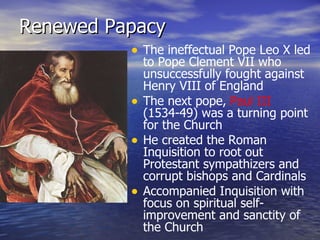
Renewed Papacy The ineffectual Pope Leo X led to Pope Clement VII who unsuccessfully fought against Henry VIII of England The next pope,  Paul III  (1534-49) was a turning point for the Church He created the Roman Inquisition to root out Protestant sympathizers and corrupt bishops and Cardinals Accompanied Inquisition with focus on spiritual self-improvement and sanctity of the Church
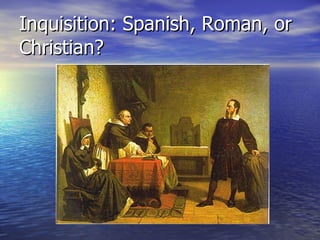
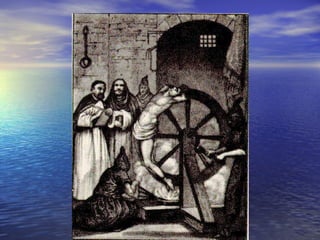
Inquisition: Spanish, Roman, or Christian?
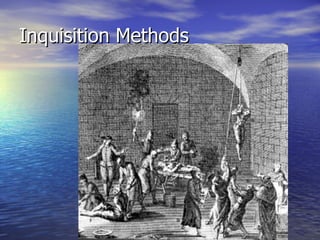
Inquisition Methods
 
 
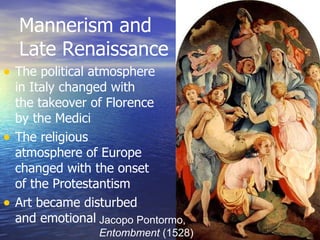
Mannerism and Late Renaissance The political atmosphere in Italy changed with the takeover of Florence by the Medici The religious atmosphere of Europe changed with the onset of the Protestantism Art became disturbed and emotional Jacopo Pontormo,  Entombment  (1528)
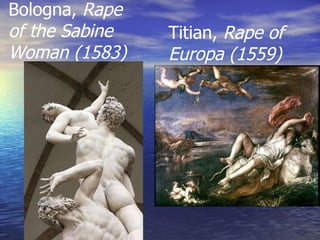
Bologna,  Rape of the Sabine Woman (1583) Titian,  Rape of Europa (1559)
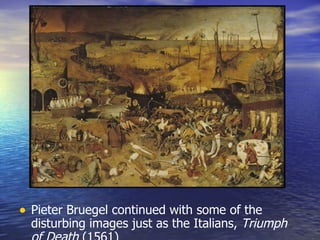
Pieter Bruegel continued with some of the disturbing images just as the Italians,  Triumph of Death  (1561)
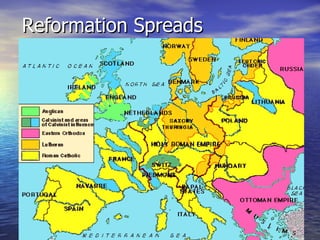
Reformation Spreads

Reformation and religious wars

  • 1.
    Reformation and ReligiousWars Protestantism and Inquisition
  • 2.
    Warm Up Whatproblems was the Catholic Church facing before & during the Renaissance?
  • 3.
    Northern Christian HumanismTurned to the Greeks and Romans for more information concerning religion Erasmus wanted to restore Christianity to simplicity and a return to biblical study Thomas Moore used his studies to try to improve the state In his book Utopia, More describes a society without corruption or fame: people work only for what they need
  • 4.
    Causes of theReformation Papal Leadership Catholic Wealth Indulgences and Relics Heresy vs. Reform
  • 5.
    Papal Leadership Failureof Renaissance popes to provide leadership Corruption and secular power of Popes Pope’s primary concern was with raising money New churches (St. Peters Basilica) Supporting the large Catholic bureaucracy
  • 6.
  • 7.
    Rome from theTop of St. Peters
  • 8.
  • 9.
    Pluralism and AbsenteeismOne clergyman held more than one position (priest, monk, bishop, archbishop, cardinal, etc) Needed more than one job obtained to increase revenue Positions often held by already rich nobles Sometimes the clergy ignored their positions and hired other, less qualified underlings to do job for them
  • 10.
    Indulgences and RelicsIndulgences were basically passes into heaven for one’s self or family member No biblical basis; fundraising alone Prince Fredrick of Saxony had 19,000 relics whose combined might could relieve one of 2 million years in purgatory simply by paying to visit them Relics were fake more often than not, but since the church backed them, they were perceived as real.
  • 11.
    Heresy vs. ReformPeople were searching for meaningful religious expression and certainty of salvation Many, especially among laymen, were looking for leadership, but found only power hungry clerics All Reformers were sure of the certainty and perfection of the Catholic Church, at first… Any challenge to the canon, beliefs, and supremacy of the Catholic Church was seen as heresy they could not be wrong as God’s representatives on Earth
  • 12.
    Martin Luther OriginallyLawyer Became monk after near death experience Luther’s primary concern: What must I do to be saved? Luther was a professor of theology in Wittenburg Came to a conclusion by teaching and studying the Bible Believed that man needed faith alone to be saved because Christ died for the salvation of mankind Catholics emphasized that certain actions on earth must also be completed
  • 13.
    Luther was aCatholic Monk! He was not interested in starting a new religion He wanted to help fix the problems that he saw in the Catholic Church Cast out as a heretic for challenging beliefs over indulgences Religion spread in part due to backing by German princes such as Saxony’s Prince Fredrick Lutheranism appealed to German princes Catholic land No control from outside sources Lutheranism also spread to Northern Europe as well
  • 14.
    Luther’s Focus onReform All religious practices (including sacraments) must be biblically based All religious laws must be biblically based Salvation through faith alone Priesthood is there for guidance, not dictatorship Church should not concern itself with amassing wealth
  • 15.
    Other Protestant MovementsZwinglianism Anabaptists Anglicanism Calvinism
  • 16.
    Zwinglianism Ulrich Zwingliwas a Swiss born son of a wealthy peasant He set the ground works for Calvin He started preaching the Gospel in 1518 Began the disputation , or town hall, method for deciding religious matters Generally favored Protestants Ideology: Looked to the State for leadership Forbade any images or music; took away from scripture Abolished monasteries, pilgrimages, saints, celibacy, and the pope’s authority Unable to ally with Luther b/c of differences over communion
  • 17.
    Anabaptism The mostradical form of Protestantism usually favored by peasants and artisans Conglomeration of different groups with similar beliefs Ideology: Adult vs. Infant baptism: no choice All believers equal: democracy Ministers appointed by vote Simple Christian living of early Christians Complete separation of church and state Most are pacifists In 1530s, violent millenarian Anabaptists take control of Munster in Westphalia John of Leiden (right) took control of the now communal city as its king Prince of Westphalia massacred Anabaptists with a large army Today, Anabaptists are known as the Amish and the Mennonites
  • 18.
  • 19.
    Calvinism John Calvin(1509-1564) was a scholar of humanism and law before conversion to Protestantism Originally from Paris, he eventually migrated to Geneva, Switzerland Ideology: Salvation through faith alone Absolute sovereignty of God Predestination The “elect” vs “probate” Militant international Protestant Importance of Scripture and 2 sacraments Jesus present in spirit during communion Future Calvinists: Puritans Presbyterians
  • 20.
    Religious Wars Verylittle unity between Protestant churches They become separated and easily defeatable Schmalkaldic Wars Charles V vs. Lutheran Princes Survives due to alliance with French Catholic Henry II Peace of Augsburg Zwinglian’s influence creates war between Catholics and Protestants Zwinglian’s forces defeated; Z killed, cut up and burned Anabaptists create widespread revolution, leaders executed Calvin’s Geneva seeks purity leading to severe punishments for “sinners”
  • 21.
    French Wars ofReligion Period lasting between 1562 and 1598 Huguenots vs. Ultra-Catholics Henry of Navarre vs. Duke of Guise Huguenots were 10% of population but 50% of the nobles Well organized and well funded Third group called politiques or people more interested in the state than religion Catherine de Medici ruled France as regent for unstable sons of King Henry II (died in an accident)
  • 22.
  • 23.
    War of theThree Henrys (1574-1589) Ultra-Catholics: Henry of Guise Henry III, King of France (son of Henry II): Politiques Lost influence due to massacre Henry of Navarre Turned Catholic to escape Paris in St. Bart’s Massacre, but turned back Calvinist Henry of Guise and Henry III assassinate each other Henry of Navarre gains throne by re-re-converting back to Catholicism Continuing warfare leads to the passing of the Edict of Nantes in 1589, ending the war
  • 24.
    Cardinal Richelieu Afterthe death of Henry IV, his son, Louis XIII is too young to rule Cardinal Richelieu assumes power as regent Disarms and takes local power from Huguenots promised in the Edict of Nantes Eliminates feudal castles, creates the French Academy, and strengthens the French monarchy Creates spy network to root out plots and crush conspiracies, further increasing the central power of the state
  • 25.
    Anglicanism King HenryVIII wanted the right to remarry when his wife, Catherine, could not produce a male heir Pope Clement VII would normally have done so, but was dependent on Charles V, nephew of Catherine With the Act of Supremacy , Henry removed all papal authority from England Created the Anglican Church with the King at the head The humanist, Thomas More, disagreed with the king’s actions and was beheaded There was almost no ideological change from the Catholic Church
  • 26.
    Anglicanism After HenryAfter Henry’s death, three of his children would reign, the sickly Edward VI, Mary, and Elizabeth. Mary, Henry VIII’s first daughter, tries to convert England back to Catholicism Mary would try to reinstitute Catholicism, in England People resist leading to burnings, murders, and vodka drinks Also after Henry’s death, the parliament of England reformed the church to follow with other Reformation churches The Anglican church always retained the grandeur of Catholicism
  • 27.
  • 28.
  • 29.
    Catholic Reformation Councilof Trent Revival of the Old Renewed Papacy Jesuits Inquisition: Malleus Malificarum
  • 30.
    Council of TrentIn 1542, a general council was called to discuss religious differences Met intermittently between 1542 and 1563 because of political strife Not well attended Nonetheless made important decisions Only the Church can interpret scripture Salvation requires works and faith 7 Sacraments Belief in transubstantiation, indulgences, and saints upheld
  • 31.
    Catholic Reforms inTrent Priests must be officially trained at a seminary in one’s diocese Illegal to forcefully push indulgences Scripture and the Bible placed on equal footing Latin upheld as the churches language Eliminated pluralism and absenteeism Gave bishops authority to enforce local rules of the church
  • 32.
    Jesuits Started by St. Ignatius of Loyola Supported the ultimate authority of the pope in all religious matters Responsible for reasserting the authority of popes over councils at the Council of Trent Militantly supportive of the Catholic Church Engaged in “conflict for God” Responsible for going out amongst the “heathens” and Protestants to covert them to Catholicism Believed education of Catholics was key to creating a strong base for the Church St. Francis Xavier one of the many missionaries, went to Asia to achieve converts in India, China, and Japan
  • 33.
    Other Monastic OrdersReformed Franciscans returned to poverty and simplicity of St. Francis Carmelite order formed by Teresa of Avilia as a mystic society to explore union between God and men (or more specifically women St. Vincent de Paul : an order specifically started to help the poor
  • 34.
    Renewed Papacy Theineffectual Pope Leo X led to Pope Clement VII who unsuccessfully fought against Henry VIII of England The next pope, Paul III (1534-49) was a turning point for the Church He created the Roman Inquisition to root out Protestant sympathizers and corrupt bishops and Cardinals Accompanied Inquisition with focus on spiritual self-improvement and sanctity of the Church
  • 35.
  • 36.
  • 37.
  • 38.
  • 39.
    Mannerism and LateRenaissance The political atmosphere in Italy changed with the takeover of Florence by the Medici The religious atmosphere of Europe changed with the onset of the Protestantism Art became disturbed and emotional Jacopo Pontormo, Entombment (1528)
  • 40.
    Bologna, Rapeof the Sabine Woman (1583) Titian, Rape of Europa (1559)
  • 41.
    Pieter Bruegel continuedwith some of the disturbing images just as the Italians, Triumph of Death (1561)
  • 42.