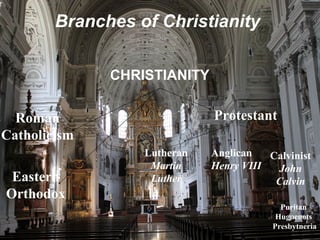
Branches of Christianity
CHRISTIANITY
Roman
Catholicism
Eastern
Orthodox
Protestant
Lutheran
Martin
Luther
Calvinist
John
Calvin
Anglican
Henry VIII
Puritan
Huguenots
Presbytneria
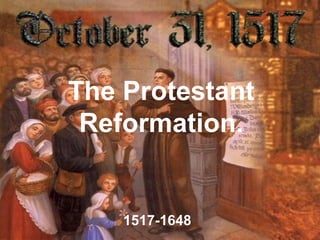
The Protestant
Reformation.
1517-1648
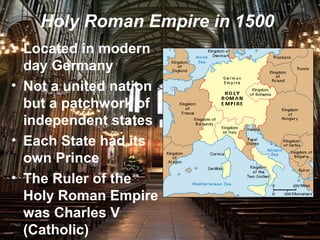
Holy Roman Empire in 1500
• Located in modern
day Germany
• Not a united nation
but a patchwork of
independent states
• Each State had its
own Prince
• The Ruler of the
Holy Roman Empire
was Charles V
(Catholic)
The Catholic Church in 1500
• The Catholic Church was the most
powerful institution in Europe
• Held the monopoly on information and
education and owned a great deal of
property
• People resented the wealth of the
Church
• The Church and Clergy did not pay taxes
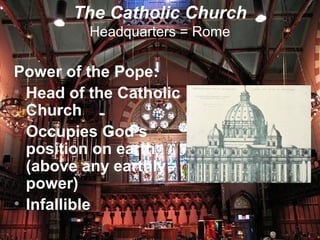
The Catholic Church
Headquarters = Rome
Power of the Pope:
• Head of the Catholic
Church
• Occupies God’s
position on earth
(above any earthly
power)
• Infallible
What Catholics Believe
The Seven Sacraments:
Baptism
Eucharist (mass/communion)
Confirmation
Confession
Anointing of the Sick – Last rites
Holy Orders – men to become
priests to not to marry.
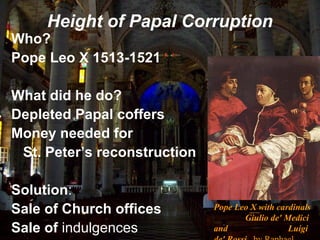
Height of Papal Corruption
Who?
Pope Leo X 1513-1521
What did he do?
Depleted Papal coffers
Money needed for
St. Peter’s reconstruction
Solution:
Sale of Church offices
Sale of indulgences
Pope Leo X with cardinals
Giulio de' Medici
and Luigi
• Prior to the Reformation all Christians
were Roman Catholic
• The Reformation was an attempt to
REFORM the Catholic Church
• Martin Luther and others wanted to get
rid of the corruption and restore
people’s faith in the church, not start a
separate church.
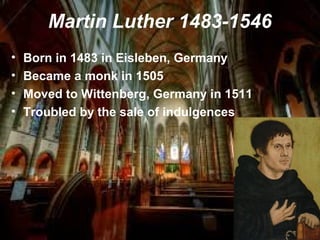
Martin Luther 1483-1546
• Born in 1483 in Eisleben, Germany
• Became a monk in 1505
• Moved to Wittenberg, Germany in 1511
• Troubled by the sale of indulgences
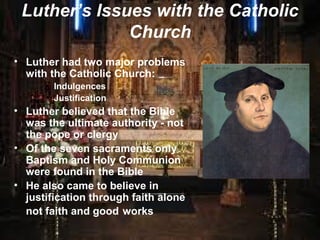
Luther’s Issues with the Catholic
Church
• Luther had two major problems
with the Catholic Church:
• Indulgences
• Justification
• Luther believed that the Bible
was the ultimate authority - not
the pope or clergy
• Of the seven sacraments only
Baptism and Holy Communion
were found in the Bible
• He also came to believe in
justification through faith alone
not faith and good works
What was an Indulgence?
• A Papal pardon for sins
• A lessening of the time a soul would have
to spend in purgatory
– Purgatory = a place where souls too impure
to enter heaven atoned for sins committed
during their lifetime
• According to Luther, indulgences had no
basis in the Bible and the Pope had no
authority to release souls from purgatory
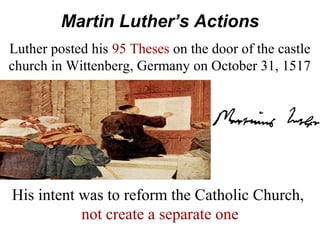
Martin Luther’s Actions
Luther posted his 95 Theses on the door of the castle
church in Wittenberg, Germany on October 31, 1517
His intent was to reform the Catholic Church,
not create a separate one
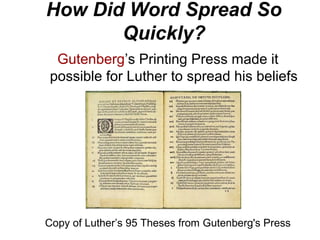
How Did Word Spread So
Quickly?
Gutenberg’s Printing Press made it
possible for Luther to spread his beliefs
Copy of Luther’s 95 Theses from Gutenberg's Press
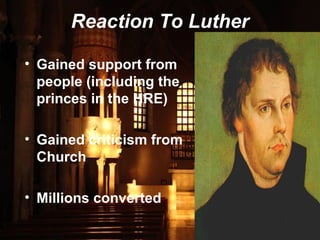
Reaction To Luther
• Gained support from
people (including the
princes in the HRE)
• Gained criticism from
Church
• Millions converted
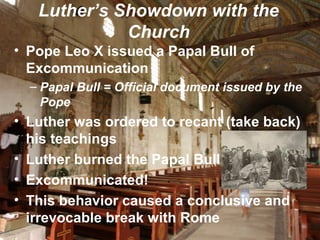
Luther’s Showdown with the
Church
• Pope Leo X issued a Papal Bull of
Excommunication
– Papal Bull = Official document issued by the
Pope
• Luther was ordered to recant (take back)
his teachings
• Luther burned the Papal Bull
• Excommunicated!
• This behavior caused a conclusive and
irrevocable break with Rome
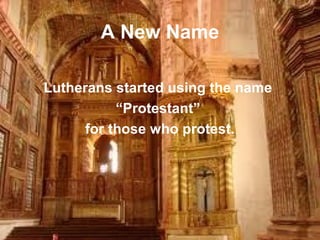
A New Name
Lutherans started using the name
“Protestant”
for those who protest.
THANK YOU.

Sects in christianity

  • 2.
  • 3.
  • 4.
    Holy Roman Empirein 1500 • Located in modern day Germany • Not a united nation but a patchwork of independent states • Each State had its own Prince • The Ruler of the Holy Roman Empire was Charles V (Catholic)
  • 5.
    The Catholic Churchin 1500 • The Catholic Church was the most powerful institution in Europe • Held the monopoly on information and education and owned a great deal of property • People resented the wealth of the Church • The Church and Clergy did not pay taxes
  • 6.
    The Catholic Church Headquarters= Rome Power of the Pope: • Head of the Catholic Church • Occupies God’s position on earth (above any earthly power) • Infallible
  • 7.
    What Catholics Believe TheSeven Sacraments: Baptism Eucharist (mass/communion) Confirmation Confession Anointing of the Sick – Last rites Holy Orders – men to become priests to not to marry.
  • 8.
    Height of PapalCorruption Who? Pope Leo X 1513-1521 What did he do? Depleted Papal coffers Money needed for St. Peter’s reconstruction Solution: Sale of Church offices Sale of indulgences Pope Leo X with cardinals Giulio de' Medici and Luigi
  • 9.
    • Prior tothe Reformation all Christians were Roman Catholic • The Reformation was an attempt to REFORM the Catholic Church • Martin Luther and others wanted to get rid of the corruption and restore people’s faith in the church, not start a separate church.
  • 10.
    Martin Luther 1483-1546 •Born in 1483 in Eisleben, Germany • Became a monk in 1505 • Moved to Wittenberg, Germany in 1511 • Troubled by the sale of indulgences
  • 11.
    Luther’s Issues withthe Catholic Church • Luther had two major problems with the Catholic Church: • Indulgences • Justification • Luther believed that the Bible was the ultimate authority - not the pope or clergy • Of the seven sacraments only Baptism and Holy Communion were found in the Bible • He also came to believe in justification through faith alone not faith and good works
  • 12.
    What was anIndulgence? • A Papal pardon for sins • A lessening of the time a soul would have to spend in purgatory – Purgatory = a place where souls too impure to enter heaven atoned for sins committed during their lifetime • According to Luther, indulgences had no basis in the Bible and the Pope had no authority to release souls from purgatory
  • 13.
    Martin Luther’s Actions Lutherposted his 95 Theses on the door of the castle church in Wittenberg, Germany on October 31, 1517 His intent was to reform the Catholic Church, not create a separate one
  • 14.
    How Did WordSpread So Quickly? Gutenberg’s Printing Press made it possible for Luther to spread his beliefs Copy of Luther’s 95 Theses from Gutenberg's Press
  • 15.
    Reaction To Luther •Gained support from people (including the princes in the HRE) • Gained criticism from Church • Millions converted
  • 16.
    Luther’s Showdown withthe Church • Pope Leo X issued a Papal Bull of Excommunication – Papal Bull = Official document issued by the Pope • Luther was ordered to recant (take back) his teachings • Luther burned the Papal Bull • Excommunicated! • This behavior caused a conclusive and irrevocable break with Rome
  • 17.
    A New Name Lutheransstarted using the name “Protestant” for those who protest.
  • 18.

Editor's Notes

  • #11 Luther came to the decision to be a monk when he traveled one night during a lightning storm. He was so frightened that he made a vow that if he survived the storm, he would enter a monastery. His decision to become a monk was a disappointment to his father.
  • #12 Indulgences: Indulgences are ways to get out of punishment in Purgatory. In the Catholic Church, even after going to the priest for absolution at confession, people enter Purgatory after they die. Purgatory is neither Heaven nor Hell, but a place of temporary punishment where souls go before entering Heaven. Indulgences were suppose to shorten that time in Purgatory by prayers or good works. However, by 1500, indulgences were abused and turned into cash donations to the Church. Rich people gave lots of money for forgiveness of past and future sins. Basically, indulgences became a fundraising activity for the Catholic Church. John Tetzel, a notorious priest who offered Indulgences had a slogan: “As soon as a coin in the coffer rings, a soul from Purgatory springs.” Justification: The Catholic Church believes that in order to be saved, i.e., go to Heaven, a person had to do good works, go through the seven sacraments, etc. However, Luther came to the conclusion that because God is perfect, nothing we do can ever be good enough for God. So, instead, he came to the conclusion that it was not by good works that we earn God’s favor, but by believing and trusting in God. Communion: Transubstantiation vs. Consubstantiation The Catholic Church believes that during communion, which recreates the Last Supper, the bread and wine become the body and blood of Jesus Christ, made possible by the priest. Protestants believe in consubstantiation, that Jesus is present during communion, but the bread and wine are only symbolic of the Last Supper.