The Constrained Application Protocol (CoAP)-
Part 3& Conclusion
Khamdamboy Urunov, a Ph.D. student.,
hamdamboy.urunov@gmail.com
2
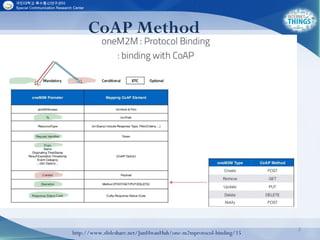
CoAP Method
http://www.slideshare.net/JunHwanHuh/one-m2mprotocol-binding/15
3
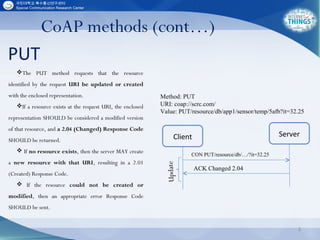
The PUT method requests that the resource
identified by the request URI be updated or created
with the enclosed representation.
If a resource exists at the request URI, the enclosed
representation SHOULD be considered a modified version
of that resource, and a 2.04 (Changed) Response Code
SHOULD be returned.
 If no resource exists, then the server MAY create
a new resource with that URI, resulting in a 2.01
(Created) Response Code.
 If the resource could not be created or
modified, then an appropriate error Response Code
SHOULD be sent.
Method: PUT
URI: coap://scrc.com/
Value: PUT/resource/db/app1/sensor/temp/5afb?it=32.25
CoAP methods (cont…)
PUT
Client Server
CON PUT/resource/db/…/?it=32.25
ACK Changed 2.04
Update
4
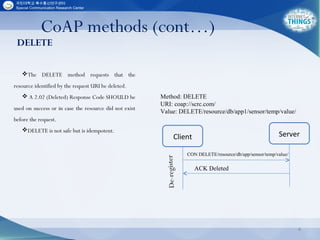
The DELETE method requests that the
resource identified by the request URI be deleted.
 A 2.02 (Deleted) Response Code SHOULD be
used on success or in case the resource did not exist
before the request.
DELETE is not safe but is idempotent.
Method: DELETE
URI: coap://scrc.com/
Value: DELETE/resource/db/app1/sensor/temp/value/
Client Server
CON DELETE/resource/db/app/sensor/temp/value/
ACK Deleted
De-register
CoAP methods (cont…)
DELETE
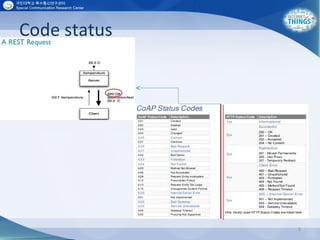
Code status
5
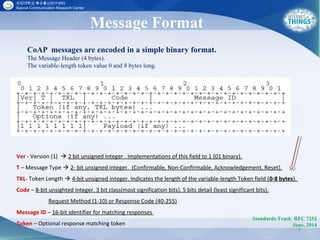
CoAP messages are encoded in a simple binary format.
The Message Header (4 bytes).
The variable-length token value 0 and 8 bytes long.
6
Ver - Version (1)  2 bit unsigned integer . Implementations of this field to 1 (01 binary).
T – Message Type  2- bit unsigned integer. (Confirmable, Non-Confirmable, Acknowledgement, Reset).
TKL- Token Length  4-bit unsigned integer. Indicates the length of the variable-length Token field (0-8 bytes).
Code – 8-bit unsighted integer. 3 bit class(most signification bits). 5 bits detail (least significant bits).
Request Method (1-10) or Response Code (40-255)
Message ID – 16-bit identifier for matching responses
Token – Optional response matching token
Message Format
Standards Track RFC 7252
June, 2014
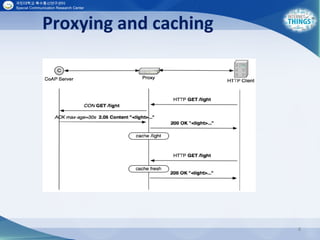
Caching
7
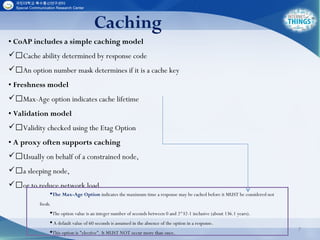
• CoAP includes a simple caching model
Cache ability determined by response code
An option number mask determines if it is a cache key
• Freshness model
Max-Age option indicates cache lifetime
• Validation model
Validity checked using the Etag Option
• A proxy often supports caching
Usually on behalf of a constrained node,
a sleeping node,
or to reduce network load
The Max-Age Option indicates the maximum time a response may be cached before it MUST be considered not
fresh.
The option value is an integer number of seconds between 0 and 2^32-1 inclusive (about 136.1 years).
 A default value of 60 seconds is assumed in the absence of the option in a response.
This option is "elective". It MUST NOT occur more than once.
Proxying and caching
8
Observation
9
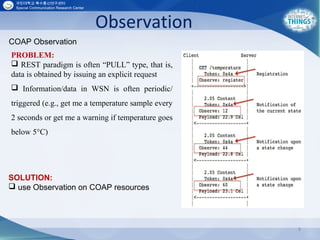
COAP Observation
PROBLEM:
 REST paradigm is often “PULL” type, that is,
data is obtained by issuing an explicit request
 Information/data in WSN is often periodic/
triggered (e.g., get me a temperature sample every
2 seconds or get me a warning if temperature goes
below 5°C)
SOLUTION:
 use Observation on COAP resources
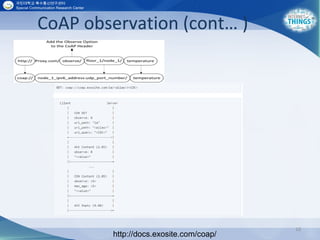
CoAP observation (cont… )
10
http://docs.exosite.com/coap/
Getting Started with CoAP
11
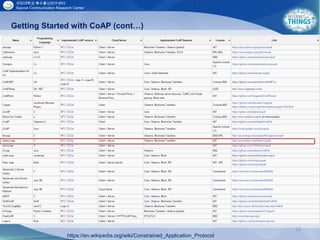
• There are many open source implementations available
Java CoAP Library Californium
C CoAP Library Erbium
libCoAP C Library
jCoAP Java Library
OpenCoAP C Library
TinyOS and Contiki include CoAP support
• CoAP is already part of many commercial products/systems
 Sensinode NanoService
 RTX 4100 WiFi Module
• Firefox has a CoAP plugin called Copper
• Wireshark has CoAP dissector support
• Implement CoAP yourself, it is not that hard!
12
Getting Started with CoAP (cont…)
https://en.wikipedia.org/wiki/Constrained_Application_Protocol
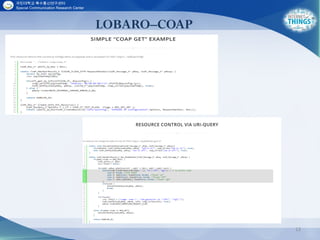
LOBARO–COAP
13
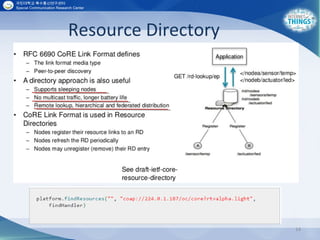
Resource Directory
14
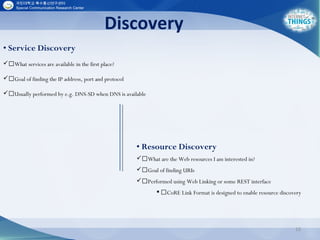
Discovery
15
• Service Discovery
What services are available in the first place?
Goal of finding the IP address, port and protocol
Usually performed by e.g. DNS-SD when DNS is available
• Resource Discovery
What are the Web resources I am interested in?
Goal of finding URIs
Performed using Web Linking or some REST interface
 CoRE Link Format is designed to enable resource discovery
Discovery (cont…)
16
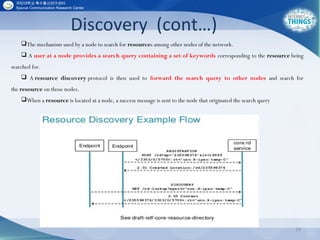
The mechanism used by a node to search for resources among other nodes of the network.
 A user at a node provides a search query containing a set of keywords corresponding to the resource being
searched for.
 A resource discovery protocol is then used to forward the search query to other nodes and search for
the resource on those nodes.
When a resource is located at a node, a success message is sent to the node that originated the search query
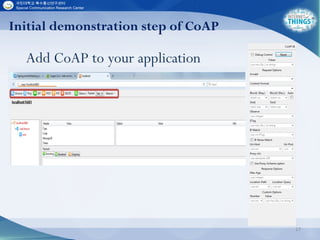
Add CoAP to your application
17
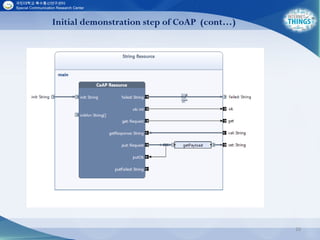
Initial demonstration step of CoAP
18
Initial demonstration step of CoAP (cont…)
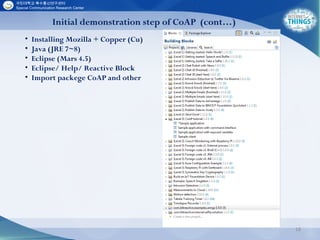
• Installing Mozilla + Copper (Cu)
• Java (JRE 7~8)
• Eclipse (Mars 4.5)
• Eclipse/ Help/ Reactive Block
• Import packege CoAP and other
19
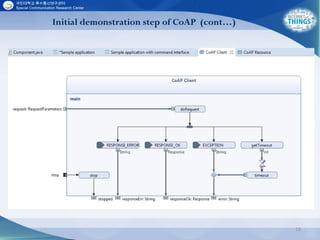
Initial demonstration step of CoAP (cont…)
20
Initial demonstration step of CoAP (cont…)
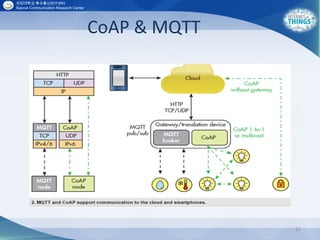
CoAP & MQTT
21
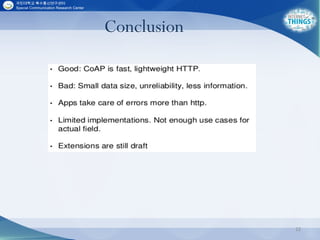
Conclusion
22
Thank you !
hamdmboy.urunov@gmail.com
23

The constrained application protocol (co ap) part 3

  • 1.
    The Constrained ApplicationProtocol (CoAP)- Part 3& Conclusion Khamdamboy Urunov, a Ph.D. student., hamdamboy.urunov@gmail.com
  • 2.
  • 3.
    3 The PUT methodrequests that the resource identified by the request URI be updated or created with the enclosed representation. If a resource exists at the request URI, the enclosed representation SHOULD be considered a modified version of that resource, and a 2.04 (Changed) Response Code SHOULD be returned.  If no resource exists, then the server MAY create a new resource with that URI, resulting in a 2.01 (Created) Response Code.  If the resource could not be created or modified, then an appropriate error Response Code SHOULD be sent. Method: PUT URI: coap://scrc.com/ Value: PUT/resource/db/app1/sensor/temp/5afb?it=32.25 CoAP methods (cont…) PUT Client Server CON PUT/resource/db/…/?it=32.25 ACK Changed 2.04 Update
  • 4.
    4 The DELETE methodrequests that the resource identified by the request URI be deleted.  A 2.02 (Deleted) Response Code SHOULD be used on success or in case the resource did not exist before the request. DELETE is not safe but is idempotent. Method: DELETE URI: coap://scrc.com/ Value: DELETE/resource/db/app1/sensor/temp/value/ Client Server CON DELETE/resource/db/app/sensor/temp/value/ ACK Deleted De-register CoAP methods (cont…) DELETE
  • 5.
  • 6.
    CoAP messages areencoded in a simple binary format. The Message Header (4 bytes). The variable-length token value 0 and 8 bytes long. 6 Ver - Version (1)  2 bit unsigned integer . Implementations of this field to 1 (01 binary). T – Message Type  2- bit unsigned integer. (Confirmable, Non-Confirmable, Acknowledgement, Reset). TKL- Token Length  4-bit unsigned integer. Indicates the length of the variable-length Token field (0-8 bytes). Code – 8-bit unsighted integer. 3 bit class(most signification bits). 5 bits detail (least significant bits). Request Method (1-10) or Response Code (40-255) Message ID – 16-bit identifier for matching responses Token – Optional response matching token Message Format Standards Track RFC 7252 June, 2014
  • 7.
    Caching 7 • CoAP includesa simple caching model Cache ability determined by response code An option number mask determines if it is a cache key • Freshness model Max-Age option indicates cache lifetime • Validation model Validity checked using the Etag Option • A proxy often supports caching Usually on behalf of a constrained node, a sleeping node, or to reduce network load The Max-Age Option indicates the maximum time a response may be cached before it MUST be considered not fresh. The option value is an integer number of seconds between 0 and 2^32-1 inclusive (about 136.1 years).  A default value of 60 seconds is assumed in the absence of the option in a response. This option is "elective". It MUST NOT occur more than once.
  • 8.
  • 9.
    Observation 9 COAP Observation PROBLEM:  RESTparadigm is often “PULL” type, that is, data is obtained by issuing an explicit request  Information/data in WSN is often periodic/ triggered (e.g., get me a temperature sample every 2 seconds or get me a warning if temperature goes below 5°C) SOLUTION:  use Observation on COAP resources
  • 10.
    CoAP observation (cont…) 10 http://docs.exosite.com/coap/
  • 11.
    Getting Started withCoAP 11 • There are many open source implementations available Java CoAP Library Californium C CoAP Library Erbium libCoAP C Library jCoAP Java Library OpenCoAP C Library TinyOS and Contiki include CoAP support • CoAP is already part of many commercial products/systems  Sensinode NanoService  RTX 4100 WiFi Module • Firefox has a CoAP plugin called Copper • Wireshark has CoAP dissector support • Implement CoAP yourself, it is not that hard!
  • 12.
    12 Getting Started withCoAP (cont…) https://en.wikipedia.org/wiki/Constrained_Application_Protocol
  • 13.
  • 14.
  • 15.
    Discovery 15 • Service Discovery Whatservices are available in the first place? Goal of finding the IP address, port and protocol Usually performed by e.g. DNS-SD when DNS is available • Resource Discovery What are the Web resources I am interested in? Goal of finding URIs Performed using Web Linking or some REST interface  CoRE Link Format is designed to enable resource discovery
  • 16.
    Discovery (cont…) 16 The mechanismused by a node to search for resources among other nodes of the network.  A user at a node provides a search query containing a set of keywords corresponding to the resource being searched for.  A resource discovery protocol is then used to forward the search query to other nodes and search for the resource on those nodes. When a resource is located at a node, a success message is sent to the node that originated the search query
  • 17.
    Add CoAP toyour application 17 Initial demonstration step of CoAP
  • 18.
    18 Initial demonstration stepof CoAP (cont…) • Installing Mozilla + Copper (Cu) • Java (JRE 7~8) • Eclipse (Mars 4.5) • Eclipse/ Help/ Reactive Block • Import packege CoAP and other
  • 19.
  • 20.
  • 21.
  • 22.
  • 23.