Message Queuing Telemetry Transport (MQTT)
Khamdamboy Urunov, a Ph.D. student.
Special Communication Research
Center.,
Graduate School of Financial
Information Security., Kookmin
Contents
• About MQTT
• Evaluation of MQTT
• Parameters and architectures of the
MQTT
2
MQTT evaluation (1/2)
3
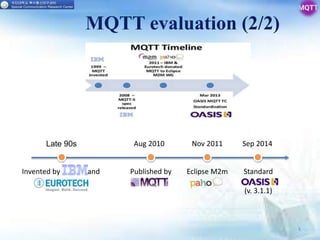
 The MQ Telemetry Transport (MQTT) protocol is
o was invented by Dr Andy Stanford-Clark of IBM®
o Arlen Nipper of Arcom (now Eurotech), in 1999
 The protocol is openly published with a royalty-free license
o has been widely implemented across a variety of industries
o MQTT.org, defines the protocol as follows
 MQTT is a machine-to-machine (M2M)/"Internet of Things" connectivity protocol
o It was designed as an extremely lightweight publish/subscribe messaging transport.
o It is useful for connections with remote locations where a small code footprint is
required and/or network bandwidth is at a premium
MQTT evaluation (2/2)
4
Late 90s Aug 2010 Nov 2011 Sep 2014
Invented by and Published by Eclipse M2m Standard
(v. 3.1.1)
Message Queue Telemetry Transport
5
 MQTT is a binary client-server publish/subscribe messaging transport protocol,
standardized by OASIS
 It is lightweight, open, simple, and easy to implement
 Designed with a minimal protocol overhead, this protocol is a good choice for a
variety of Machine-to-Machine (M2M) and Internet of Things applications
 especially where a small code footprint is required and/or network bandwidth is at
a premium
About MQTT (1/2)
6
http://www.slideshare.net/nivertech/zvi-mqtts-foreuc2013
About MQTT (2/2)
 MQTT utilizes many characteristics of the TCP transport, so the minimum
requirement for using MQTT is a working TCP stack, which is now available for even
the smallest microcontrollers
 Lightweight publish/ subscribe protocol standard for traditional networks
 Data-centric
• Separates Data (Payload) from Metadata (Topic)
MQTT types
7
• MQTT
• MQTT-S
• MQTT-SN
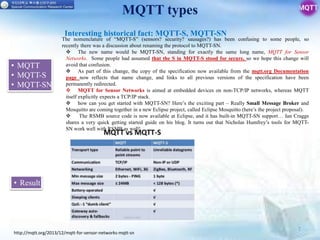
The nomenclature of “MQTT-S” (sensors? security? sausages?) has been confusing to some people, so
recently there was a discussion about renaming the protocol to MQTT-SN.
 The new name would be MQTT-SN, standing for exactly the same long name, MQTT for Sensor
Networks. Some people had assumed that the S in MQTT-S stood for secure, so we hope this change will
avoid that confusion.
 As part of this change, the copy of the specification now available from the mqtt.org Documentation
page now reflects that name change, and links to all previous versions of the specification have been
permanently redirected.
 MQTT for Sensor Networks is aimed at embedded devices on non-TCP/IP networks, whereas MQTT
itself explicitly expects a TCP/IP stack.
 how can you get started with MQTT-SN? Here’s the exciting part – Really Small Message Broker and
Mosquitto are coming together in a new Eclipse project, called Eclipse Mosquitto (here’s the project proposal).
 The RSMB source code is now available at Eclipse, and it has built-in MQTT-SN support… Ian Craggs
shares a very quick getting started guide on his blog. It turns out that Nicholas Humfrey’s tools for MQTT-
SN work well with RSMB as well!
http://mqtt.org/2013/12/mqtt-for-sensor-networks-mqtt-sn
Interesting historical fact: MQTT-S, MQTT-SN
• Result
Use Cases
8
MQTT excels in scenarios where reliable message delivery is crucial for an application
but a reliable network connection is not necessarily available, e.g. mobile networks.
Typical use cases of MQTT include:
 Telemetry
 Automotive
 Smart Home
 Energy Monitoring
 Chat Applications
 Notification Services
 Healthcare Applications
MQTT parameters
9
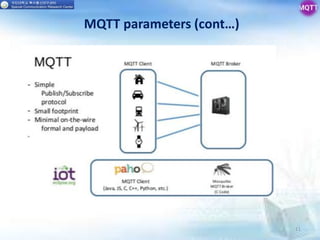
MQTT implements the brokered publish / subscribe pattern:
 The publish / subscribe pattern decouples a client (“publisher”)
 which is sending a particular message from other clients (“subscribers”), which
are receiving the message
 This means that the publisher and subscribers don’t know about the existence of
one another
 The clients do not know each other, but they know the message broker, which
filters all incoming messages and distributes them to the correct subscribers
MQTT parameters (cont…)
10
This decoupling of sender and receiver can be differentiated in three dimensions:
• Space decoupling: Publisher and subscriber do not need to know each other (for example, by IP address and port)
• Time decoupling: Publisher and subscriber do not need to be connected at the same time
• Synchronization decoupling: Operations on both components are not halted during publishing or receiving
messages
11
MQTT parameters (cont…)
MQTT Architecture
12
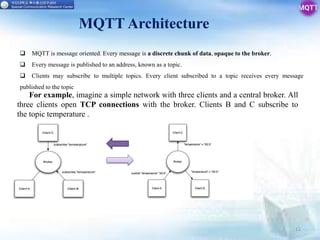
 MQTT is message oriented. Every message is a discrete chunk of data, opaque to the broker.
 Every message is published to an address, known as a topic.
 Clients may subscribe to multiple topics. Every client subscribed to a topic receives every message
published to the topic
For example, imagine a simple network with three clients and a central broker. All
three clients open TCP connections with the broker. Clients B and C subscribe to
the topic temperature .
Protocol layer
13
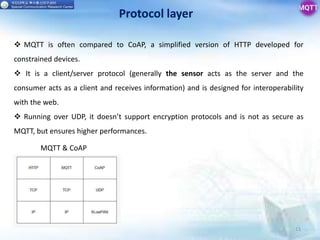
 MQTT is often compared to CoAP, a simplified version of HTTP developed for
constrained devices.
 It is a client/server protocol (generally the sensor acts as the server and the
consumer acts as a client and receives information) and is designed for interoperability
with the web.
 Running over UDP, it doesn’t support encryption protocols and is not as secure as
MQTT, but ensures higher performances.
MQTT & CoAP
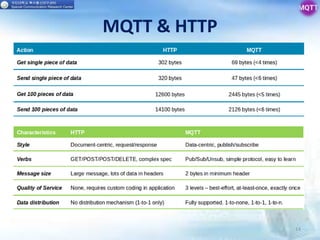
MQTT & HTTP
14
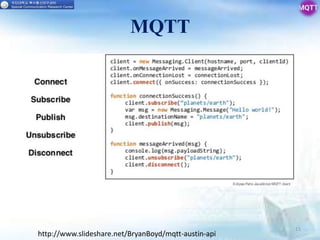
MQTT
15
http://www.slideshare.net/BryanBoyd/mqtt-austin-api
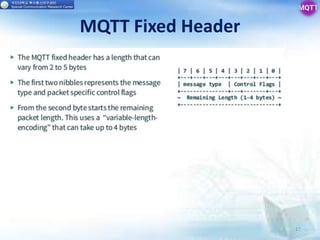
MQTT message format structure
16
MQTT Fixed Header
17
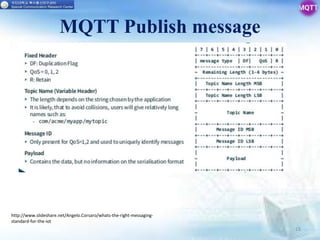
MQTT Publish message
18
http://www.slideshare.net/Angelo.Corsaro/whats-the-right-messaging-
standard-for-the-iot
Thank you
19

Message queuing telemetry transport (mqtt) launch

  • 1.
    Message Queuing TelemetryTransport (MQTT) Khamdamboy Urunov, a Ph.D. student. Special Communication Research Center., Graduate School of Financial Information Security., Kookmin
  • 2.
    Contents • About MQTT •Evaluation of MQTT • Parameters and architectures of the MQTT 2
  • 3.
    MQTT evaluation (1/2) 3 The MQ Telemetry Transport (MQTT) protocol is o was invented by Dr Andy Stanford-Clark of IBM® o Arlen Nipper of Arcom (now Eurotech), in 1999  The protocol is openly published with a royalty-free license o has been widely implemented across a variety of industries o MQTT.org, defines the protocol as follows  MQTT is a machine-to-machine (M2M)/"Internet of Things" connectivity protocol o It was designed as an extremely lightweight publish/subscribe messaging transport. o It is useful for connections with remote locations where a small code footprint is required and/or network bandwidth is at a premium
  • 4.
    MQTT evaluation (2/2) 4 Late90s Aug 2010 Nov 2011 Sep 2014 Invented by and Published by Eclipse M2m Standard (v. 3.1.1)
  • 5.
    Message Queue TelemetryTransport 5  MQTT is a binary client-server publish/subscribe messaging transport protocol, standardized by OASIS  It is lightweight, open, simple, and easy to implement  Designed with a minimal protocol overhead, this protocol is a good choice for a variety of Machine-to-Machine (M2M) and Internet of Things applications  especially where a small code footprint is required and/or network bandwidth is at a premium About MQTT (1/2)
  • 6.
    6 http://www.slideshare.net/nivertech/zvi-mqtts-foreuc2013 About MQTT (2/2) MQTT utilizes many characteristics of the TCP transport, so the minimum requirement for using MQTT is a working TCP stack, which is now available for even the smallest microcontrollers  Lightweight publish/ subscribe protocol standard for traditional networks  Data-centric • Separates Data (Payload) from Metadata (Topic)
  • 7.
    MQTT types 7 • MQTT •MQTT-S • MQTT-SN The nomenclature of “MQTT-S” (sensors? security? sausages?) has been confusing to some people, so recently there was a discussion about renaming the protocol to MQTT-SN.  The new name would be MQTT-SN, standing for exactly the same long name, MQTT for Sensor Networks. Some people had assumed that the S in MQTT-S stood for secure, so we hope this change will avoid that confusion.  As part of this change, the copy of the specification now available from the mqtt.org Documentation page now reflects that name change, and links to all previous versions of the specification have been permanently redirected.  MQTT for Sensor Networks is aimed at embedded devices on non-TCP/IP networks, whereas MQTT itself explicitly expects a TCP/IP stack.  how can you get started with MQTT-SN? Here’s the exciting part – Really Small Message Broker and Mosquitto are coming together in a new Eclipse project, called Eclipse Mosquitto (here’s the project proposal).  The RSMB source code is now available at Eclipse, and it has built-in MQTT-SN support… Ian Craggs shares a very quick getting started guide on his blog. It turns out that Nicholas Humfrey’s tools for MQTT- SN work well with RSMB as well! http://mqtt.org/2013/12/mqtt-for-sensor-networks-mqtt-sn Interesting historical fact: MQTT-S, MQTT-SN • Result
  • 8.
    Use Cases 8 MQTT excelsin scenarios where reliable message delivery is crucial for an application but a reliable network connection is not necessarily available, e.g. mobile networks. Typical use cases of MQTT include:  Telemetry  Automotive  Smart Home  Energy Monitoring  Chat Applications  Notification Services  Healthcare Applications
  • 9.
    MQTT parameters 9 MQTT implementsthe brokered publish / subscribe pattern:  The publish / subscribe pattern decouples a client (“publisher”)  which is sending a particular message from other clients (“subscribers”), which are receiving the message  This means that the publisher and subscribers don’t know about the existence of one another  The clients do not know each other, but they know the message broker, which filters all incoming messages and distributes them to the correct subscribers
  • 10.
    MQTT parameters (cont…) 10 Thisdecoupling of sender and receiver can be differentiated in three dimensions: • Space decoupling: Publisher and subscriber do not need to know each other (for example, by IP address and port) • Time decoupling: Publisher and subscriber do not need to be connected at the same time • Synchronization decoupling: Operations on both components are not halted during publishing or receiving messages
  • 11.
  • 12.
    MQTT Architecture 12  MQTTis message oriented. Every message is a discrete chunk of data, opaque to the broker.  Every message is published to an address, known as a topic.  Clients may subscribe to multiple topics. Every client subscribed to a topic receives every message published to the topic For example, imagine a simple network with three clients and a central broker. All three clients open TCP connections with the broker. Clients B and C subscribe to the topic temperature .
  • 13.
    Protocol layer 13  MQTTis often compared to CoAP, a simplified version of HTTP developed for constrained devices.  It is a client/server protocol (generally the sensor acts as the server and the consumer acts as a client and receives information) and is designed for interoperability with the web.  Running over UDP, it doesn’t support encryption protocols and is not as secure as MQTT, but ensures higher performances. MQTT & CoAP
  • 14.
  • 15.
  • 16.
    MQTT message formatstructure 16
  • 17.
  • 18.
  • 19.