1 
IPSO Smart Objects 
November18, 2014 
And Related Standards 
for 
IoT Interoperability
IPSO Smart Objects 
 A simple Data Model for 
 Semantic Interoperability across IoT Devices 
 Requires only simple URI addressing and a few data types 
 Mapping to internet content-types 
 Usable on many different transport protocols (CoAP, HTTP, MQTT) 
 This presentation discusses the architecture and features of a rich 
implementation of IPSO Smart Objects on constrained devices and networks 
using CoAP and OMA LWM2M 
2
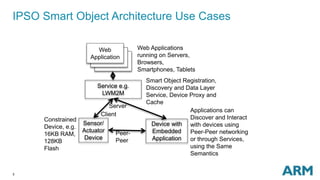
IPSO Smart Object Architecture Use Cases 
3 
Web 
Application 
Application 
Service e.g. 
LWM2M 
Sensor/ 
Actuator 
Device 
Web Applications 
running on Servers, 
Browsers, 
Smartphones, Tablets 
Device with 
Embedded 
Application 
Application 
Server 
Client 
Peer- 
Peer 
Constrained 
Device, e.g. 
16KB RAM, 
128KB 
Flash 
Smart Object Registration, 
Discovery and Data Layer 
Service, Device Proxy and 
Cache 
Applications can 
Discover and Interact 
with devices using 
Peer-Peer networking 
or through Services, 
using the Same 
Semantics
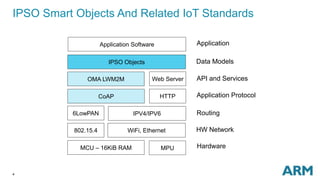
IPSO Smart Objects And Related IoT Standards 
4 
Application Software 
IPSO Objects 
OMA LWM2M 
CoAP HTTP 
6LowPAN IPV4/IPV6 
802.15.4 WiFi, Ethernet 
MCU – 16KiB RAM MPU 
Application 
Data Models 
API and Services 
Application Protocol 
Routing 
HW Network 
Hardware 
Web Server
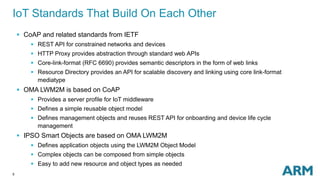
IoT Standards That Build On Each Other 
5 
 CoAP and related standards from IETF 
 REST API for constrained networks and devices 
 HTTP Proxy provides abstraction through standard web APIs 
 Core-link-format (RFC 6690) provides semantic descriptors in the form of web links 
 Resource Directory provides an API for scalable discovery and linking using core link-format 
mediatype 
 OMA LWM2M is based on CoAP 
 Provides a server profile for IoT middleware 
 Defines a simple reusable object model 
 Defines management objects and reuses REST API for onboarding and device life cycle 
management 
 IPSO Smart Objects are based on OMA LWM2M 
 Defines application objects using the LWM2M Object Model 
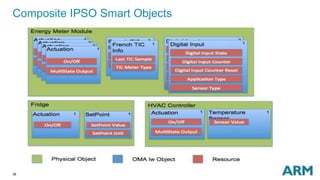
 Complex objects can be composed from simple objects 
 Easy to add new resource and object types as needed
6 
CoAP
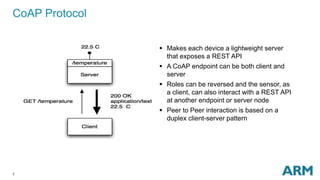
CoAP Protocol 
7 
 Makes each device a lightweight server 
that exposes a REST API 
 A CoAP endpoint can be both client and 
server 
 Roles can be reversed and the sensor, as 
a client, can also interact with a REST API 
at another endpoint or server node 
 Peer to Peer interaction is based on a 
duplex client-server pattern
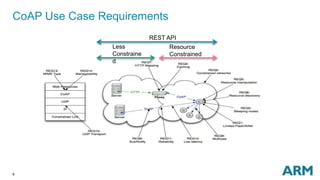
CoAP Use Case Requirements 
8 
REST API 
Less 
Constraine 
d 
Resource 
Constrained
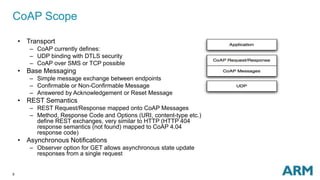
CoAP Scope 
9 
• Transport 
– CoAP currently defines: 
– UDP binding with DTLS security 
– CoAP over SMS or TCP possible 
• Base Messaging 
– Simple message exchange between endpoints 
– Confirmable or Non-Confirmable Message 
– Answered by Acknowledgement or Reset Message 
• REST Semantics 
– REST Request/Response mapped onto CoAP Messages 
– Method, Response Code and Options (URI, content-type etc.) 
define REST exchanges, very similar to HTTP (HTTP 404 
response semantics (not found) mapped to CoAP 4.04 
response code) 
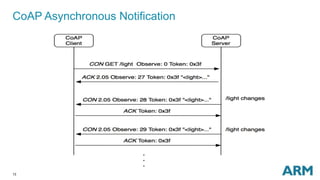
• Asynchronous Notifications 
– Observer option for GET allows asynchronous state update 
responses from a single request
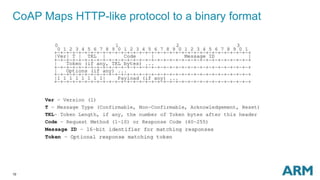
CoAP Maps HTTP-like protocol to a binary format 
10
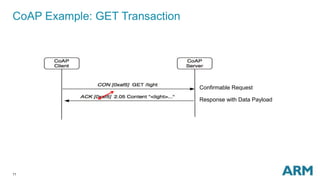
CoAP Example: GET Transaction 
11 
Confirmable Request 
Response with Data Payload
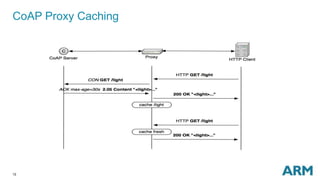
CoAP Proxy Caching 
12
CoAP Asynchronous Notification 
13
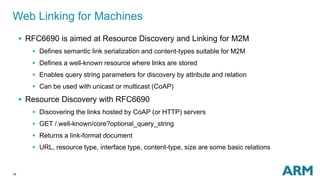
Web Linking for Machines 
14 
 RFC6690 is aimed at Resource Discovery and Linking for M2M 
 Defines semantic link serialization and content-types suitable for M2M 
 Defines a well-known resource where links are stored 
 Enables query string parameters for discovery by attribute and relation 
 Can be used with unicast or multicast (CoAP) 
 Resource Discovery with RFC6690 
 Discovering the links hosted by CoAP (or HTTP) servers 
 GET /.well-known/core?optional_query_string 
 Returns a link-format document 
 URL, resource type, interface type, content-type, size are some basic relations
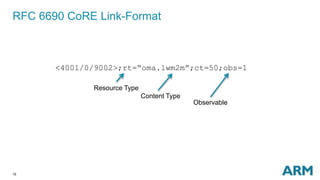
RFC 6690 CoRE Link-Format 
15 
<4001/0/9002>;rt=“oma.lwm2m”;ct=50;obs=1 
Resource Type 
Content Type 
Observable
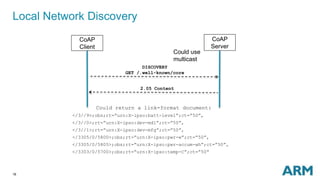
Local Network Discovery 
16 
CoAP 
Server 
DISCOVERY 
Could use 
multicast 
GET /.well-known/core 
2.05 Content 
Could return a link-format document: 
CoAP 
Client 
</3//9>;obs;rt=“urn:X-ipso:batt-level”;ct=”50”, 
</3//0>;rt=”urn:X-ipso:dev-mdl”;ct=”50”, 
</3//1>;rt=”urn:X-ipso:dev-mfg”;ct=”50”, 
</3305/0/5800>;obs;rt=”urn:X-ipso:pwr-w”;ct=”50”, 
</3305/0/5805>;obs;rt=”urn:X-ipso:pwr-accum-wh”;ct=”50”, 
</3303/0/5700>;obs;rt=”urn:X-ipso:temp-C”;ct=”50”
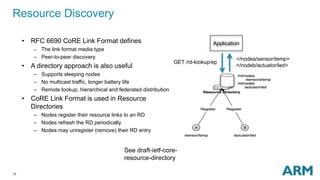
Resource Discovery 
17 
See draft-ietf-core-resource- 
directory 
• RFC 6690 CoRE Link Format defines 
– The link format media type 
– Peer-to-peer discovery 
• A directory approach is also useful 
– Supports sleeping nodes 
– No multicast traffic, longer battery life 
– Remote lookup, hierarchical and federated distribution 
• CoRE Link Format is used in Resource 
Directories 
– Nodes register their resource links to an RD 
– Nodes refresh the RD periodically 
– Nodes may unregister (remove) their RD entry 
Application 
GET /rd-lookup/ep 
</nodea/sensor/temp> 
</nodeb/actuator/led>
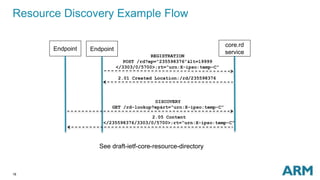
Resource Discovery Example Flow 
18 
See draft-ietf-core-resource-directory 
core.rd 
service 
REGISTRATION 
POST /rd?ep=“235598376”&lt=19999 
</3303/0/5700>;rt=“urn:X-ipso:temp-C” 
Endpoint 
2.01 Created Location:/rd/235598376 
DISCOVERY 
GET /rd-lookup?ep&rt=“urn:X-ipso:temp-C” 
2.05 Content 
</235598376/3303/0/5700>;rt=“urn:X-ipso:temp-C” 
Endpoint
19 
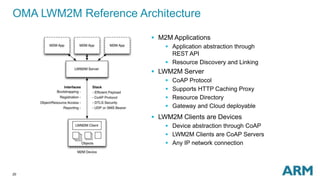
OMA LWM2M
OMA LWM2M Reference Architecture 
20 
 M2M Applications 
 Application abstraction through 
REST API 
 Resource Discovery and Linking 
 LWM2M Server 
 CoAP Protocol 
 Supports HTTP Caching Proxy 
 Resource Directory 
 Gateway and Cloud deployable 
 LWM2M Clients are Devices 
 Device abstraction through CoAP 
 LWM2M Clients are CoAP Servers 
 Any IP network connection
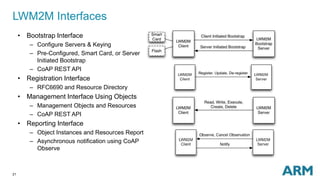
LWM2M Interfaces 
21 
• Bootstrap Interface 
– Configure Servers & Keying 
– Pre-Configured, Smart Card, or Server 
Initiated Bootstrap 
– CoAP REST API 
• Registration Interface 
– RFC6690 and Resource Directory 
• Management Interface Using Objects 
– Management Objects and Resources 
– CoAP REST API 
• Reporting Interface 
– Object Instances and Resources Report 
– Asynchronous notification using CoAP 
Observe
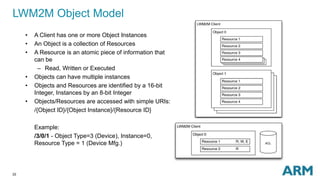
LWM2M Object Model 
22 
• A Client has one or more Object Instances 
• An Object is a collection of Resources 
• A Resource is an atomic piece of information that 
can be 
– Read, Written or Executed 
• Objects can have multiple instances 
• Objects and Resources are identified by a 16-bit 
Integer, Instances by an 8-bit Integer 
• Objects/Resources are accessed with simple URIs: 
/{Object ID}/{Object Instance}/{Resource ID} 
Example: 
/3/0/1 - Object Type=3 (Device), Instance=0, 
Resource Type = 1 (Device Mfg.)
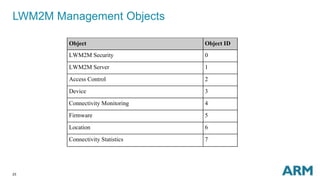
LWM2M Management Objects 
23 
Object Object ID 
LWM2M Security 0 
LWM2M Server 1 
Access Control 2 
Device 3 
Connectivity Monitoring 4 
Firmware 5 
Location 6 
Connectivity Statistics 7
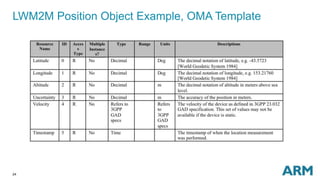
LWM2M Position Object Example, OMA Template 
24
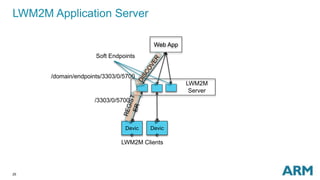
LWM2M Application Server 
25 
Web App 
LWM2M 
Server 
Soft Endpoints 
IP 
Devic 
e 
/domain/endpoints/3303/0/5700 
/3303/0/5700 
IP 
Devic 
e 
LWM2M Clients
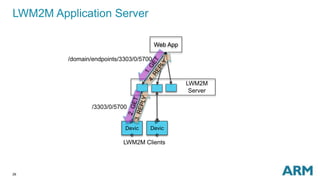
LWM2M Application Server 
26 
Web App 
LWM2M 
Server 
/domain/endpoints/3303/0/5700 
IP 
Devic 
e 
/3303/0/5700 
IP 
Devic 
e 
LWM2M Clients
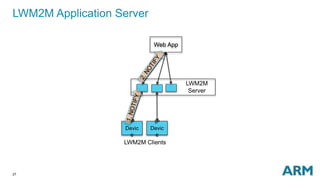
LWM2M Application Server 
27 
Web App 
LWM2M 
Server 
IP 
Devic 
e 
IP 
Devic 
e 
LWM2M Clients
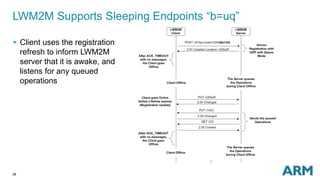
LWM2M Supports Sleeping Endpoints “b=uq” 
 Client uses the registration 
refresh to inform LWM2M 
server that it is awake, and 
listens for any queued 
operations 
28
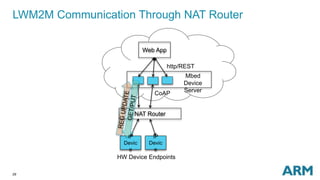
LWM2M Communication Through NAT Router 
29 
Web App 
http/REST 
Mbed 
Device 
Server 
CoAP 
NAT Router 
IP 
Devic 
e 
IP 
Devic 
e 
HW Device Endpoints
LWM2M Observe Parameters 
 LWM2M provides a mechanism to control Observation 
 “Write Attributes” Interface using query parameters to set observe attributes: 
 Pmin – minimum observation quiet period, to limit notification frequency 
 Pmax – maximum observation quiet period, to guarantee notifications 
 Lt – low limit measurement notification, like low alarm, in engineering units 
 Gt – high limit measurement notification, like a high alarm, in engineering units 
 Step – Minimum delta change required to notify, in engineering units 
30
LWM2M Bulk Read 
31 
 Returns TLV or JSON based on 
requested content-format 
 CBOR needs to be added 
 Linked Objects are supported 
{“e”:[ 
{"n":"0","sv":"Open Mobile Alliance"}, 
{"n":"1","sv":"Lightweight M2M Client"}, 
{"n":"2","sv":"345000123"}, 
{"n":"3","sv":"1.0"}, 
{"n":"6/0","v":"1"}, 
{"n":"6/1","v":"5"}, 
{"n":"7/0","v":"3800"}, 
{"n":"7/1","v":"5000"}, 
{"n":"8/0","v":"125"}, 
{"n":"8/1","v":"900"}, 
{"n":"9","v":"100"}, 
{"n":"10","v":"15"}, 
{"n":"11/0","v":"0"}, 
{"n":"13","v":"1367491215"}, 
{"n":"14","sv":"+02:00"}, 
{"n":"15","sv":"U"}] 
}
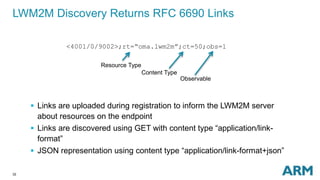
LWM2M Discovery Returns RFC 6690 Links 
32 
<4001/0/9002>;rt=“oma.lwm2m”;ct=50;obs=1 
Resource Type 
Content Type 
Observable 
 Links are uploaded during registration to inform the LWM2M server 
about resources on the endpoint 
 Links are discovered using GET with content type “application/link-format” 
 JSON representation using content type “application/link-format+json”
33 
IPSO Smart Objects
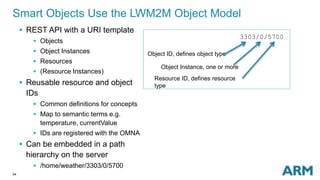
Smart Objects Use the LWM2M Object Model 
34 
 REST API with a URI template 
 Objects 
 Object Instances 
 Resources 
 (Resource Instances) 
 Reusable resource and object 
IDs 
 Common definitions for concepts 
 Map to semantic terms e.g. 
temperature, currentValue 
 IDs are registered with the OMNA 
 Can be embedded in a path 
hierarchy on the server 
 /home/weather/3303/0/5700 
3303/0/5700 
Object ID, defines object type 
Object Instance, one or more 
Resource ID, defines resource 
type
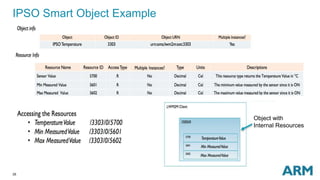
IPSO Smart Object Example 
35 
Object with 
Internal Resources
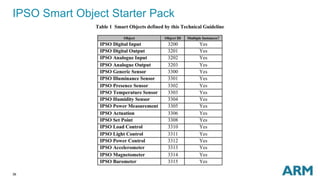
IPSO Smart Object Starter Pack 
36
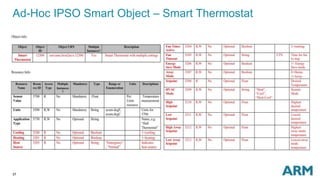
Ad-Hoc IPSO Smart Object – Smart Thermostat 
37
Composite IPSO Smart Objects 
38
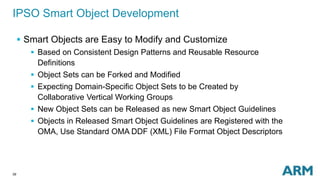
IPSO Smart Object Development 
39 
 Smart Objects are Easy to Modify and Customize 
 Based on Consistent Design Patterns and Reusable Resource 
Definitions 
 Object Sets can be Forked and Modified 
 Expecting Domain-Specific Object Sets to be Created by 
Collaborative Vertical Working Groups 
 New Object Sets can be Released as new Smart Object Guidelines 
 Objects in Released Smart Object Guidelines are Registered with the 
OMA, Use Standard OMA DDF (XML) File Format Object Descriptors
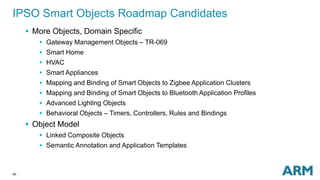
IPSO Smart Objects Roadmap Candidates 
40 
 More Objects, Domain Specific 
 Gateway Management Objects – TR-069 
 Smart Home 
 HVAC 
 Smart Appliances 
 Mapping and Binding of Smart Objects to Zigbee Application Clusters 
 Mapping and Binding of Smart Objects to Bluetooth Application Profiles 
 Advanced Lighting Objects 
 Behavioral Objects – Timers, Controllers, Rules and Bindings 
 Object Model 
 Linked Composite Objects 
 Semantic Annotation and Application Templates
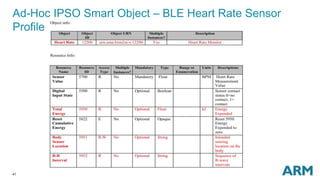
Ad-Hoc IPSO Smart Object – BLE Heart Rate Sensor 
Profile 
41
Semantic Annotation of Smart Objects 
42 
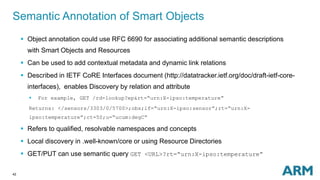
 Object annotation could use RFC 6690 for associating additional semantic descriptions 
with Smart Objects and Resources 
 Can be used to add contextual metadata and dynamic link relations 
 Described in IETF CoRE Interfaces document (http://datatracker.ietf.org/doc/draft-ietf-core-interfaces), 
enables Discovery by relation and attribute 
 For example, GET /rd-lookup?ep&rt=“urn:X-ipso:temperature” 
Returns: </sensors/3303/0/5700>;obs;if=“urn:X-ipso:sensor”;rt=“urn:X-ipso: 
temperature”;ct=50;u=“ucum:degC” 
 Refers to qualified, resolvable namespaces and concepts 
 Local discovery in .well-known/core or using Resource Directories 
 GET/PUT can use semantic query GET <URL>?rt=“urn:X-ipso:temperature”
Application Templates 
43 
“objects”:{ 
3303:{ 
“description”:”ipso temperature sensor”, 
“attributes”:{“pmin’:60, “pmax”:300, “max-age”:360}, 
“link-attributes”:{“rt”:[”oma.lwm2m”, “urn:X-ipso:temperature”]}, 
“instances”:{ 
0:{ 
“attributes”:{}, 
“link-attributes”:{“rt”:”urn:oma:lwm2m:ext:3303”}, 
“resources”:{ 
5700:{ 
“description”:”Current Measured Value” 
“attributes”:{“pmin”:10,”step”:0.5}, 
“link-attributes”:{“rt”:”ucum:temperature”,”obs”, “ct”:50} 
}, 
5701:{ 
“description”:”units”, 
”value”:”ucum:Cel”, 
“operations”:[“r”] 
}, 
5601:{“description”:”Min Measured Value”,”value”:100}, 
5602:{“description”:”Max Measured Value”,”value”:0}, 
5603:{“description”:”Min Range Value”,”value”:0}, 
5604:{“description”:”Max Range Value”,”value”:100}, 
5605:{“description”:”Reset Min/Max”} 
} 
 JSON templates for instance 
constructor and application schema 
 Interface to high level semantic 
models 
 Example template fragment for 
OMA LWM2M Application 
 Can carry Semantic Annotation as 
link attributes
Summary 
44 
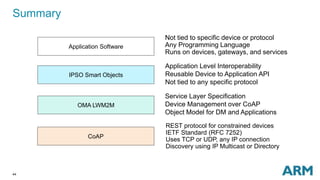
Application Software 
IPSO Smart Objects 
OMA LWM2M 
CoAP 
Not tied to specific device or protocol 
Any Programming Language 
Runs on devices, gateways, and services 
Application Level Interoperability 
Reusable Device to Application API 
Not tied to any specific protocol 
Service Layer Specification 
Device Management over CoAP 
Object Model for DM and Applications 
REST protocol for constrained devices 
IETF Standard (RFC 7252) 
Uses TCP or UDP, any IP connection 
Discovery using IP Multicast or Directory
References 
45 
IPSO Smart Object Guideline 
http://www.ipso-alliance.org/smart-object-guidelines 
OMA LWM2M Specification 
http://openmobilealliance.hs-sites.com/lightweight-m2m-specification-from-oma 
IETF CoAP and Related Specifications 
CoAP (RFC 7252): 
http://tools.ietf.org/html/rfc7252 
CoRE Link-Format (RFC 6690): 
http://tools.ietf.org/html/rfc6690 
CoRE Resource Directory: http://tools.ietf.org/html/draft-ietf-core-resource-directory- 
01 
CoAP Community Site 
http://coap.technology/

Ipso smart object seminar

  • 1.
    1 IPSO SmartObjects November18, 2014 And Related Standards for IoT Interoperability
  • 2.
    IPSO Smart Objects  A simple Data Model for  Semantic Interoperability across IoT Devices  Requires only simple URI addressing and a few data types  Mapping to internet content-types  Usable on many different transport protocols (CoAP, HTTP, MQTT)  This presentation discusses the architecture and features of a rich implementation of IPSO Smart Objects on constrained devices and networks using CoAP and OMA LWM2M 2
  • 3.
    IPSO Smart ObjectArchitecture Use Cases 3 Web Application Application Service e.g. LWM2M Sensor/ Actuator Device Web Applications running on Servers, Browsers, Smartphones, Tablets Device with Embedded Application Application Server Client Peer- Peer Constrained Device, e.g. 16KB RAM, 128KB Flash Smart Object Registration, Discovery and Data Layer Service, Device Proxy and Cache Applications can Discover and Interact with devices using Peer-Peer networking or through Services, using the Same Semantics
  • 4.
    IPSO Smart ObjectsAnd Related IoT Standards 4 Application Software IPSO Objects OMA LWM2M CoAP HTTP 6LowPAN IPV4/IPV6 802.15.4 WiFi, Ethernet MCU – 16KiB RAM MPU Application Data Models API and Services Application Protocol Routing HW Network Hardware Web Server
  • 5.
    IoT Standards ThatBuild On Each Other 5  CoAP and related standards from IETF  REST API for constrained networks and devices  HTTP Proxy provides abstraction through standard web APIs  Core-link-format (RFC 6690) provides semantic descriptors in the form of web links  Resource Directory provides an API for scalable discovery and linking using core link-format mediatype  OMA LWM2M is based on CoAP  Provides a server profile for IoT middleware  Defines a simple reusable object model  Defines management objects and reuses REST API for onboarding and device life cycle management  IPSO Smart Objects are based on OMA LWM2M  Defines application objects using the LWM2M Object Model  Complex objects can be composed from simple objects  Easy to add new resource and object types as needed
  • 6.
  • 7.
    CoAP Protocol 7  Makes each device a lightweight server that exposes a REST API  A CoAP endpoint can be both client and server  Roles can be reversed and the sensor, as a client, can also interact with a REST API at another endpoint or server node  Peer to Peer interaction is based on a duplex client-server pattern
  • 8.
    CoAP Use CaseRequirements 8 REST API Less Constraine d Resource Constrained
  • 9.
    CoAP Scope 9 • Transport – CoAP currently defines: – UDP binding with DTLS security – CoAP over SMS or TCP possible • Base Messaging – Simple message exchange between endpoints – Confirmable or Non-Confirmable Message – Answered by Acknowledgement or Reset Message • REST Semantics – REST Request/Response mapped onto CoAP Messages – Method, Response Code and Options (URI, content-type etc.) define REST exchanges, very similar to HTTP (HTTP 404 response semantics (not found) mapped to CoAP 4.04 response code) • Asynchronous Notifications – Observer option for GET allows asynchronous state update responses from a single request
  • 10.
    CoAP Maps HTTP-likeprotocol to a binary format 10
  • 11.
    CoAP Example: GETTransaction 11 Confirmable Request Response with Data Payload
  • 12.
  • 13.
  • 14.
    Web Linking forMachines 14  RFC6690 is aimed at Resource Discovery and Linking for M2M  Defines semantic link serialization and content-types suitable for M2M  Defines a well-known resource where links are stored  Enables query string parameters for discovery by attribute and relation  Can be used with unicast or multicast (CoAP)  Resource Discovery with RFC6690  Discovering the links hosted by CoAP (or HTTP) servers  GET /.well-known/core?optional_query_string  Returns a link-format document  URL, resource type, interface type, content-type, size are some basic relations
  • 15.
    RFC 6690 CoRELink-Format 15 <4001/0/9002>;rt=“oma.lwm2m”;ct=50;obs=1 Resource Type Content Type Observable
  • 16.
    Local Network Discovery 16 CoAP Server DISCOVERY Could use multicast GET /.well-known/core 2.05 Content Could return a link-format document: CoAP Client </3//9>;obs;rt=“urn:X-ipso:batt-level”;ct=”50”, </3//0>;rt=”urn:X-ipso:dev-mdl”;ct=”50”, </3//1>;rt=”urn:X-ipso:dev-mfg”;ct=”50”, </3305/0/5800>;obs;rt=”urn:X-ipso:pwr-w”;ct=”50”, </3305/0/5805>;obs;rt=”urn:X-ipso:pwr-accum-wh”;ct=”50”, </3303/0/5700>;obs;rt=”urn:X-ipso:temp-C”;ct=”50”
  • 17.
    Resource Discovery 17 See draft-ietf-core-resource- directory • RFC 6690 CoRE Link Format defines – The link format media type – Peer-to-peer discovery • A directory approach is also useful – Supports sleeping nodes – No multicast traffic, longer battery life – Remote lookup, hierarchical and federated distribution • CoRE Link Format is used in Resource Directories – Nodes register their resource links to an RD – Nodes refresh the RD periodically – Nodes may unregister (remove) their RD entry Application GET /rd-lookup/ep </nodea/sensor/temp> </nodeb/actuator/led>
  • 18.
    Resource Discovery ExampleFlow 18 See draft-ietf-core-resource-directory core.rd service REGISTRATION POST /rd?ep=“235598376”&lt=19999 </3303/0/5700>;rt=“urn:X-ipso:temp-C” Endpoint 2.01 Created Location:/rd/235598376 DISCOVERY GET /rd-lookup?ep&rt=“urn:X-ipso:temp-C” 2.05 Content </235598376/3303/0/5700>;rt=“urn:X-ipso:temp-C” Endpoint
  • 19.
  • 20.
    OMA LWM2M ReferenceArchitecture 20  M2M Applications  Application abstraction through REST API  Resource Discovery and Linking  LWM2M Server  CoAP Protocol  Supports HTTP Caching Proxy  Resource Directory  Gateway and Cloud deployable  LWM2M Clients are Devices  Device abstraction through CoAP  LWM2M Clients are CoAP Servers  Any IP network connection
  • 21.
    LWM2M Interfaces 21 • Bootstrap Interface – Configure Servers & Keying – Pre-Configured, Smart Card, or Server Initiated Bootstrap – CoAP REST API • Registration Interface – RFC6690 and Resource Directory • Management Interface Using Objects – Management Objects and Resources – CoAP REST API • Reporting Interface – Object Instances and Resources Report – Asynchronous notification using CoAP Observe
  • 22.
    LWM2M Object Model 22 • A Client has one or more Object Instances • An Object is a collection of Resources • A Resource is an atomic piece of information that can be – Read, Written or Executed • Objects can have multiple instances • Objects and Resources are identified by a 16-bit Integer, Instances by an 8-bit Integer • Objects/Resources are accessed with simple URIs: /{Object ID}/{Object Instance}/{Resource ID} Example: /3/0/1 - Object Type=3 (Device), Instance=0, Resource Type = 1 (Device Mfg.)
  • 23.
    LWM2M Management Objects 23 Object Object ID LWM2M Security 0 LWM2M Server 1 Access Control 2 Device 3 Connectivity Monitoring 4 Firmware 5 Location 6 Connectivity Statistics 7
  • 24.
    LWM2M Position ObjectExample, OMA Template 24
  • 25.
    LWM2M Application Server 25 Web App LWM2M Server Soft Endpoints IP Devic e /domain/endpoints/3303/0/5700 /3303/0/5700 IP Devic e LWM2M Clients
  • 26.
    LWM2M Application Server 26 Web App LWM2M Server /domain/endpoints/3303/0/5700 IP Devic e /3303/0/5700 IP Devic e LWM2M Clients
  • 27.
    LWM2M Application Server 27 Web App LWM2M Server IP Devic e IP Devic e LWM2M Clients
  • 28.
    LWM2M Supports SleepingEndpoints “b=uq”  Client uses the registration refresh to inform LWM2M server that it is awake, and listens for any queued operations 28
  • 29.
    LWM2M Communication ThroughNAT Router 29 Web App http/REST Mbed Device Server CoAP NAT Router IP Devic e IP Devic e HW Device Endpoints
  • 30.
    LWM2M Observe Parameters  LWM2M provides a mechanism to control Observation  “Write Attributes” Interface using query parameters to set observe attributes:  Pmin – minimum observation quiet period, to limit notification frequency  Pmax – maximum observation quiet period, to guarantee notifications  Lt – low limit measurement notification, like low alarm, in engineering units  Gt – high limit measurement notification, like a high alarm, in engineering units  Step – Minimum delta change required to notify, in engineering units 30
  • 31.
    LWM2M Bulk Read 31  Returns TLV or JSON based on requested content-format  CBOR needs to be added  Linked Objects are supported {“e”:[ {"n":"0","sv":"Open Mobile Alliance"}, {"n":"1","sv":"Lightweight M2M Client"}, {"n":"2","sv":"345000123"}, {"n":"3","sv":"1.0"}, {"n":"6/0","v":"1"}, {"n":"6/1","v":"5"}, {"n":"7/0","v":"3800"}, {"n":"7/1","v":"5000"}, {"n":"8/0","v":"125"}, {"n":"8/1","v":"900"}, {"n":"9","v":"100"}, {"n":"10","v":"15"}, {"n":"11/0","v":"0"}, {"n":"13","v":"1367491215"}, {"n":"14","sv":"+02:00"}, {"n":"15","sv":"U"}] }
  • 32.
    LWM2M Discovery ReturnsRFC 6690 Links 32 <4001/0/9002>;rt=“oma.lwm2m”;ct=50;obs=1 Resource Type Content Type Observable  Links are uploaded during registration to inform the LWM2M server about resources on the endpoint  Links are discovered using GET with content type “application/link-format”  JSON representation using content type “application/link-format+json”
  • 33.
  • 34.
    Smart Objects Usethe LWM2M Object Model 34  REST API with a URI template  Objects  Object Instances  Resources  (Resource Instances)  Reusable resource and object IDs  Common definitions for concepts  Map to semantic terms e.g. temperature, currentValue  IDs are registered with the OMNA  Can be embedded in a path hierarchy on the server  /home/weather/3303/0/5700 3303/0/5700 Object ID, defines object type Object Instance, one or more Resource ID, defines resource type
  • 35.
    IPSO Smart ObjectExample 35 Object with Internal Resources
  • 36.
    IPSO Smart ObjectStarter Pack 36
  • 37.
    Ad-Hoc IPSO SmartObject – Smart Thermostat 37
  • 38.
  • 39.
    IPSO Smart ObjectDevelopment 39  Smart Objects are Easy to Modify and Customize  Based on Consistent Design Patterns and Reusable Resource Definitions  Object Sets can be Forked and Modified  Expecting Domain-Specific Object Sets to be Created by Collaborative Vertical Working Groups  New Object Sets can be Released as new Smart Object Guidelines  Objects in Released Smart Object Guidelines are Registered with the OMA, Use Standard OMA DDF (XML) File Format Object Descriptors
  • 40.
    IPSO Smart ObjectsRoadmap Candidates 40  More Objects, Domain Specific  Gateway Management Objects – TR-069  Smart Home  HVAC  Smart Appliances  Mapping and Binding of Smart Objects to Zigbee Application Clusters  Mapping and Binding of Smart Objects to Bluetooth Application Profiles  Advanced Lighting Objects  Behavioral Objects – Timers, Controllers, Rules and Bindings  Object Model  Linked Composite Objects  Semantic Annotation and Application Templates
  • 41.
    Ad-Hoc IPSO SmartObject – BLE Heart Rate Sensor Profile 41
  • 42.
    Semantic Annotation ofSmart Objects 42  Object annotation could use RFC 6690 for associating additional semantic descriptions with Smart Objects and Resources  Can be used to add contextual metadata and dynamic link relations  Described in IETF CoRE Interfaces document (http://datatracker.ietf.org/doc/draft-ietf-core-interfaces), enables Discovery by relation and attribute  For example, GET /rd-lookup?ep&rt=“urn:X-ipso:temperature” Returns: </sensors/3303/0/5700>;obs;if=“urn:X-ipso:sensor”;rt=“urn:X-ipso: temperature”;ct=50;u=“ucum:degC”  Refers to qualified, resolvable namespaces and concepts  Local discovery in .well-known/core or using Resource Directories  GET/PUT can use semantic query GET <URL>?rt=“urn:X-ipso:temperature”
  • 43.
    Application Templates 43 “objects”:{ 3303:{ “description”:”ipso temperature sensor”, “attributes”:{“pmin’:60, “pmax”:300, “max-age”:360}, “link-attributes”:{“rt”:[”oma.lwm2m”, “urn:X-ipso:temperature”]}, “instances”:{ 0:{ “attributes”:{}, “link-attributes”:{“rt”:”urn:oma:lwm2m:ext:3303”}, “resources”:{ 5700:{ “description”:”Current Measured Value” “attributes”:{“pmin”:10,”step”:0.5}, “link-attributes”:{“rt”:”ucum:temperature”,”obs”, “ct”:50} }, 5701:{ “description”:”units”, ”value”:”ucum:Cel”, “operations”:[“r”] }, 5601:{“description”:”Min Measured Value”,”value”:100}, 5602:{“description”:”Max Measured Value”,”value”:0}, 5603:{“description”:”Min Range Value”,”value”:0}, 5604:{“description”:”Max Range Value”,”value”:100}, 5605:{“description”:”Reset Min/Max”} }  JSON templates for instance constructor and application schema  Interface to high level semantic models  Example template fragment for OMA LWM2M Application  Can carry Semantic Annotation as link attributes
  • 44.
    Summary 44 ApplicationSoftware IPSO Smart Objects OMA LWM2M CoAP Not tied to specific device or protocol Any Programming Language Runs on devices, gateways, and services Application Level Interoperability Reusable Device to Application API Not tied to any specific protocol Service Layer Specification Device Management over CoAP Object Model for DM and Applications REST protocol for constrained devices IETF Standard (RFC 7252) Uses TCP or UDP, any IP connection Discovery using IP Multicast or Directory
  • 45.
    References 45 IPSOSmart Object Guideline http://www.ipso-alliance.org/smart-object-guidelines OMA LWM2M Specification http://openmobilealliance.hs-sites.com/lightweight-m2m-specification-from-oma IETF CoAP and Related Specifications CoAP (RFC 7252): http://tools.ietf.org/html/rfc7252 CoRE Link-Format (RFC 6690): http://tools.ietf.org/html/rfc6690 CoRE Resource Directory: http://tools.ietf.org/html/draft-ietf-core-resource-directory- 01 CoAP Community Site http://coap.technology/