
1
From Embedded to Connected
Internet Architecture for the Internet of Things
May 7, 2015
2
Internet Architecture for the Internet of Things
ď‚§ Review of IoT Design Patterns
ď‚§ Design Patterns are recurring solutions to common problems
ď‚§ Design Patterns occur at many levels in system design
 Standards – Interoperability and Reusability
3
Design Patterns
ď‚§ Design Patterns are recurring solutions to common problems
ď‚§ Design Patterns occur at many levels in system design
ď‚§ These are some common IoT Design Patterns related to the
tradeoff of embedded vs. connected intelligence in evolving
systems
4
Connected Intelligence and Virtualization
5
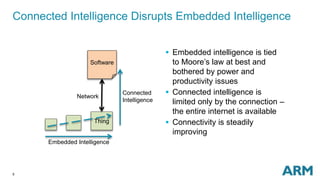
Connected Intelligence Disrupts Embedded Intelligence
Thing
Software
Connected
Intelligence
Embedded Intelligence
Network
ď‚§ Embedded intelligence is tied
to Moore’s law at best and
bothered by power and
productivity issues
ď‚§ Connected intelligence is
limited only by the connection –
the entire internet is available
ď‚§ Connectivity is steadily
improving
6
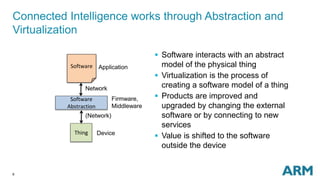
Connected Intelligence works through Abstraction and
Virtualization
Thing
Software
Network
Software
Abstraction
(Network)
Firmware,
Middleware
Device
Application
ď‚§ Software interacts with an abstract
model of the physical thing
ď‚§ Virtualization is the process of
creating a software model of a thing
ď‚§ Products are improved and
upgraded by changing the external
software or by connecting to new
services
ď‚§ Value is shifted to the software
outside the device
7
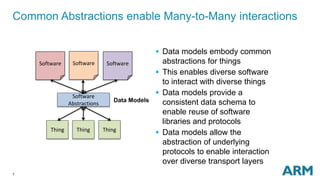
Common Abstractions enable Many-to-Many interactions
Thing
Software
Software
Abstractions
Data Models
Software Software
ThingThing
ď‚§ Data models embody common
abstractions for things
ď‚§ This enables diverse software
to interact with diverse things
ď‚§ Data models provide a
consistent data schema to
enable reuse of software
libraries and protocols
ď‚§ Data models allow the
abstraction of underlying
protocols to enable interaction
over diverse transport layers
8
High Level Design Patterns for IoT
9
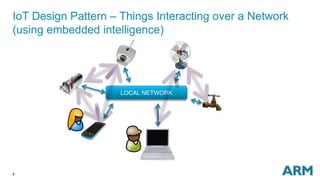
IoT Design Pattern – Things Interacting over a Network
(using embedded intelligence)
LOCAL NETWORK
10
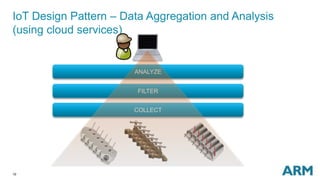
IoT Design Pattern – Data Aggregation and Analysis
(using cloud services)
COLLECT
FILTER
ANALYZE
11
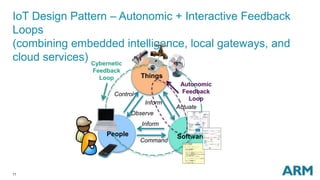
IoT Design Pattern – Autonomic + Interactive Feedback
Loops
(combining embedded intelligence, local gateways, and
cloud services)
Things
People Software
Inform
Command
Inform
Actuate
Autonomic
Feedback
Loop
Cybernetic
Feedback
Loop
Observe
Control
12
Protocols and Services
13
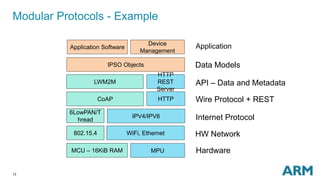
Modular Protocols - Example
Application Software
IPSO Objects
LWM2M
CoAP HTTP
6LowPAN/T
hread
IPV4/IPV6
MCU – 16KiB RAM MPU
802.15.4 WiFi, Ethernet
Hardware
HW Network
Internet Protocol
Wire Protocol + REST
API – Data and Metadata
Data Models
Application
HTTP
REST
Server
Device
Management
14
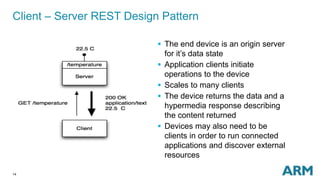
Client – Server REST Design Pattern
ď‚§ The end device is an origin server
for it’s data state
ď‚§ Application clients initiate
operations to the device
ď‚§ Scales to many clients
ď‚§ The device returns the data and a
hypermedia response describing
the content returned
ď‚§ Devices may also need to be
clients in order to run connected
applications and discover external
resources
15
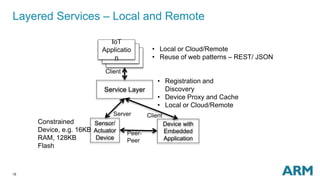
Layered Services – Local and Remote
Application
Sensor/
Actuator
Device
Service Layer
Device with
Embedded
Application
Application
IoT
Applicatio
n
ClientServer
Peer-
Peer
Constrained
Device, e.g. 16KB
RAM, 128KB
Flash
• Registration and
Discovery
• Device Proxy and Cache
• Local or Cloud/Remote
• Reuse of web patterns – REST/ JSON
Client
16
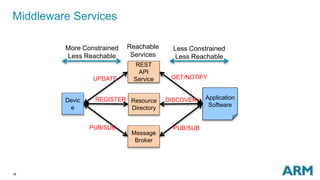
Middleware Services
Devic
e
Application
Software
REST
API
Service
Resource
Directory
Message
Broker
Reachable
Services
REGISTER DISCOVER
PUB/SUB PUB/SUB
UPDATE GET/NOTIFY
More Constrained
Less Reachable
Less Constrained
Less Reachable
17
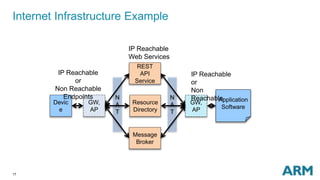
Internet Infrastructure Example
Devic
e
N
A
T
Application
Software
N
A
T
GW,
AP
GW,
AP
REST
API
Service
Resource
Directory
Message
Broker
IP Reachable
Web Services
IP Reachable
or
Non Reachable
Endpoints
IP Reachable
or
Non
Reachable
18
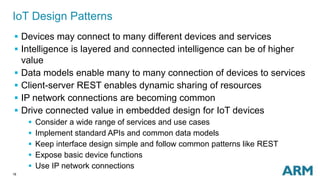
IoT Design Patterns
ď‚§ Devices may connect to many different devices and services
ď‚§ Intelligence is layered and connected intelligence can be of higher
value
ď‚§ Data models enable many to many connection of devices to services
ď‚§ Client-server REST enables dynamic sharing of resources
ď‚§ IP network connections are becoming common
ď‚§ Drive connected value in embedded design for IoT devices
ď‚§ Consider a wide range of services and use cases
ď‚§ Implement standard APIs and common data models
ď‚§ Keep interface design simple and follow common patterns like REST
ď‚§ Expose basic device functions
ď‚§ Use IP network connections
19
IoT Standards
20
Standards – Interoperability and Reusability
ď‚§ Interoperability results in a larger ecosystem of devices and
applications
ď‚§ Reusability of technology and designs makes it easier for new
devices and applications to be created
ď‚§ Open standards that provide APIs and data models for IP based IoT
ď‚§ CoAP
ď‚§ OMA LWM2M
ď‚§ IPSO Smart Objects
21
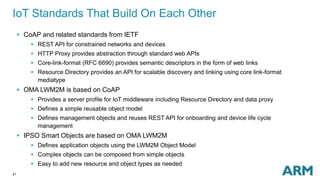
IoT Standards That Build On Each Other
ď‚§ CoAP and related standards from IETF
ď‚§ REST API for constrained networks and devices
ď‚§ HTTP Proxy provides abstraction through standard web APIs
ď‚§ Core-link-format (RFC 6690) provides semantic descriptors in the form of web links
ď‚§ Resource Directory provides an API for scalable discovery and linking using core link-format
mediatype
ď‚§ OMA LWM2M is based on CoAP
ď‚§ Provides a server profile for IoT middleware including Resource Directory and data proxy
ď‚§ Defines a simple reusable object model
ď‚§ Defines management objects and reuses REST API for onboarding and device life cycle
management
ď‚§ IPSO Smart Objects are based on OMA LWM2M
ď‚§ Defines application objects using the LWM2M Object Model
ď‚§ Complex objects can be composed from simple objects
ď‚§ Easy to add new resource and object types as needed
22
CoAP and Related IETF Standards
23
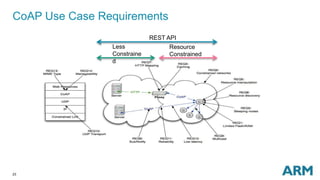
CoAP Use Case Requirements
REST API
Less
Constraine
d
Resource
Constrained
24
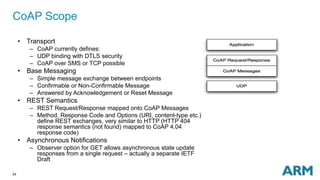
CoAP Scope
• Transport
– CoAP currently defines:
– UDP binding with DTLS security
– CoAP over SMS or TCP possible
• Base Messaging
– Simple message exchange between endpoints
– Confirmable or Non-Confirmable Message
– Answered by Acknowledgement or Reset Message
• REST Semantics
– REST Request/Response mapped onto CoAP Messages
– Method, Response Code and Options (URI, content-type etc.)
define REST exchanges, very similar to HTTP (HTTP 404
response semantics (not found) mapped to CoAP 4.04
response code)
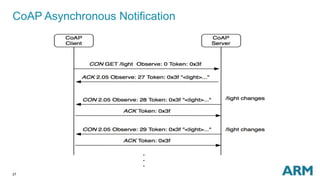
• Asynchronous Notifications
– Observer option for GET allows asynchronous state update
responses from a single request – actually a separate IETF
Draft
25
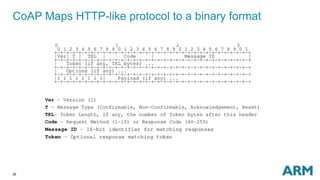
CoAP Maps HTTP-like protocol to a binary format
26
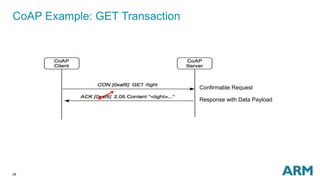
CoAP Example: GET Transaction
Response with Data Payload
Confirmable Request
27
CoAP Asynchronous Notification
28
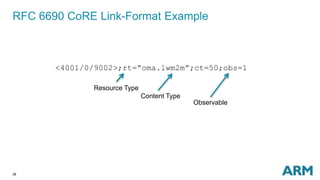
RFC 6690 CoRE Link-Format Example
<4001/0/9002>;rt=“oma.lwm2m”;ct=50;obs=1
Resource Type
Content Type
Observable
29
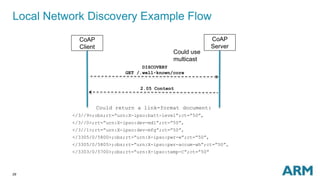
Local Network Discovery Example Flow
Could return a link-format document:
</3//9>;obs;rt=“urn:X-ipso:batt-level”;ct=”50”,
</3//0>;rt=”urn:X-ipso:dev-mdl”;ct=”50”,
</3//1>;rt=”urn:X-ipso:dev-mfg”;ct=”50”,
</3305/0/5800>;obs;rt=”urn:X-ipso:pwr-w”;ct=”50”,
</3305/0/5805>;obs;rt=”urn:X-ipso:pwr-accum-wh”;ct=”50”,
</3303/0/5700>;obs;rt=”urn:X-ipso:temp-C”;ct=”50”
CoAP
Server
CoAP
Client
DISCOVERY
GET /.well-known/core
2.05 Content
Could use
multicast
30
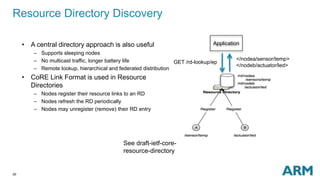
Resource Directory Discovery
See draft-ietf-core-
resource-directory
• A central directory approach is also useful
– Supports sleeping nodes
– No multicast traffic, longer battery life
– Remote lookup, hierarchical and federated distribution
• CoRE Link Format is used in Resource
Directories
– Nodes register their resource links to an RD
– Nodes refresh the RD periodically
– Nodes may unregister (remove) their RD entry
Application
GET /rd-lookup/ep
</nodea/sensor/temp>
</nodeb/actuator/led>
31
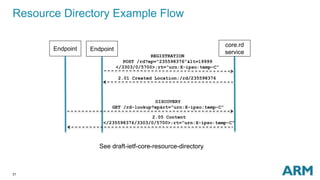
Resource Directory Example Flow
See draft-ietf-core-resource-directory
core.rd
service
REGISTRATION
POST /rd?ep=“235598376”&lt=19999
</3303/0/5700>;rt=“urn:X-ipso:temp-C”
Endpoint
2.01 Created Location:/rd/235598376
DISCOVERY
GET /rd-lookup?ep&rt=“urn:X-ipso:temp-C”
2.05 Content
</235598376/3303/0/5700>;rt=“urn:X-ipso:temp-C”
Endpoint
32
OMA LWM2M
33
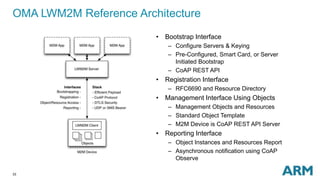
OMA LWM2M Reference Architecture
• Bootstrap Interface
– Configure Servers & Keying
– Pre-Configured, Smart Card, or Server
Initiated Bootstrap
– CoAP REST API
• Registration Interface
– RFC6690 and Resource Directory
• Management Interface Using Objects
– Management Objects and Resources
– Standard Object Template
– M2M Device is CoAP REST API Server
• Reporting Interface
– Object Instances and Resources Report
– Asynchronous notification using CoAP
Observe
34
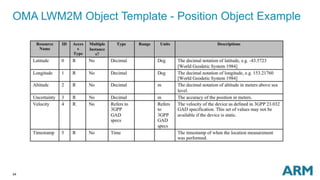
OMA LWM2M Object Template - Position Object Example
35
IPSO Smart Objects
36
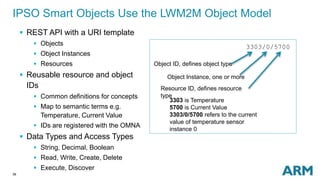
IPSO Smart Objects Use the LWM2M Object Model
ď‚§ REST API with a URI template
ď‚§ Objects
ď‚§ Object Instances
ď‚§ Resources
ď‚§ Reusable resource and object
IDs
ď‚§ Common definitions for concepts
ď‚§ Map to semantic terms e.g.
Temperature, Current Value
ď‚§ IDs are registered with the OMNA
ď‚§ Data Types and Access Types
ď‚§ String, Decimal, Boolean
ď‚§ Read, Write, Create, Delete
ď‚§ Execute, Discover
3303/0/5700
Object ID, defines object type
Object Instance, one or more
Resource ID, defines resource
type
3303 is Temperature
5700 is Current Value
3303/0/5700 refers to the current
value of temperature sensor
instance 0
37
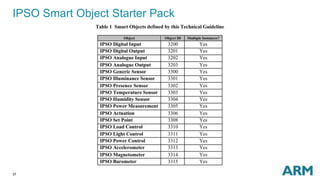
IPSO Smart Object Starter Pack
38
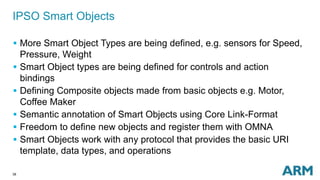
IPSO Smart Objects
ď‚§ More Smart Object Types are being defined, e.g. sensors for Speed,
Pressure, Weight
ď‚§ Smart Object types are being defined for controls and action
bindings
ď‚§ Defining Composite objects made from basic objects e.g. Motor,
Coffee Maker
ď‚§ Semantic annotation of Smart Objects using Core Link-Format
ď‚§ Freedom to define new objects and register them with OMNA
ď‚§ Smart Objects work with any protocol that provides the basic URI
template, data types, and operations
39
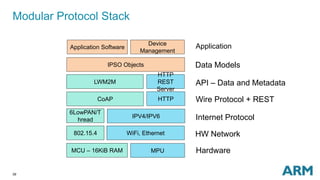
Modular Protocol Stack
Application Software
IPSO Objects
LWM2M
CoAP HTTP
6LowPAN/T
hread
IPV4/IPV6
MCU – 16KiB RAM MPU
802.15.4 WiFi, Ethernet
Hardware
HW Network
Internet Protocol
Wire Protocol + REST
API – Data and Metadata
Data Models
Application
HTTP
REST
Server
Device
Management
40
Summary
ď‚§ Value is shifting to connected software applications
ď‚§ Common data models enable reusable software in devices and
applications
ď‚§ IP networking and related standards provide points of interoperability
with modular protocol stacks
ď‚§ Embedded software can expose standard APIs and data models to
enable IoT value through connected software
41
References
IPSO Smart Object Guideline
http://www.ipso-alliance.org/smart-object-guidelines
OMA LWM2M Specification
http://openmobilealliance.hs-sites.com/lightweight-m2m-specification-from-
oma
IETF CoAP and Related Specifications
CoAP (RFC 7252):
http://tools.ietf.org/html/rfc7252
CoRE Link-Format (RFC 6690):
http://tools.ietf.org/html/rfc6690
CoRE Resource Directory: http://tools.ietf.org/html/draft-ietf-core-resource-
directory-01
CoAP Community Site
http://coap.technology/

Embedded to connected

  • 1.
    1 From Embedded toConnected Internet Architecture for the Internet of Things May 7, 2015
  • 2.
    2 Internet Architecture forthe Internet of Things  Review of IoT Design Patterns  Design Patterns are recurring solutions to common problems  Design Patterns occur at many levels in system design  Standards – Interoperability and Reusability
  • 3.
    3 Design Patterns ď‚§ DesignPatterns are recurring solutions to common problems ď‚§ Design Patterns occur at many levels in system design ď‚§ These are some common IoT Design Patterns related to the tradeoff of embedded vs. connected intelligence in evolving systems
  • 4.
  • 5.
    5 Connected Intelligence DisruptsEmbedded Intelligence Thing Software Connected Intelligence Embedded Intelligence Network  Embedded intelligence is tied to Moore’s law at best and bothered by power and productivity issues  Connected intelligence is limited only by the connection – the entire internet is available  Connectivity is steadily improving
  • 6.
    6 Connected Intelligence worksthrough Abstraction and Virtualization Thing Software Network Software Abstraction (Network) Firmware, Middleware Device Application ď‚§ Software interacts with an abstract model of the physical thing ď‚§ Virtualization is the process of creating a software model of a thing ď‚§ Products are improved and upgraded by changing the external software or by connecting to new services ď‚§ Value is shifted to the software outside the device
  • 7.
    7 Common Abstractions enableMany-to-Many interactions Thing Software Software Abstractions Data Models Software Software ThingThing ď‚§ Data models embody common abstractions for things ď‚§ This enables diverse software to interact with diverse things ď‚§ Data models provide a consistent data schema to enable reuse of software libraries and protocols ď‚§ Data models allow the abstraction of underlying protocols to enable interaction over diverse transport layers
  • 8.
    8 High Level DesignPatterns for IoT
  • 9.
    9 IoT Design Pattern– Things Interacting over a Network (using embedded intelligence) LOCAL NETWORK
  • 10.
    10 IoT Design Pattern– Data Aggregation and Analysis (using cloud services) COLLECT FILTER ANALYZE
  • 11.
    11 IoT Design Pattern– Autonomic + Interactive Feedback Loops (combining embedded intelligence, local gateways, and cloud services) Things People Software Inform Command Inform Actuate Autonomic Feedback Loop Cybernetic Feedback Loop Observe Control
  • 12.
  • 13.
    13 Modular Protocols -Example Application Software IPSO Objects LWM2M CoAP HTTP 6LowPAN/T hread IPV4/IPV6 MCU – 16KiB RAM MPU 802.15.4 WiFi, Ethernet Hardware HW Network Internet Protocol Wire Protocol + REST API – Data and Metadata Data Models Application HTTP REST Server Device Management
  • 14.
    14 Client – ServerREST Design Pattern  The end device is an origin server for it’s data state  Application clients initiate operations to the device  Scales to many clients  The device returns the data and a hypermedia response describing the content returned  Devices may also need to be clients in order to run connected applications and discover external resources
  • 15.
    15 Layered Services –Local and Remote Application Sensor/ Actuator Device Service Layer Device with Embedded Application Application IoT Applicatio n ClientServer Peer- Peer Constrained Device, e.g. 16KB RAM, 128KB Flash • Registration and Discovery • Device Proxy and Cache • Local or Cloud/Remote • Local or Cloud/Remote • Reuse of web patterns – REST/ JSON Client
  • 16.
  • 17.
  • 18.
    18 IoT Design Patterns ď‚§Devices may connect to many different devices and services ď‚§ Intelligence is layered and connected intelligence can be of higher value ď‚§ Data models enable many to many connection of devices to services ď‚§ Client-server REST enables dynamic sharing of resources ď‚§ IP network connections are becoming common ď‚§ Drive connected value in embedded design for IoT devices ď‚§ Consider a wide range of services and use cases ď‚§ Implement standard APIs and common data models ď‚§ Keep interface design simple and follow common patterns like REST ď‚§ Expose basic device functions ď‚§ Use IP network connections
  • 19.
  • 20.
    20 Standards – Interoperabilityand Reusability  Interoperability results in a larger ecosystem of devices and applications  Reusability of technology and designs makes it easier for new devices and applications to be created  Open standards that provide APIs and data models for IP based IoT  CoAP  OMA LWM2M  IPSO Smart Objects
  • 21.
    21 IoT Standards ThatBuild On Each Other ď‚§ CoAP and related standards from IETF ď‚§ REST API for constrained networks and devices ď‚§ HTTP Proxy provides abstraction through standard web APIs ď‚§ Core-link-format (RFC 6690) provides semantic descriptors in the form of web links ď‚§ Resource Directory provides an API for scalable discovery and linking using core link-format mediatype ď‚§ OMA LWM2M is based on CoAP ď‚§ Provides a server profile for IoT middleware including Resource Directory and data proxy ď‚§ Defines a simple reusable object model ď‚§ Defines management objects and reuses REST API for onboarding and device life cycle management ď‚§ IPSO Smart Objects are based on OMA LWM2M ď‚§ Defines application objects using the LWM2M Object Model ď‚§ Complex objects can be composed from simple objects ď‚§ Easy to add new resource and object types as needed
  • 22.
    22 CoAP and RelatedIETF Standards
  • 23.
    23 CoAP Use CaseRequirements REST API Less Constraine d Resource Constrained
  • 24.
    24 CoAP Scope • Transport –CoAP currently defines: – UDP binding with DTLS security – CoAP over SMS or TCP possible • Base Messaging – Simple message exchange between endpoints – Confirmable or Non-Confirmable Message – Answered by Acknowledgement or Reset Message • REST Semantics – REST Request/Response mapped onto CoAP Messages – Method, Response Code and Options (URI, content-type etc.) define REST exchanges, very similar to HTTP (HTTP 404 response semantics (not found) mapped to CoAP 4.04 response code) • Asynchronous Notifications – Observer option for GET allows asynchronous state update responses from a single request – actually a separate IETF Draft
  • 25.
    25 CoAP Maps HTTP-likeprotocol to a binary format
  • 26.
    26 CoAP Example: GETTransaction Response with Data Payload Confirmable Request
  • 27.
  • 28.
    28 RFC 6690 CoRELink-Format Example <4001/0/9002>;rt=“oma.lwm2m”;ct=50;obs=1 Resource Type Content Type Observable
  • 29.
    29 Local Network DiscoveryExample Flow Could return a link-format document: </3//9>;obs;rt=“urn:X-ipso:batt-level”;ct=”50”, </3//0>;rt=”urn:X-ipso:dev-mdl”;ct=”50”, </3//1>;rt=”urn:X-ipso:dev-mfg”;ct=”50”, </3305/0/5800>;obs;rt=”urn:X-ipso:pwr-w”;ct=”50”, </3305/0/5805>;obs;rt=”urn:X-ipso:pwr-accum-wh”;ct=”50”, </3303/0/5700>;obs;rt=”urn:X-ipso:temp-C”;ct=”50” CoAP Server CoAP Client DISCOVERY GET /.well-known/core 2.05 Content Could use multicast
  • 30.
    30 Resource Directory Discovery Seedraft-ietf-core- resource-directory • A central directory approach is also useful – Supports sleeping nodes – No multicast traffic, longer battery life – Remote lookup, hierarchical and federated distribution • CoRE Link Format is used in Resource Directories – Nodes register their resource links to an RD – Nodes refresh the RD periodically – Nodes may unregister (remove) their RD entry Application GET /rd-lookup/ep </nodea/sensor/temp> </nodeb/actuator/led>
  • 31.
    31 Resource Directory ExampleFlow See draft-ietf-core-resource-directory core.rd service REGISTRATION POST /rd?ep=“235598376”&lt=19999 </3303/0/5700>;rt=“urn:X-ipso:temp-C” Endpoint 2.01 Created Location:/rd/235598376 DISCOVERY GET /rd-lookup?ep&rt=“urn:X-ipso:temp-C” 2.05 Content </235598376/3303/0/5700>;rt=“urn:X-ipso:temp-C” Endpoint
  • 32.
  • 33.
    33 OMA LWM2M ReferenceArchitecture • Bootstrap Interface – Configure Servers & Keying – Pre-Configured, Smart Card, or Server Initiated Bootstrap – CoAP REST API • Registration Interface – RFC6690 and Resource Directory • Management Interface Using Objects – Management Objects and Resources – Standard Object Template – M2M Device is CoAP REST API Server • Reporting Interface – Object Instances and Resources Report – Asynchronous notification using CoAP Observe
  • 34.
    34 OMA LWM2M ObjectTemplate - Position Object Example
  • 35.
  • 36.
    36 IPSO Smart ObjectsUse the LWM2M Object Model ď‚§ REST API with a URI template ď‚§ Objects ď‚§ Object Instances ď‚§ Resources ď‚§ Reusable resource and object IDs ď‚§ Common definitions for concepts ď‚§ Map to semantic terms e.g. Temperature, Current Value ď‚§ IDs are registered with the OMNA ď‚§ Data Types and Access Types ď‚§ String, Decimal, Boolean ď‚§ Read, Write, Create, Delete ď‚§ Execute, Discover 3303/0/5700 Object ID, defines object type Object Instance, one or more Resource ID, defines resource type 3303 is Temperature 5700 is Current Value 3303/0/5700 refers to the current value of temperature sensor instance 0
  • 37.
  • 38.
    38 IPSO Smart Objects ď‚§More Smart Object Types are being defined, e.g. sensors for Speed, Pressure, Weight ď‚§ Smart Object types are being defined for controls and action bindings ď‚§ Defining Composite objects made from basic objects e.g. Motor, Coffee Maker ď‚§ Semantic annotation of Smart Objects using Core Link-Format ď‚§ Freedom to define new objects and register them with OMNA ď‚§ Smart Objects work with any protocol that provides the basic URI template, data types, and operations
  • 39.
    39 Modular Protocol Stack ApplicationSoftware IPSO Objects LWM2M CoAP HTTP 6LowPAN/T hread IPV4/IPV6 MCU – 16KiB RAM MPU 802.15.4 WiFi, Ethernet Hardware HW Network Internet Protocol Wire Protocol + REST API – Data and Metadata Data Models Application HTTP REST Server Device Management
  • 40.
    40 Summary ď‚§ Value isshifting to connected software applications ď‚§ Common data models enable reusable software in devices and applications ď‚§ IP networking and related standards provide points of interoperability with modular protocol stacks ď‚§ Embedded software can expose standard APIs and data models to enable IoT value through connected software
  • 41.
    41 References IPSO Smart ObjectGuideline http://www.ipso-alliance.org/smart-object-guidelines OMA LWM2M Specification http://openmobilealliance.hs-sites.com/lightweight-m2m-specification-from- oma IETF CoAP and Related Specifications CoAP (RFC 7252): http://tools.ietf.org/html/rfc7252 CoRE Link-Format (RFC 6690): http://tools.ietf.org/html/rfc6690 CoRE Resource Directory: http://tools.ietf.org/html/draft-ietf-core-resource- directory-01 CoAP Community Site http://coap.technology/