1
ARM IoT Tutorial
Zach Shelby
April 30th, 2014
CoAP: The Web of Things Protocol
2
Introduction
3
3
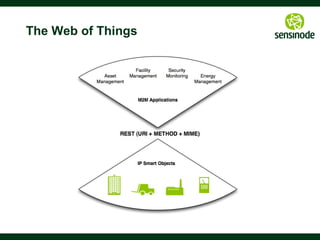
M2M Internet of Things
Little Data
Big Data
Web
Evolution from M2M to IoT
The Web
Things
Services
4
CoAP:The Web of Things Protocol
§  Open IETF Standard
§  Compact 4-byte Header
§  UDP, SMS, (TCP) Support
§  Strong DTLS Security
§  Asynchronous Subscription
§  Built-in Discovery
5
From Web Applications to IoT Nodes
Web Application
1000s of bytes
HTTP
IP
TLS / TCP
DTLS / UDP
Binary Web Object
CoAP
IP
100s bytes
10s of bytes
IoT Backhaul
IoT Node Network
Proxy Router
Web Object
DTLS / UDP
Binary Web Object
CoAP
6LoWPAN
6
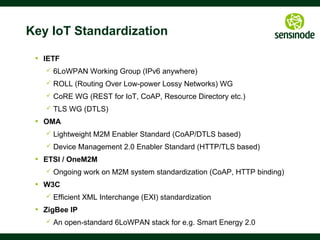
CoAP is One Key IoT Standard
Local
Network
Protocols,
Security
Application
ZigBee IP ZigBee NANBT Smart IP
TLS Based SecurityWeb: CoAP & HTTP
Lightweight M2M Application Objects ZigBee Web Objects
Mature New
ZigBee IP 1.X
CoRE
6LoWPAN
7
The Web and REST
8
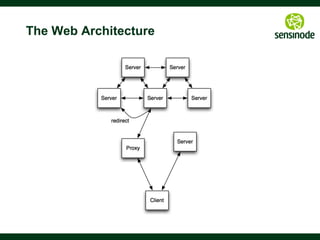
The Web Architecture
9
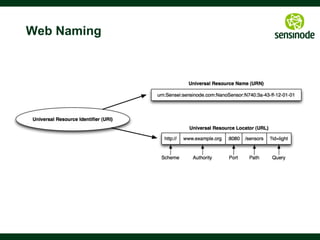
Web Naming
10
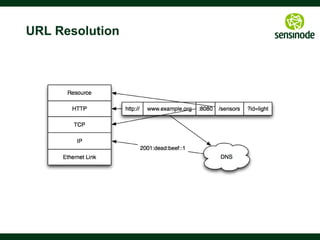
URL Resolution
11
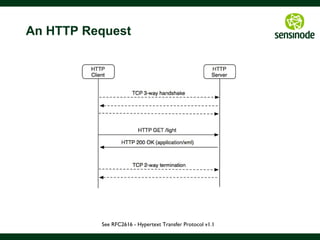
An HTTP Request
See RFC2616 - Hypertext Transfer Protocol v1.1
12
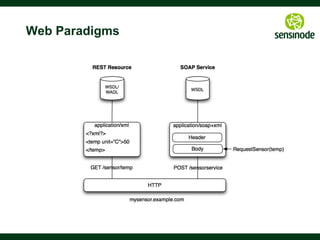
Web Paradigms
13
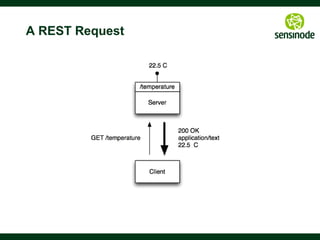
A REST Request
14
CoAP: Constrained Application Protocol
15
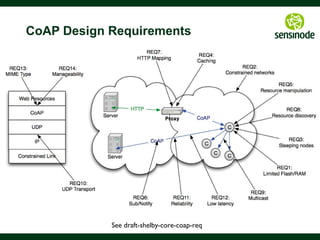
CoAP Design Requirements
16
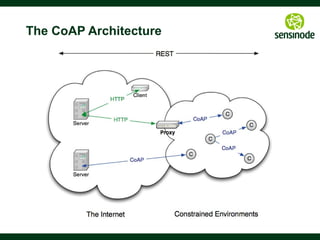
The CoAP Architecture
17
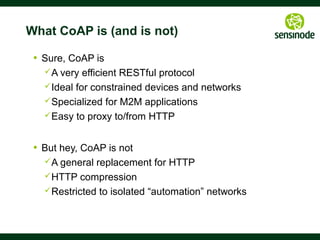
What CoAP is (and is not)
§  Sure, CoAP is
§  A very efficient RESTful protocol
§  Ideal for constrained devices and networks
§  Specialized for M2M applications
§  Easy to proxy to/from HTTP
§  But hey, CoAP is not
§  A general replacement for HTTP
§  HTTP compression
§  Restricted to isolated “automation” networks
18
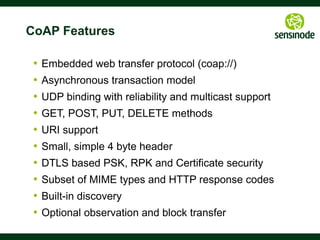
CoAP Features
§  Embedded web transfer protocol (coap://)
§  Asynchronous transaction model
§  UDP binding with reliability and multicast support
§  GET, POST, PUT, DELETE methods
§  URI support
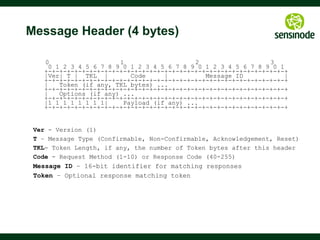
§  Small, simple 4 byte header
§  DTLS based PSK, RPK and Certificate security
§  Subset of MIME types and HTTP response codes
§  Built-in discovery
§  Optional observation and block transfer
19
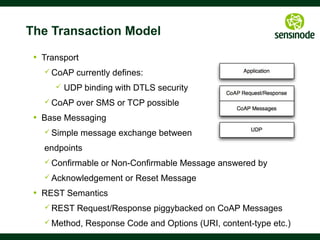
Transaction Model
§  Transport
§  CoAP currently defines:
§  UDP binding with DTLS security
§  CoAP over SMS or TCP possible
§  Base Messaging
§  Simple message exchange between endpoints
§  Confirmable or Non-Confirmable Message answered by Acknowledgement or Reset Message
§  REST Semantics
§  REST Request/Response piggybacked on CoAP Messages
§  Method, Response Code and Options (URI, content-type etc.)
20
Message Header (4 bytes)
21
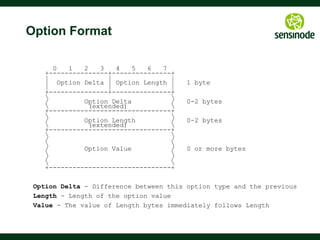
Option Format
22
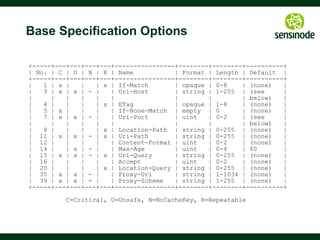
Base Specification Options
23
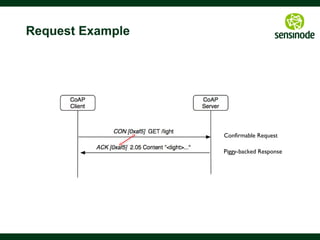
Request Example
Piggy-backed Response	

Confirmable Request
24
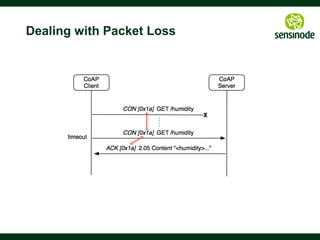
Dealing with Packet Loss
25
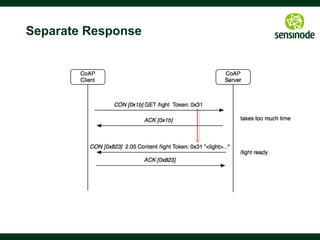
Separate Response
26
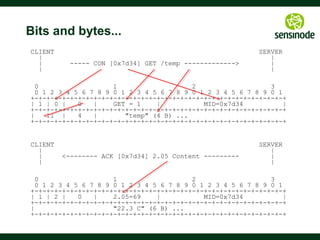
Bits and bytes...
27
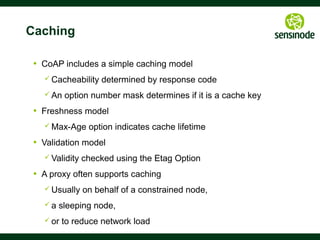
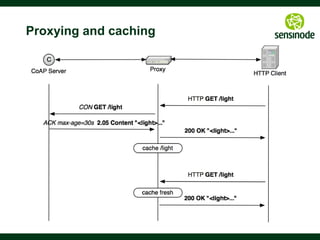
Caching
§  CoAP includes a simple caching model
§  Cacheability determined by response code
§  An option number mask determines if it is a cache key
§  Freshness model
§  Max-Age option indicates cache lifetime
§  Validation model
§  Validity checked using the Etag Option
§  A proxy often supports caching
§  Usually on behalf of a constrained node,
§  a sleeping node,
§  or to reduce network load
28
Proxying and caching
29
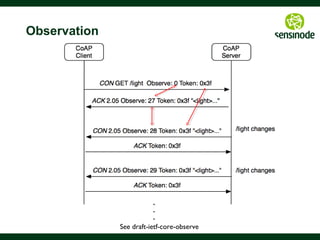
Observation
See draft-ietf-core-observe
30
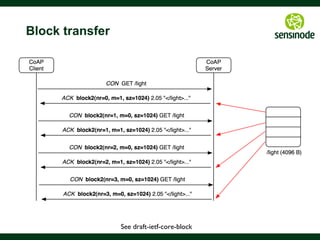
Block transfer
See draft-ietf-core-block
31
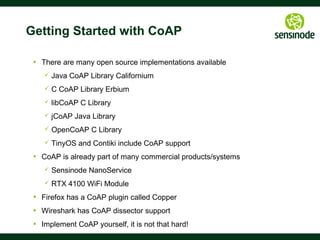
Getting Started with CoAP
§  There are many open source implementations available
§  mbed includes CoAP support
§  Java CoAP Library Californium
§  C CoAP Library Erbium
§  libCoAP C Library
§  jCoAP Java Library
§  OpenCoAP C Library
§  TinyOS and Contiki include CoAP support
§  CoAP is already part of many commercial products/systems
§  ARM Sensinode NanoService
§  RTX 4100 WiFi Module
§  Firefox has a CoAP plugin called Copper
§  Wireshark has CoAP dissector support
§  Implement CoAP yourself, it is not that hard!
32
Discovery & Semantics
33
What is Web Linking?
§  Links have been around a long time
§  Web Linking formalizes links with defined relations, typed links
§  HTML and Atom have allow links
§  RFC5988 defines a framework for Web Linking
§  Combines and expands the Atom and HTML relation types
§  Defines a unified typed link concept
§  A link can be serialized in any number of formats
§  RFC5988 revives the HTTP Link Header and defines its format
§  Atom and HTML are equivalent serializations
34
What is Web Linking?
§  A type link consists of:
§  Context URI – What the link is from
§  Relation Type – Indicates the semantics of the link
§  Target URI – What the link is too
§  Attributes – Key value pairs describing the link or its target
§  Relations include e.g. copyright, author, chapter, service etc.
§  Attributes include e.g. language, media type, title etc.
§  Example in HTTP Link Header format:
Link: <http://example.com/TheBook/chapter2>; rel="previous"; title="previous
chapter" !
35
Resource Discovery
§  Service Discovery
§  What services are available in the first place?
§  Goal of finding the IP address, port and protocol
§  Usually performed by e.g. DNS-SD when DNS is available
§  Resource Discovery
§  What are the Web resources I am interested in?
§  Goal of finding URIs
§  Performed using Web Linking or some REST interface
§  CoRE Link Format is designed to enable resource discovery
36
CoRE Link Format
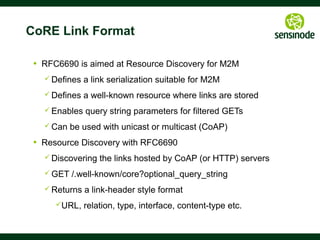
§  RFC6690 is aimed at Resource Discovery for M2M
§  Defines a link serialization suitable for M2M
§  Defines a well-known resource where links are stored
§  Enables query string parameters for filtered GETs
§  Can be used with unicast or multicast (CoAP)
§  Resource Discovery with RFC6690
§  Discovering the links hosted by CoAP (or HTTP) servers
§  GET /.well-known/core?optional_query_string
§  Returns a link-header style format
§  URL, relation, type, interface, content-type etc.
37
CoRE Resource Discovery
!
!
!
!
!
!
!
</dev/bat>;obs;rt="ipso:dev-bat";ct="0",!
</dev/mdl>;rt="ipso:dev-mdl";ct="0",!
</dev/mfg>;rt="ipso:dev-mfg";ct="0”,!
</pwr/0/rel>;obs;rt="ipso:pwr-rel";ct="0",!
</pwr/0/w>;obs;rt="ipso:pwr-w";ct="0",!
</sen/temp>;obs;rt="ucum:Cel";ct="0"!
38
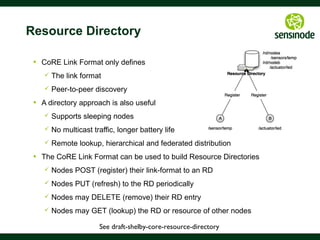
Resource Directory
§  CoRE Link Format only defines
§  The link format
§  Peer-to-peer discovery
§  A directory approach is also useful
§  Supports sleeping nodes
§  No multicast traffic, longer battery life
§  Remote lookup, hierarchical and federated distribution
§  The CoRE Link Format can be used to build Resource Directories
§  Nodes POST (register) their link-format to an RD
§  Nodes PUT (refresh) to the RD periodically
§  Nodes may DELETE (remove) their RD entry
§  Nodes may GET (lookup) the RD or resource of other nodes
See draft-ietf-core-resource-directory
39
Resource Directory
See draft-ietf-core-resource-directory
40
How to get Semantic?
§  So how to use CoRE in real applications?
§  Resources need meaningful naming (rt=)
§  A resource needs an interface (if=)
§  See [draft-vial-core-link-format-wadl] on using WADL for this
§  A payload needs a format (EXI, JSON etc.)
§  Deployment or industry specific today
§  oBIX, SensorML, EEML, sMAP etc.
§  SenML is a promising format [draft-jennings-senml]
§  CBOR is a standard for binary JSON [RFC7049]
§  Promising data semantics for use with CoAP
§  OMA Lightweight M2M [http://j.mp/lwm2m]
§  IPSO Objects [http://www.ipso-alliance.org/smart-object-committee-charter]
§  CoRE Interfaces [draft-ietf-core-interfaces]
41
CoRE Link Format Semantics
§  RFC6690 = Simple semantics for machines
§  IANA registry for rt= and if= parameters
§  Resource Type (rt=)
§  What is this resource and what is it for?
§  e.g. Device Model could be rt=“ipso.dev.mdl”
§  Interface Description (if=)
§  How do I access this resource?
§  e.g. Sensor resource accessible with GET if=“core.s”
§  Content Type (ct=)
§  What is the data format of the resource payloads?
§  e.g. text/plain (0)
42
CoRE Interfaces
§  CoRE Interfaces [draft-ietf-core-interfaces]
§  A paradigm for REST profiles made up of function sets
§  Simple interface types
!

ARM CoAP Tutorial

  • 1.
    1 ARM IoT Tutorial ZachShelby April 30th, 2014 CoAP: The Web of Things Protocol
  • 2.
  • 3.
    3 3 M2M Internet ofThings Little Data Big Data Web Evolution from M2M to IoT The Web Things Services
  • 4.
    4 CoAP:The Web ofThings Protocol §  Open IETF Standard §  Compact 4-byte Header §  UDP, SMS, (TCP) Support §  Strong DTLS Security §  Asynchronous Subscription §  Built-in Discovery
  • 5.
    5 From Web Applicationsto IoT Nodes Web Application 1000s of bytes HTTP IP TLS / TCP DTLS / UDP Binary Web Object CoAP IP 100s bytes 10s of bytes IoT Backhaul IoT Node Network Proxy Router Web Object DTLS / UDP Binary Web Object CoAP 6LoWPAN
  • 6.
    6 CoAP is OneKey IoT Standard Local Network Protocols, Security Application ZigBee IP ZigBee NANBT Smart IP TLS Based SecurityWeb: CoAP & HTTP Lightweight M2M Application Objects ZigBee Web Objects Mature New ZigBee IP 1.X CoRE 6LoWPAN
  • 7.
  • 8.
  • 9.
  • 10.
  • 11.
    11 An HTTP Request SeeRFC2616 - Hypertext Transfer Protocol v1.1
  • 12.
  • 13.
  • 14.
  • 15.
  • 16.
  • 17.
    17 What CoAP is(and is not) §  Sure, CoAP is §  A very efficient RESTful protocol §  Ideal for constrained devices and networks §  Specialized for M2M applications §  Easy to proxy to/from HTTP §  But hey, CoAP is not §  A general replacement for HTTP §  HTTP compression §  Restricted to isolated “automation” networks
  • 18.
    18 CoAP Features §  Embeddedweb transfer protocol (coap://) §  Asynchronous transaction model §  UDP binding with reliability and multicast support §  GET, POST, PUT, DELETE methods §  URI support §  Small, simple 4 byte header §  DTLS based PSK, RPK and Certificate security §  Subset of MIME types and HTTP response codes §  Built-in discovery §  Optional observation and block transfer
  • 19.
    19 Transaction Model §  Transport § CoAP currently defines: §  UDP binding with DTLS security §  CoAP over SMS or TCP possible §  Base Messaging §  Simple message exchange between endpoints §  Confirmable or Non-Confirmable Message answered by Acknowledgement or Reset Message §  REST Semantics §  REST Request/Response piggybacked on CoAP Messages §  Method, Response Code and Options (URI, content-type etc.)
  • 20.
  • 21.
  • 22.
  • 23.
  • 24.
  • 25.
  • 26.
  • 27.
    27 Caching §  CoAP includesa simple caching model §  Cacheability determined by response code §  An option number mask determines if it is a cache key §  Freshness model §  Max-Age option indicates cache lifetime §  Validation model §  Validity checked using the Etag Option §  A proxy often supports caching §  Usually on behalf of a constrained node, §  a sleeping node, §  or to reduce network load
  • 28.
  • 29.
  • 30.
  • 31.
    31 Getting Started withCoAP §  There are many open source implementations available §  mbed includes CoAP support §  Java CoAP Library Californium §  C CoAP Library Erbium §  libCoAP C Library §  jCoAP Java Library §  OpenCoAP C Library §  TinyOS and Contiki include CoAP support §  CoAP is already part of many commercial products/systems §  ARM Sensinode NanoService §  RTX 4100 WiFi Module §  Firefox has a CoAP plugin called Copper §  Wireshark has CoAP dissector support §  Implement CoAP yourself, it is not that hard!
  • 32.
  • 33.
    33 What is WebLinking? §  Links have been around a long time §  Web Linking formalizes links with defined relations, typed links §  HTML and Atom have allow links §  RFC5988 defines a framework for Web Linking §  Combines and expands the Atom and HTML relation types §  Defines a unified typed link concept §  A link can be serialized in any number of formats §  RFC5988 revives the HTTP Link Header and defines its format §  Atom and HTML are equivalent serializations
  • 34.
    34 What is WebLinking? §  A type link consists of: §  Context URI – What the link is from §  Relation Type – Indicates the semantics of the link §  Target URI – What the link is too §  Attributes – Key value pairs describing the link or its target §  Relations include e.g. copyright, author, chapter, service etc. §  Attributes include e.g. language, media type, title etc. §  Example in HTTP Link Header format: Link: <http://example.com/TheBook/chapter2>; rel="previous"; title="previous chapter" !
  • 35.
    35 Resource Discovery §  ServiceDiscovery §  What services are available in the first place? §  Goal of finding the IP address, port and protocol §  Usually performed by e.g. DNS-SD when DNS is available §  Resource Discovery §  What are the Web resources I am interested in? §  Goal of finding URIs §  Performed using Web Linking or some REST interface §  CoRE Link Format is designed to enable resource discovery
  • 36.
    36 CoRE Link Format § RFC6690 is aimed at Resource Discovery for M2M §  Defines a link serialization suitable for M2M §  Defines a well-known resource where links are stored §  Enables query string parameters for filtered GETs §  Can be used with unicast or multicast (CoAP) §  Resource Discovery with RFC6690 §  Discovering the links hosted by CoAP (or HTTP) servers §  GET /.well-known/core?optional_query_string §  Returns a link-header style format §  URL, relation, type, interface, content-type etc.
  • 37.
  • 38.
    38 Resource Directory §  CoRELink Format only defines §  The link format §  Peer-to-peer discovery §  A directory approach is also useful §  Supports sleeping nodes §  No multicast traffic, longer battery life §  Remote lookup, hierarchical and federated distribution §  The CoRE Link Format can be used to build Resource Directories §  Nodes POST (register) their link-format to an RD §  Nodes PUT (refresh) to the RD periodically §  Nodes may DELETE (remove) their RD entry §  Nodes may GET (lookup) the RD or resource of other nodes See draft-ietf-core-resource-directory
  • 39.
  • 40.
    40 How to getSemantic? §  So how to use CoRE in real applications? §  Resources need meaningful naming (rt=) §  A resource needs an interface (if=) §  See [draft-vial-core-link-format-wadl] on using WADL for this §  A payload needs a format (EXI, JSON etc.) §  Deployment or industry specific today §  oBIX, SensorML, EEML, sMAP etc. §  SenML is a promising format [draft-jennings-senml] §  CBOR is a standard for binary JSON [RFC7049] §  Promising data semantics for use with CoAP §  OMA Lightweight M2M [http://j.mp/lwm2m] §  IPSO Objects [http://www.ipso-alliance.org/smart-object-committee-charter] §  CoRE Interfaces [draft-ietf-core-interfaces]
  • 41.
    41 CoRE Link FormatSemantics §  RFC6690 = Simple semantics for machines §  IANA registry for rt= and if= parameters §  Resource Type (rt=) §  What is this resource and what is it for? §  e.g. Device Model could be rt=“ipso.dev.mdl” §  Interface Description (if=) §  How do I access this resource? §  e.g. Sensor resource accessible with GET if=“core.s” §  Content Type (ct=) §  What is the data format of the resource payloads? §  e.g. text/plain (0)
  • 42.
    42 CoRE Interfaces §  CoREInterfaces [draft-ietf-core-interfaces] §  A paradigm for REST profiles made up of function sets §  Simple interface types !

Editor's Notes

  • #16 Explain the core idea of the REST paradigm and how that differs from RPC realized with e.g. SOAP. The role of WSDL and WADL in the description of web-service interfaces is also important. See Book Sections 5.3.4 and 5.4.1 for more information on web-services and 6LoWPAN.