Simple Network Management Protocol
1
Hamdamboy Urunov, a Ph.D. student.
Special Communication Research Center.,
Kookmin University
Seoul, South Korea
Contents
• SNMP versions
• SNMP architecture
• SNMP Manager and Agent Communication flow
examples
2
SNMP versions
3
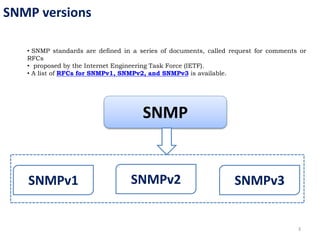
• SNMP standards are defined in a series of documents, called request for comments or
RFCs
• proposed by the Internet Engineering Task Force (IETF).
• A list of RFCs for SNMPv1, SNMPv2, and SNMPv3 is available.
SNMP
SNMPv1 SNMPv2 SNMPv3
SNMP version 1
4
SNMPv1 RFC
The SNMP Version 1 RFC is:
RFC 1157. Simple Network Management Protocol
SMIv1 RFCs also apply to all SNMPv1 entities.
MIB-II RFCs also apply to all SNMPv1 agent entities.
SNMP version 2
5
The SNMP Version 2 RFCs are:
RFC 1901. Introduction to Community-based SNMPv2
RFC 1908. Coexistence between Version 1 and Version 2 of the
Internet-standard Network Management Framework
RFC 3416. Version 2 of SNMP Protocol Operations
RFC 3417. Transport Mappings
SMIv1 and SMIv2 RFCs also apply to all SNMPv2c entities.
MIB-II RFCs also apply to all SNMPv2c agent entities.
http://www.snmp.com/protocol/snmp_rfcs.shtml
• The SNMP Version 3 RFCs are:
• RFC 3410. Introduction and Applicability Statements for Internet Standard Management Framework
• RFC 3411. An Architecture for Describing SNMP Management Frameworks
• RFC 3412. Message Processing and Dispatching
• RFC 3413. SNMP Applications
• RFC 3414. User-based Security Model
• RFC 3415. View-based Access Control Model
• RFC 3416. Version 2 of SNMP Protocol Operations
• RFC 3417. Transport Mappings
• RFC 3584. Coexistence between Version 1, Version 2, and Version 3 of the Internet-standard Network
Management Framework
• RFC 3826. The Advanced Encryption Standard (AES) Cipher Algorithm in the SNMP User-based
Security Model
• RFC 5343. Simple Network Management Protocol (SNMP) Context EngineID Discovery
• Additional SNMPv3 RFCs including the Datagram Transport Layer Security RFCs (also known as DTLS
or (D)TLS) are:
• RFC 5590. Transport Subsystem for the Simple Network Management Protocol (SNMP)
• RFC 5591. Transport Security Model for the Simple Network Management Protocol (SNMP)
• RFC 5953. Transport Layer Security (TLS) Transport Model for the Simple Network Management
Protocol (SNMP)
• SMIv1 and SMIv2 RFCs also apply to all SNMPv3 entities.
MIB-II RFCs also apply to all SNMPv3 agent entities.
6
SNMP version 3
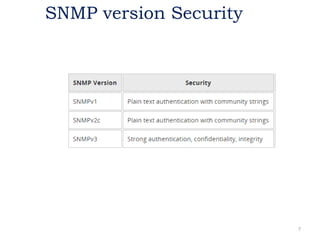
SNMP version Security
7
SNMP Architecture
http://www.learncisco.net/courses/icnd-2/network-management/snmp-v1-v2c-v3-
overview-and-configuration.html
8
SNMP uses both SMI and MIB in Internet network management. It is
an application program that allows
1. A manager to retrieve the value of an object defined in an agent.
2. A manager to store a value in an object defined in an agent.
3. An agent to send an alarm message about an abnormal situation
(such as it’s rebooting) to the manager.
SNMP
PDUs
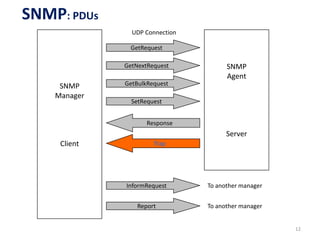
SNMPv3 defines eight types of packets (or PDUs):
GetRequest, GetNextRequest, GetBulkRequest, SetRequest, Response, Trap,
InformRequest and Report.
GetRequest: it is sent from the manager (client) to the agent (server) to retrieve
the value of a variable or a set of variables.
GetNextRequest: it is sent from the manager (client) to the agent (server) to
retrieve the value of a variable. It is mostly used to retrieve the values of the
entries in a table.
GetBulkRequest: it is sent from the manager (client) to the agent (server) to
retrieve a large amount of data. It can be used instead of above two PDUs
9
PDUs
SetRequest: it is sent from the manager (client) to the agent (server) to set (store)
a value in a variable.
Response: it is sent from an agent (server) to the manager (client) in response to
GetRequest or GetNextRequest. It contains the values of the variables
requested by manager.
Trap: the trap PDU is sent from the agent (server) to the manager (client) to
report an event, for example: if the agent is rebooted, it informs the manager
and reports the time of rebooting.
InformRequest: it is sent from one manager (client) to another remote manager
to get the value of some variables from agents under the control of the
remote manager. The remote manager responds with a Response PDU.
Report: the Report PDU is designed to report some types of errors between
managers. It is not yet in use.
SNMP
http://highered.mheducation.com/sites/0072967722/student_view0/chapter_27_quiz.html
10
11
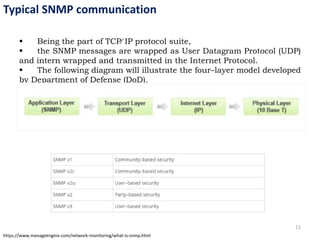
 Being the part of TCP⁄ IP protocol suite,
 the SNMP messages are wrapped as User Datagram Protocol (UDP)
and intern wrapped and transmitted in the Internet Protocol.
 The following diagram will illustrate the four–layer model developed
by Department of Defense (DoD).
Typical SNMP communication
https://www.manageengine.com/network-monitoring/what-is-snmp.html
SNMP
Manager
Client
SNMP
Agent
Server
GetRequest
GetNextRequest
GetBulkRequest
SetRequest
Response
Trap
InformRequest
Report
To another manager
To another manager
UDP Connection
SNMP: PDUs
12
13
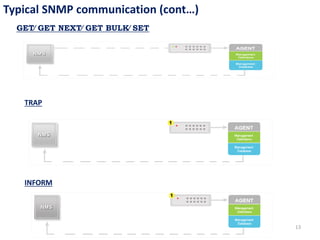
GET⁄ GET NEXT⁄ GET BULK⁄ SET
Typical SNMP communication (cont…)
TRAP
INFORM
Thank you
hamdamboy.urunov@gmail.com
14

Network Management System and Protocol usibility

  • 1.
    Simple Network ManagementProtocol 1 Hamdamboy Urunov, a Ph.D. student. Special Communication Research Center., Kookmin University Seoul, South Korea
  • 2.
    Contents • SNMP versions •SNMP architecture • SNMP Manager and Agent Communication flow examples 2
  • 3.
    SNMP versions 3 • SNMPstandards are defined in a series of documents, called request for comments or RFCs • proposed by the Internet Engineering Task Force (IETF). • A list of RFCs for SNMPv1, SNMPv2, and SNMPv3 is available. SNMP SNMPv1 SNMPv2 SNMPv3
  • 4.
    SNMP version 1 4 SNMPv1RFC The SNMP Version 1 RFC is: RFC 1157. Simple Network Management Protocol SMIv1 RFCs also apply to all SNMPv1 entities. MIB-II RFCs also apply to all SNMPv1 agent entities.
  • 5.
    SNMP version 2 5 TheSNMP Version 2 RFCs are: RFC 1901. Introduction to Community-based SNMPv2 RFC 1908. Coexistence between Version 1 and Version 2 of the Internet-standard Network Management Framework RFC 3416. Version 2 of SNMP Protocol Operations RFC 3417. Transport Mappings SMIv1 and SMIv2 RFCs also apply to all SNMPv2c entities. MIB-II RFCs also apply to all SNMPv2c agent entities. http://www.snmp.com/protocol/snmp_rfcs.shtml
  • 6.
    • The SNMPVersion 3 RFCs are: • RFC 3410. Introduction and Applicability Statements for Internet Standard Management Framework • RFC 3411. An Architecture for Describing SNMP Management Frameworks • RFC 3412. Message Processing and Dispatching • RFC 3413. SNMP Applications • RFC 3414. User-based Security Model • RFC 3415. View-based Access Control Model • RFC 3416. Version 2 of SNMP Protocol Operations • RFC 3417. Transport Mappings • RFC 3584. Coexistence between Version 1, Version 2, and Version 3 of the Internet-standard Network Management Framework • RFC 3826. The Advanced Encryption Standard (AES) Cipher Algorithm in the SNMP User-based Security Model • RFC 5343. Simple Network Management Protocol (SNMP) Context EngineID Discovery • Additional SNMPv3 RFCs including the Datagram Transport Layer Security RFCs (also known as DTLS or (D)TLS) are: • RFC 5590. Transport Subsystem for the Simple Network Management Protocol (SNMP) • RFC 5591. Transport Security Model for the Simple Network Management Protocol (SNMP) • RFC 5953. Transport Layer Security (TLS) Transport Model for the Simple Network Management Protocol (SNMP) • SMIv1 and SMIv2 RFCs also apply to all SNMPv3 entities. MIB-II RFCs also apply to all SNMPv3 agent entities. 6 SNMP version 3
  • 7.
  • 8.
    SNMP Architecture http://www.learncisco.net/courses/icnd-2/network-management/snmp-v1-v2c-v3- overview-and-configuration.html 8 SNMP usesboth SMI and MIB in Internet network management. It is an application program that allows 1. A manager to retrieve the value of an object defined in an agent. 2. A manager to store a value in an object defined in an agent. 3. An agent to send an alarm message about an abnormal situation (such as it’s rebooting) to the manager.
  • 9.
    SNMP PDUs SNMPv3 defines eighttypes of packets (or PDUs): GetRequest, GetNextRequest, GetBulkRequest, SetRequest, Response, Trap, InformRequest and Report. GetRequest: it is sent from the manager (client) to the agent (server) to retrieve the value of a variable or a set of variables. GetNextRequest: it is sent from the manager (client) to the agent (server) to retrieve the value of a variable. It is mostly used to retrieve the values of the entries in a table. GetBulkRequest: it is sent from the manager (client) to the agent (server) to retrieve a large amount of data. It can be used instead of above two PDUs 9
  • 10.
    PDUs SetRequest: it issent from the manager (client) to the agent (server) to set (store) a value in a variable. Response: it is sent from an agent (server) to the manager (client) in response to GetRequest or GetNextRequest. It contains the values of the variables requested by manager. Trap: the trap PDU is sent from the agent (server) to the manager (client) to report an event, for example: if the agent is rebooted, it informs the manager and reports the time of rebooting. InformRequest: it is sent from one manager (client) to another remote manager to get the value of some variables from agents under the control of the remote manager. The remote manager responds with a Response PDU. Report: the Report PDU is designed to report some types of errors between managers. It is not yet in use. SNMP http://highered.mheducation.com/sites/0072967722/student_view0/chapter_27_quiz.html 10
  • 11.
    11  Being thepart of TCP⁄ IP protocol suite,  the SNMP messages are wrapped as User Datagram Protocol (UDP) and intern wrapped and transmitted in the Internet Protocol.  The following diagram will illustrate the four–layer model developed by Department of Defense (DoD). Typical SNMP communication https://www.manageengine.com/network-monitoring/what-is-snmp.html
  • 12.
  • 13.
    13 GET⁄ GET NEXT⁄GET BULK⁄ SET Typical SNMP communication (cont…) TRAP INFORM
  • 14.