THE COMPUTER AS THE
TEACHER’S TOOL
JODILYN M. ALCALA
KHAREN ANTIVO
REYJHON ALCONTIN
Philippine Electronics and Communication Institute
of Technology (PECIT)
BUTUAN CITY
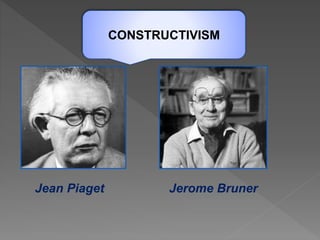
CONSTRUCTIVISM
Jean Piaget Jerome Bruner
Was introduced by Piaget (1981)
and Bruner(1990). They gave
stress to KNOWLEDGE
DISCOVERY of new meaning/
concepts/ principles in the
learning process.
 While knowledge is constructed by the individual
learner in the constructivism , knowledge can also
socially constructed.
 SOCIAL CONSTRUCTIVISM is an effort to show
that the construction of knowledge is governed by
social, historical and cultural context.
 The Psychologist VYGOTSKY stressed that
learning is affected by Social Influences. He
suggested the interactive process in learning.
 In Addition, DEWEY sees language as a medium for
social coordination and Adaption. For Dewey human
learning is really human languaging.
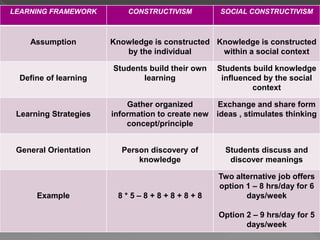
LEARNING FRAMEWORK CONSTRUCTIVISM SOCIAL CONSTRUCTIVISM
Assumption Knowledge is constructed
by the individual
Knowledge is constructed
within a social context
Define of learning
Students build their own
learning
Students build knowledge
influenced by the social
context
Learning Strategies
Gather organized
information to create new
concept/principle
Exchange and share form
ideas , stimulates thinking
General Orientation Person discovery of
knowledge
Students discuss and
discover meanings
Example 8 * 5 – 8 + 8 + 8 + 8 + 8
Two alternative job offers
option 1 – 8 hrs/day for 6
days/week
Option 2 – 9 hrs/day for 5
days/week
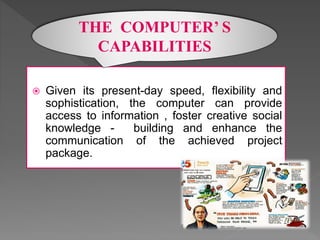
 Given its present-day speed, flexibility and
sophistication, the computer can provide
access to information , foster creative social
knowledge - building and enhance the
communication of the achieved project
package.
THE COMPUTER’ S
CAPABILITIES
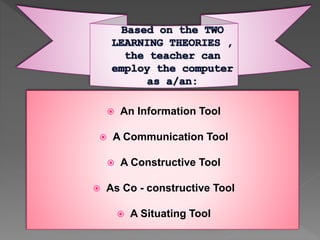
 An Information Tool
 A Communication Tool
 A Constructive Tool
 As Co - constructive Tool
 A Situating Tool
 The computer can provide vast amounts of
information in various forms, such as text ,
graphics, sound, and video.
 The internet itself provide s an enormous
database from which user can access global
information resources that includes the latest
news, weather Forecast, airline schedule,
sports development, entertainment news and
features. As well as educational information
directly useful to learners.
 The computer itself can be use
for manipulating information,
visualizing ones understanding
and building new knowledge.
CONSTRUCTIVE
TOOL
CO – CONTRUCTIVIST TOOL
Students can use co-constructivist tools
to work cooperatively and construct a shared
understanding of new knowledge.
The Computer - Supported Intentional
Learning Environments (CSILE) is an example
of an integrated environment developed by
Ontario Institute for studies in Education.
Manifest in the students-generated
database are higher level thinking processes-
explaining, problem solving/finding , expertise
and development , literacy improvement.
 Means of virtual reality (RS)
extension systems, the computer can
create 3-D images on display to give
the user the feeling that are
situated in a virtual environment.
 Multi- User domains or Dungeons
(MUDs), MUD Object – Oriented (MOOs)
and Multi-User Shared hallucination
(MUSHs) are examples of situating
systems.
SITUATING TOOL
Educational Technology 2 ... LESSON 11 THE COMPUTER AS THE TEACHER'S TOOL

Educational Technology 2 ... LESSON 11 THE COMPUTER AS THE TEACHER'S TOOL

  • 1.
    THE COMPUTER ASTHE TEACHER’S TOOL JODILYN M. ALCALA KHAREN ANTIVO REYJHON ALCONTIN Philippine Electronics and Communication Institute of Technology (PECIT) BUTUAN CITY
  • 2.
  • 3.
    Was introduced byPiaget (1981) and Bruner(1990). They gave stress to KNOWLEDGE DISCOVERY of new meaning/ concepts/ principles in the learning process.
  • 4.
     While knowledgeis constructed by the individual learner in the constructivism , knowledge can also socially constructed.  SOCIAL CONSTRUCTIVISM is an effort to show that the construction of knowledge is governed by social, historical and cultural context.  The Psychologist VYGOTSKY stressed that learning is affected by Social Influences. He suggested the interactive process in learning.  In Addition, DEWEY sees language as a medium for social coordination and Adaption. For Dewey human learning is really human languaging.
  • 5.
    LEARNING FRAMEWORK CONSTRUCTIVISMSOCIAL CONSTRUCTIVISM Assumption Knowledge is constructed by the individual Knowledge is constructed within a social context Define of learning Students build their own learning Students build knowledge influenced by the social context Learning Strategies Gather organized information to create new concept/principle Exchange and share form ideas , stimulates thinking General Orientation Person discovery of knowledge Students discuss and discover meanings Example 8 * 5 – 8 + 8 + 8 + 8 + 8 Two alternative job offers option 1 – 8 hrs/day for 6 days/week Option 2 – 9 hrs/day for 5 days/week
  • 6.
     Given itspresent-day speed, flexibility and sophistication, the computer can provide access to information , foster creative social knowledge - building and enhance the communication of the achieved project package. THE COMPUTER’ S CAPABILITIES
  • 7.
     An InformationTool  A Communication Tool  A Constructive Tool  As Co - constructive Tool  A Situating Tool
  • 8.
     The computercan provide vast amounts of information in various forms, such as text , graphics, sound, and video.  The internet itself provide s an enormous database from which user can access global information resources that includes the latest news, weather Forecast, airline schedule, sports development, entertainment news and features. As well as educational information directly useful to learners.
  • 9.
     The computeritself can be use for manipulating information, visualizing ones understanding and building new knowledge. CONSTRUCTIVE TOOL
  • 10.
    CO – CONTRUCTIVISTTOOL Students can use co-constructivist tools to work cooperatively and construct a shared understanding of new knowledge. The Computer - Supported Intentional Learning Environments (CSILE) is an example of an integrated environment developed by Ontario Institute for studies in Education. Manifest in the students-generated database are higher level thinking processes- explaining, problem solving/finding , expertise and development , literacy improvement.
  • 11.
     Means ofvirtual reality (RS) extension systems, the computer can create 3-D images on display to give the user the feeling that are situated in a virtual environment.  Multi- User domains or Dungeons (MUDs), MUD Object – Oriented (MOOs) and Multi-User Shared hallucination (MUSHs) are examples of situating systems. SITUATING TOOL