Constructivist Approaches
To Teaching
What is constructivism?
● It is a system of explanation of how individuals learn. It is a theory of how the learner
constructs knowledge from experience, which is unique to each individual.
● It considers knowledge as a constructed entity and consists of what individuals create
and express.
● All knowledge is tentative, subjective and personal, since individuals make their own
meaning from their beliefs and experiences.
● Individuals create their own understanding, based on the interaction of what they
already know and believe, and the phenomena or ideas with which they come into
contact.
● Here, learners actively restructure knowledge in highly individualized ways, based on
intellectual configurations on existing knowledge and formal instructional
experiences.
The constructivism ideas of learning can be broadly grouped into two:
1. Those who focus on the individual acting as sole agent in the process of constructing and
reconstructing meaning.
○ This view of learning emphasises that learning occurs when a learner actively constructs a
knowledge representation.
○ Here, the learner constructs his/her own understanding of the world by reflecting on his/her
experiences. In the learning process, the learner selects, organises and integrates information to
construct knowledge
○ Here, the learner is an active player in the process of constructing knowledge.
○ Therefore, instructions are to be provided to the learner with appropriate experiences with a view
that enables them to construct knowledge.
2. Others focus on the socio-cultural context of the individual, which influences the construction of
knowledge.
○ In this view, learning occurs in a socio-constructional context of the learner, with social interaction.
○ It is also referred to as ‘situated cognition’.
○ The socio-cultural setting impact the students as they change their ideas. In other words, learning
has a social and cultural aspect.
○ The cultural and the social background of students, use of language, how meaning is derived from
various contexts play a role in the students’ construction of ideas. These aspects are
‘fundamental to any learning’ and ‘knowledge construction’.
Summary of constructivist ideas about knowledge and
learning
● Knowledge is not fully known and fixed. Knowledge is
somewhat personal.
● There is a real world that we experience, but many ways to
structure the world.
● The learner plays an active role in the personal creation of
knowledge through experiences.
● Learning is a social process in which the learner constructs
meaning that is influenced by the interaction of prior
knowledge and new learning events.
Schools of constructivism
There are different schools of constructivism:
● Radical constructivism
● Relational constructivism
● Social constructivism
● Communal constructivism
[https://en.wikipedia.org/wiki/Constructivism_(philosophy_of_education)]
Vygotsky’s Contribution
Vygotsky emphasized that learner begin learning from their surroundings, and from
people around, and from their social world.
He believed that our social world is the source of all concepts, ideas, facts, skills and
attitudes.
All personal psychological processes begin as social processes shared among people.
According to Vygotsky, there are three ways of learning:
1. Imitative learning where one person tries to imitate the other.
2. Instructed learning where learners internalise the instructions of the teacher
and use these to control their learning.
3. Collaborative learning where a group of peers strives to understand each
other and through their interactions, learning occurs.
Vygotsky thought that through instruction, learners would develop the skills
associated with living successfully in the culture.
He gave more importance to collaborative activity between learners and more
matured members of the society, through which children will be able to master
activities and think in ways that have meaning in their culture.
His concept of Zone of Proximal Development (ZPD) explains how this kind of
learning occurs.
ZPD
● Vygotsky recognised that there is a gap between what
the person could do without assistance and what they
could do if some help was provided.
● He called this gap “the Zone of Proximal
Development”.
● When we provide a set of temporary supports so that
someone can complete a task, we are working in their
ZPD.
● This refers to each person’s range of potential for
learning, and emphasises that learning is culturally
shaped by the social environment.
● A learner ultimately appropriates and internalizes the
knowledge transacted through assisted performance so
that it becomes their own.
● A distance teacher instructional designer has to design
learning within this zone.
ZPD
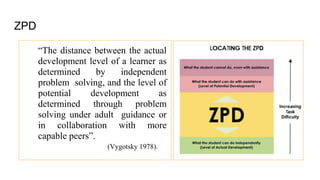
“The distance between the actual
development level of a learner as
determined by independent
problem solving, and the level of
potential development as
determined through problem
solving under adult guidance or
in collaboration with more
capable peers”.
(Vygotsky 1978).
Stages in ZPD
According to Galllimore and Tharp (1990), there are four stages in the ZPD that a learner goes through.
● First stage: In this stage, the learner’s performance is assisted by more capable persons such as
parents, teachers, and peers.
● Second stage: In this stage, there is less dependence on external assistance and the performance
begins to become internalised. The learners help themselves by using self-directed speech.
● Third stage: In this stage, the performance is developed, automated and fossilised. At this time
assistance from others and self-directed speech is not required. Task performance is smooth and
integrated, internalised and automated.
● Fourth stage: In this stage, deautomatization of performance takes place which leads the individual
to re enter the ZPD.
○ For example, at times, even, well learned responses are forgotten, or become rusty.
○ At these times, the individual reenters the ZPD and consciously talks through the matter
internally or seeks external assistance.
○ To this extent there is a continual movement in and out of the ZPD. Gallimore and Tharp
term this a ‘recursion’.
Project based learning
● It is an experience centred strategy related to life situation
● Focuses on socialisation of the child, and holistic development
of the child(cog, affect, psycho)
● Evolved from pragmatist philosophy (Pierce, John Dewey,
Kilpatrick)
What is a project?
● ‘A wholehearted purposeful activity proceeding in a social
environment’
-Kilpatrick
Types of projects
1. Constructive: learner construct something related to
social life.
2. Artistics: projects related to aesthetic fields of life,
Music, drawing, dace, painting, culture
3. Problem solving: given to solve problems related to
life or any subject
4. Group project: Done in groups
Principles of project method
1. Principle of Utility:
2. Principle of readiness
3. Learning by doing
4. Socialisation
5. Interdisciplinary approach
Basic elements of projects method
1. Spontaneity
2. Purpose
3. Significance
4. Interest or motivation
Merits and demerits
Advantages:
● Develop social values
● Opportunities for correlating different elements of social sciences
● Transfer of learning or training
● Promote effective learning
Disadvantages
● Difficult to plan projects for all students
● Time consuming and costly
● Difficulty in supervising the planning and execution
Suggestions to improve
1. Use it as a supplementary method of teaching
2. Appoint students leaders for supervising the projects
3. Fix time limit for completion
4. Link with assessment/evaluation if necessary
5. Use rubrics for assessment of projects

Constructivist Approaches To Teaching.pptx

  • 1.
  • 2.
    What is constructivism? ●It is a system of explanation of how individuals learn. It is a theory of how the learner constructs knowledge from experience, which is unique to each individual. ● It considers knowledge as a constructed entity and consists of what individuals create and express. ● All knowledge is tentative, subjective and personal, since individuals make their own meaning from their beliefs and experiences. ● Individuals create their own understanding, based on the interaction of what they already know and believe, and the phenomena or ideas with which they come into contact. ● Here, learners actively restructure knowledge in highly individualized ways, based on intellectual configurations on existing knowledge and formal instructional experiences.
  • 3.
    The constructivism ideasof learning can be broadly grouped into two: 1. Those who focus on the individual acting as sole agent in the process of constructing and reconstructing meaning. ○ This view of learning emphasises that learning occurs when a learner actively constructs a knowledge representation. ○ Here, the learner constructs his/her own understanding of the world by reflecting on his/her experiences. In the learning process, the learner selects, organises and integrates information to construct knowledge ○ Here, the learner is an active player in the process of constructing knowledge. ○ Therefore, instructions are to be provided to the learner with appropriate experiences with a view that enables them to construct knowledge. 2. Others focus on the socio-cultural context of the individual, which influences the construction of knowledge. ○ In this view, learning occurs in a socio-constructional context of the learner, with social interaction. ○ It is also referred to as ‘situated cognition’. ○ The socio-cultural setting impact the students as they change their ideas. In other words, learning has a social and cultural aspect. ○ The cultural and the social background of students, use of language, how meaning is derived from various contexts play a role in the students’ construction of ideas. These aspects are ‘fundamental to any learning’ and ‘knowledge construction’.
  • 4.
    Summary of constructivistideas about knowledge and learning ● Knowledge is not fully known and fixed. Knowledge is somewhat personal. ● There is a real world that we experience, but many ways to structure the world. ● The learner plays an active role in the personal creation of knowledge through experiences. ● Learning is a social process in which the learner constructs meaning that is influenced by the interaction of prior knowledge and new learning events.
  • 5.
    Schools of constructivism Thereare different schools of constructivism: ● Radical constructivism ● Relational constructivism ● Social constructivism ● Communal constructivism [https://en.wikipedia.org/wiki/Constructivism_(philosophy_of_education)]
  • 6.
    Vygotsky’s Contribution Vygotsky emphasizedthat learner begin learning from their surroundings, and from people around, and from their social world. He believed that our social world is the source of all concepts, ideas, facts, skills and attitudes. All personal psychological processes begin as social processes shared among people. According to Vygotsky, there are three ways of learning: 1. Imitative learning where one person tries to imitate the other. 2. Instructed learning where learners internalise the instructions of the teacher and use these to control their learning. 3. Collaborative learning where a group of peers strives to understand each other and through their interactions, learning occurs.
  • 7.
    Vygotsky thought thatthrough instruction, learners would develop the skills associated with living successfully in the culture. He gave more importance to collaborative activity between learners and more matured members of the society, through which children will be able to master activities and think in ways that have meaning in their culture. His concept of Zone of Proximal Development (ZPD) explains how this kind of learning occurs.
  • 8.
    ZPD ● Vygotsky recognisedthat there is a gap between what the person could do without assistance and what they could do if some help was provided. ● He called this gap “the Zone of Proximal Development”. ● When we provide a set of temporary supports so that someone can complete a task, we are working in their ZPD. ● This refers to each person’s range of potential for learning, and emphasises that learning is culturally shaped by the social environment. ● A learner ultimately appropriates and internalizes the knowledge transacted through assisted performance so that it becomes their own. ● A distance teacher instructional designer has to design learning within this zone.
  • 9.
    ZPD “The distance betweenthe actual development level of a learner as determined by independent problem solving, and the level of potential development as determined through problem solving under adult guidance or in collaboration with more capable peers”. (Vygotsky 1978).
  • 10.
    Stages in ZPD Accordingto Galllimore and Tharp (1990), there are four stages in the ZPD that a learner goes through. ● First stage: In this stage, the learner’s performance is assisted by more capable persons such as parents, teachers, and peers. ● Second stage: In this stage, there is less dependence on external assistance and the performance begins to become internalised. The learners help themselves by using self-directed speech. ● Third stage: In this stage, the performance is developed, automated and fossilised. At this time assistance from others and self-directed speech is not required. Task performance is smooth and integrated, internalised and automated. ● Fourth stage: In this stage, deautomatization of performance takes place which leads the individual to re enter the ZPD. ○ For example, at times, even, well learned responses are forgotten, or become rusty. ○ At these times, the individual reenters the ZPD and consciously talks through the matter internally or seeks external assistance. ○ To this extent there is a continual movement in and out of the ZPD. Gallimore and Tharp term this a ‘recursion’.
  • 12.
    Project based learning ●It is an experience centred strategy related to life situation ● Focuses on socialisation of the child, and holistic development of the child(cog, affect, psycho) ● Evolved from pragmatist philosophy (Pierce, John Dewey, Kilpatrick) What is a project? ● ‘A wholehearted purposeful activity proceeding in a social environment’ -Kilpatrick
  • 13.
    Types of projects 1.Constructive: learner construct something related to social life. 2. Artistics: projects related to aesthetic fields of life, Music, drawing, dace, painting, culture 3. Problem solving: given to solve problems related to life or any subject 4. Group project: Done in groups
  • 14.
    Principles of projectmethod 1. Principle of Utility: 2. Principle of readiness 3. Learning by doing 4. Socialisation 5. Interdisciplinary approach
  • 15.
    Basic elements ofprojects method 1. Spontaneity 2. Purpose 3. Significance 4. Interest or motivation
  • 16.
    Merits and demerits Advantages: ●Develop social values ● Opportunities for correlating different elements of social sciences ● Transfer of learning or training ● Promote effective learning Disadvantages ● Difficult to plan projects for all students ● Time consuming and costly ● Difficulty in supervising the planning and execution
  • 17.
    Suggestions to improve 1.Use it as a supplementary method of teaching 2. Appoint students leaders for supervising the projects 3. Fix time limit for completion 4. Link with assessment/evaluation if necessary 5. Use rubrics for assessment of projects