Conceptual Framework
• The design of the curricula is student-centered, based on
spiral progression of processes, concepts and skills and
grounded in performance-based learning.
• Thus, the learner is empowered, through active involvement
and participation, to effectively correlate music and art to the
development of his/her own cultural identity and the expansion of
his/her vision of the world.
• Arts is a performance-based discipline, effective learning occurs
through active experience, participation, and performance,
creative expression, aesthetic valuation, critical response, and
interpretation.
• The skills that are developed include reading/analyzing,
listening/observing, performing, (singing, using musical
instruments, movement, acting, and playing, using different art
materials, techniques and processes, responding, composing,
and creating.
• The philosophical foundations upon which standards and
competencies are based include: A Process of Education by
Jerome Bruner, Performance-Based Learning by Cleve Miller,
Aesthetic Education by Bennett Reimer, Multiple Intelligences by
Howard Gardner, A Structure for Music Education by Ronald
Thomas, Gongs and Bamboo by Jose Maceda
• Compendium on the Humanities: Musical Arts produced by the National
Research Council of the Philippines, Cultural Dictionary for Filipinos by
Thelma Kintanar and Associates, Creative and Mental Growth by Viktor
Lowenfeld and W. Lambert Brittain, Discipline-Based Art Education by Elliot
Eisner, Encyclopedia of Philippine Arts and Tuklas Sining, bothproduced by
the Cultural Center of the Philippines.
Philosophy and Rationale for Arts
The Arts has been present since the beginning of
civilization as it is an essential means for man to live and
communicate with others. It has been used to enhance
man’s life and surroundings, to express his thoughts,
dreams, and spiritual beliefs, and to share his own and his
community’s aspirations, celebrations, and events. Arts
records, reflects, and rearranges man’s life and existence.
The 21st Century is a different world: it is
highly visual, with a proliferation of images seen
not only in static media like magazines, books,
paintings and posters. Now images are kinetic and
accessible in various media like television, outdoor
advertisements, movies, cell phones, and new
technologies like iPads, iPods, DVD players,
personal computers, and tablets.
• The focus of the K-12 Art curriculum is PHILIPPINE ART,
CULTURE and HERITAGE, appreciating the diversity of our
local artists, our arts, crafts, and indigenous materials to
strengthen the student’s identity of being Filipino, before he/she
is introduced to the art of other countries.
• The modules guide educators and provide our students with art
experiences, concepts, and processes that are presented in a
SPIRAL PROGRESSION of difficulty and depth from
Kindergarten to Grade 12.
• The approach is CHILD-CENTERED and HANDS-ON in
creating art using locally available materials. It
develops the student’s imagination and individual
expression, and his/her CRITICAL THINKING SKILLS
through inquiry into the aesthetic qualities of his
work, the work of others and of artists from the
Philippines and other parts of the world.
The Curriculum Framework of Music and Art
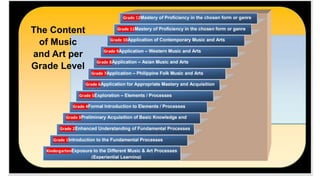
The Content
of Music
and Art per
Grade Level
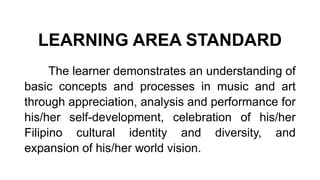
LEARNING AREA STANDARD
The learner demonstrates an understanding of
basic concepts and processes in music and art
through appreciation, analysis and performance for
his/her self-development, celebration of his/her
Filipino cultural identity and diversity, and
expansion of his/her world vision.
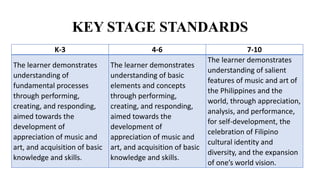
KEY STAGE STANDARDS
K-3 4-6 7-10
The learner demonstrates
understanding of
fundamental processes
through performing,
creating, and responding,
aimed towards the
development of
appreciation of music and
art, and acquisition of basic
knowledge and skills.
The learner demonstrates
understanding of basic
elements and concepts
through performing,
creating, and responding,
aimed towards the
development of
appreciation of music and
art, and acquisition of basic
knowledge and skills.
The learner demonstrates
understanding of salient
features of music and art of
the Philippines and the
world, through appreciation,
analysis, and performance,
for self-development, the
celebration of Filipino
cultural identity and
diversity, and the expansion
of one’s world vision.
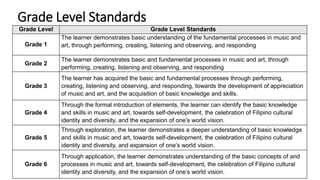
Grade Level Standards
Grade Level Grade Level Standards
Grade 1
The learner demonstrates basic understanding of the fundamental processes in music and
art, through performing, creating, listening and observing, and responding
Grade 2
The learner demonstrates basic and fundamental processes in music and art, through
performing, creating, listening and observing, and responding
Grade 3
The learner has acquired the basic and fundamental processes through performing,
creating, listening and observing, and responding, towards the development of appreciation
of music and art, and the acquisition of basic knowledge and skills.
Grade 4
Through the formal introduction of elements, the learner can identify the basic knowledge
and skills in music and art, towards self-development, the celebration of Filipino cultural
identity and diversity, and the expansion of one’s world vision.
Grade 5
Through exploration, the learner demonstrates a deeper understanding of basic knowledge
and skills in music and art, towards self-development, the celebration of Filipino cultural
identity and diversity, and expansion of one’s world vision.
Grade 6
Through application, the learner demonstrates understanding of the basic concepts of and
processes in music and art, towards self-development, the celebration of Filipino cultural
identity and diversity, and the expansion of one’s world vision.
References:
• K-12 Deped Arts curriculum guide (2016). Retrieved
https://deped.gov.ph

Teaching arts in elementary

  • 3.
    Conceptual Framework • Thedesign of the curricula is student-centered, based on spiral progression of processes, concepts and skills and grounded in performance-based learning. • Thus, the learner is empowered, through active involvement and participation, to effectively correlate music and art to the development of his/her own cultural identity and the expansion of his/her vision of the world.
  • 4.
    • Arts isa performance-based discipline, effective learning occurs through active experience, participation, and performance, creative expression, aesthetic valuation, critical response, and interpretation. • The skills that are developed include reading/analyzing, listening/observing, performing, (singing, using musical instruments, movement, acting, and playing, using different art materials, techniques and processes, responding, composing, and creating.
  • 5.
    • The philosophicalfoundations upon which standards and competencies are based include: A Process of Education by Jerome Bruner, Performance-Based Learning by Cleve Miller, Aesthetic Education by Bennett Reimer, Multiple Intelligences by Howard Gardner, A Structure for Music Education by Ronald Thomas, Gongs and Bamboo by Jose Maceda
  • 6.
    • Compendium onthe Humanities: Musical Arts produced by the National Research Council of the Philippines, Cultural Dictionary for Filipinos by Thelma Kintanar and Associates, Creative and Mental Growth by Viktor Lowenfeld and W. Lambert Brittain, Discipline-Based Art Education by Elliot Eisner, Encyclopedia of Philippine Arts and Tuklas Sining, bothproduced by the Cultural Center of the Philippines.
  • 7.
    Philosophy and Rationalefor Arts The Arts has been present since the beginning of civilization as it is an essential means for man to live and communicate with others. It has been used to enhance man’s life and surroundings, to express his thoughts, dreams, and spiritual beliefs, and to share his own and his community’s aspirations, celebrations, and events. Arts records, reflects, and rearranges man’s life and existence.
  • 8.
    The 21st Centuryis a different world: it is highly visual, with a proliferation of images seen not only in static media like magazines, books, paintings and posters. Now images are kinetic and accessible in various media like television, outdoor advertisements, movies, cell phones, and new technologies like iPads, iPods, DVD players, personal computers, and tablets.
  • 9.
    • The focusof the K-12 Art curriculum is PHILIPPINE ART, CULTURE and HERITAGE, appreciating the diversity of our local artists, our arts, crafts, and indigenous materials to strengthen the student’s identity of being Filipino, before he/she is introduced to the art of other countries. • The modules guide educators and provide our students with art experiences, concepts, and processes that are presented in a SPIRAL PROGRESSION of difficulty and depth from Kindergarten to Grade 12.
  • 10.
    • The approachis CHILD-CENTERED and HANDS-ON in creating art using locally available materials. It develops the student’s imagination and individual expression, and his/her CRITICAL THINKING SKILLS through inquiry into the aesthetic qualities of his work, the work of others and of artists from the Philippines and other parts of the world.
  • 11.
    The Curriculum Frameworkof Music and Art
  • 12.
    The Content of Music andArt per Grade Level
  • 14.
    LEARNING AREA STANDARD Thelearner demonstrates an understanding of basic concepts and processes in music and art through appreciation, analysis and performance for his/her self-development, celebration of his/her Filipino cultural identity and diversity, and expansion of his/her world vision.
  • 15.
    KEY STAGE STANDARDS K-34-6 7-10 The learner demonstrates understanding of fundamental processes through performing, creating, and responding, aimed towards the development of appreciation of music and art, and acquisition of basic knowledge and skills. The learner demonstrates understanding of basic elements and concepts through performing, creating, and responding, aimed towards the development of appreciation of music and art, and acquisition of basic knowledge and skills. The learner demonstrates understanding of salient features of music and art of the Philippines and the world, through appreciation, analysis, and performance, for self-development, the celebration of Filipino cultural identity and diversity, and the expansion of one’s world vision.
  • 16.
    Grade Level Standards GradeLevel Grade Level Standards Grade 1 The learner demonstrates basic understanding of the fundamental processes in music and art, through performing, creating, listening and observing, and responding Grade 2 The learner demonstrates basic and fundamental processes in music and art, through performing, creating, listening and observing, and responding Grade 3 The learner has acquired the basic and fundamental processes through performing, creating, listening and observing, and responding, towards the development of appreciation of music and art, and the acquisition of basic knowledge and skills. Grade 4 Through the formal introduction of elements, the learner can identify the basic knowledge and skills in music and art, towards self-development, the celebration of Filipino cultural identity and diversity, and the expansion of one’s world vision. Grade 5 Through exploration, the learner demonstrates a deeper understanding of basic knowledge and skills in music and art, towards self-development, the celebration of Filipino cultural identity and diversity, and expansion of one’s world vision. Grade 6 Through application, the learner demonstrates understanding of the basic concepts of and processes in music and art, towards self-development, the celebration of Filipino cultural identity and diversity, and the expansion of one’s world vision.
  • 18.
    References: • K-12 DepedArts curriculum guide (2016). Retrieved https://deped.gov.ph