By: Monica D’Angelo
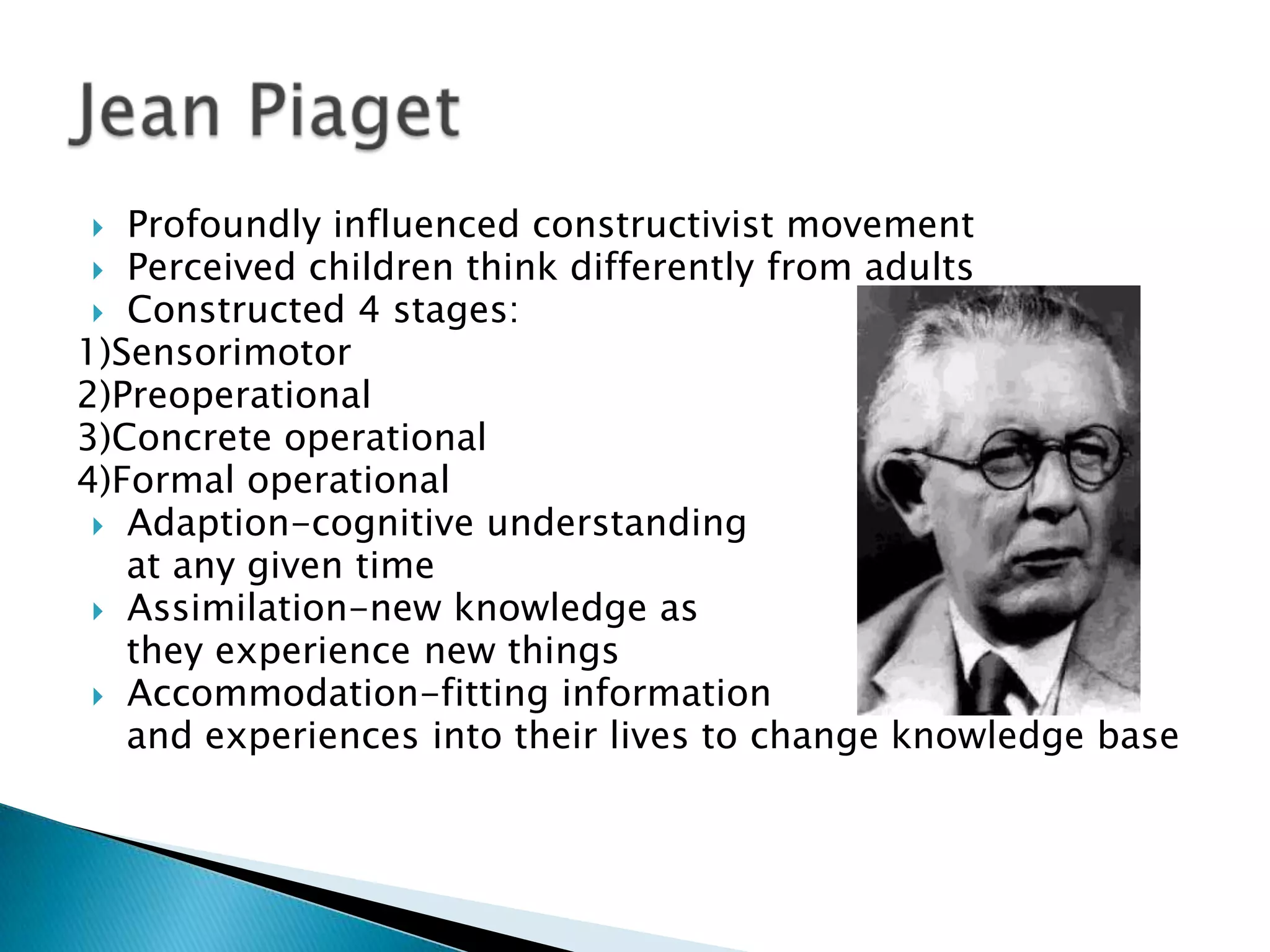
  Profoundly influenced constructivist movement
  Perceived children think differently from adults
  Constructed 4 stages:
1)Sensorimotor
2)Preoperational
3)Concrete operational
4)Formal operational
  Adaption-cognitive understanding
   at any given time
  Assimilation-new knowledge as
   they experience new things
  Accommodation-fitting information
   and experiences into their lives to change knowledge base
   Proposed learning is an active process in which the
    learner constructs new ideas or concepts based on
    current or past knowledge
   Constructive learners are participatory learners
   Cognition-individual progresses through different
    intellectual stages
   Bruner felt teacher’s role should be to encourage
    students, learning should be through discovery
   Socratic method-students learn how to analyze
    problems, think critically, and defend their position
   Spiral curriculum-Bruner felt curriculum should be
    organized in a spiral manner so students continue to
    build
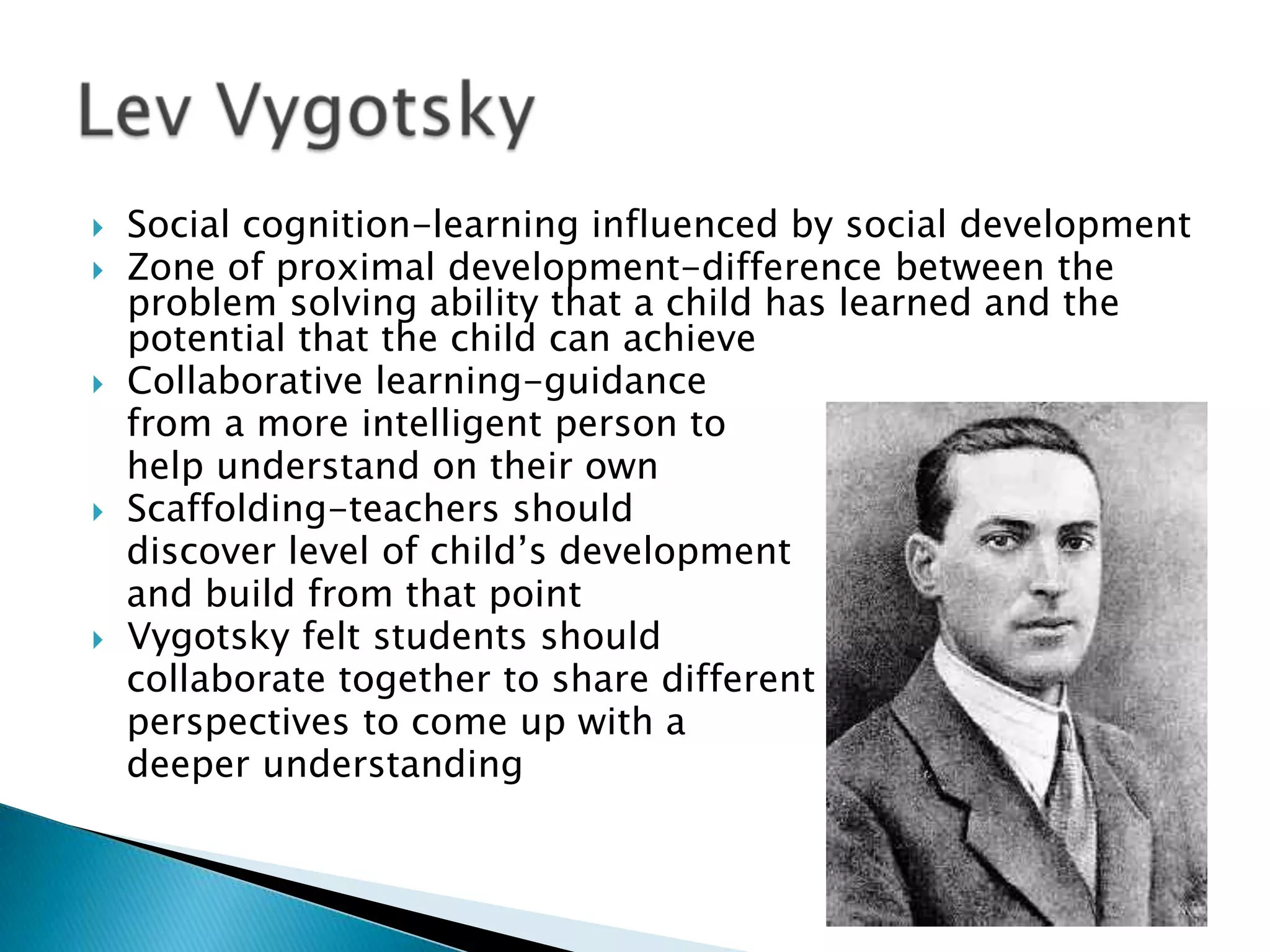
   Social cognition-learning influenced by social development
   Zone of proximal development-difference between the
    problem solving ability that a child has learned and the
    potential that the child can achieve
   Collaborative learning-guidance
    from a more intelligent person to
    help understand on their own
   Scaffolding-teachers should
    discover level of child’s development
    and build from that point
   Vygotsky felt students should
    collaborate together to share different
    perspectives to come up with a
    deeper understanding
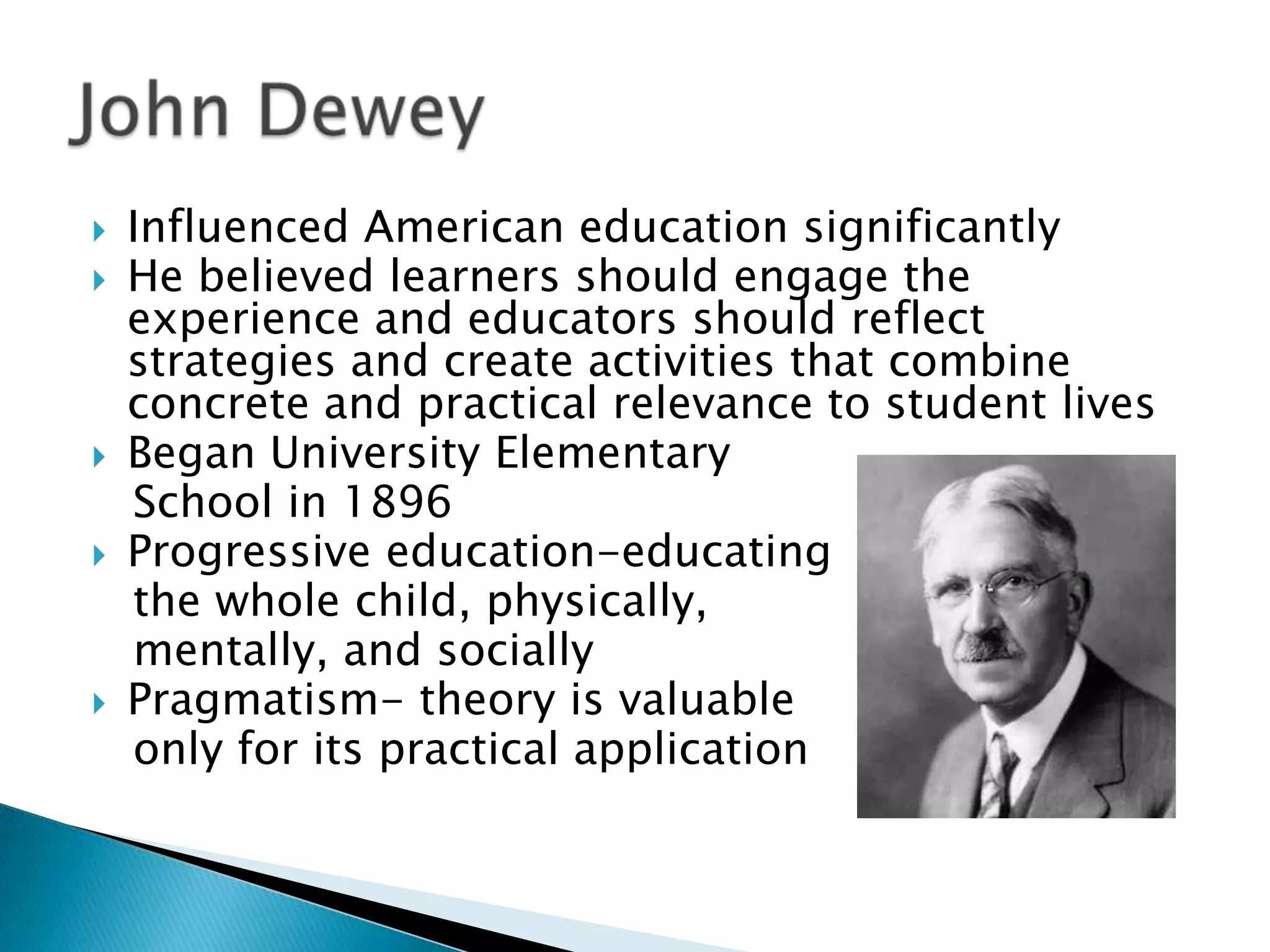
   Influenced American education significantly
   He believed learners should engage the
    experience and educators should reflect
    strategies and create activities that combine
    concrete and practical relevance to student lives
   Began University Elementary
    School in 1896
   Progressive education-educating
    the whole child, physically,
    mentally, and socially
   Pragmatism- theory is valuable
    only for its practical application
 Based on a type of learning in
 which the learner forms, or
 constructs, much of what he or
 she learns or comprehends
   Learning is an active process, as an educator
    we need to give the learners something to do
   Provide activities which engage the mind as
    well as the hands
   Group activities; our learning is intimately
    associated with our connection with other
    human beings
   Provide material that is connected to the state
    of the learner, must provide a path into the
    subject for the learner based on that learners
    previous knowledge
   Offers many strategies for the Constructivist
    learning environment
   When using Constructivist approach students
    may complete a variety of activities while
    learning about a topic which makes it easy to
    integrate technology in the classroom
   Because the Constructivist Theory relies a lot
    on social reconstruction, I would as an
    educator not make technology based lessons
    a priority
   I chose this learning process because I believe it
    is the most functional and effective in the
    classroom. I agree that learning starts when we
    are very young and that this time is very
    important because it is when we absorb the
    most. As humans we learn from our experiences
    and we build our knowledge off of what we have
    been through. As a student now, it is most
    beneficial to me when I am assigned an
    assignment and am left alone to work on it and
    my teacher is there just as a guide if I need help.
    I learn from my mistakes and grow from them.
   http://humbertoschwab.net/my-favourite-
    philosophers/john-dewey/
   http://www.nndb.com/people/359/0000940
    77/
   http://5122psychology.pbworks.com/w/page
    /992136/Lev%20Vygotsky
   Shelly, G., Gunter, G., & Gunter, R. (2012).
    Integrating technology in a connected world.
    Course Technology
   Hein, G. (1991, October 22). Institute of
    inquiry. Retrieved from
    http://www.exploratorium.edu/IFI/resources/
    constructivistlearning.html

Constructivism theory

  • 1.
  • 2.
     Profoundlyinfluenced constructivist movement  Perceived children think differently from adults  Constructed 4 stages: 1)Sensorimotor 2)Preoperational 3)Concrete operational 4)Formal operational  Adaption-cognitive understanding at any given time  Assimilation-new knowledge as they experience new things  Accommodation-fitting information and experiences into their lives to change knowledge base
  • 3.
    Proposed learning is an active process in which the learner constructs new ideas or concepts based on current or past knowledge  Constructive learners are participatory learners  Cognition-individual progresses through different intellectual stages  Bruner felt teacher’s role should be to encourage students, learning should be through discovery  Socratic method-students learn how to analyze problems, think critically, and defend their position  Spiral curriculum-Bruner felt curriculum should be organized in a spiral manner so students continue to build
  • 4.
    Social cognition-learning influenced by social development  Zone of proximal development-difference between the problem solving ability that a child has learned and the potential that the child can achieve  Collaborative learning-guidance from a more intelligent person to help understand on their own  Scaffolding-teachers should discover level of child’s development and build from that point  Vygotsky felt students should collaborate together to share different perspectives to come up with a deeper understanding
  • 5.
    Influenced American education significantly  He believed learners should engage the experience and educators should reflect strategies and create activities that combine concrete and practical relevance to student lives  Began University Elementary School in 1896  Progressive education-educating the whole child, physically, mentally, and socially  Pragmatism- theory is valuable only for its practical application
  • 6.
     Based ona type of learning in which the learner forms, or constructs, much of what he or she learns or comprehends
  • 7.
    Learning is an active process, as an educator we need to give the learners something to do  Provide activities which engage the mind as well as the hands  Group activities; our learning is intimately associated with our connection with other human beings  Provide material that is connected to the state of the learner, must provide a path into the subject for the learner based on that learners previous knowledge
  • 8.
    Offers many strategies for the Constructivist learning environment  When using Constructivist approach students may complete a variety of activities while learning about a topic which makes it easy to integrate technology in the classroom  Because the Constructivist Theory relies a lot on social reconstruction, I would as an educator not make technology based lessons a priority
  • 9.
    I chose this learning process because I believe it is the most functional and effective in the classroom. I agree that learning starts when we are very young and that this time is very important because it is when we absorb the most. As humans we learn from our experiences and we build our knowledge off of what we have been through. As a student now, it is most beneficial to me when I am assigned an assignment and am left alone to work on it and my teacher is there just as a guide if I need help. I learn from my mistakes and grow from them.
  • 10.
    http://humbertoschwab.net/my-favourite- philosophers/john-dewey/  http://www.nndb.com/people/359/0000940 77/  http://5122psychology.pbworks.com/w/page /992136/Lev%20Vygotsky
  • 11.
    Shelly, G., Gunter, G., & Gunter, R. (2012). Integrating technology in a connected world. Course Technology  Hein, G. (1991, October 22). Institute of inquiry. Retrieved from http://www.exploratorium.edu/IFI/resources/ constructivistlearning.html