We shall again look at the
   computer, but this time from
another perspective the computer
as a teacher’s handy tool. It can in
fact support the constructivist and
social constructivist paradigms of
      constructivist learning.
Was introduced by Piaget (1981) and
  Bruner (1990).
They gave stress to Knowledge Discovery
  of new meaning/concepts/principles
  in the learning process.
Various strategies have been suggested to
  foster knowledge, discovery.
   Students are engaged to apply
    discovered knowledge to new
    situations, a process for making
    their knowledge applicable to real
    life.
   Knowledge can also be socially
    constructed.
 SOCIAL CONSTRUCTIVISM
    is an effort to show that the
   construction of knowledge is
   governed by social, historical
       and cultural contexts.
   VYGOTSKY – stressed that learning
    is affected by social influences.
    Interactive process in learning, the
    more capable adult can aid or
    complement what the learner sees in a
    given class project.
   DEWEY – human learning is really
    human language that occurs when
    students socially share, build and
    agree upon meanings and knowledge.
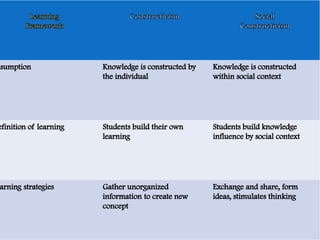
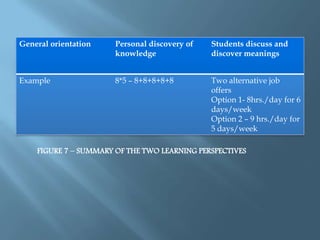
General orientation    Personal discovery of   Students discuss and
                       knowledge               discover meanings


Example                8*5 – 8+8+8+8+8         Two alternative job
                                               offers
                                               Option 1- 8hrs./day for 6
                                               days/week
                                               Option 2 – 9 hrs./day for
                                               5 days/week

    FIGURE 7 – SUMMARY OF THE TWO LEARNING PERSPECTIVES
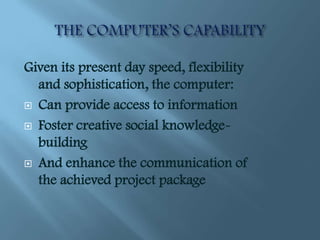
Given its present day speed, flexibility
  and sophistication, the computer:
 Can provide access to information

 Foster creative social knowledge-
  building
 And enhance the communication of
  the achieved project package
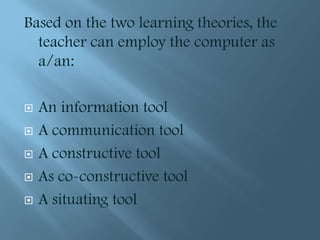
Based on the two learning theories, the
  teacher can employ the computer as
  a/an:

   An information tool
   A communication tool
   A constructive tool
   As co-constructive tool
   A situating tool
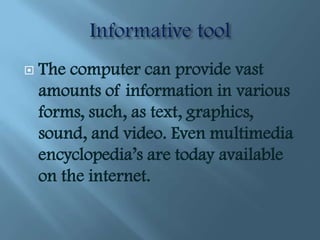
   The computer can provide vast
    amounts of information in various
    forms, such, as text, graphics,
    sound, and video. Even multimedia
    encyclopedia’s are today available
    on the internet.
 Thecomputer itself can be
 used for manipulating
 information, visualizing one’s
 understanding, and building
 new knowledge.
   Students can used constructive tools to
    work cooperatively and construct a
    shared understanding of new
    knowledge. One way of co-construction
    is the use of the electronic whiteboard
    where students may post notices to a
    shared document, and can also co-edit
    the same document.
   Students can enter their ideas in notes and
    respond to each other’s ideas.
   Manifest in the student-generated database
    are higher level thinking processes-
    explaining, problem solving/finding,
    expertise and development, literacy
    improvement.
   A flight simulation program is an
    example of situating tool which places
    the user in a simulated flying
    environment.

   The computer as a situating tool is news
    and still undergoing further research
    and development.
Ppt.jane'ed.tech2

Ppt.jane'ed.tech2

  • 2.
    We shall againlook at the computer, but this time from another perspective the computer as a teacher’s handy tool. It can in fact support the constructivist and social constructivist paradigms of constructivist learning.
  • 4.
    Was introduced byPiaget (1981) and Bruner (1990). They gave stress to Knowledge Discovery of new meaning/concepts/principles in the learning process. Various strategies have been suggested to foster knowledge, discovery.
  • 5.
    Students are engaged to apply discovered knowledge to new situations, a process for making their knowledge applicable to real life.  Knowledge can also be socially constructed.
  • 6.
     SOCIAL CONSTRUCTIVISM is an effort to show that the construction of knowledge is governed by social, historical and cultural contexts.
  • 7.
    VYGOTSKY – stressed that learning is affected by social influences. Interactive process in learning, the more capable adult can aid or complement what the learner sees in a given class project.  DEWEY – human learning is really human language that occurs when students socially share, build and agree upon meanings and knowledge.
  • 9.
    General orientation Personal discovery of Students discuss and knowledge discover meanings Example 8*5 – 8+8+8+8+8 Two alternative job offers Option 1- 8hrs./day for 6 days/week Option 2 – 9 hrs./day for 5 days/week FIGURE 7 – SUMMARY OF THE TWO LEARNING PERSPECTIVES
  • 10.
    Given its presentday speed, flexibility and sophistication, the computer:  Can provide access to information  Foster creative social knowledge- building  And enhance the communication of the achieved project package
  • 11.
    Based on thetwo learning theories, the teacher can employ the computer as a/an:  An information tool  A communication tool  A constructive tool  As co-constructive tool  A situating tool
  • 12.
    The computer can provide vast amounts of information in various forms, such, as text, graphics, sound, and video. Even multimedia encyclopedia’s are today available on the internet.
  • 13.
     Thecomputer itselfcan be used for manipulating information, visualizing one’s understanding, and building new knowledge.
  • 14.
    Students can used constructive tools to work cooperatively and construct a shared understanding of new knowledge. One way of co-construction is the use of the electronic whiteboard where students may post notices to a shared document, and can also co-edit the same document.
  • 15.
    Students can enter their ideas in notes and respond to each other’s ideas.  Manifest in the student-generated database are higher level thinking processes- explaining, problem solving/finding, expertise and development, literacy improvement.
  • 16.
    A flight simulation program is an example of situating tool which places the user in a simulated flying environment.  The computer as a situating tool is news and still undergoing further research and development.