COMPONEN
T METHOD
The component method is generally
used when more than two vectors are to
be added. The steps involved in adding
vectors using component method are as
follows:
1. Resolve the given vectors into its
horizontal and vertical components.
The components may be positive or
negative depending on which
quadratic the vector is found.
Signs of X and Y in the different quadrants
quadrant x y
1 + +
2 - +
3 - -
4 + -
The component method is generally used
when more than two vectors are to be
added. The steps involved in adding vectors
using component method are as follows.
2. Get the algebraic sum of all the
horizontal components. Get also the
algebraic sum of the vertical components.
These sums represent the horizontal
component and the vertical component of
the resultant respectively.
The component method is generally
used when more than two vectors are to
be added. The steps involved in adding
vectors using component method are as
follows.
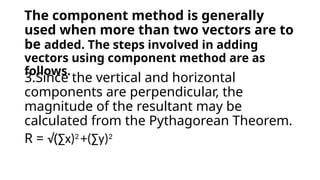
3.Since the vertical and horizontal
components are perpendicular, the
magnitude of the resultant may be
calculated from the Pythagorean Theorem.
R = √(∑x)2
+(∑y)2
The component method is generally
used when more than two vectors are to
be added. The steps involved in adding
vectors using component method are as
follows.
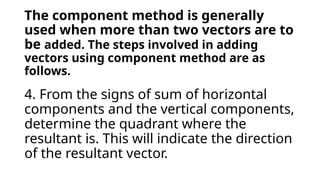
4. From the signs of sum of horizontal
components and the vertical components,
determine the quadrant where the
resultant is. This will indicate the direction
of the resultant vector.
The component method is generally
used when more than two vectors are to
be added. The steps involved in adding
vectors using component method are as
follows.
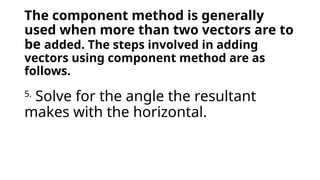
5.
Solve for the angle the resultant
makes with the horizontal.
SIGNS OF X AND Y IN THE DIFFERENT
QUADRANTS
QUADRANT X Y
1 + +
2 - +
3 - -
4 + -
SAMPLE PROBLEM
A jogger runs 4.00 m 40o
N of E, 2.00 m east, 5.20m 30.0o
S of W, 6.50
m S, and then collapses. Find his resultant displacement from where he
starred. Solution: Let us tabulate the horizontal and vertical
components of each vector.
VECTORS HORIZONTAL
COMPONENT
VERTICAL COMPONENT
A = 4.00 m 40.0O
N
of E
+4.00 m cos 40.0o
= +
3.06 m
+ 4.00 m sin 40.0o
=2.57m
B = 2.00 m E + 2.00 m 0.00
C = 5.20 m 30.0o
S of
W
-5.20 m cos 30.0o
= -
4.50 m
-5.20 m sin 30.0o
= -
2.60 m
D = 6.50 m S 0.00 -6.50 m
∑ = +0.560 m ∑ = -6.53m
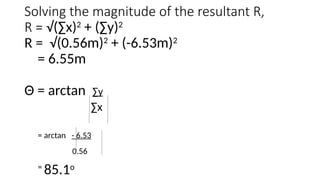
Solving the magnitude of the resultant R,
R = √(∑x)2
+ (∑y)2
R = √(0.56m)2
+ (-6.53m)2
= 6.55m
Θ = arctan ∑y
∑x
= arctan - 6.53
0.56
=
85.1o
Since ∑x is positive and ∑y is negative, the
resultant must be in the fourth quadrant ,
hence the direction must be 85.1o
S of E.
Thus R is 6.55 m 85.1o
S of E
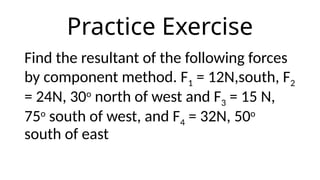
Practice Exercise
Find the resultant of the following forces
by component method. F1 = 12N,south, F2
= 24N, 30o
north of west and F3 = 15 N,
75o
south of west, and F4 = 32N, 50o
south of east

THE COMPONENT METHOD (GRADE 12 STEM).pptx

  • 1.
  • 2.
    The component methodis generally used when more than two vectors are to be added. The steps involved in adding vectors using component method are as follows: 1. Resolve the given vectors into its horizontal and vertical components. The components may be positive or negative depending on which quadratic the vector is found.
  • 3.
    Signs of Xand Y in the different quadrants quadrant x y 1 + + 2 - + 3 - - 4 + -
  • 4.
    The component methodis generally used when more than two vectors are to be added. The steps involved in adding vectors using component method are as follows. 2. Get the algebraic sum of all the horizontal components. Get also the algebraic sum of the vertical components. These sums represent the horizontal component and the vertical component of the resultant respectively.
  • 5.
    The component methodis generally used when more than two vectors are to be added. The steps involved in adding vectors using component method are as follows. 3.Since the vertical and horizontal components are perpendicular, the magnitude of the resultant may be calculated from the Pythagorean Theorem. R = √(∑x)2 +(∑y)2
  • 6.
    The component methodis generally used when more than two vectors are to be added. The steps involved in adding vectors using component method are as follows. 4. From the signs of sum of horizontal components and the vertical components, determine the quadrant where the resultant is. This will indicate the direction of the resultant vector.
  • 7.
    The component methodis generally used when more than two vectors are to be added. The steps involved in adding vectors using component method are as follows. 5. Solve for the angle the resultant makes with the horizontal.
  • 9.
    SIGNS OF XAND Y IN THE DIFFERENT QUADRANTS QUADRANT X Y 1 + + 2 - + 3 - - 4 + -
  • 10.
    SAMPLE PROBLEM A joggerruns 4.00 m 40o N of E, 2.00 m east, 5.20m 30.0o S of W, 6.50 m S, and then collapses. Find his resultant displacement from where he starred. Solution: Let us tabulate the horizontal and vertical components of each vector. VECTORS HORIZONTAL COMPONENT VERTICAL COMPONENT A = 4.00 m 40.0O N of E +4.00 m cos 40.0o = + 3.06 m + 4.00 m sin 40.0o =2.57m B = 2.00 m E + 2.00 m 0.00 C = 5.20 m 30.0o S of W -5.20 m cos 30.0o = - 4.50 m -5.20 m sin 30.0o = - 2.60 m D = 6.50 m S 0.00 -6.50 m ∑ = +0.560 m ∑ = -6.53m
  • 11.
    Solving the magnitudeof the resultant R, R = √(∑x)2 + (∑y)2 R = √(0.56m)2 + (-6.53m)2 = 6.55m Θ = arctan ∑y ∑x = arctan - 6.53 0.56 = 85.1o
  • 12.
    Since ∑x ispositive and ∑y is negative, the resultant must be in the fourth quadrant , hence the direction must be 85.1o S of E. Thus R is 6.55 m 85.1o S of E
  • 13.
    Practice Exercise Find theresultant of the following forces by component method. F1 = 12N,south, F2 = 24N, 30o north of west and F3 = 15 N, 75o south of west, and F4 = 32N, 50o south of east