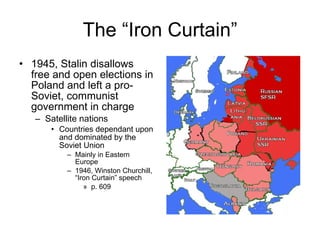
The “Iron Curtain” 1945, Stalin disallows free and open elections in Poland and left a pro-Soviet, communist government in charge Satellite nations Countries dependant upon and dominated by the Soviet Union Mainly in Eastern Europe 1946, Winston Churchill, “Iron Curtain” speech p. 609
The Cold War Begins Truman Doctrine Containment Devised by George F. Kennan Effort to block the Soviets’ attempts to spread their influence Contain communism and disallow its spread to new territories 1947 Asked for $400 million dollars in economic and military aid for Greece and Turkey to stop Communist takeovers Marshall Plan Western Europe in economic chaos June 1947, Secretary of State George C. Marshall U.S. program for reconstruction of post-WWII Europe through massive aid to former enemy and allied nations Nations that accepted aid had to remove trade barriers Attempt to avoid depression (WWI) and communist takeovers 1952, Western Europe was recovering ($17 billion) Chart p. 610 Cold War State of hostility short of direct military confrontation that developed between the U.S. and Soviet Union between 1945-1989
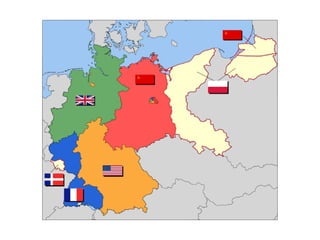
Reunification Attempts in Germany 1948 U.S., U.K., and France decided to unify three western zones (including western zones of Berlin) Soviets cut off western Berlin from West Germany Berlin Airlift May, 1949 blockade lifted April 4, 1949 North Atlantic Treaty Organization (NATO) Defensive military alliance Ten Western European nations and U.S. Belgium, Denmark, France, U.K., Iceland, Italy, Luxembourg, the Netherlands, Norway, and Portugal
 
Buildup to Korean War National Security Act, 1947 Created Department of Defense Central Intelligence Agency (CIA) Permanent peacetime draft, 1948 National Security Council NSC-68, 1949 Detailed Soviet’s plans for worldwide domination and encouraged buildup of nation’s military China fell to communism, 1949 Mao Tse-Tung and Joseph Stalin sign a pact linking the two nations into one communist bloc, 1950 Korea Had been Japanese colony until end of WWII (1945) Japanese troops north of the 38 th  parallel surrendered to Soviets Japanese troops south of the 38 th  parallel surrendered to Americans Two governments established (1948, Soviets & Americans left)
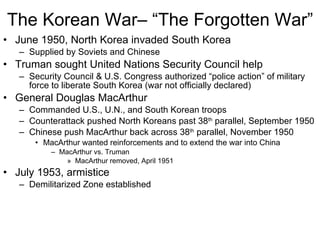
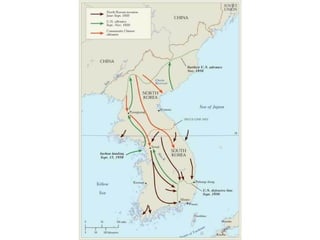
The Korean War– “The Forgotten War” June 1950, North Korea invaded South Korea Supplied by Soviets and Chinese Truman sought United Nations Security Council help Security Council & U.S. Congress authorized “police action” of military force to liberate South Korea (war not officially declared) General Douglas MacArthur Commanded U.S., U.N., and South Korean troops Counterattack pushed North Koreans past 38 th  parallel, September 1950 Chinese push MacArthur back across 38 th  parallel, November 1950 MacArthur wanted reinforcements and to extend the war into China MacArthur vs. Truman MacArthur removed, April 1951 July 1953, armistice Demilitarized Zone established
 
Eisenhower Dwight D. Eisenhower, president 1953-1961 Appointed Earl Warren (former governor of CA) as Chief Justice of the Supreme Court, 1953 Warren Court turned out to be one of the most liberal in history Civil Rights Issues Brown v. Board of Education  (1954) Thurgood Marshall (NAACP lawyer, first AA on Supreme Court) 14 th  Amendment Overturned  Plessy v. Ferguson “ Separate facilities were inherently unequal” Rosa Parks, 1955 Bus boycott, Dr. Martin Luther King, Jr., 1956 Little Rock 9, 1957 Foreign Policy John Foster Dulles (SOS) Brinkmanship    U.S. would force aggressor nations to the brink of nuclear war and thus force them to back down in wake of U.S. superiority “ massive retaliation,” arms race, & MAD Middle East U.S. support for Israel Eisenhower Doctrine    U.S. would defend Middle East against any attack by a communist country Postwar Economic Boom Consumer spending more than the 1920’s Middle class, suburbs, and Interstate Highway Act Baby Boom
JFK John F. Kennedy, president 1961-1963 All four presidential debates televised (first time) Cuba Fidel Castro, 1959 Bay of Pigs, April 1961 CIA operatives and Cuban exiles captured immediately Soviet premier Nikita Khrushchev, Berlin Wall 1961 Cuban Missile Crisis, October 1962 Castro and Khrushchev formed alliance U.S. spy plane found Soviet medium and long-range nuclear missiles in Cuba Naval blockade of Cuba “ We are eyeball to eyeball and the other fellow just blinked” Khrushchev offered to remove missiles in exchange for U.S. promise never to invade Cuba and U.S. removal of missiles from Turkey New Frontier Domestic policy promising equality, employment, and aid to the poor Race to the Moon Feb. 20, 1962 John Glenn orbited the earth three times July 20, 1969 Neil Armstrong became first person to set foot on moon Assassination November 22, 1963 Dallas, Texas Lee Harvey Oswald Killed by Jack Ruby Warren Commission    Oswald acted on his own

Post WWII

  • 1.
    The “Iron Curtain”1945, Stalin disallows free and open elections in Poland and left a pro-Soviet, communist government in charge Satellite nations Countries dependant upon and dominated by the Soviet Union Mainly in Eastern Europe 1946, Winston Churchill, “Iron Curtain” speech p. 609
  • 2.
    The Cold WarBegins Truman Doctrine Containment Devised by George F. Kennan Effort to block the Soviets’ attempts to spread their influence Contain communism and disallow its spread to new territories 1947 Asked for $400 million dollars in economic and military aid for Greece and Turkey to stop Communist takeovers Marshall Plan Western Europe in economic chaos June 1947, Secretary of State George C. Marshall U.S. program for reconstruction of post-WWII Europe through massive aid to former enemy and allied nations Nations that accepted aid had to remove trade barriers Attempt to avoid depression (WWI) and communist takeovers 1952, Western Europe was recovering ($17 billion) Chart p. 610 Cold War State of hostility short of direct military confrontation that developed between the U.S. and Soviet Union between 1945-1989
  • 3.
    Reunification Attempts inGermany 1948 U.S., U.K., and France decided to unify three western zones (including western zones of Berlin) Soviets cut off western Berlin from West Germany Berlin Airlift May, 1949 blockade lifted April 4, 1949 North Atlantic Treaty Organization (NATO) Defensive military alliance Ten Western European nations and U.S. Belgium, Denmark, France, U.K., Iceland, Italy, Luxembourg, the Netherlands, Norway, and Portugal
  • 4.
  • 5.
    Buildup to KoreanWar National Security Act, 1947 Created Department of Defense Central Intelligence Agency (CIA) Permanent peacetime draft, 1948 National Security Council NSC-68, 1949 Detailed Soviet’s plans for worldwide domination and encouraged buildup of nation’s military China fell to communism, 1949 Mao Tse-Tung and Joseph Stalin sign a pact linking the two nations into one communist bloc, 1950 Korea Had been Japanese colony until end of WWII (1945) Japanese troops north of the 38 th parallel surrendered to Soviets Japanese troops south of the 38 th parallel surrendered to Americans Two governments established (1948, Soviets & Americans left)
  • 6.
    The Korean War–“The Forgotten War” June 1950, North Korea invaded South Korea Supplied by Soviets and Chinese Truman sought United Nations Security Council help Security Council & U.S. Congress authorized “police action” of military force to liberate South Korea (war not officially declared) General Douglas MacArthur Commanded U.S., U.N., and South Korean troops Counterattack pushed North Koreans past 38 th parallel, September 1950 Chinese push MacArthur back across 38 th parallel, November 1950 MacArthur wanted reinforcements and to extend the war into China MacArthur vs. Truman MacArthur removed, April 1951 July 1953, armistice Demilitarized Zone established
  • 7.
  • 8.
    Eisenhower Dwight D.Eisenhower, president 1953-1961 Appointed Earl Warren (former governor of CA) as Chief Justice of the Supreme Court, 1953 Warren Court turned out to be one of the most liberal in history Civil Rights Issues Brown v. Board of Education (1954) Thurgood Marshall (NAACP lawyer, first AA on Supreme Court) 14 th Amendment Overturned Plessy v. Ferguson “ Separate facilities were inherently unequal” Rosa Parks, 1955 Bus boycott, Dr. Martin Luther King, Jr., 1956 Little Rock 9, 1957 Foreign Policy John Foster Dulles (SOS) Brinkmanship  U.S. would force aggressor nations to the brink of nuclear war and thus force them to back down in wake of U.S. superiority “ massive retaliation,” arms race, & MAD Middle East U.S. support for Israel Eisenhower Doctrine  U.S. would defend Middle East against any attack by a communist country Postwar Economic Boom Consumer spending more than the 1920’s Middle class, suburbs, and Interstate Highway Act Baby Boom
  • 9.
    JFK John F.Kennedy, president 1961-1963 All four presidential debates televised (first time) Cuba Fidel Castro, 1959 Bay of Pigs, April 1961 CIA operatives and Cuban exiles captured immediately Soviet premier Nikita Khrushchev, Berlin Wall 1961 Cuban Missile Crisis, October 1962 Castro and Khrushchev formed alliance U.S. spy plane found Soviet medium and long-range nuclear missiles in Cuba Naval blockade of Cuba “ We are eyeball to eyeball and the other fellow just blinked” Khrushchev offered to remove missiles in exchange for U.S. promise never to invade Cuba and U.S. removal of missiles from Turkey New Frontier Domestic policy promising equality, employment, and aid to the poor Race to the Moon Feb. 20, 1962 John Glenn orbited the earth three times July 20, 1969 Neil Armstrong became first person to set foot on moon Assassination November 22, 1963 Dallas, Texas Lee Harvey Oswald Killed by Jack Ruby Warren Commission  Oswald acted on his own