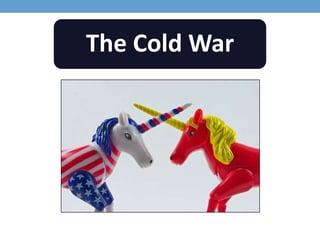
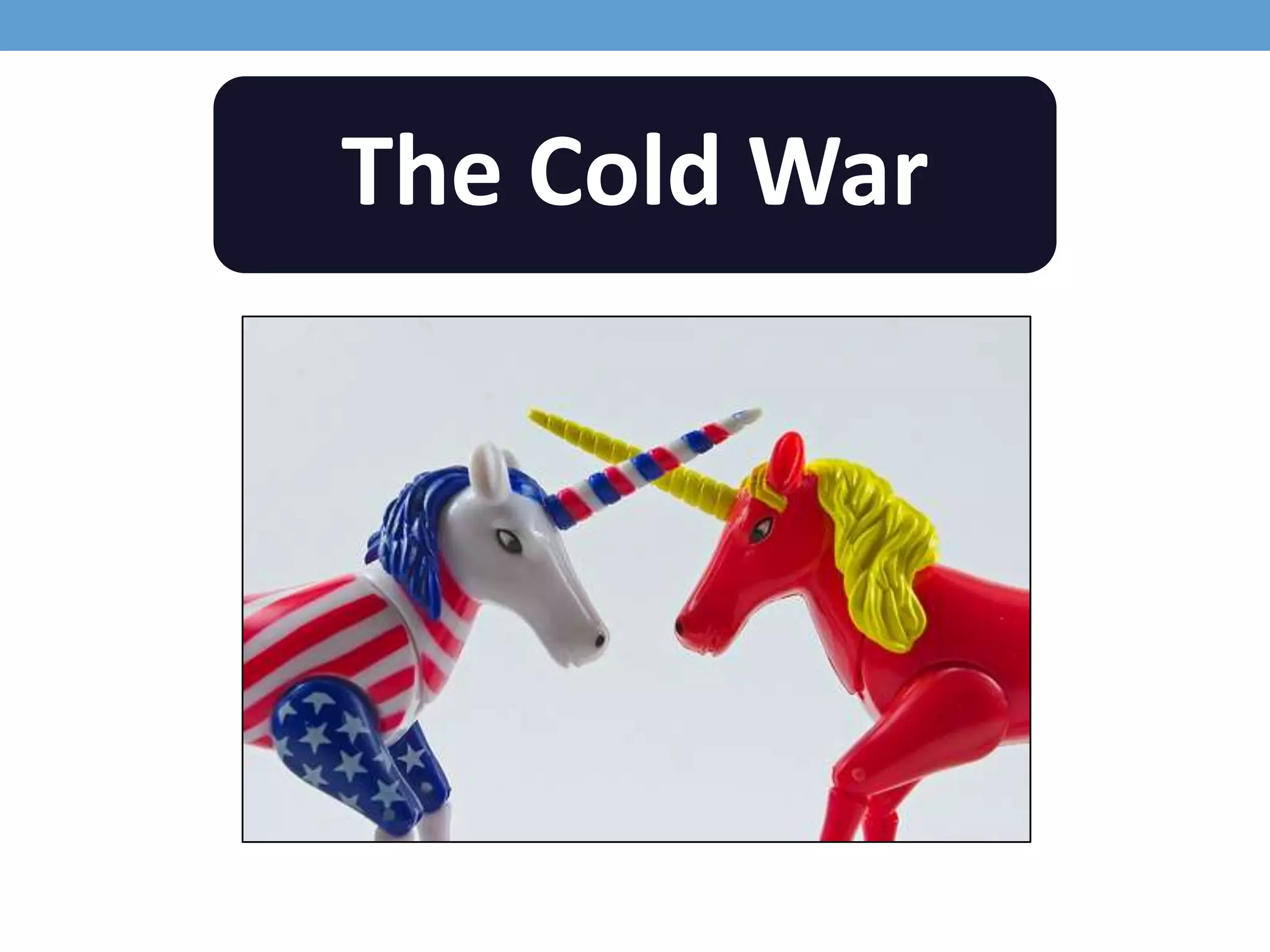
The Cold War
I. The Post-War World (1945-1949)
II. Communism in Asia (1949-1953)
III. The Khrushchev Era (1955-1964)
IV. The Brezhnev Era (1964-1985)
V. The Fall of Communism (1985-1992)
Outline
I. The Post-War World
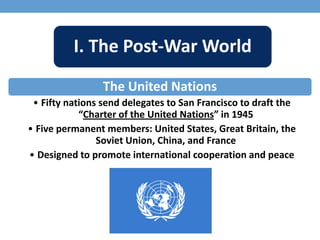
The United Nations
• Fifty nations send delegates to San Francisco to draft the
“Charter of the United Nations” in 1945
• Five permanent members: United States, Great Britain, the
Soviet Union, China, and France
• Designed to promote international cooperation and peace
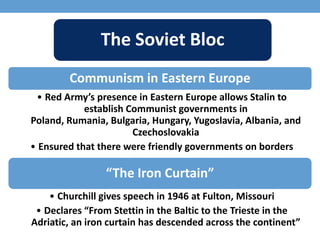
The Soviet Bloc
Communism in Eastern Europe
• Red Army’s presence in Eastern Europe allows Stalin to
establish Communist governments in
Poland, Rumania, Bulgaria, Hungary, Yugoslavia, Albania, and
Czechoslovakia
• Ensured that there were friendly governments on borders
• Mutual defense treaty, Warsaw Pact
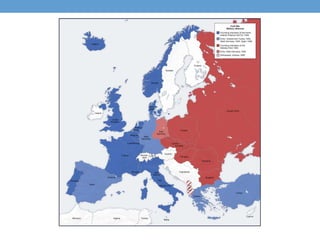
“The Iron Curtain”
• Churchill gives speech in 1946 at Fulton, Missouri
• Declares “From Stettin in the Baltic to the Trieste in the
Adriatic, an iron curtain has descended across the continent”
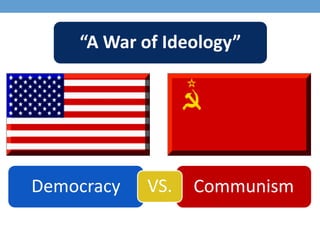
Democracy CommunismVS.
“A War of Ideology”
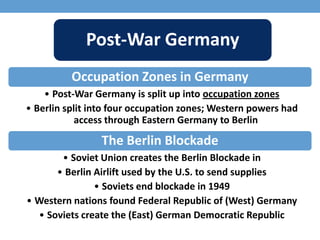
Post-War Germany
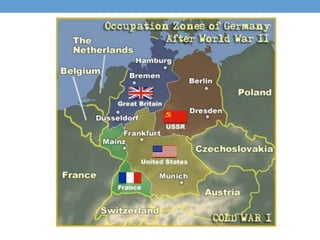
Occupation Zones in Germany
• Post-War Germany is split up into occupation zones
• Berlin split into four occupation zones; Western powers had
access through Eastern Germany to Berlin
The Berlin Blockade
• Soviet Union creates the Berlin Blockade in
• Berlin Airlift used by the U.S. to send supplies
• Soviets end blockade in 1949
• Western nations found Federal Republic of (West) Germany
• Soviets create the (East) German Democratic Republic
Containment
U.S. Policy Against Communism
• Domino effect/domino theory
• The Truman Doctrine: United States provides assistance to
Greece and Turkey to fight against Communist rebels
• The Marshall Plan: Provision of $13 billion for the economic
restoration of Europe; European Recovery Program
The Establishment of NATO
• Military alliance for Western Countries
• In 1949, twelve nations meet to sign the North Atlantic
Pact, establishing the North Atlantic Treaty Organization
(NATO)
II. Communism in Asia
The Cold War in China
• Soviet Union gives support to Communists, led by Mao Zedong
• United States supports Nationalists led by Chiang Kai-Shek
• Nationalists retreat to TAIWAN, Mao forms the People’s
Republic of China in 1949
Pre-War Korea
• Yalta Conference grants North Korea to the Soviets
• Communist government led by Kim Il-Sung
• United States supports South Koreans, led by Syngman Rhee
• Occupying powers withdraw in 1949
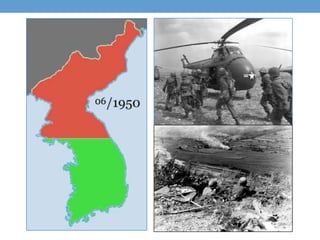
The Korean War
Initial North Korean Attacks
• North Korea invades in 1950
• Americans and S. Koreans surrounded at the Pusan Perimeter
• General MacArthur conducts landing at Inchon; destroys
majority of North Korean army in the South
Stabilization of the Front
• South Korean forces approach China; Chinese join the fight
• Chinese troops push Americans and S. Koreans out of N. Korea
• MacArthur dismissed for protesting against limited war
• UN armies stabilize front near 38th Parallel in 1953
The Vietnam War
Pre-War Vietnam
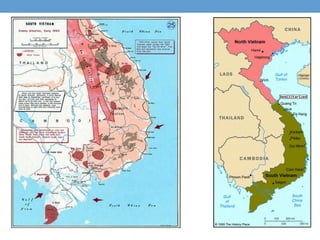
• Ho Chi Minh declares independence, defeats French in 1954
• Anti-communist Ngo Dinh Diem wins power in the South
• Gulf of Tonkin Incident: USS Maddox attacked by NV PT boats
• Lyndon B. Johnson declares war in 1964,
United States Involvement
• Operation Rolling Thunder: Bombing of supply lines
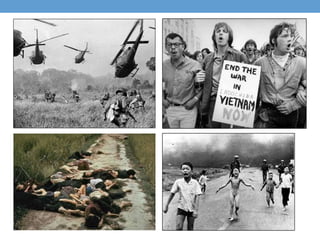
• Military drafting imposed by US increases
• Tet Offensive by NV, political and strategic victory
• Protests against war in US, “Vietnamization”
III. The Khrushchev Era
Tension in Europe
• Nikita Khrushchev rises to power in 1955, calls for “peaceful
coexistence” between Russia and the West; “The Thaw”
• Demands demilitarization of Germany; request ignored
• U-2 incident; Khrushchev breaks up the Paris Summit in 1960
• Berlin wall constructed in early 1961
Castro in Cuba
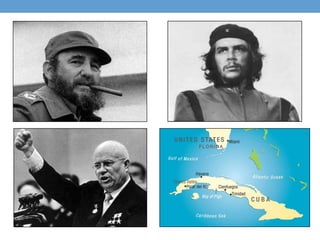
• In 1959, Fidel Castro (assisted by Che Guevara) overthrows
Fulgencia Batista, a US supported dictator; United States
breaks diplomatic relations
• CIA begins to train Cuban exiles to oust Castro
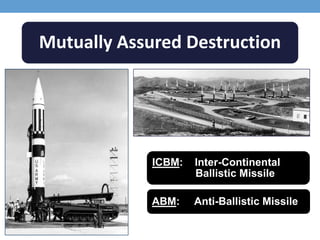
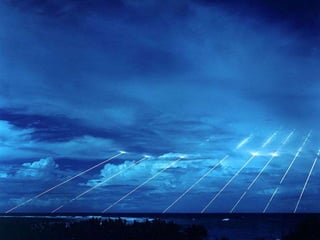
Mutually Assured Destruction
ICBM: Inter-Continental
Ballistic Missile
ABM: Anti-Ballistic Missile
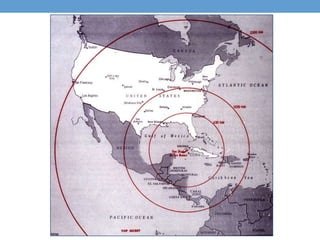
The Cuban Missile Crisis
Bay of Pigs Invasion
• Plan approved by new president John F. Kennedy
• 1,500 Cuban exiles invade in 1961; crushed in three days
• Castro declares himself a Marxist; allies with Soviet Union
Nuclear Missiles in Cuba
• Soviets send weapons and missiles to Cuba in May 1962
• On Oct. 22, Kennedy demands removal of missiles
• Khrushchev demands removal of missiles from Turkey
• Crisis resolved on Oct. 28; closest to nuclear war
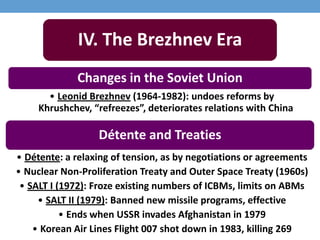
IV. The Brezhnev Era
Changes in the Soviet Union
• Leonid Brezhnev (1964-1982): undoes reforms by
Khrushchev, “refreezes”, deteriorates relations with China
Détente and Treaties
• Détente: a relaxing of tension, as by negotiations or agreements
• Nuclear Non-Proliferation Treaty and Outer Space Treaty (1960s)
• SALT I (1972): Froze existing numbers of ICBMs, limits on ABMs
• SALT II (1979): Banned new missile programs, effective
• Ends when USSR invades Afghanistan in 1979
• Korean Air Lines Flight 007 shot down in 1983, killing 269
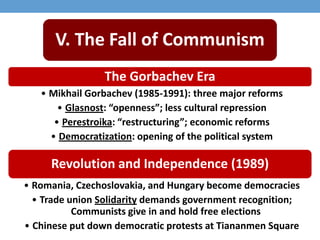
V. The Fall of Communism
The Gorbachev Era
• Mikhail Gorbachev (1985-1991): three major reforms
• Glasnost: “openness”; less cultural repression
• Perestroika: “restructuring”; economic reforms
• Democratization: opening of the political system
Revolution and Independence (1989)
• Romania, Czechoslovakia, and Hungary become democracies
• Trade union Solidarity demands government recognition;
Communists give in and hold free elections
• Chinese put down democratic protests at Tiananmen Square
Fall of the Soviet Union
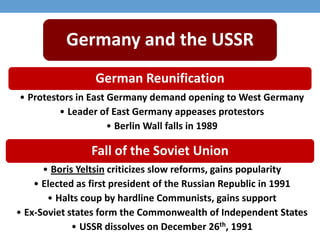
• Boris Yeltsin criticizes slow reforms, gains popularity
• Elected as first president of the Russian Republic in 1991
• Halts coup by hardline Communists, gains support
• Ex-Soviet states form the Commonwealth of Independent States
• USSR dissolves on December 26th, 1991
German Reunification
• Protestors in East Germany demand opening to West Germany
• Leader of East Germany appeases protestors
• Berlin Wall falls in 1989
Germany and the USSR

The Cold War PPT

  • 1.
  • 2.
    I. The Post-WarWorld (1945-1949) II. Communism in Asia (1949-1953) III. The Khrushchev Era (1955-1964) IV. The Brezhnev Era (1964-1985) V. The Fall of Communism (1985-1992) Outline
  • 3.
    I. The Post-WarWorld The United Nations • Fifty nations send delegates to San Francisco to draft the “Charter of the United Nations” in 1945 • Five permanent members: United States, Great Britain, the Soviet Union, China, and France • Designed to promote international cooperation and peace
  • 4.
    The Soviet Bloc Communismin Eastern Europe • Red Army’s presence in Eastern Europe allows Stalin to establish Communist governments in Poland, Rumania, Bulgaria, Hungary, Yugoslavia, Albania, and Czechoslovakia • Ensured that there were friendly governments on borders • Mutual defense treaty, Warsaw Pact “The Iron Curtain” • Churchill gives speech in 1946 at Fulton, Missouri • Declares “From Stettin in the Baltic to the Trieste in the Adriatic, an iron curtain has descended across the continent”
  • 6.
  • 7.
    Post-War Germany Occupation Zonesin Germany • Post-War Germany is split up into occupation zones • Berlin split into four occupation zones; Western powers had access through Eastern Germany to Berlin The Berlin Blockade • Soviet Union creates the Berlin Blockade in • Berlin Airlift used by the U.S. to send supplies • Soviets end blockade in 1949 • Western nations found Federal Republic of (West) Germany • Soviets create the (East) German Democratic Republic
  • 9.
    Containment U.S. Policy AgainstCommunism • Domino effect/domino theory • The Truman Doctrine: United States provides assistance to Greece and Turkey to fight against Communist rebels • The Marshall Plan: Provision of $13 billion for the economic restoration of Europe; European Recovery Program The Establishment of NATO • Military alliance for Western Countries • In 1949, twelve nations meet to sign the North Atlantic Pact, establishing the North Atlantic Treaty Organization (NATO)
  • 10.
    II. Communism inAsia The Cold War in China • Soviet Union gives support to Communists, led by Mao Zedong • United States supports Nationalists led by Chiang Kai-Shek • Nationalists retreat to TAIWAN, Mao forms the People’s Republic of China in 1949 Pre-War Korea • Yalta Conference grants North Korea to the Soviets • Communist government led by Kim Il-Sung • United States supports South Koreans, led by Syngman Rhee • Occupying powers withdraw in 1949
  • 11.
    The Korean War InitialNorth Korean Attacks • North Korea invades in 1950 • Americans and S. Koreans surrounded at the Pusan Perimeter • General MacArthur conducts landing at Inchon; destroys majority of North Korean army in the South Stabilization of the Front • South Korean forces approach China; Chinese join the fight • Chinese troops push Americans and S. Koreans out of N. Korea • MacArthur dismissed for protesting against limited war • UN armies stabilize front near 38th Parallel in 1953
  • 13.
    The Vietnam War Pre-WarVietnam • Ho Chi Minh declares independence, defeats French in 1954 • Anti-communist Ngo Dinh Diem wins power in the South • Gulf of Tonkin Incident: USS Maddox attacked by NV PT boats • Lyndon B. Johnson declares war in 1964, United States Involvement • Operation Rolling Thunder: Bombing of supply lines • Military drafting imposed by US increases • Tet Offensive by NV, political and strategic victory • Protests against war in US, “Vietnamization”
  • 16.
    III. The KhrushchevEra Tension in Europe • Nikita Khrushchev rises to power in 1955, calls for “peaceful coexistence” between Russia and the West; “The Thaw” • Demands demilitarization of Germany; request ignored • U-2 incident; Khrushchev breaks up the Paris Summit in 1960 • Berlin wall constructed in early 1961 Castro in Cuba • In 1959, Fidel Castro (assisted by Che Guevara) overthrows Fulgencia Batista, a US supported dictator; United States breaks diplomatic relations • CIA begins to train Cuban exiles to oust Castro
  • 18.
    Mutually Assured Destruction ICBM:Inter-Continental Ballistic Missile ABM: Anti-Ballistic Missile
  • 19.
    The Cuban MissileCrisis Bay of Pigs Invasion • Plan approved by new president John F. Kennedy • 1,500 Cuban exiles invade in 1961; crushed in three days • Castro declares himself a Marxist; allies with Soviet Union Nuclear Missiles in Cuba • Soviets send weapons and missiles to Cuba in May 1962 • On Oct. 22, Kennedy demands removal of missiles • Khrushchev demands removal of missiles from Turkey • Crisis resolved on Oct. 28; closest to nuclear war
  • 21.
    IV. The BrezhnevEra Changes in the Soviet Union • Leonid Brezhnev (1964-1982): undoes reforms by Khrushchev, “refreezes”, deteriorates relations with China Détente and Treaties • Détente: a relaxing of tension, as by negotiations or agreements • Nuclear Non-Proliferation Treaty and Outer Space Treaty (1960s) • SALT I (1972): Froze existing numbers of ICBMs, limits on ABMs • SALT II (1979): Banned new missile programs, effective • Ends when USSR invades Afghanistan in 1979 • Korean Air Lines Flight 007 shot down in 1983, killing 269
  • 23.
    V. The Fallof Communism The Gorbachev Era • Mikhail Gorbachev (1985-1991): three major reforms • Glasnost: “openness”; less cultural repression • Perestroika: “restructuring”; economic reforms • Democratization: opening of the political system Revolution and Independence (1989) • Romania, Czechoslovakia, and Hungary become democracies • Trade union Solidarity demands government recognition; Communists give in and hold free elections • Chinese put down democratic protests at Tiananmen Square
  • 24.
    Fall of theSoviet Union • Boris Yeltsin criticizes slow reforms, gains popularity • Elected as first president of the Russian Republic in 1991 • Halts coup by hardline Communists, gains support • Ex-Soviet states form the Commonwealth of Independent States • USSR dissolves on December 26th, 1991 German Reunification • Protestors in East Germany demand opening to West Germany • Leader of East Germany appeases protestors • Berlin Wall falls in 1989 Germany and the USSR