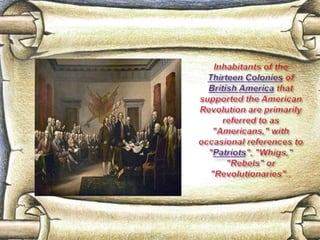
American
Revolution
 The geographical area of the thirteen colonies is
often referred to simply as ‘’AMERICA’’
 Loyalist - Colonists who supported the British in
opposing the Revolution usually called ‘’Tories””.
American Revolution
 was predicated by a number of ideas and
events that, combined, led to a political and
social separation of colonial possessions from
the home nation and a coalescing of those
former individual colonies into an
independent nation.
was the political upheaval during the last half of the
18th century in which thirteen colonies in North
America joined together to break free from the British
Empire, combining to become the United States of
America. They first rejected the authority of the
Parliament of Great Britain to govern them from
overseas without representation, and then expelled all
royal officials.
 was the result of a series of social, political, and
intellectual transformations in early American
society and government, collectively referred to as
the American Enlightenment. Americans rejected the
oligarchies and aristocracies common in Europe at
the time, championing instead the development of
republicanism based on the Enlightenment
understanding of liberalism.
• 1763-> American revolutionary era began
, after a series of victories by British
forces at the conclusion of the French and
Indian War that ended the French
military threat to British North American
colonies.
 . Thomas Paine's best-seller pamphlet Common
Sense appeared in January 1776, after the
Revolution had started. It was widely
distributed and loaned, and often read aloud in
taverns, contributing significantly to spreading
the ideas of republicanism and liberalism
together, bolstering enthusiasm for separation
from Britain, and encouraging recruitment for
the Continental Army. Paine provided a new
and widely accepted argument for
independence, by advocating a complete break
with history.
 The Revolution was in some ways incited by a number of pieces of
legislation originating from the British Parliament that, for
Americans, were illegitimate acts of a government that had no
right to pass laws on Englishmen in the Americas who did not
have elected representation in that government.
 For the British, policy makers saw these laws as necessary to rein
in colonial subjects who, in the name of economic development
that was designed to benefit the home nation, had been allowed
near-autonomy for too long.
 The American people were strongly independent. They wanted to do
things for themselves. Great Britain was a long way away. The American
people didn't want people an ocean away telling them how to live their
lives.
 The British government decided to make the American colonies pay a
large share of the war debt from the French and Indian War.
 Through the Sugar Act, Stamp Act, and other taxes, the British tried to
collect taxes that the American people considered harsh.
 The American people also thought that they should be able to send their
own people to Britain's Parliament or at least vote for Britain's
lawmakers.
 The combination of the harsh taxes and the lack of an American voice in
Parliament gave rise to the famous phrase "taxation without
representation."
 Patrick Henry, Thomas Paine, and others called for an independent
America, colonies free from British rule and interference.
 Americans started stockpiling guns and ammunition in violation of
British laws. Their defense of such a stockpile led to the shots fired at
Lexington and Concord and the beginning of the Revolutionary War.
 Mercantile system= where all trade was concentrated inside the Empire, and trade
with other empires was forbidden. The goal was to enrich Britain—its merchants
and its government. Whether the policy was good for the colonists was not an
issue in London, but Americans became increasingly restive with mercantilist
policies[17]
 Navigation Acts, which Americans avoided as often as they could. The royal
officials responded to smuggling with open-ended search warrants (Writs of
Assistance). In 1761, Boston lawyer James Otis argued that the writs violated the
constitutional rights of the colonists. He lost the case, but John Adams later wrote,
"Then and there the child Independence was born."[18]
 the Royal Proclamation of 1763 restricted settlement west of the Appalachian
Mountains as this was designated an Indian Reserve.[20] Disregarding the
proclamation, some groups of settlers continued to move west and establish farms.
 Sugar Act,
 Currency Act,
 Quartering Acts,
 Stamp Act 1765, and
 Declaratory Act
 Quebec Act
 Intolerable Act
 Patriot women
confronted a war that permeated all aspects of political,
civil, and domestic life.
participated by boycotting British goods, spying on the
British, following armies as they marched, washing,
cooking, and tending for soldiers, delivering secret
messages, and in a few cases like Deborah Samson,
fighting disguised as men.
 they continued the agricultural work at home
to feed their families and the armies.
 maintained their families during their
husbands' absences and sometimes after their
deaths.[41]
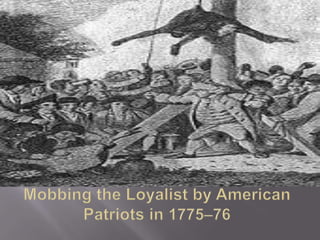
 about 15–20% of the population remained loyal
to the British Crown; these were known at the
time as "Loyalists", "Tories", or "King's men".
 .[53] Loyalists were typically older, less willing
to break with old loyalties, often connected to
the Church of England, and included many
established merchants with strong business
connections across the Empire, as well as royal
officials
 A minority of uncertain size tried to stay
neutral in the war. Most kept a low profile, but
the Quakers, especially in Pennsylvania, were
the most important group to speak out for
neutrality
 Economic policies of Britain.
 The Stamp Act of 1765
 Inspiration of natural rights philosophers
 Representation in parliament
 ‘’The Boston Massacre’’-
 -- March 1770, violent anti-British riots broke
out into many cities. British soldiers in Boston
panicked and opened fire on a hostile
demonstration, killing 5 men and wounded six.
 -December 16, 1773, a group of American
patriots, disguised as Indians, crept into British
ships at the harbor and dumped their cargoes
of tea in the sea.
 April 19, 1775
 - the first shot for American freedom was fired
at Lexington, Massachusetts.
 July 4, 1776- the historic declaration was
written by Thomas Jefferson and approved by
the congress.
 The American Declaration of Independence
consisted of 3 parts.
 1.

American revolution

  • 1.
  • 3.
     The geographicalarea of the thirteen colonies is often referred to simply as ‘’AMERICA’’  Loyalist - Colonists who supported the British in opposing the Revolution usually called ‘’Tories””.
  • 4.
    American Revolution  waspredicated by a number of ideas and events that, combined, led to a political and social separation of colonial possessions from the home nation and a coalescing of those former individual colonies into an independent nation.
  • 5.
    was the politicalupheaval during the last half of the 18th century in which thirteen colonies in North America joined together to break free from the British Empire, combining to become the United States of America. They first rejected the authority of the Parliament of Great Britain to govern them from overseas without representation, and then expelled all royal officials.
  • 6.
     was theresult of a series of social, political, and intellectual transformations in early American society and government, collectively referred to as the American Enlightenment. Americans rejected the oligarchies and aristocracies common in Europe at the time, championing instead the development of republicanism based on the Enlightenment understanding of liberalism.
  • 7.
    • 1763-> Americanrevolutionary era began , after a series of victories by British forces at the conclusion of the French and Indian War that ended the French military threat to British North American colonies.
  • 11.
     . ThomasPaine's best-seller pamphlet Common Sense appeared in January 1776, after the Revolution had started. It was widely distributed and loaned, and often read aloud in taverns, contributing significantly to spreading the ideas of republicanism and liberalism together, bolstering enthusiasm for separation from Britain, and encouraging recruitment for the Continental Army. Paine provided a new and widely accepted argument for independence, by advocating a complete break with history.
  • 14.
     The Revolutionwas in some ways incited by a number of pieces of legislation originating from the British Parliament that, for Americans, were illegitimate acts of a government that had no right to pass laws on Englishmen in the Americas who did not have elected representation in that government.  For the British, policy makers saw these laws as necessary to rein in colonial subjects who, in the name of economic development that was designed to benefit the home nation, had been allowed near-autonomy for too long.
  • 15.
     The Americanpeople were strongly independent. They wanted to do things for themselves. Great Britain was a long way away. The American people didn't want people an ocean away telling them how to live their lives.  The British government decided to make the American colonies pay a large share of the war debt from the French and Indian War.  Through the Sugar Act, Stamp Act, and other taxes, the British tried to collect taxes that the American people considered harsh.  The American people also thought that they should be able to send their own people to Britain's Parliament or at least vote for Britain's lawmakers.  The combination of the harsh taxes and the lack of an American voice in Parliament gave rise to the famous phrase "taxation without representation."  Patrick Henry, Thomas Paine, and others called for an independent America, colonies free from British rule and interference.  Americans started stockpiling guns and ammunition in violation of British laws. Their defense of such a stockpile led to the shots fired at Lexington and Concord and the beginning of the Revolutionary War.
  • 16.
     Mercantile system=where all trade was concentrated inside the Empire, and trade with other empires was forbidden. The goal was to enrich Britain—its merchants and its government. Whether the policy was good for the colonists was not an issue in London, but Americans became increasingly restive with mercantilist policies[17]  Navigation Acts, which Americans avoided as often as they could. The royal officials responded to smuggling with open-ended search warrants (Writs of Assistance). In 1761, Boston lawyer James Otis argued that the writs violated the constitutional rights of the colonists. He lost the case, but John Adams later wrote, "Then and there the child Independence was born."[18]  the Royal Proclamation of 1763 restricted settlement west of the Appalachian Mountains as this was designated an Indian Reserve.[20] Disregarding the proclamation, some groups of settlers continued to move west and establish farms.
  • 17.
     Sugar Act, Currency Act,  Quartering Acts,  Stamp Act 1765, and  Declaratory Act  Quebec Act  Intolerable Act
  • 20.
     Patriot women confronteda war that permeated all aspects of political, civil, and domestic life. participated by boycotting British goods, spying on the British, following armies as they marched, washing, cooking, and tending for soldiers, delivering secret messages, and in a few cases like Deborah Samson, fighting disguised as men.
  • 21.
     they continuedthe agricultural work at home to feed their families and the armies.  maintained their families during their husbands' absences and sometimes after their deaths.[41]
  • 23.
     about 15–20%of the population remained loyal to the British Crown; these were known at the time as "Loyalists", "Tories", or "King's men".  .[53] Loyalists were typically older, less willing to break with old loyalties, often connected to the Church of England, and included many established merchants with strong business connections across the Empire, as well as royal officials
  • 24.
     A minorityof uncertain size tried to stay neutral in the war. Most kept a low profile, but the Quakers, especially in Pennsylvania, were the most important group to speak out for neutrality
  • 26.
     Economic policiesof Britain.  The Stamp Act of 1765  Inspiration of natural rights philosophers  Representation in parliament
  • 27.
     ‘’The BostonMassacre’’-  -- March 1770, violent anti-British riots broke out into many cities. British soldiers in Boston panicked and opened fire on a hostile demonstration, killing 5 men and wounded six.
  • 28.
     -December 16,1773, a group of American patriots, disguised as Indians, crept into British ships at the harbor and dumped their cargoes of tea in the sea.  April 19, 1775  - the first shot for American freedom was fired at Lexington, Massachusetts.
  • 29.
     July 4,1776- the historic declaration was written by Thomas Jefferson and approved by the congress.  The American Declaration of Independence consisted of 3 parts.
  • 30.