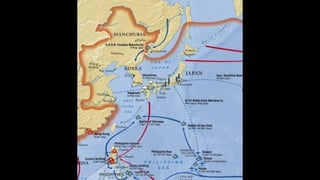
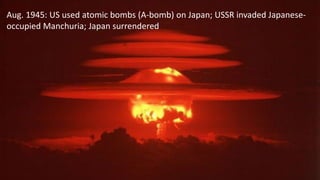
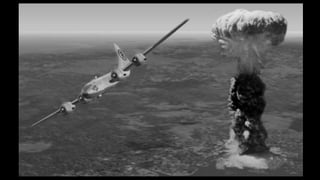
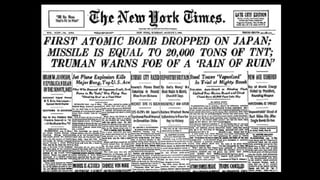
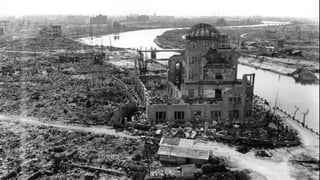
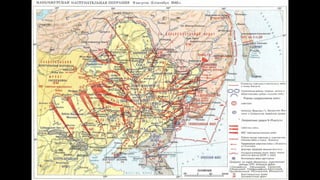
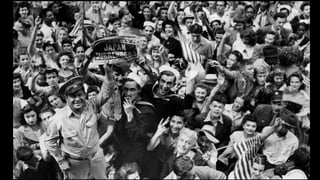
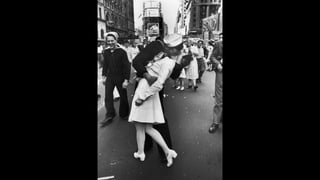
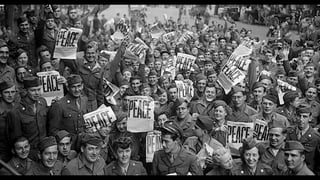
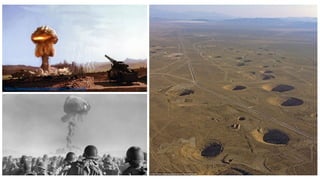
Aug. 1945: US used atomic bombs (A-bomb) on Japan; USSR invaded Japanese-
occupied Manchuria; Japan surrendered
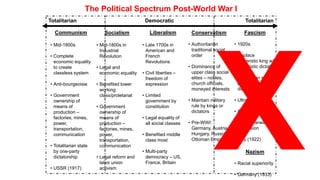
Totalitarian Democratic Totalitarian
The Political Spectrum Post-World War I
Liberalism
• Late 1700s in
American and
French
Revolutions
• Civil liberties –
freedom of
expression
• Limited
government by
constitution
• Legal equality of
all social classes
• Benefited middle
class most
• Multi-party
democracy – US,
France, Britain
Conservatism
• Authoritarian
traditional social
order
• Dominance of
upper class social
elites – nobles,
church officials,
moneyed interests
• Maintain military
rule by kings or
dictators
• Pre-WWI:
Germany, Austria-
Hungary, Russia,
Ottoman Empire
Fascism
• 1920s
• Replace
militaristic king w/
militaristic dictator
• Totalitarian state
by one-party
dictatorship
• Ultra-nationalist
• Anti-communist
• Social Darwinian
expansion
• Italy (1922)
Nazism
• Racial superiority
• Germany (1933)
Socialism
• Mid-1800s in
Industrial
Revolution
• Legal and
economic equality
• Benefited lower
working
class/proletariat
• Government
ownership of
means of
production –
factories, mines,
power,
transportation,
communication
• Legal reform and
labor union
activism
Communism
• Mid-1800s
• Complete
economic equality
to create
classless system
• Anti-bourgeoisie
• Government
ownership of
means of
production –
factories, mines,
power,
transportation,
communication
• Totalitarian state
by one-party
dictatorship
• USSR (1917)
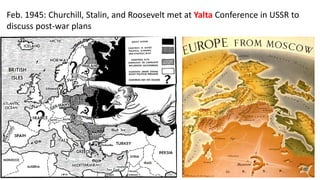
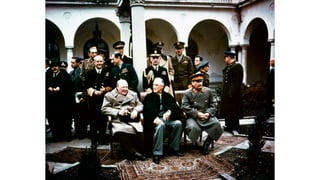
Feb. 1945: Churchill, Stalin, and Roosevelt met at Yalta Conference in USSR to
discuss post-war plans
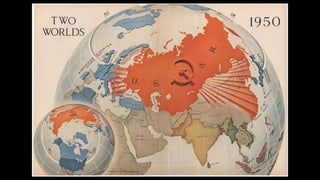
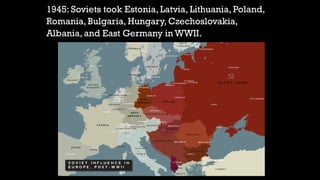
1945: Soviets took Estonia, Latvia, Lithuania, Poland,
Romania, Bulgaria, Hungary, Czechoslovakia,
Albania, and East Germany in WWII.
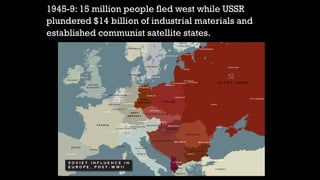
1945-9: 15 million people fled west while USSR
plundered $14 billion of industrial materials and
established communist satellite states.
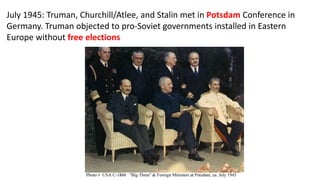
July 1945: Truman, Churchill/Atlee, and Stalin met in Potsdam Conference in
Germany. Truman objected to pro-Soviet governments installed in Eastern
Europe without free elections
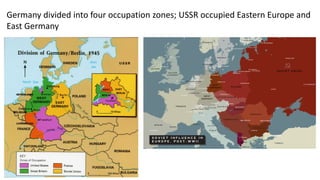
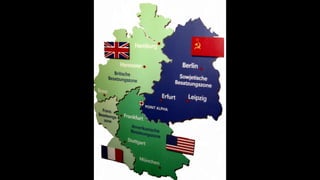
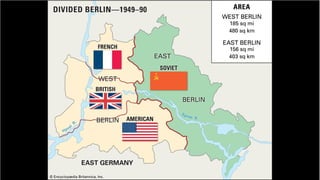
Germany divided into four occupation zones; USSR occupied Eastern Europe and
East Germany
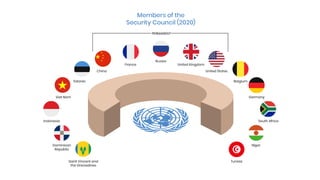
April 1945: first meeting of the United Nations
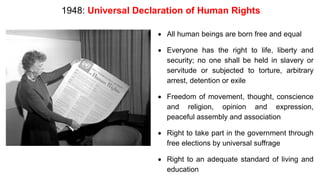
1948: Universal Declaration of Human Rights
• All human beings are born free and equal
• Everyone has the right to life, liberty and
security; no one shall be held in slavery or
servitude or subjected to torture, arbitrary
arrest, detention or exile
• Freedom of movement, thought, conscience
and religion, opinion and expression,
peaceful assembly and association
• Right to take part in the government through
free elections by universal suffrage
• Right to an adequate standard of living and
education
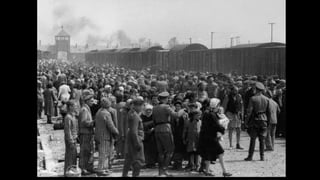
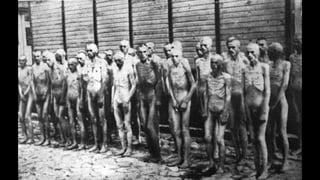
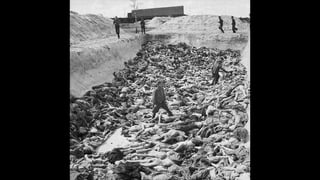
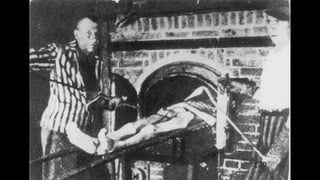
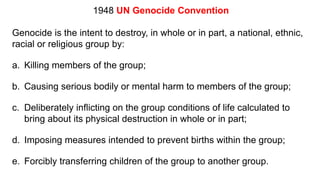
1948 UN Genocide Convention
Genocide is the intent to destroy, in whole or in part, a national, ethnic,
racial or religious group by:
a. Killing members of the group;
b. Causing serious bodily or mental harm to members of the group;
c. Deliberately inflicting on the group conditions of life calculated to
bring about its physical destruction in whole or in part;
d. Imposing measures intended to prevent births within the group;
e. Forcibly transferring children of the group to another group.
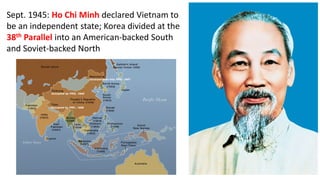
Sept. 1945: Ho Chi Minh declared Vietnam to
be an independent state; Korea divided at the
38th Parallel into an American-backed South
and Soviet-backed North
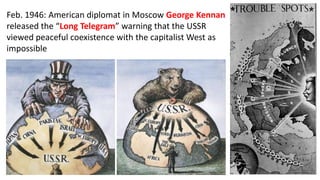
Feb. 1946: American diplomat in Moscow George Kennan
released the “Long Telegram” warning that the USSR
viewed peaceful coexistence with the capitalist West as
impossible
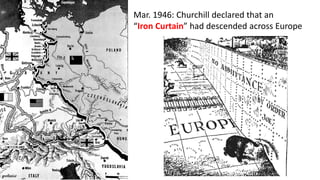
Mar. 1946: Churchill declared that an
“Iron Curtain” had descended across Europe
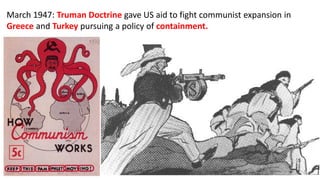
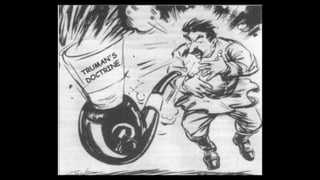
March 1947: Truman Doctrine gave US aid to fight communist expansion in
Greece and Turkey pursuing a policy of containment.
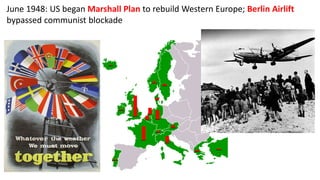
June 1948: US began Marshall Plan to rebuild Western Europe; Berlin Airlift
bypassed communist blockade
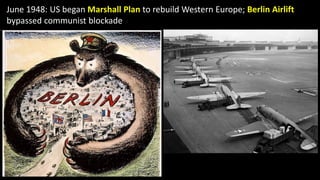
June 1948: US began Marshall Plan to rebuild Western Europe; Berlin Airlift
bypassed communist blockade
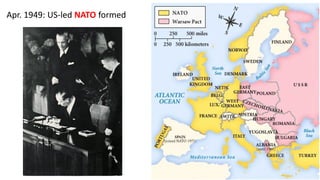
Apr. 1949: US-led NATO formed
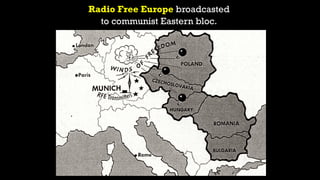
Radio Free Europe broadcasted
to communist Eastern bloc.
tps://www.youtube.com/watch?v=NF4LQaWJRDg
https://www.youtube.com/watch?v=E_Zozvmxat0
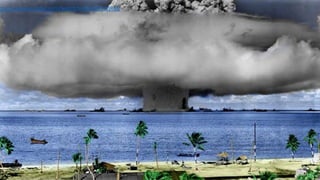
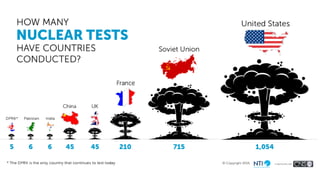
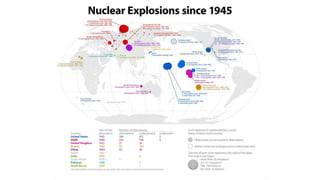
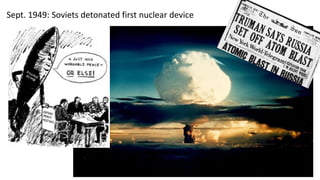
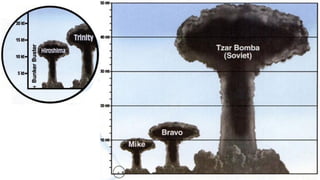
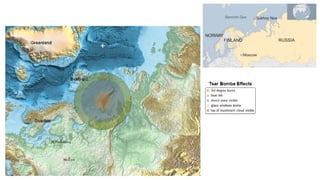
Sept. 1949: Soviets detonated first nuclear device
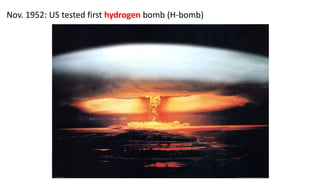
Nov. 1952: US tested first hydrogen bomb (H-bomb)
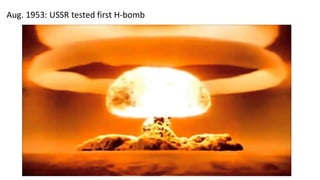
Aug. 1953: USSR tested first H-bomb
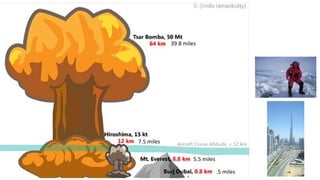
39.8 miles
7.5 miles
5.5 miles
.5 miles
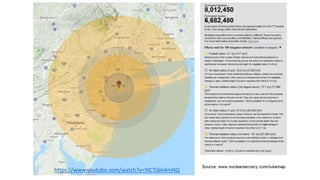
https://www.youtube.com/watch?v=YtCTzbh4mNQ
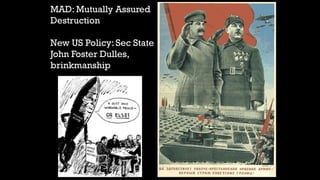
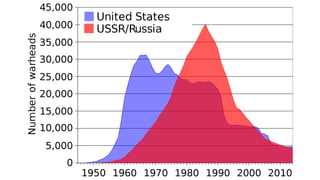
MAD: Mutually Assured
Destruction
New US Policy: Sec State
John Foster Dulles,
brinkmanship
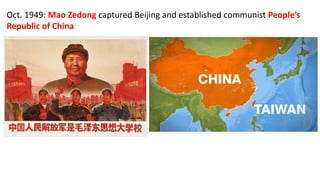
Oct. 1949: Mao Zedong captured Beijing and established communist People’s
Republic of China
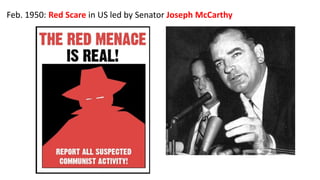
Feb. 1950: Red Scare in US led by Senator Joseph McCarthy
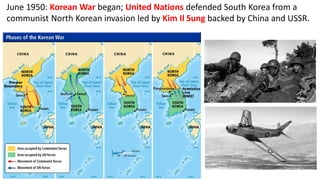
June 1950: Korean War began; United Nations defended South Korea from a
communist North Korean invasion led by Kim Il Sung backed by China and USSR.
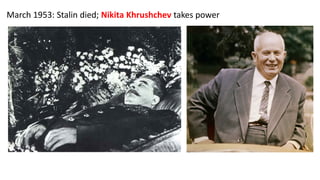
March 1953: Stalin died; Nikita Khrushchev takes power
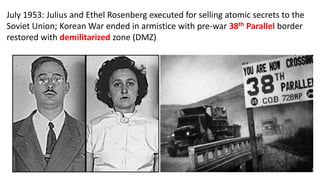
July 1953: Julius and Ethel Rosenberg executed for selling atomic secrets to the
Soviet Union; Korean War ended in armistice with pre-war 38th Parallel border
restored with demilitarized zone (DMZ)
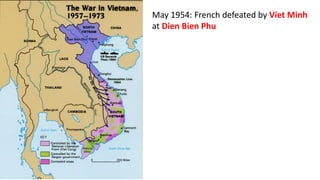
May 1954: French defeated by Viet Minh
at Dien Bien Phu
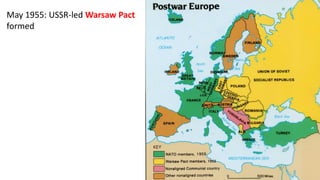
May 1955: USSR-led Warsaw Pact
formed
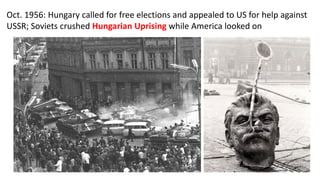
Oct. 1956: Hungary called for free elections and appealed to US for help against
USSR; Soviets crushed Hungarian Uprising while America looked on
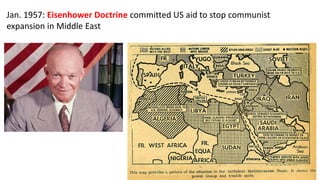
Jan. 1957: Eisenhower Doctrine committed US aid to stop communist
expansion in Middle East
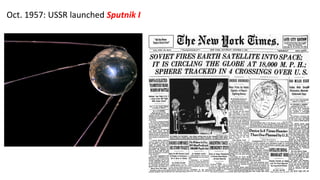
Oct. 1957: USSR launched Sputnik I
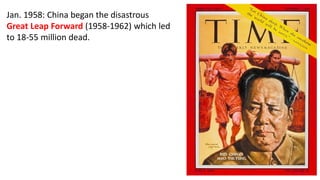
Jan. 1958: China began the disastrous
Great Leap Forward (1958-1962) which led
to 18-55 million dead.
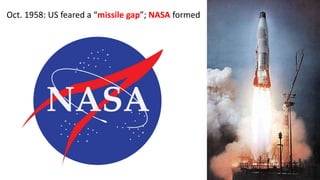
Oct. 1958: US feared a “missile gap”; NASA formed
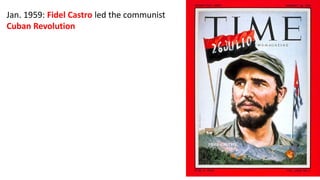
Jan. 1959: Fidel Castro led the communist
Cuban Revolution
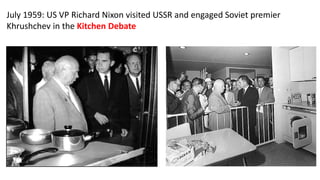
July 1959: US VP Richard Nixon visited USSR and engaged Soviet premier
Khrushchev in the Kitchen Debate
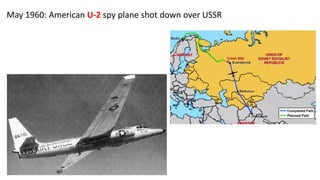
May 1960: American U-2 spy plane shot down over USSR
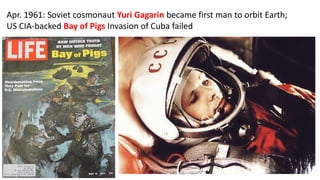
Apr. 1961: Soviet cosmonaut Yuri Gagarin became first man to orbit Earth;
US CIA-backed Bay of Pigs Invasion of Cuba failed
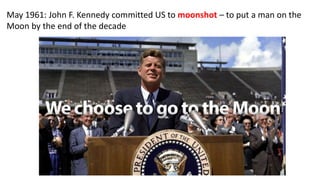
May 1961: John F. Kennedy committed US to moonshot – to put a man on the
Moon by the end of the decade
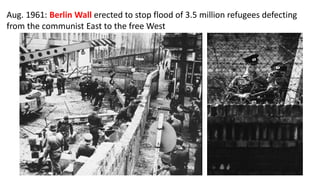
Aug. 1961: Berlin Wall erected to stop flood of 3.5 million refugees defecting
from the communist East to the free West
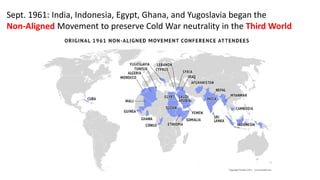
Sept. 1961: India, Indonesia, Egypt, Ghana, and Yugoslavia began the
Non-Aligned Movement to preserve Cold War neutrality in the Third World
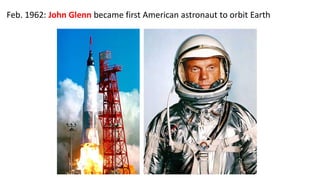
Feb. 1962: John Glenn became first American astronaut to orbit Earth
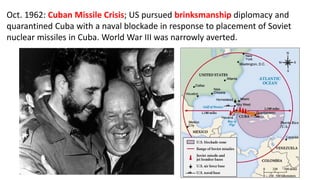
Oct. 1962: Cuban Missile Crisis; US pursued brinksmanship diplomacy and
quarantined Cuba with a naval blockade in response to placement of Soviet
nuclear missiles in Cuba. World War III was narrowly averted.

The Early Cold War, 1945-1962.pdf

  • 9.
    Aug. 1945: USused atomic bombs (A-bomb) on Japan; USSR invaded Japanese- occupied Manchuria; Japan surrendered
  • 18.
    Totalitarian Democratic Totalitarian ThePolitical Spectrum Post-World War I Liberalism • Late 1700s in American and French Revolutions • Civil liberties – freedom of expression • Limited government by constitution • Legal equality of all social classes • Benefited middle class most • Multi-party democracy – US, France, Britain Conservatism • Authoritarian traditional social order • Dominance of upper class social elites – nobles, church officials, moneyed interests • Maintain military rule by kings or dictators • Pre-WWI: Germany, Austria- Hungary, Russia, Ottoman Empire Fascism • 1920s • Replace militaristic king w/ militaristic dictator • Totalitarian state by one-party dictatorship • Ultra-nationalist • Anti-communist • Social Darwinian expansion • Italy (1922) Nazism • Racial superiority • Germany (1933) Socialism • Mid-1800s in Industrial Revolution • Legal and economic equality • Benefited lower working class/proletariat • Government ownership of means of production – factories, mines, power, transportation, communication • Legal reform and labor union activism Communism • Mid-1800s • Complete economic equality to create classless system • Anti-bourgeoisie • Government ownership of means of production – factories, mines, power, transportation, communication • Totalitarian state by one-party dictatorship • USSR (1917)
  • 19.
    Feb. 1945: Churchill,Stalin, and Roosevelt met at Yalta Conference in USSR to discuss post-war plans
  • 21.
    1945: Soviets tookEstonia, Latvia, Lithuania, Poland, Romania, Bulgaria, Hungary, Czechoslovakia, Albania, and East Germany in WWII.
  • 22.
    1945-9: 15 millionpeople fled west while USSR plundered $14 billion of industrial materials and established communist satellite states.
  • 23.
    July 1945: Truman,Churchill/Atlee, and Stalin met in Potsdam Conference in Germany. Truman objected to pro-Soviet governments installed in Eastern Europe without free elections
  • 24.
    Germany divided intofour occupation zones; USSR occupied Eastern Europe and East Germany
  • 27.
    April 1945: firstmeeting of the United Nations
  • 29.
    1948: Universal Declarationof Human Rights • All human beings are born free and equal • Everyone has the right to life, liberty and security; no one shall be held in slavery or servitude or subjected to torture, arbitrary arrest, detention or exile • Freedom of movement, thought, conscience and religion, opinion and expression, peaceful assembly and association • Right to take part in the government through free elections by universal suffrage • Right to an adequate standard of living and education
  • 34.
    1948 UN GenocideConvention Genocide is the intent to destroy, in whole or in part, a national, ethnic, racial or religious group by: a. Killing members of the group; b. Causing serious bodily or mental harm to members of the group; c. Deliberately inflicting on the group conditions of life calculated to bring about its physical destruction in whole or in part; d. Imposing measures intended to prevent births within the group; e. Forcibly transferring children of the group to another group.
  • 36.
    Sept. 1945: HoChi Minh declared Vietnam to be an independent state; Korea divided at the 38th Parallel into an American-backed South and Soviet-backed North
  • 37.
    Feb. 1946: Americandiplomat in Moscow George Kennan released the “Long Telegram” warning that the USSR viewed peaceful coexistence with the capitalist West as impossible
  • 38.
    Mar. 1946: Churchilldeclared that an “Iron Curtain” had descended across Europe
  • 39.
    March 1947: TrumanDoctrine gave US aid to fight communist expansion in Greece and Turkey pursuing a policy of containment.
  • 41.
    June 1948: USbegan Marshall Plan to rebuild Western Europe; Berlin Airlift bypassed communist blockade
  • 42.
    June 1948: USbegan Marshall Plan to rebuild Western Europe; Berlin Airlift bypassed communist blockade
  • 43.
    Apr. 1949: US-ledNATO formed
  • 44.
    Radio Free Europebroadcasted to communist Eastern bloc.
  • 45.
  • 48.
  • 49.
    Sept. 1949: Sovietsdetonated first nuclear device
  • 50.
    Nov. 1952: UStested first hydrogen bomb (H-bomb)
  • 51.
    Aug. 1953: USSRtested first H-bomb
  • 53.
  • 57.
  • 58.
    MAD: Mutually Assured Destruction NewUS Policy: Sec State John Foster Dulles, brinkmanship
  • 61.
    Oct. 1949: MaoZedong captured Beijing and established communist People’s Republic of China
  • 62.
    Feb. 1950: RedScare in US led by Senator Joseph McCarthy
  • 63.
    June 1950: KoreanWar began; United Nations defended South Korea from a communist North Korean invasion led by Kim Il Sung backed by China and USSR.
  • 64.
    March 1953: Stalindied; Nikita Khrushchev takes power
  • 65.
    July 1953: Juliusand Ethel Rosenberg executed for selling atomic secrets to the Soviet Union; Korean War ended in armistice with pre-war 38th Parallel border restored with demilitarized zone (DMZ)
  • 66.
    May 1954: Frenchdefeated by Viet Minh at Dien Bien Phu
  • 67.
    May 1955: USSR-ledWarsaw Pact formed
  • 68.
    Oct. 1956: Hungarycalled for free elections and appealed to US for help against USSR; Soviets crushed Hungarian Uprising while America looked on
  • 69.
    Jan. 1957: EisenhowerDoctrine committed US aid to stop communist expansion in Middle East
  • 70.
    Oct. 1957: USSRlaunched Sputnik I
  • 71.
    Jan. 1958: Chinabegan the disastrous Great Leap Forward (1958-1962) which led to 18-55 million dead.
  • 72.
    Oct. 1958: USfeared a “missile gap”; NASA formed
  • 73.
    Jan. 1959: FidelCastro led the communist Cuban Revolution
  • 74.
    July 1959: USVP Richard Nixon visited USSR and engaged Soviet premier Khrushchev in the Kitchen Debate
  • 75.
    May 1960: AmericanU-2 spy plane shot down over USSR
  • 76.
    Apr. 1961: Sovietcosmonaut Yuri Gagarin became first man to orbit Earth; US CIA-backed Bay of Pigs Invasion of Cuba failed
  • 77.
    May 1961: JohnF. Kennedy committed US to moonshot – to put a man on the Moon by the end of the decade
  • 78.
    Aug. 1961: BerlinWall erected to stop flood of 3.5 million refugees defecting from the communist East to the free West
  • 79.
    Sept. 1961: India,Indonesia, Egypt, Ghana, and Yugoslavia began the Non-Aligned Movement to preserve Cold War neutrality in the Third World
  • 80.
    Feb. 1962: JohnGlenn became first American astronaut to orbit Earth
  • 81.
    Oct. 1962: CubanMissile Crisis; US pursued brinksmanship diplomacy and quarantined Cuba with a naval blockade in response to placement of Soviet nuclear missiles in Cuba. World War III was narrowly averted.