Influences
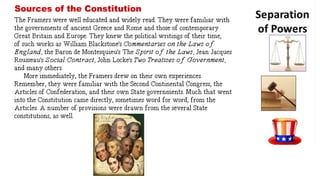
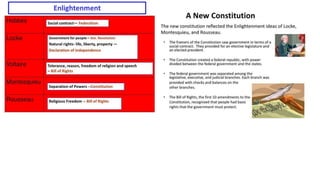
• The Framers were familiar with
the political writings of their
time, such as works by Jean
Jacques Rousseau and John
Locke.
• They also were seasoned,
variously, by the Second
Continental Congress, the
Articles of Confederation and
experiences with their own State
governments.
Reactions
• When the Constitution was complete, the
Framers’ opinions of their work varied.
Some were disappointed, like George
Mason of Virginia, who opposed the
Constitution until his death in 1792.
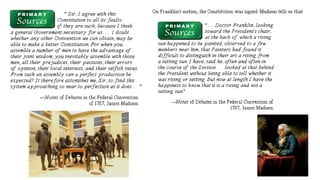
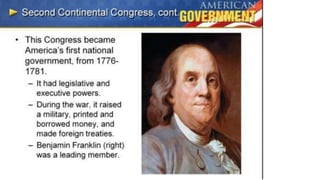
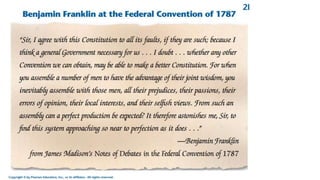
• Most agreed with Ben Franklin’s thoughts
when he said,
“From such an assembly [of fallible men]
can a perfect production be expected?
It…astonishes me, Sir, to find this system
approaching so near to perfection as it
does…”
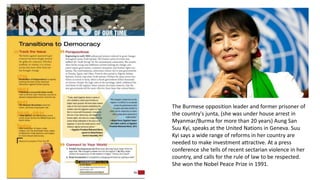
The Burmese opposition leader and former prisoner of
the country's junta, (she was under house arrest in
Myanmar/Burma for more than 20 years) Aung San
Suu Kyi, speaks at the United Nations in Geneva. Suu
Kyi says a wide range of reforms in her country are
needed to make investment attractive. At a press
conference she tells of recent sectarian violence in her
country, and calls for the rule of law to be respected.
She won the Nobel Peace Prize in 1991.
Section 1 Review
1. All of the following are basic concepts of government brought to the
colonies by English settlers EXCEPT
(a) the need for limited government.
(b) the need for a representative government.
(c) the need for an autocratic government.
(d) the need for an ordered social system.
2. Which of the following was not one of the rights granted in the Magna
Carta?
(a) The right to private property.
(b) The right to a trial by jury.
(c) The right to freedom of religion.
(d) The right to undergo due process of the law.
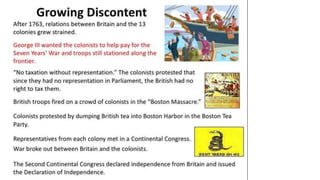
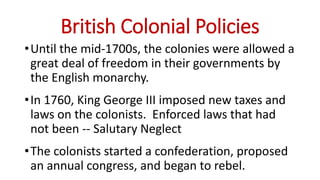
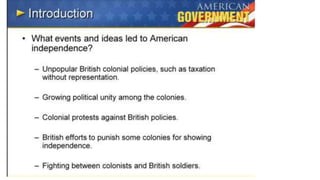
British Colonial Policies
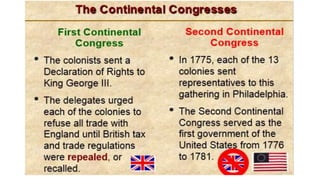
•Until the mid-1700s, the colonies were allowed a
great deal of freedom in their governments by
the English monarchy.
•In 1760, King George III imposed new taxes and
laws on the colonists. Enforced laws that had
not been -- Salutary Neglect
•The colonists started a confederation, proposed
an annual congress, and began to rebel.
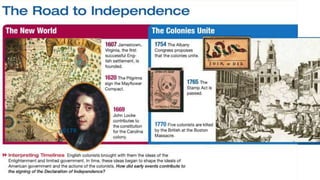
Growing Colonial
Unity
Early Attempts
• In 1643, several New
England settlements
formed the New
England Confederation.
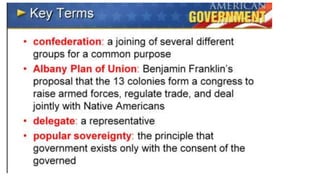
•A confederation is a
joining of several
groups for a common
purpose.
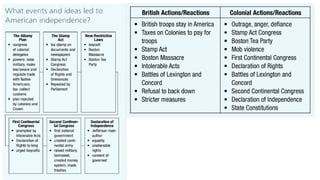
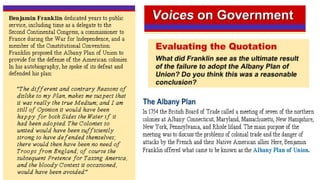
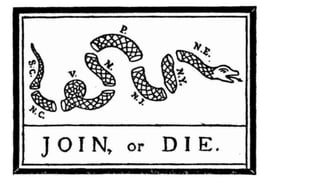
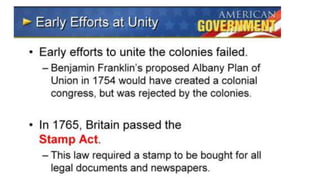
The Albany Plan of Union
•In 1754, Benjamin Franklin
proposed the Albany Plan
of Union, in which an
annual congress of
delegates (representatives)
from each of the 13
colonies would be formed,
primarily for the common
defense of the colonies on
their own.
•It failed.
• In 1765, a group of colonies
sent delegates to the Stamp
Act Congress in New York.
• These delegates prepared the
Declaration of Rights and
Grievances against British
policies and sent it to the king.
• Taxes in America were not all that
high! Average Londoner was paying
much more.
• Taxes were placed on tea, playing
cards, licenses, deeds, alcohol, any
imported good or finished product.
• England needed the $$$-foreign
wars cost big bucks!
• It was just that we had gotten away
without paying these taxes before,
or we had smuggled in goods and
had avoided paying any at all. Now
that England was enforcing her
laws—we cry foul!
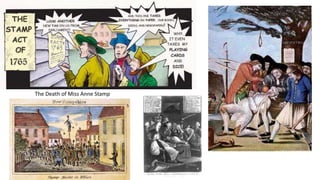
The Stamp Act
Congress
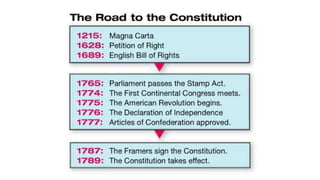
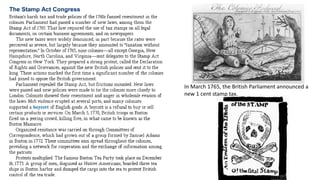
In March 1765, the British Parliament announced a
new 1 cent stamp tax.
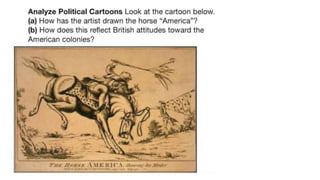
The Death of Miss Anne Stamp
“The Bostonians paying the excise-man, or
tarring and feathering,” Philip Dawe [?], 1774 .
This tinted engraving depicts the tarring and feathering of John
Malcolm, a Commissioner of Customs, by the Sons of Liberty a
little less than a decade after the Stamp Act protests.
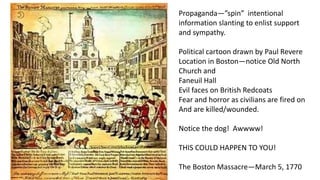
Propaganda—”spin” intentional
information slanting to enlist support
and sympathy.
Political cartoon drawn by Paul Revere
Location in Boston—notice Old North
Church and
Faneuil Hall
Evil faces on British Redcoats
Fear and horror as civilians are fired on
And are killed/wounded.
Notice the dog! Awwww!
THIS COULD HAPPEN TO YOU!
The Boston Massacre—March 5, 1770
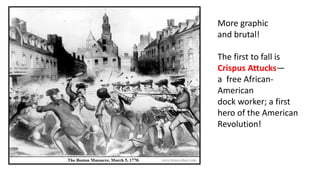
More graphic
and brutal!
The first to fall is
Crispus Attucks—
a free African-
American
dock worker; a first
hero of the American
Revolution!
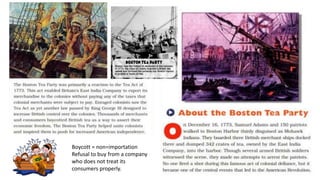
Boycott = non=importation
Refusal to buy from a company
who does not treat its
consumers properly.
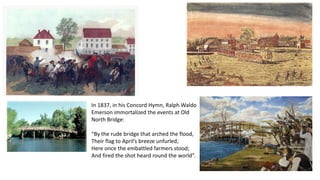
In 1837, in his Concord Hymn, Ralph Waldo
Emerson immortalized the events at Old
North Bridge:
“By the rude bridge that arched the flood,
Their flag to April’s breeze unfurled;
Here once the embattled farmers stood;
And fired the shot heard round the world”.
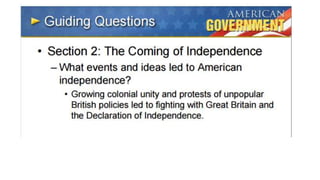
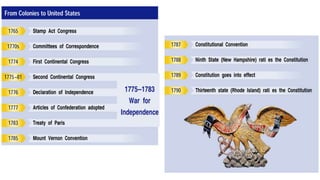
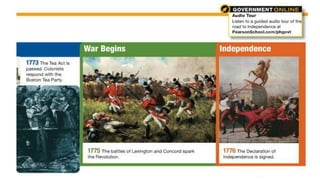
American Independence
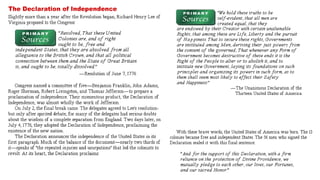
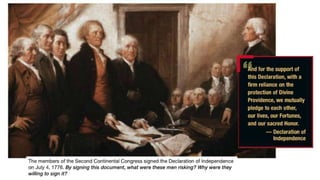
•On July 4, 1776, the Second Continental
Congress adopted the Declaration of
Independence.
•Between 1776 and 1777, most of the States
adopted constitutions instead of charters.
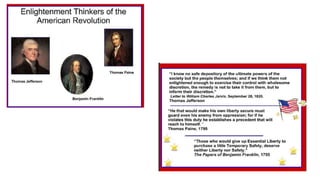
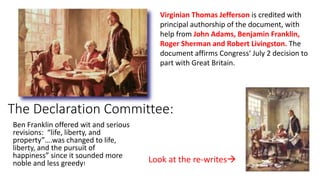
Virginian Thomas Jefferson is credited with
principal authorship of the document, with
help from John Adams, Benjamin Franklin,
Roger Sherman and Robert Livingston. The
document affirms Congress‘ July 2 decision to
part with Great Britain.
The Declaration Committee:
Look at the re-writes
Ben Franklin offered wit and serious
revisions: “life, liberty, and
property”….was changed to life,
liberty, and the pursuit of
happiness” since it sounded more
noble and less greedy!
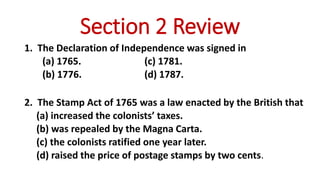
Section 2 Review
1. The Declaration of Independence was signed in
(a) 1765. (c) 1781.
(b) 1776. (d) 1787.
2. The Stamp Act of 1765 was a law enacted by the British that
(a) increased the colonists’ taxes.
(b) was repealed by the Magna Carta.
(c) the colonists ratified one year later.
(d) raised the price of postage stamps by two cents.
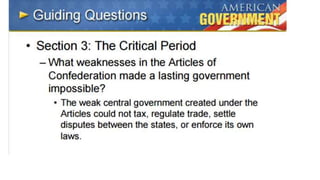
Section 3 Review
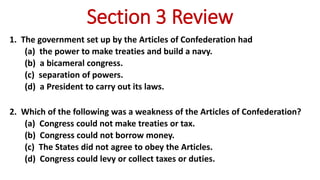
1. The government set up by the Articles of Confederation had
(a) the power to make treaties and build a navy.
(b) a bicameral congress.
(c) separation of powers.
(d) a President to carry out its laws.
2. Which of the following was a weakness of the Articles of Confederation?
(a) Congress could not make treaties or tax.
(b) Congress could not borrow money.
(c) The States did not agree to obey the Articles.
(d) Congress could levy or collect taxes or duties.
Influences
• The Framers were familiar with
the political writings of their
time, such as works by Jean
Jacques Rousseau and John
Locke.
• They also were seasoned,
variously, by the Second
Continental Congress, the
Articles of Confederation and
experiences with their own State
governments.
Reactions
• When the Constitution was complete, the
Framers’ opinions of their work varied.
Some were disappointed, like George
Mason of Virginia, who opposed the
Constitution until his death in 1792.
• Most agreed with Ben Franklin’s thoughts
when he said,
“From such an assembly [of fallible men]
can a perfect production be expected?
It…astonishes me, Sir, to find this system
approaching so near to perfection as it
does…”
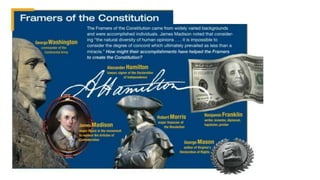
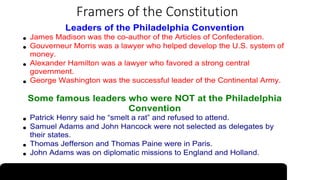
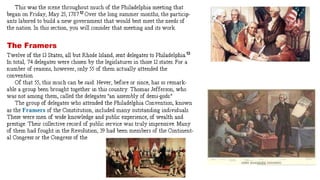
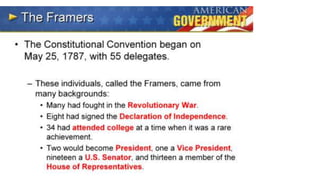
Framers of the Constitution
Leaders of the Philadelphia Convention
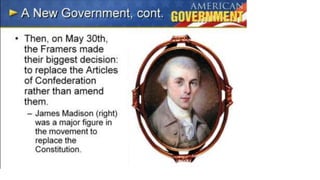
 James Madison was the co-author of the Articles of Confederation.
 Gouverneur Morris was a lawyer who helped develop the U.S. system of
money.
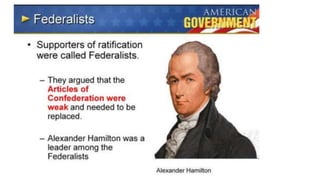
 Alexander Hamilton was a lawyer who favored a strong central
government.
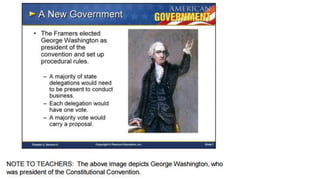
 George Washington was the successful leader of the Continental Army.
Some famous leaders who were NOT at the Philadelphia
Convention
 Patrick Henry said he “smelt a rat” and refused to attend.
 Samuel Adams and John Hancock were not selected as delegates by
their states.
 Thomas Jefferson and Thomas Paine were in Paris.
 John Adams was on diplomatic missions to England and Holland.
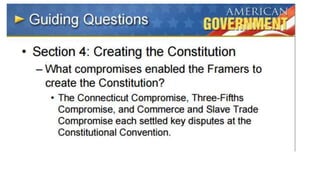
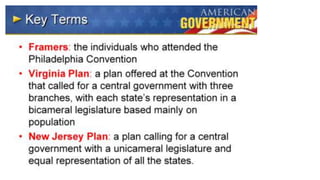
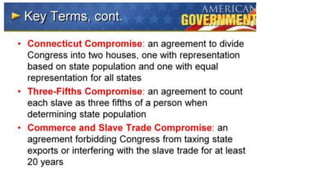
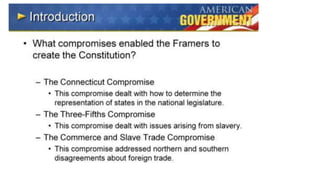
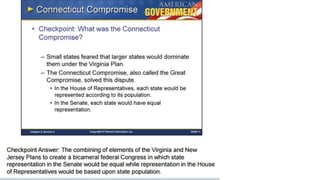
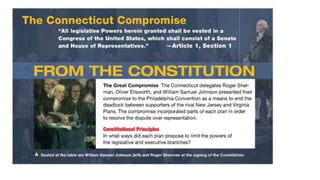
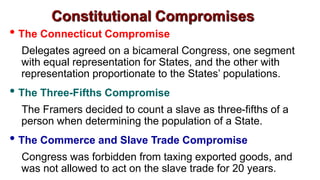
• The Connecticut Compromise
Delegates agreed on a bicameral Congress, one segment
with equal representation for States, and the other with
representation proportionate to the States’ populations.
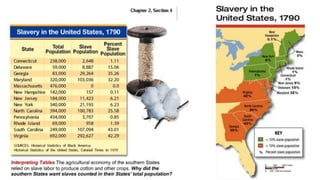
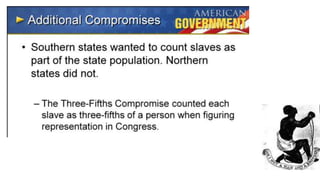
• The Three-Fifths Compromise
The Framers decided to count a slave as three-fifths of a
person when determining the population of a State.
• The Commerce and Slave Trade Compromise
Congress was forbidden from taxing exported goods, and
was not allowed to act on the slave trade for 20 years.
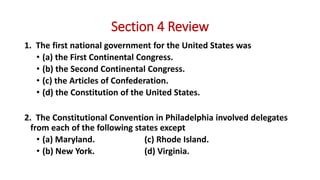
Section 4 Review
1. The first national government for the United States was
• (a) the First Continental Congress.
• (b) the Second Continental Congress.
• (c) the Articles of Confederation.
• (d) the Constitution of the United States.
2. The Constitutional Convention in Philadelphia involved delegates
from each of the following states except
• (a) Maryland. (c) Rhode Island.
• (b) New York. (d) Virginia.
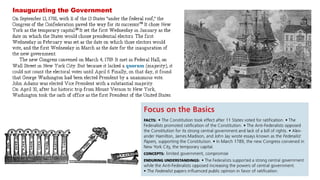
Inaugurating the Government
• The new Congress met for the first time on March 4,
1789.
• Congress finally attained a quorum (majority) on April
6 and counted the electoral votes. Congress found
that George Washington had been unanimously
elected President. He was inaugurated on April 30.
Precedents:
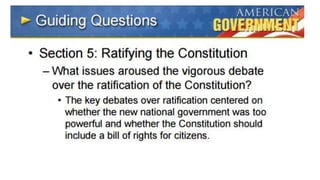
Section 5 Review
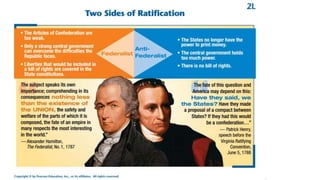
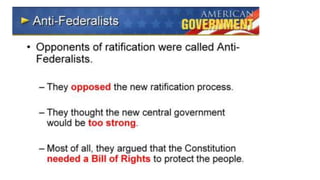
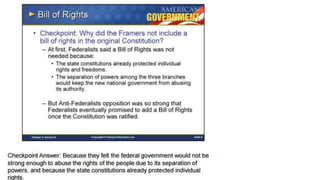
1. The debate over the ratification of the Constitution was
won by the
(a) Anti-Federalists. (c) Whigs.
(b) Federalists. (d) Tories.
2. The temporary capital of the United States where
Congress met in 1789 was
(a) Washington, D.C. (c) Philadelphia.
(b) New York. (d) Mount Vernon.

Ch2 Am Gov

  • 33.
    Influences • The Framerswere familiar with the political writings of their time, such as works by Jean Jacques Rousseau and John Locke. • They also were seasoned, variously, by the Second Continental Congress, the Articles of Confederation and experiences with their own State governments. Reactions • When the Constitution was complete, the Framers’ opinions of their work varied. Some were disappointed, like George Mason of Virginia, who opposed the Constitution until his death in 1792. • Most agreed with Ben Franklin’s thoughts when he said, “From such an assembly [of fallible men] can a perfect production be expected? It…astonishes me, Sir, to find this system approaching so near to perfection as it does…”
  • 39.
    The Burmese oppositionleader and former prisoner of the country's junta, (she was under house arrest in Myanmar/Burma for more than 20 years) Aung San Suu Kyi, speaks at the United Nations in Geneva. Suu Kyi says a wide range of reforms in her country are needed to make investment attractive. At a press conference she tells of recent sectarian violence in her country, and calls for the rule of law to be respected. She won the Nobel Peace Prize in 1991.
  • 40.
    Section 1 Review 1.All of the following are basic concepts of government brought to the colonies by English settlers EXCEPT (a) the need for limited government. (b) the need for a representative government. (c) the need for an autocratic government. (d) the need for an ordered social system. 2. Which of the following was not one of the rights granted in the Magna Carta? (a) The right to private property. (b) The right to a trial by jury. (c) The right to freedom of religion. (d) The right to undergo due process of the law.
  • 45.
    British Colonial Policies •Untilthe mid-1700s, the colonies were allowed a great deal of freedom in their governments by the English monarchy. •In 1760, King George III imposed new taxes and laws on the colonists. Enforced laws that had not been -- Salutary Neglect •The colonists started a confederation, proposed an annual congress, and began to rebel.
  • 53.
    Growing Colonial Unity Early Attempts •In 1643, several New England settlements formed the New England Confederation. •A confederation is a joining of several groups for a common purpose. The Albany Plan of Union •In 1754, Benjamin Franklin proposed the Albany Plan of Union, in which an annual congress of delegates (representatives) from each of the 13 colonies would be formed, primarily for the common defense of the colonies on their own. •It failed.
  • 59.
    • In 1765,a group of colonies sent delegates to the Stamp Act Congress in New York. • These delegates prepared the Declaration of Rights and Grievances against British policies and sent it to the king. • Taxes in America were not all that high! Average Londoner was paying much more. • Taxes were placed on tea, playing cards, licenses, deeds, alcohol, any imported good or finished product. • England needed the $$$-foreign wars cost big bucks! • It was just that we had gotten away without paying these taxes before, or we had smuggled in goods and had avoided paying any at all. Now that England was enforcing her laws—we cry foul! The Stamp Act Congress
  • 60.
    In March 1765,the British Parliament announced a new 1 cent stamp tax.
  • 62.
    The Death ofMiss Anne Stamp
  • 63.
    “The Bostonians payingthe excise-man, or tarring and feathering,” Philip Dawe [?], 1774 . This tinted engraving depicts the tarring and feathering of John Malcolm, a Commissioner of Customs, by the Sons of Liberty a little less than a decade after the Stamp Act protests.
  • 64.
    Propaganda—”spin” intentional information slantingto enlist support and sympathy. Political cartoon drawn by Paul Revere Location in Boston—notice Old North Church and Faneuil Hall Evil faces on British Redcoats Fear and horror as civilians are fired on And are killed/wounded. Notice the dog! Awwww! THIS COULD HAPPEN TO YOU! The Boston Massacre—March 5, 1770
  • 65.
    More graphic and brutal! Thefirst to fall is Crispus Attucks— a free African- American dock worker; a first hero of the American Revolution!
  • 66.
    Boycott = non=importation Refusalto buy from a company who does not treat its consumers properly.
  • 68.
    In 1837, inhis Concord Hymn, Ralph Waldo Emerson immortalized the events at Old North Bridge: “By the rude bridge that arched the flood, Their flag to April’s breeze unfurled; Here once the embattled farmers stood; And fired the shot heard round the world”.
  • 74.
    American Independence •On July4, 1776, the Second Continental Congress adopted the Declaration of Independence. •Between 1776 and 1777, most of the States adopted constitutions instead of charters.
  • 75.
    Virginian Thomas Jeffersonis credited with principal authorship of the document, with help from John Adams, Benjamin Franklin, Roger Sherman and Robert Livingston. The document affirms Congress‘ July 2 decision to part with Great Britain. The Declaration Committee: Look at the re-writes Ben Franklin offered wit and serious revisions: “life, liberty, and property”….was changed to life, liberty, and the pursuit of happiness” since it sounded more noble and less greedy!
  • 85.
    Section 2 Review 1.The Declaration of Independence was signed in (a) 1765. (c) 1781. (b) 1776. (d) 1787. 2. The Stamp Act of 1765 was a law enacted by the British that (a) increased the colonists’ taxes. (b) was repealed by the Magna Carta. (c) the colonists ratified one year later. (d) raised the price of postage stamps by two cents.
  • 104.
    Section 3 Review 1.The government set up by the Articles of Confederation had (a) the power to make treaties and build a navy. (b) a bicameral congress. (c) separation of powers. (d) a President to carry out its laws. 2. Which of the following was a weakness of the Articles of Confederation? (a) Congress could not make treaties or tax. (b) Congress could not borrow money. (c) The States did not agree to obey the Articles. (d) Congress could levy or collect taxes or duties.
  • 105.
    Influences • The Framerswere familiar with the political writings of their time, such as works by Jean Jacques Rousseau and John Locke. • They also were seasoned, variously, by the Second Continental Congress, the Articles of Confederation and experiences with their own State governments. Reactions • When the Constitution was complete, the Framers’ opinions of their work varied. Some were disappointed, like George Mason of Virginia, who opposed the Constitution until his death in 1792. • Most agreed with Ben Franklin’s thoughts when he said, “From such an assembly [of fallible men] can a perfect production be expected? It…astonishes me, Sir, to find this system approaching so near to perfection as it does…”
  • 109.
    Framers of theConstitution Leaders of the Philadelphia Convention  James Madison was the co-author of the Articles of Confederation.  Gouverneur Morris was a lawyer who helped develop the U.S. system of money.  Alexander Hamilton was a lawyer who favored a strong central government.  George Washington was the successful leader of the Continental Army. Some famous leaders who were NOT at the Philadelphia Convention  Patrick Henry said he “smelt a rat” and refused to attend.  Samuel Adams and John Hancock were not selected as delegates by their states.  Thomas Jefferson and Thomas Paine were in Paris.  John Adams was on diplomatic missions to England and Holland.
  • 132.
    • The ConnecticutCompromise Delegates agreed on a bicameral Congress, one segment with equal representation for States, and the other with representation proportionate to the States’ populations. • The Three-Fifths Compromise The Framers decided to count a slave as three-fifths of a person when determining the population of a State. • The Commerce and Slave Trade Compromise Congress was forbidden from taxing exported goods, and was not allowed to act on the slave trade for 20 years.
  • 134.
    Section 4 Review 1.The first national government for the United States was • (a) the First Continental Congress. • (b) the Second Continental Congress. • (c) the Articles of Confederation. • (d) the Constitution of the United States. 2. The Constitutional Convention in Philadelphia involved delegates from each of the following states except • (a) Maryland. (c) Rhode Island. • (b) New York. (d) Virginia.
  • 155.
    Inaugurating the Government •The new Congress met for the first time on March 4, 1789. • Congress finally attained a quorum (majority) on April 6 and counted the electoral votes. Congress found that George Washington had been unanimously elected President. He was inaugurated on April 30.
  • 157.
  • 162.
    Section 5 Review 1.The debate over the ratification of the Constitution was won by the (a) Anti-Federalists. (c) Whigs. (b) Federalists. (d) Tories. 2. The temporary capital of the United States where Congress met in 1789 was (a) Washington, D.C. (c) Philadelphia. (b) New York. (d) Mount Vernon.