The Cognitive Theory of Multimedia LearningAn Overview & Research Implications
“Click Next to Continue”
Cognitive Theory of Multimedia Learning
What is Multimedia Learning?
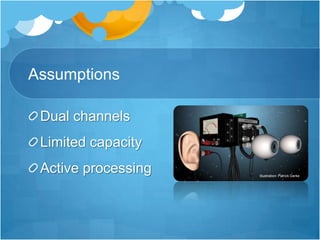
AssumptionsDual channelsLimited capacityActive processingIllustration: Patrick Gerke
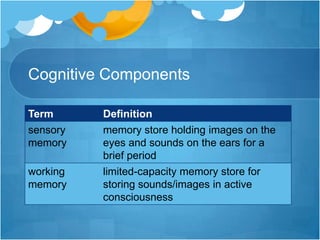
Cognitive Components
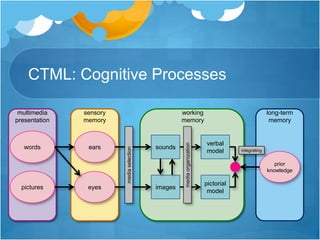
CTML: Cognitive Processesmultimedia presentationsensory memoryworking memorylong-term memorywordsearssoundsverbal modelintegratingprior knowledgemedia selectionmedia organizationpictureseyesimagespictorial model
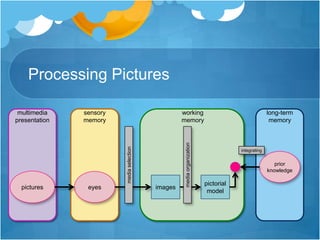
Processing Picturesmultimedia presentationsensory memoryworking memorylong-term memoryintegratingprior knowledgemedia selectionmedia organizationpictureseyesimagespictorial model
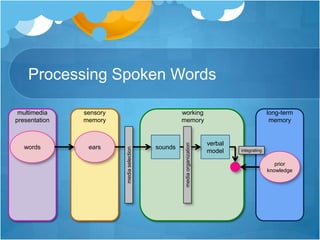
Processing Spoken Wordsmultimedia presentationsensory memoryworking memorylong-term memorywordsearssoundsverbal modelintegratingprior knowledgemedia selectionmedia organization
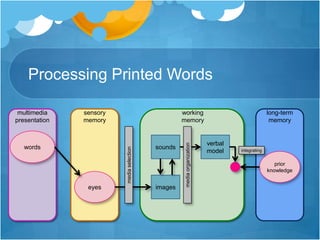
Processing Printed Wordsmultimedia presentationsensory memoryworking memorylong-term memorywordssoundsverbal modelintegratingprior knowledgemedia selectionmedia organizationeyesimages
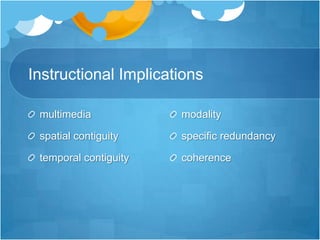
Instructional Implicationsmultimediaspatial contiguitytemporal contiguitymodalityspecific redundancycoherence
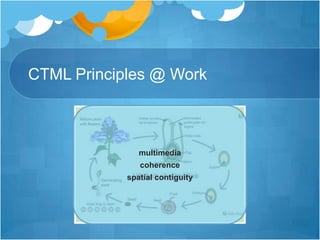
CTML Principles @ Workmultimediacoherencespatial contiguity
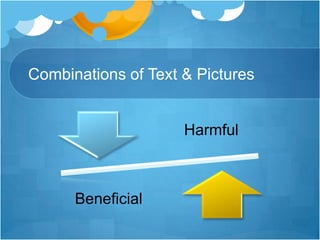
Combinations of Text & Pictures
The Cognitive Theory of Multimedia Learning

The Cognitive Theory of Multimedia Learning

Editor's Notes

  • #3 Who has taken the IRB online training? Did you learn how to “click next”?
  • #5 Note that hypermedia includes multimedia.
  • #6 Pavio (1986) & Baddeley (1986, 1999) tell us that humans possess separate channels for processing visual and auditory information.Baddeley (1986, 1999), Chandler & Sweller (1991) showed us that humans are limited in the amount of information that can be processed each channel at one time.Mayer (2001) & Wittrock (1989) propose that humans engage in active learning by attending to relevant incoming information, organizing selected information into coherent mental representations, and integrating mental representations with other knowledge.
  • #7 Media selection occurs when the learner pays attention to relevant words in a message to create sounds/images in working memoryMedia organization occurs when the learner builds a connection between selected sounds/images to create a coherent model in working memory.
  • #12 Multimedia principle – Use text combined with content-related pictures, when learners have low prior knowledge, but sufficient cognitive abilities to process both the text and picturesSpatial contiguity principle – If written text is used, present it in close spatial proximity to the pictureTemporal contiguity principle – If spoken text is used, present it in close spatial proximity to the pictureModality principle – If animation is used, use spoken text instead of written textSpecific redundancy principle – Do not add written text that duplicates spoken text combined with picturesCoherence principle – Do not use extraneous words and pictures. Do not add unnecessary sound or music.
  • #13 1. multimedia (text + pictures)2. spatial contiguity (text + pictures in close proximity)3. DOES NOT use modality (uses written instead of spoken)4. coherence (only uses relevant images)
  • #14 In 2005, Wolfgang Schnotz stated that, “Further research is…needed to predict more precisely under which conditions the combination of text and pictures is beneficial and under which circumstances it is harmful for learning.
  • #15 Savannah