Cognitive Theory of Multimedia
Raed Mohammad P-PM 0334/12
Basheer Obidat P_PM 0152/12
Falih Shahri P_PM 094/12
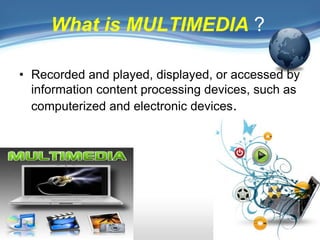
What is MULTIMEDIA ?
• Recorded and played, displayed, or accessed by
information content processing devices, such as
computerized and electronic devices.
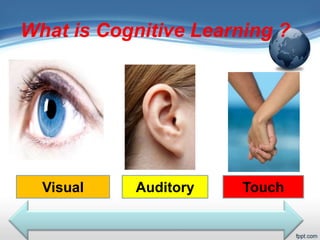
What is Cognitive Learning ?
Visual Auditory Touch
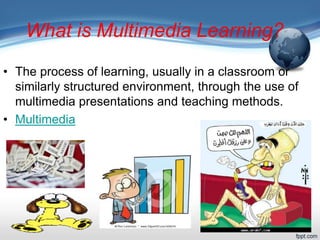
What is Multimedia Learning?
• The process of learning, usually in a classroom or
similarly structured environment, through the use of
multimedia presentations and teaching methods.
• Multimedia
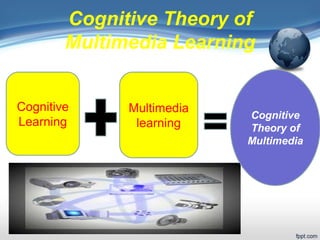
Cognitive Theory of
Multimedia Learning
Cognitive
Learning
Multimedia
learning
Cognitive
Theory of
Multimedia
Cognitive Theory of Multimedia
• An advanced theory that describes learning
from words and images.
• Increasing Multimedia Design..
• Increases Learning for Learner..
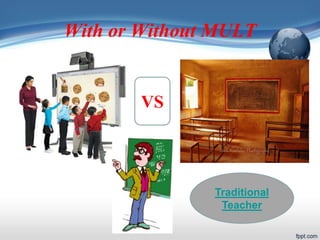
With or Without MULT
VS
Traditional
Teacher
Characteristics
• Without Multimedia..
• Traditional type of instructions.
• Lacks the use of supplemental materials
• With Multimedia..
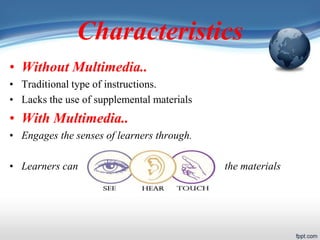
• Engages the senses of learners through.
• Learners can the materials
The Proof ?
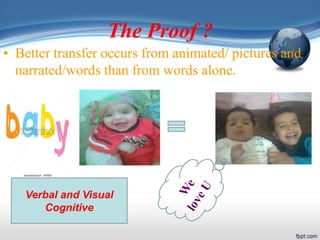
• Better transfer occurs from animated/ pictures and
narrated/words than from words alone.
Verbal and Visual
Cognitive
With All Good Things in Life
Excess Can Lead to Failure
Are U Hungry ?
Too Much of the good things can
be bad
• Too much multimedia can cause learners
to drift away from the lesson.
• “ Multimedia Overloaded “
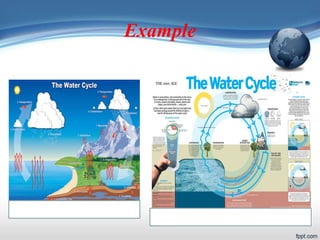
Example
• How can we make instruction
with multimedia work in our
class ?
• “Meaningful Learning”
Cognitive Theory
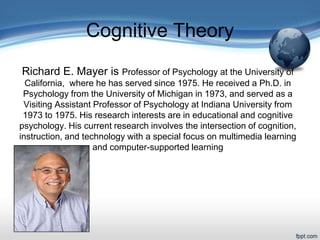
Richard E. Mayer is Professor of Psychology at the University of
California, where he has served since 1975. He received a Ph.D. in
Psychology from the University of Michigan in 1973, and served as a
Visiting Assistant Professor of Psychology at Indiana University from
1973 to 1975. His research interests are in educational and cognitive
psychology. His current research involves the intersection of cognition,
instruction, and technology with a special focus on multimedia learning
and computer-supported learning
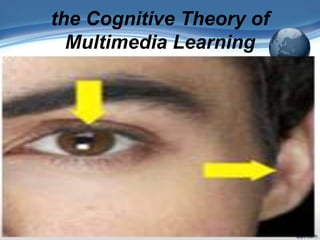
the Cognitive Theory of
Multimedia Learning
the Cognitive Theory of
Multimedia Learning
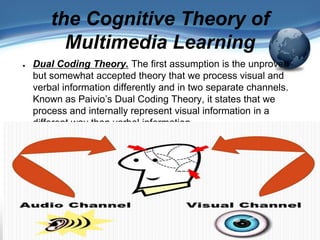
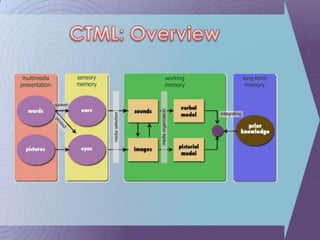
● Dual Coding Theory. The first assumption is the unproven
but somewhat accepted theory that we process visual and
verbal information differently and in two separate channels.
Known as Paivio’s Dual Coding Theory, it states that we
process and internally represent visual information in a
different way than verbal information.
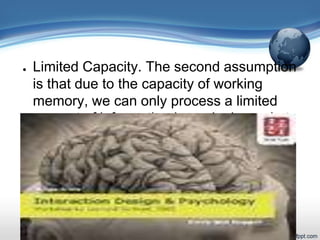
● Limited Capacity. The second assumption
is that due to the capacity of working
memory, we can only process a limited
amount of information in each channel at
one time
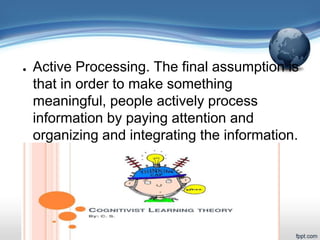
● Active Processing. The final assumption is
that in order to make something
meaningful, people actively process
information by paying attention and
organizing and integrating the information.
Cognitive Process
● Selecting words and Pictures
● Organizing Words and Pictures
● Integrating with prior knowledge into a long
term memory to form last learning.
• How can we make instruction
with multimedia work in our
class ?
• “Meaningful Learning”
• Multimedia Learning Theory.
Principles of Multimedia
Design
1- Coherence principle
• People learn better when extraneous
words, pictures, and sounds are excluded
rather than included
2-Redundancy principle
• People learn better from animation and
narration than from animation, narration,
and on on-screen text.
3-Spatial contiguity principle
• People learn better when corresponding
words and pictures are presented near
rather than far from each other on the
page or screen.
4-Temporal contiguity
principle
• People learn better when corresponding
words and pictures are presented
simultaneously rather than successively.
5-Modality principle
• People learn better from animation and
narration than from animation and on-
screen text
• Thank You So much
• For your kind Attention

Cognitive theory of multimedia

  • 1.
    Cognitive Theory ofMultimedia Raed Mohammad P-PM 0334/12 Basheer Obidat P_PM 0152/12 Falih Shahri P_PM 094/12
  • 2.
    What is MULTIMEDIA? • Recorded and played, displayed, or accessed by information content processing devices, such as computerized and electronic devices.
  • 3.
    What is CognitiveLearning ? Visual Auditory Touch
  • 4.
    What is MultimediaLearning? • The process of learning, usually in a classroom or similarly structured environment, through the use of multimedia presentations and teaching methods. • Multimedia
  • 5.
    Cognitive Theory of MultimediaLearning Cognitive Learning Multimedia learning Cognitive Theory of Multimedia
  • 6.
    Cognitive Theory ofMultimedia • An advanced theory that describes learning from words and images. • Increasing Multimedia Design.. • Increases Learning for Learner..
  • 7.
    With or WithoutMULT VS Traditional Teacher
  • 8.
    Characteristics • Without Multimedia.. •Traditional type of instructions. • Lacks the use of supplemental materials • With Multimedia.. • Engages the senses of learners through. • Learners can the materials
  • 9.
    The Proof ? •Better transfer occurs from animated/ pictures and narrated/words than from words alone. Verbal and Visual Cognitive
  • 10.
    With All GoodThings in Life Excess Can Lead to Failure
  • 11.
  • 12.
    Too Much ofthe good things can be bad • Too much multimedia can cause learners to drift away from the lesson. • “ Multimedia Overloaded “
  • 13.
  • 14.
    • How canwe make instruction with multimedia work in our class ? • “Meaningful Learning”
  • 15.
    Cognitive Theory Richard E.Mayer is Professor of Psychology at the University of California, where he has served since 1975. He received a Ph.D. in Psychology from the University of Michigan in 1973, and served as a Visiting Assistant Professor of Psychology at Indiana University from 1973 to 1975. His research interests are in educational and cognitive psychology. His current research involves the intersection of cognition, instruction, and technology with a special focus on multimedia learning and computer-supported learning
  • 16.
    the Cognitive Theoryof Multimedia Learning
  • 17.
    the Cognitive Theoryof Multimedia Learning ● Dual Coding Theory. The first assumption is the unproven but somewhat accepted theory that we process visual and verbal information differently and in two separate channels. Known as Paivio’s Dual Coding Theory, it states that we process and internally represent visual information in a different way than verbal information.
  • 18.
    ● Limited Capacity.The second assumption is that due to the capacity of working memory, we can only process a limited amount of information in each channel at one time
  • 19.
    ● Active Processing.The final assumption is that in order to make something meaningful, people actively process information by paying attention and organizing and integrating the information.
  • 20.
    Cognitive Process ● Selectingwords and Pictures ● Organizing Words and Pictures ● Integrating with prior knowledge into a long term memory to form last learning.
  • 22.
    • How canwe make instruction with multimedia work in our class ? • “Meaningful Learning” • Multimedia Learning Theory.
  • 25.
  • 26.
    1- Coherence principle •People learn better when extraneous words, pictures, and sounds are excluded rather than included
  • 27.
    2-Redundancy principle • Peoplelearn better from animation and narration than from animation, narration, and on on-screen text.
  • 28.
    3-Spatial contiguity principle •People learn better when corresponding words and pictures are presented near rather than far from each other on the page or screen.
  • 29.
    4-Temporal contiguity principle • Peoplelearn better when corresponding words and pictures are presented simultaneously rather than successively.
  • 30.
    5-Modality principle • Peoplelearn better from animation and narration than from animation and on- screen text
  • 31.
    • Thank YouSo much • For your kind Attention