Multimedia Learning
Darryl Minor
Cognitive Psychology in SMED
Dr. D. Moustapha
11/17/21
Introduction
• This presentation is dedicated to walking you through three
aspects of Multimedia Learning.
A. Cognitive Theory
B. Multimedia Principles
C. Cognitive Load
Cognitive Theory
A cognitive theory of multimedia learning based on three main
assumptions: there are two separate channels (auditory and visual)
for processing information; there is limited channel capacity; and that
learning is an active process of filtering, selecting, organizing, and
integrating information.
Cognitive Theory
The goal is to use instructional media in the light of how human mind works. This
is the basis for Mayer’s cognitive theory of multimedia learning. This theory
proposes three main assumptions when it comes to learning with multimedia:
1. There are two separate channels (auditory and visual) for processing
information (sometimes referred to as Dual-Coding theory)
2. Each channel has a limited (finite) capacity.
3. Learning is an active process of filtering, selecting, organizing, and
integrating information based upon prior knowledge.
Auditory Cognition
• Auditory cognition (the mind's ear) describes a group of processes
by which the brain makes sense of the sound world.
• We study the normal perception of complex sound relevant to the
analysis of speech, music and environmental sounds, and their
associated brain bases.
Visual Cognition
Visual perception is vital in cognitive processing. Visual perception is
the process of absorbing what one sees, organizing it in the brain,
and making sense of it. One of the most common examples of visual
perception's importance in cognitive processes is reading.
Limitations
Humans can only process a finite amount of information in a channel
at a time, and they make sense of incoming information by actively
creating mental representations.
Cognitive Theory Cont.
Mayer’s cognitive theory of multimedia learning presents the idea that
the brain does not interpret a multimedia presentation of words,
pictures, and auditory information in a mutually exclusive fashion;
rather, these elements are selected and organized dynamically to
produce logical mental constructs. Furthermore, Mayer underscores
the importance of learning (based upon the testing of content and
demonstrating the successful transfer of knowledge) when new
information is integrated with prior knowledge.
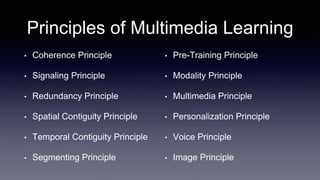
Principles of Multimedia Learning
• Coherence Principle
• Signaling Principle
• Redundancy Principle
• Spatial Contiguity Principle
• Temporal Contiguity Principle
• Segmenting Principle
• Pre-Training Principle
• Modality Principle
• Multimedia Principle
• Personalization Principle
• Voice Principle
• Image Principle
Principles of Multimedia Learning
Utilizing the list of Mayer's cognitive theory of multimedia learning
presents the idea that the brain does not interpret a multimedia
presentation of words, pictures, and auditory information in a
mutually exclusive fashion; rather, these elements are selected and
organized dynamically to produce logical mental constructs.
Principles of Multimedia Learning
One interesting thing about these principles is their applicability over
the long haul. While education's growing use of technology as an
instructional aid calls for the use of guiding constructs like these
more than ever, these fundamental principles were published back
2001 and it's a safe bet that they will remain relevant for decades to
come.
Cognitive Load Theory
Cognitive Load Theory (CLT) is an instructional design theory that
reflects our "cognitive architecture," or the way that we process
information. During learning, information must be held in your
working memory until it has been processed sufficiently to pass into
your long-term memory.
Cognitive Load Theory
The theory identifies three different forms of cognitive load:
• Intrinsic cognitive load: the inherent difficulty of the material itself, which
can be influenced by prior knowledge of the topic
• Extraneous cognitive load: the load generated by the way the material is
presented and which does not aid learning
• Germane cognitive load: the elements that aid information processing
and contribute to the development of ‘schemas’.
Cognitive Load Theory
Working memory should be seen as short term and finite, whereas long-term memory can be seen
as infinite. The aim should be to move knowledge to long-term memory because when a student is
exposed to new material, they can draw on this previous knowledge and the cognitive load is
reduced. However, if subject knowledge is incomplete, the student is unable to fall back on the long-
term memory and the working memory becomes overloaded, leading to working memory
failures. Indications of working memory failures include:
• incomplete recall
• failing to follow instructions
• place-keeping errors
• task abandonment.
Cognitive Load Theory
Of course, there are many other reasons for these that are not
related to CLT; however, if teachers understand how this
theory applies to their classroom, they can plan their lessons in a
way that takes into account cognitive load.
Reducing Cognitive Load
Intrinsic cognitive load can be reduced by breaking down the subject content, sequencing the
delivery so that sub-tasks are taught individually before being explained together as a whole. The
idea is to not overwhelm a student too early on in the introduction of new work.
Extraneous cognitive load can be reduced by the way in which instructions are presented. We
make sense of new material by referencing schema or mental models of pre-existing knowledge.
Lack of clarity in instruction puts too high a load on the working memory, and so too much time is
spent problem-solving the instructions as opposed to new schema formation. For example,
lessons that use PowerPoint with excessive writing and the teacher talking at the same time, can
inadvertently generate excessive cognitive load and lead to working memory failures.
References
Sorden, S., Cognitive Theory of Multimedia. Retrieved from
https://moodle.sus.edu/pluginfile.php/96078/mod_resource/content/2/cognitivetheorymmedi
as.pdf
Davis, G., Norman, M., (2016) Principles of Multimedia Learning, Wiley Education Services,
Retrieved from https://ctl.wiley.com/principles-of-multimedia-learning/
Shaw, A., (2016) Cognitive Load Theory: Structuring Learning Materials for Maximum
Retention, Wiley Education Services, Retrieved from https://ctl.wiley.com/cognitive-load-
theory-structuring-learning-materials-for-maximum-retention/

Multimedia learning

  • 1.
    Multimedia Learning Darryl Minor CognitivePsychology in SMED Dr. D. Moustapha 11/17/21
  • 2.
    Introduction • This presentationis dedicated to walking you through three aspects of Multimedia Learning. A. Cognitive Theory B. Multimedia Principles C. Cognitive Load
  • 3.
    Cognitive Theory A cognitivetheory of multimedia learning based on three main assumptions: there are two separate channels (auditory and visual) for processing information; there is limited channel capacity; and that learning is an active process of filtering, selecting, organizing, and integrating information.
  • 4.
    Cognitive Theory The goalis to use instructional media in the light of how human mind works. This is the basis for Mayer’s cognitive theory of multimedia learning. This theory proposes three main assumptions when it comes to learning with multimedia: 1. There are two separate channels (auditory and visual) for processing information (sometimes referred to as Dual-Coding theory) 2. Each channel has a limited (finite) capacity. 3. Learning is an active process of filtering, selecting, organizing, and integrating information based upon prior knowledge.
  • 5.
    Auditory Cognition • Auditorycognition (the mind's ear) describes a group of processes by which the brain makes sense of the sound world. • We study the normal perception of complex sound relevant to the analysis of speech, music and environmental sounds, and their associated brain bases.
  • 6.
    Visual Cognition Visual perceptionis vital in cognitive processing. Visual perception is the process of absorbing what one sees, organizing it in the brain, and making sense of it. One of the most common examples of visual perception's importance in cognitive processes is reading.
  • 7.
    Limitations Humans can onlyprocess a finite amount of information in a channel at a time, and they make sense of incoming information by actively creating mental representations.
  • 8.
    Cognitive Theory Cont. Mayer’scognitive theory of multimedia learning presents the idea that the brain does not interpret a multimedia presentation of words, pictures, and auditory information in a mutually exclusive fashion; rather, these elements are selected and organized dynamically to produce logical mental constructs. Furthermore, Mayer underscores the importance of learning (based upon the testing of content and demonstrating the successful transfer of knowledge) when new information is integrated with prior knowledge.
  • 9.
    Principles of MultimediaLearning • Coherence Principle • Signaling Principle • Redundancy Principle • Spatial Contiguity Principle • Temporal Contiguity Principle • Segmenting Principle • Pre-Training Principle • Modality Principle • Multimedia Principle • Personalization Principle • Voice Principle • Image Principle
  • 10.
    Principles of MultimediaLearning Utilizing the list of Mayer's cognitive theory of multimedia learning presents the idea that the brain does not interpret a multimedia presentation of words, pictures, and auditory information in a mutually exclusive fashion; rather, these elements are selected and organized dynamically to produce logical mental constructs.
  • 11.
    Principles of MultimediaLearning One interesting thing about these principles is their applicability over the long haul. While education's growing use of technology as an instructional aid calls for the use of guiding constructs like these more than ever, these fundamental principles were published back 2001 and it's a safe bet that they will remain relevant for decades to come.
  • 12.
    Cognitive Load Theory CognitiveLoad Theory (CLT) is an instructional design theory that reflects our "cognitive architecture," or the way that we process information. During learning, information must be held in your working memory until it has been processed sufficiently to pass into your long-term memory.
  • 13.
    Cognitive Load Theory Thetheory identifies three different forms of cognitive load: • Intrinsic cognitive load: the inherent difficulty of the material itself, which can be influenced by prior knowledge of the topic • Extraneous cognitive load: the load generated by the way the material is presented and which does not aid learning • Germane cognitive load: the elements that aid information processing and contribute to the development of ‘schemas’.
  • 14.
    Cognitive Load Theory Workingmemory should be seen as short term and finite, whereas long-term memory can be seen as infinite. The aim should be to move knowledge to long-term memory because when a student is exposed to new material, they can draw on this previous knowledge and the cognitive load is reduced. However, if subject knowledge is incomplete, the student is unable to fall back on the long- term memory and the working memory becomes overloaded, leading to working memory failures. Indications of working memory failures include: • incomplete recall • failing to follow instructions • place-keeping errors • task abandonment.
  • 15.
    Cognitive Load Theory Ofcourse, there are many other reasons for these that are not related to CLT; however, if teachers understand how this theory applies to their classroom, they can plan their lessons in a way that takes into account cognitive load.
  • 16.
    Reducing Cognitive Load Intrinsiccognitive load can be reduced by breaking down the subject content, sequencing the delivery so that sub-tasks are taught individually before being explained together as a whole. The idea is to not overwhelm a student too early on in the introduction of new work. Extraneous cognitive load can be reduced by the way in which instructions are presented. We make sense of new material by referencing schema or mental models of pre-existing knowledge. Lack of clarity in instruction puts too high a load on the working memory, and so too much time is spent problem-solving the instructions as opposed to new schema formation. For example, lessons that use PowerPoint with excessive writing and the teacher talking at the same time, can inadvertently generate excessive cognitive load and lead to working memory failures.
  • 17.
    References Sorden, S., CognitiveTheory of Multimedia. Retrieved from https://moodle.sus.edu/pluginfile.php/96078/mod_resource/content/2/cognitivetheorymmedi as.pdf Davis, G., Norman, M., (2016) Principles of Multimedia Learning, Wiley Education Services, Retrieved from https://ctl.wiley.com/principles-of-multimedia-learning/ Shaw, A., (2016) Cognitive Load Theory: Structuring Learning Materials for Maximum Retention, Wiley Education Services, Retrieved from https://ctl.wiley.com/cognitive-load- theory-structuring-learning-materials-for-maximum-retention/