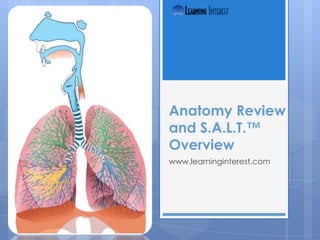
Anatomy Review
and S.A.L.T.™
Overview
www.learninginterest.com
Objectives
 Name   the major components of the upper
  and lower airways
 Describe the functions of the upper and
  lower airways
 Describe the process of ventilation
 Describe the process of respiration
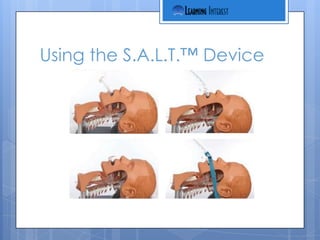
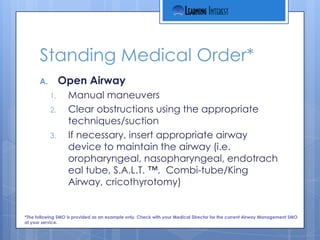
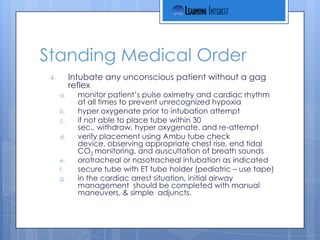
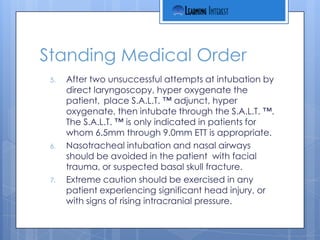
 Identify the S.A.L.T.™ device
 Demonstrate use of the S.A.L.T.™ device
 Explain the SMO for the S.A.L.T.™ device
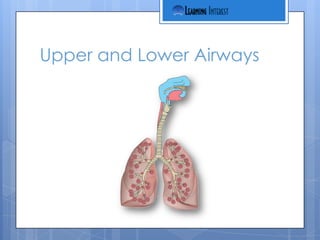
Upper and Lower Airways
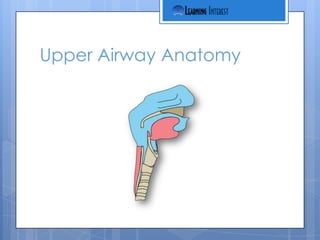
Upper Airway Anatomy
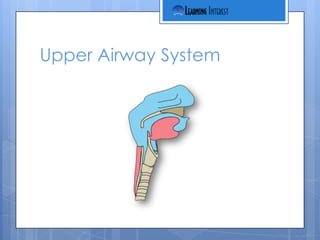
Upper Airway System
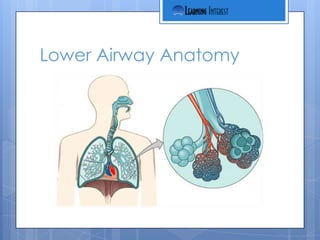
Lower Airway Anatomy
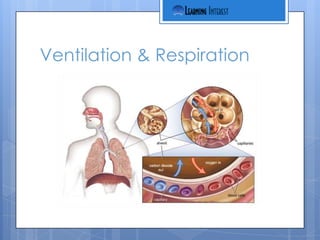
Ventilation & Respiration
Alveolar Function
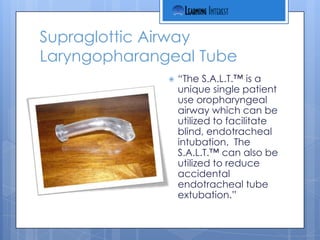
Supraglottic Airway
Laryngopharangeal Tube
                 “The S.A.L.T.™ is a
                  unique single patient
                  use oropharyngeal
                  airway which can be
                  utilized to facilitate
                  blind, endotracheal
                  intubation. The
                  S.A.L.T.™ can also be
                  utilized to reduce
                  accidental
                  endotracheal tube
                  extubation.”
Using the S.A.L.T.™ Device
Standing Medical Order*
      A.        Open Airway
           1.      Manual maneuvers
           2.      Clear obstructions using the appropriate
                   techniques/suction
           3.      If necessary, insert appropriate airway
                   device to maintain the airway (i.e.
                   oropharyngeal, nasopharyngeal, endotrach
                   eal tube, S.A.L.T. ™, Combi-tube/King
                   Airway, cricothyrotomy)


*The following SMO is provided as an example only. Check with your Medical Director for the current Airway Management SMO
at your service.
Standing Medical Order
 4.        Intubate any unconscious patient without a gag
           reflex
      a.     monitor patient’s pulse oximetry and cardiac rhythm
             at all times to prevent unrecognized hypoxia
      b.     hyper oxygenate prior to intubation attempt
      c.     if not able to place tube within 30
             sec., withdraw, hyper oxygenate, and re-attempt
      d.     verify placement using Ambu tube check
             device, observing appropriate chest rise, end tidal
             CO2 monitoring, and auscultation of breath sounds
      e.     orotracheal or nasotracheal intubation as indicated
      f.     secure tube with ET tube holder (pediatric – use tape)
      g.     in the cardiac arrest situation, initial airway
             management should be completed with manual
             maneuvers, & simple adjuncts.
Standing Medical Order
 5.   After two unsuccessful attempts at intubation by
      direct laryngoscopy, hyper oxygenate the
      patient, place S.A.L.T. ™ adjunct, hyper
      oxygenate, then intubate through the S.A.L.T. ™.
      The S.A.L.T. ™ is only indicated in patients for
      whom 6.5mm through 9.0mm ETT is appropriate.
 6.   Nasotracheal intubation and nasal airways
      should be avoided in the patient with facial
      trauma, or suspected basal skull fracture.
 7.   Extreme caution should be exercised in any
      patient experiencing significant head injury, or
      with signs of rising intracranial pressure.
Standing Medical Order
 8.    With suspected head injuries, administer
       Lidocaine 1.5 mg/kg prior to ETT intubation to
       help prevent rise in ICP.
 9.    For any patient with a GCS < 8, complete
       endotracheal intubation
 10.   Only if necessary, in the unusually difficult
       intubation, and when the patient can not
       otherwise be oxygenated by basic life
       support measures, consider giving Versed
       (or valium) 5 mg IVP + Morphine Sulfate 2 mg
       IVP to facilitate intubation per Medication
       Facilitated Intubation Standing Order.
Standing Medical Order
 11.        A Combi-tube/King Airway should be used if
            attempts at intubation with the S.A.L.T. ™ are
            unsuccessful. For EMT-I’s, the Combi-tube/King
            Airway is the advanced airway for utilization. The
            Combi-tube/King Airway is contraindicated in
            the following:
       a.     patients under 5 feet in height or over 6’4” in
              height
       b.     patients who are less than 16 years of age
       c.     patients who weigh less than 90 lbs
       d.     patients who have known esophageal disease
       e.     patients who have ingested caustic substances
Objectives Review
 Name   the major components of the upper
  and lower airways
 Describe the functions of the upper and
  lower airways
 Describe the process of ventilation
 Describe the process of respiration
 Identify the S.A.L.T.™ device
 Demonstrate use of the S.A.L.T.™ device
 Explain the SMO for the S.A.L.T.™ device
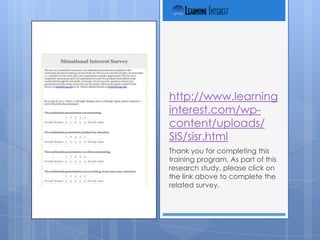
http://www.learning
interest.com/wp-
content/uploads/
SIS/sisr.html
Thank you for completing this
training program. As part of this
research study, please click on
the link above to complete the
related survey.

Anatomy Review and S.A.L.T.™ OveRview

  • 1.
  • 2.
    Objectives  Name the major components of the upper and lower airways  Describe the functions of the upper and lower airways  Describe the process of ventilation  Describe the process of respiration  Identify the S.A.L.T.™ device  Demonstrate use of the S.A.L.T.™ device  Explain the SMO for the S.A.L.T.™ device
  • 3.
  • 4.
  • 5.
  • 6.
  • 7.
  • 8.
  • 9.
    Supraglottic Airway Laryngopharangeal Tube  “The S.A.L.T.™ is a unique single patient use oropharyngeal airway which can be utilized to facilitate blind, endotracheal intubation. The S.A.L.T.™ can also be utilized to reduce accidental endotracheal tube extubation.”
  • 10.
  • 11.
    Standing Medical Order* A. Open Airway 1. Manual maneuvers 2. Clear obstructions using the appropriate techniques/suction 3. If necessary, insert appropriate airway device to maintain the airway (i.e. oropharyngeal, nasopharyngeal, endotrach eal tube, S.A.L.T. ™, Combi-tube/King Airway, cricothyrotomy) *The following SMO is provided as an example only. Check with your Medical Director for the current Airway Management SMO at your service.
  • 12.
    Standing Medical Order 4. Intubate any unconscious patient without a gag reflex a. monitor patient’s pulse oximetry and cardiac rhythm at all times to prevent unrecognized hypoxia b. hyper oxygenate prior to intubation attempt c. if not able to place tube within 30 sec., withdraw, hyper oxygenate, and re-attempt d. verify placement using Ambu tube check device, observing appropriate chest rise, end tidal CO2 monitoring, and auscultation of breath sounds e. orotracheal or nasotracheal intubation as indicated f. secure tube with ET tube holder (pediatric – use tape) g. in the cardiac arrest situation, initial airway management should be completed with manual maneuvers, & simple adjuncts.
  • 13.
    Standing Medical Order 5. After two unsuccessful attempts at intubation by direct laryngoscopy, hyper oxygenate the patient, place S.A.L.T. ™ adjunct, hyper oxygenate, then intubate through the S.A.L.T. ™. The S.A.L.T. ™ is only indicated in patients for whom 6.5mm through 9.0mm ETT is appropriate. 6. Nasotracheal intubation and nasal airways should be avoided in the patient with facial trauma, or suspected basal skull fracture. 7. Extreme caution should be exercised in any patient experiencing significant head injury, or with signs of rising intracranial pressure.
  • 14.
    Standing Medical Order 8. With suspected head injuries, administer Lidocaine 1.5 mg/kg prior to ETT intubation to help prevent rise in ICP. 9. For any patient with a GCS < 8, complete endotracheal intubation 10. Only if necessary, in the unusually difficult intubation, and when the patient can not otherwise be oxygenated by basic life support measures, consider giving Versed (or valium) 5 mg IVP + Morphine Sulfate 2 mg IVP to facilitate intubation per Medication Facilitated Intubation Standing Order.
  • 15.
    Standing Medical Order 11. A Combi-tube/King Airway should be used if attempts at intubation with the S.A.L.T. ™ are unsuccessful. For EMT-I’s, the Combi-tube/King Airway is the advanced airway for utilization. The Combi-tube/King Airway is contraindicated in the following: a. patients under 5 feet in height or over 6’4” in height b. patients who are less than 16 years of age c. patients who weigh less than 90 lbs d. patients who have known esophageal disease e. patients who have ingested caustic substances
  • 16.
    Objectives Review  Name the major components of the upper and lower airways  Describe the functions of the upper and lower airways  Describe the process of ventilation  Describe the process of respiration  Identify the S.A.L.T.™ device  Demonstrate use of the S.A.L.T.™ device  Explain the SMO for the S.A.L.T.™ device
  • 17.
    http://www.learning interest.com/wp- content/uploads/ SIS/sisr.html Thank you forcompleting this training program. As part of this research study, please click on the link above to complete the related survey.