Cognitive Theory of Multimedia LearningCitM Productions
What is Multimedia Learning?
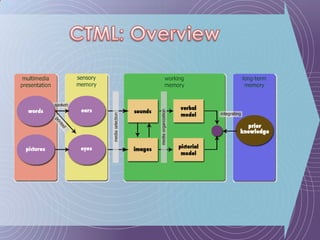
CTML: Overview
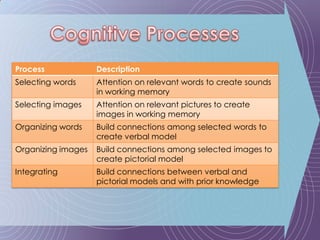
Cognitive Processes
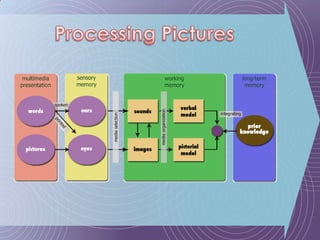
Processing Pictures
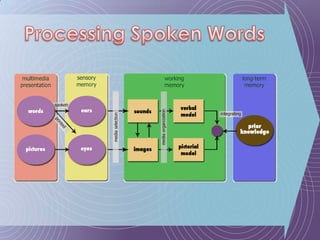
Processing Spoken Words
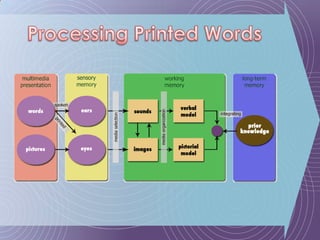
Processing Printed Words
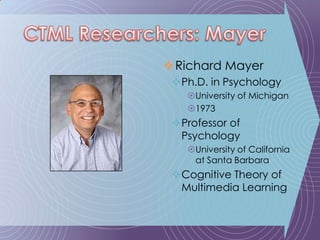
Richard MayerPh.D. in PsychologyUniversity of Michigan1973Professor of PsychologyUniversity of California at Santa BarbaraCognitive Theory of Multimedia LearningCTML Researchers: Mayer
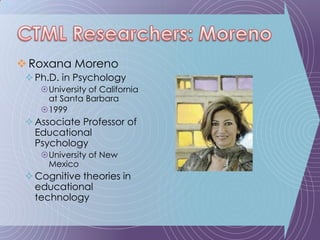
Roxana MorenoPh.D. in PsychologyUniversity of California at Santa Barbara1999Associate Professor of Educational PsychologyUniversity of New MexicoCognitive theories in educational technologyCTML Researchers: Moreno
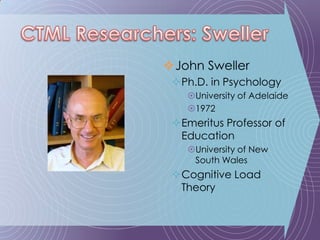
John SwellerPh.D. in PsychologyUniversity of Adelaide1972Emeritus Professor of EducationUniversity of New South WalesCognitive Load TheoryCTML Researchers: Sweller
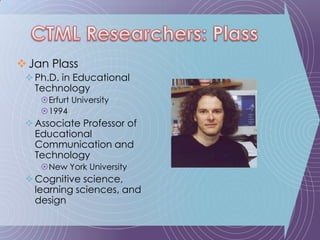
Jan PlassPh.D. in Educational TechnologyErfurt University1994Associate Professor of Educational Communication and TechnologyNew York UniversityCognitive science, learning sciences, and designCTML Researchers: Plass
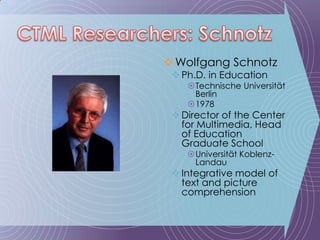
Wolfgang SchnotzPh.D. in EducationTechnische Universität Berlin1978Director of the Center for Multimedia, Head of Education Graduate SchoolUniversität Koblenz-LandauIntegrative model of text and picture comprehensionCTML Researchers: Schnotz
Mayer, R.E., & Anderson, R.B. (1991). Animations need narrations: An experimental test of a dual-coding hypothesis. Journal of Educational Psychology. 83, 484-490.Moreno, R. & Mayer, R.E. (2000). A coherence effect in multimedia learning: The case for minimizing irrelevant sounds in the design of multimedia instructional messages. Journal of Educational Psychology.  92(1), 117-125.Significant Studies
Pass, F., Renkl, A., & Sweller, J. (2004). Cognitive load theory: Instructional implications of the interaction between information structures and cognitive architecture. Instructional Science. 32, 1-8.Plass, J.L., Chun, D.M., Mayer, R.E., & Leutner, D. (1998). Supporting visual and verbal learning preferences in a second-language multimedia learning environment. Journal of Educational Psychology. 90, 25-36.Significant Studies
multimediasplit-attentionmodalityredundancysegmenting, pre-training, and modalitycoherence, signaling, spatial contiguity, and redundancypersonalization, voice, and imageBasic Principles
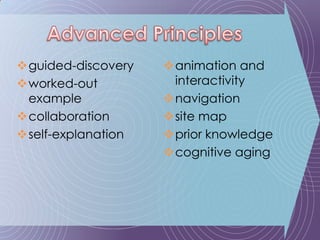
guided-discoveryworked-out examplecollaborationself-explanationanimation and interactivitynavigationsite mapprior knowledgecognitive agingAdvanced Principles
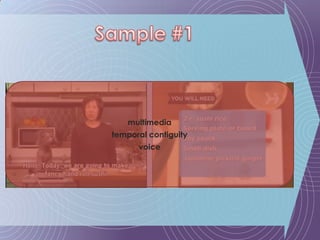
Sample #1multimediatemporal contiguityvoice
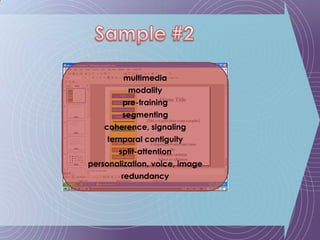
Sample #2multimediamodalitypre-trainingsegmentingcoherence, signalingtemporal contiguitysplit-attentionpersonalization, voice, imageredundancy
Sample #3coherencesignalingspatial contiguitysegmentingmultimedia
CTML

Cognitive Theory of Multimedia Learning

Editor's Notes

  • #4 This cognitive model represents the human information-processing system.
  • #11 Sweller has significantly contributed to the split-attention principle.