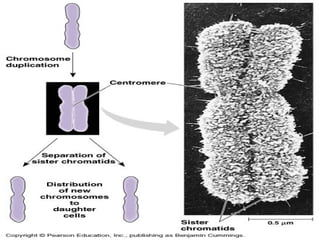
Sister chromatids of each chromosomes separate
completely to become daughter chromosomes.


 New chromosomes move towards the poles along the
 path of their spindle fibers


  Centromeres lead the path and arms trail behind
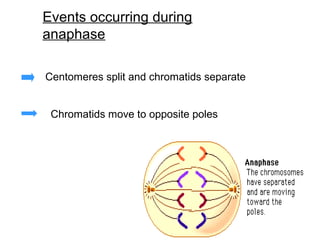
Events occurring during
anaphase

Centomeres split and chromatids separate


 Chromatids move to opposite poles
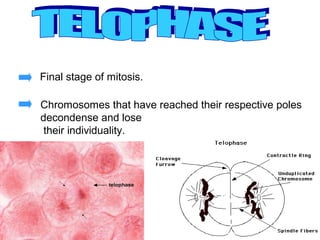
Final stage of mitosis.

Chromosomes that have reached their respective poles
decondense and lose
 their individuality.
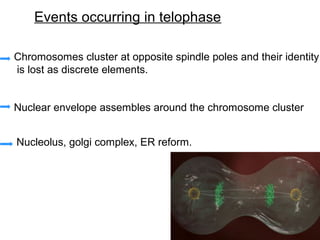
Events occurring in telophase

Chromosomes cluster at opposite spindle poles and their identity
is lost as discrete elements.


Nuclear envelope assembles around the chromosome cluster


Nucleolus, golgi complex, ER reform.
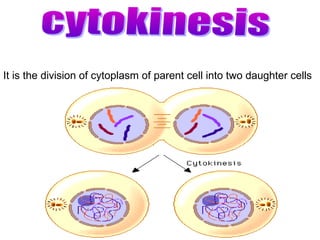
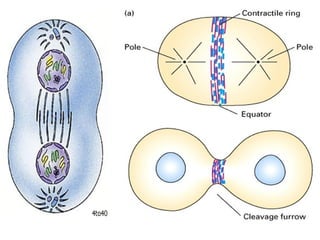
It is the division of cytoplasm of parent cell into two daughter cells
Cytokinesis in animal cells

In animal cell it is achieved by the appearance of a furrow
 in the plasma membrane
The furrow gradually deepens and ultimately joins the centre
dividing the cell cytoplasm into two


Wall formation starts in the centre of the cell and grows
outward to meet the existing lateral walls.
Cytokinesis in plant cells

Plant cells are enclosed by relatively inextensible cell wall.
Therefore they undergo cytokinesis by a different mechanism.

Wall formation starts in the centre of the cell
and grows outward to meet the existing
lateral walls.

Formation of new cell wall begins with the formation o a simple
 precursor, called the cell plate that represents the middle
lamella
between the walls of two adj cells.
In some organisms karyokinesis is
not followed by cytokinesis as a result
of which multinucleate condition
arises leading to the formation of
syncytium
GROWTH: New somatic cells are formed by mitosis.
Therefore, mitosis helps in growth and development
of multicellular organisms

REPAIR: Repair of the body takes place because of
the addition of cells by mitosis.
The cells of the upper layer of the epidermis, cells of lining of the
gut,
and RBCs are constantly being replaced

Bio cell cycle and cell division

  • 2.
    Sister chromatids ofeach chromosomes separate completely to become daughter chromosomes. New chromosomes move towards the poles along the path of their spindle fibers Centromeres lead the path and arms trail behind
  • 4.
    Events occurring during anaphase Centomeressplit and chromatids separate Chromatids move to opposite poles
  • 5.
    Final stage ofmitosis. Chromosomes that have reached their respective poles decondense and lose their individuality.
  • 6.
    Events occurring intelophase Chromosomes cluster at opposite spindle poles and their identity is lost as discrete elements. Nuclear envelope assembles around the chromosome cluster Nucleolus, golgi complex, ER reform.
  • 7.
    It is thedivision of cytoplasm of parent cell into two daughter cells
  • 8.
    Cytokinesis in animalcells In animal cell it is achieved by the appearance of a furrow in the plasma membrane The furrow gradually deepens and ultimately joins the centre dividing the cell cytoplasm into two Wall formation starts in the centre of the cell and grows outward to meet the existing lateral walls.
  • 9.
    Cytokinesis in plantcells Plant cells are enclosed by relatively inextensible cell wall. Therefore they undergo cytokinesis by a different mechanism. Wall formation starts in the centre of the cell and grows outward to meet the existing lateral walls. Formation of new cell wall begins with the formation o a simple precursor, called the cell plate that represents the middle lamella between the walls of two adj cells.
  • 11.
    In some organismskaryokinesis is not followed by cytokinesis as a result of which multinucleate condition arises leading to the formation of syncytium
  • 12.
    GROWTH: New somaticcells are formed by mitosis. Therefore, mitosis helps in growth and development of multicellular organisms REPAIR: Repair of the body takes place because of the addition of cells by mitosis. The cells of the upper layer of the epidermis, cells of lining of the gut, and RBCs are constantly being replaced