The Church as a major source of
POWER!
Those Who Prey
and Those Who Kill
Feudal European
Government
Society was divided into three estates or groups of people.
The First Estate: “Those Who Prey”, the Church Clergy
The Second Estate: “Those Who Kill”, the Nobility
(kings, nobles, and knights)
The Third Estate: “ Those Who Work”, the peasants / serfs
For ordinary people, the Church decided who
received salvation and who did not.
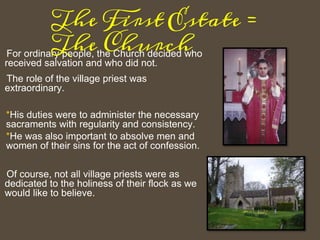
The role of the village priest was
extraordinary.
*His duties were to administer the necessary
sacraments with regularity and consistency.
*He was also important to absolve men and
women of their sins for the act of confession.
Of course, not all village priests were as
dedicated to the holiness of their flock as we
would like to believe.
The First Estate =
The Church
Monk
Priest
Bishop
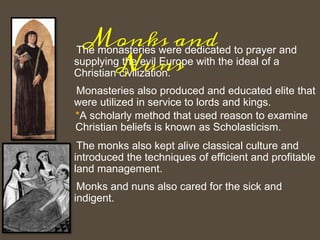
The monasteries were dedicated to prayer and
supplying the evil Europe with the ideal of a
Christian civilization.
Monasteries also produced and educated elite that
were utilized in service to lords and kings.
*A scholarly method that used reason to examine
Christian beliefs is known as Scholasticism.
The monks also kept alive classical culture and
introduced the techniques of efficient and profitable
land management.
Monks and nuns also cared for the sick and
indigent.
Monks and
Nuns
By the 11th or 12 century, the original mission
of the monastic movement had been altered to
accommodate the children of the nobility with
an honorable an aristocratic life.
*Such a life also held out the possibility for an
ecclesiastical (religious) career.
There were three major orders of monks:
Benedictine, Dominicans and Franciscans.
*As a result, more monks had to be recruited
from the middle classes who inhabited the
area near an abbey.
A tax, called a tithe, was to be paid by the
people to support the efforts of the church,
monasteries and convents.
More Monks &
Nuns
Most medieval men and women regarded their Christianity
with seriousness and genuine faith.
What the townspeople began to observe was a clergy who
seemed more willing to live the life of a European prince or
noble (aggrandizement of their own wealth, power, and
prestige), than someone whose sole duty was the spiritual
guidance of the people.
If monks, and bishops, and other members of the clergy,
were engaged in acts of holiness, then why did it seem that
they were living a life of luxury and opulence?
The Church grew weak and corrupt.
Church
Corruption
Even in 1591, the corruption of the church was evident as can be
seen in this painting by Cornelis Cornelisz Van Haarlem. Well, it could
have been seen if I hadn’t removed that part.
Scandal
The Monk and
the Nun
Corruption
Because the Church had extraordinary power in the feudal
era, it is natural that they, and not a king, would call for the
crusades.
*A crusade is a war fought for religious reasons.
In 1007 the Sultan of Egypt had the Church of the Holy
Sepulcher, in Jerusalem, destroyed.
Christians saw this as an attack on Christianity and started
discussing a crusade to take the “Holy Lands” back from
the Muslims.
The
Crusades
Sultan Al-Hakim Di-Amr-Allah
Church of the
Holy Sepulcher
Before the destruction After being rebuilt
Inside
The First Crusade began in 1095 when Pope
Urban II, answering a call for assistance from the
Byzantine Emperor, called on Europeans to take
back the Holy Lands from an internally weakened
Muslim Empire.
Victory! The First Crusade successfully captured
the Holy Lands and held them for 100 years.
Saladin, the Sultan of Egypt, would drive the
Christians out of Jerusalem.
A series of crusades would follow, but all would
fail.
The 1st
Crusade
The Other
Crusades*2nd Crusade ( 1145 – 1147 ) – Fails!
Saladin the Great organizes the Muslims and
would drive the Christians out of Jerusalem.
*3rd Crusade ( 1188 – 1192 ) – Fails!
Christian armies fall apart and are defeated.
*4th Crusade ( 1202 – 1204 ) – Fails!
Christians attack the Christian city of
Constantinople and never get to the “Holy Land”
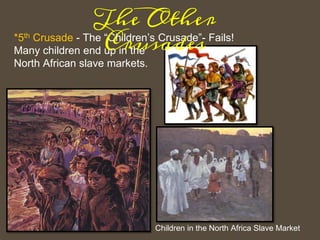
*5th Crusade - The “Children’s Crusade”- Fails!
Many children end up in the
North African slave markets.
Children in the North Africa Slave Market
The Other
Crusades
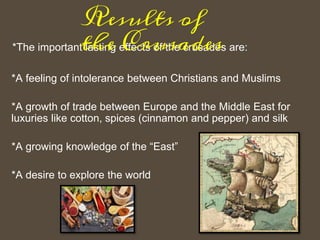
*The important lasting effects of the crusades are:
*A feeling of intolerance between Christians and Muslims
*A growth of trade between Europe and the Middle East for
luxuries like cotton, spices (cinnamon and pepper) and silk
*A growing knowledge of the “East”
*A desire to explore the world
Results of
the Crusades

Those Who Pray,Kill,and Work

  • 1.
    The Church asa major source of POWER! Those Who Prey and Those Who Kill
  • 2.
    Feudal European Government Society wasdivided into three estates or groups of people. The First Estate: “Those Who Prey”, the Church Clergy The Second Estate: “Those Who Kill”, the Nobility (kings, nobles, and knights) The Third Estate: “ Those Who Work”, the peasants / serfs
  • 3.
    For ordinary people,the Church decided who received salvation and who did not. The role of the village priest was extraordinary. *His duties were to administer the necessary sacraments with regularity and consistency. *He was also important to absolve men and women of their sins for the act of confession. Of course, not all village priests were as dedicated to the holiness of their flock as we would like to believe. The First Estate = The Church
  • 4.
  • 5.
    The monasteries werededicated to prayer and supplying the evil Europe with the ideal of a Christian civilization. Monasteries also produced and educated elite that were utilized in service to lords and kings. *A scholarly method that used reason to examine Christian beliefs is known as Scholasticism. The monks also kept alive classical culture and introduced the techniques of efficient and profitable land management. Monks and nuns also cared for the sick and indigent. Monks and Nuns
  • 6.
    By the 11thor 12 century, the original mission of the monastic movement had been altered to accommodate the children of the nobility with an honorable an aristocratic life. *Such a life also held out the possibility for an ecclesiastical (religious) career. There were three major orders of monks: Benedictine, Dominicans and Franciscans. *As a result, more monks had to be recruited from the middle classes who inhabited the area near an abbey. A tax, called a tithe, was to be paid by the people to support the efforts of the church, monasteries and convents. More Monks & Nuns
  • 7.
    Most medieval menand women regarded their Christianity with seriousness and genuine faith. What the townspeople began to observe was a clergy who seemed more willing to live the life of a European prince or noble (aggrandizement of their own wealth, power, and prestige), than someone whose sole duty was the spiritual guidance of the people. If monks, and bishops, and other members of the clergy, were engaged in acts of holiness, then why did it seem that they were living a life of luxury and opulence? The Church grew weak and corrupt. Church Corruption
  • 8.
    Even in 1591,the corruption of the church was evident as can be seen in this painting by Cornelis Cornelisz Van Haarlem. Well, it could have been seen if I hadn’t removed that part. Scandal The Monk and the Nun Corruption
  • 9.
    Because the Churchhad extraordinary power in the feudal era, it is natural that they, and not a king, would call for the crusades. *A crusade is a war fought for religious reasons. In 1007 the Sultan of Egypt had the Church of the Holy Sepulcher, in Jerusalem, destroyed. Christians saw this as an attack on Christianity and started discussing a crusade to take the “Holy Lands” back from the Muslims. The Crusades Sultan Al-Hakim Di-Amr-Allah
  • 10.
    Church of the HolySepulcher Before the destruction After being rebuilt Inside
  • 11.
    The First Crusadebegan in 1095 when Pope Urban II, answering a call for assistance from the Byzantine Emperor, called on Europeans to take back the Holy Lands from an internally weakened Muslim Empire. Victory! The First Crusade successfully captured the Holy Lands and held them for 100 years. Saladin, the Sultan of Egypt, would drive the Christians out of Jerusalem. A series of crusades would follow, but all would fail. The 1st Crusade
  • 12.
    The Other Crusades*2nd Crusade( 1145 – 1147 ) – Fails! Saladin the Great organizes the Muslims and would drive the Christians out of Jerusalem. *3rd Crusade ( 1188 – 1192 ) – Fails! Christian armies fall apart and are defeated. *4th Crusade ( 1202 – 1204 ) – Fails! Christians attack the Christian city of Constantinople and never get to the “Holy Land”
  • 13.
    *5th Crusade -The “Children’s Crusade”- Fails! Many children end up in the North African slave markets. Children in the North Africa Slave Market The Other Crusades
  • 14.
    *The important lastingeffects of the crusades are: *A feeling of intolerance between Christians and Muslims *A growth of trade between Europe and the Middle East for luxuries like cotton, spices (cinnamon and pepper) and silk *A growing knowledge of the “East” *A desire to explore the world Results of the Crusades